
QSn6.5-0.1 Phosphor Tin Bronze
Fatigue Strength
Resistance
Resistance
Performance
QSn6.5-0.1 Phosphor Tin Bronze: Basic Overview
QSn6.5-0.1 belongs to the tin bronze family and is a phosphor tin bronze grade defined under the Chinese national standard system.
Phosphor tin bronze is a copper-based alloy in which tin is the main alloying element, while phosphorus is added for deoxidation and secondary strengthening.
The “6.5” indicates a tin content of about 6.5%, and the “0.1” indicates a phosphorus content of about 0.1%.
Tin forms a solid solution in the copper matrix, which effectively improves the material’s strength, elastic limit, and wear resistance. Although the phosphorus content is relatively low, it plays an important deoxidizing role during melting. A small amount also remains in solid solution within the matrix, helping improve casting quality, material fluidity, and fatigue performance.
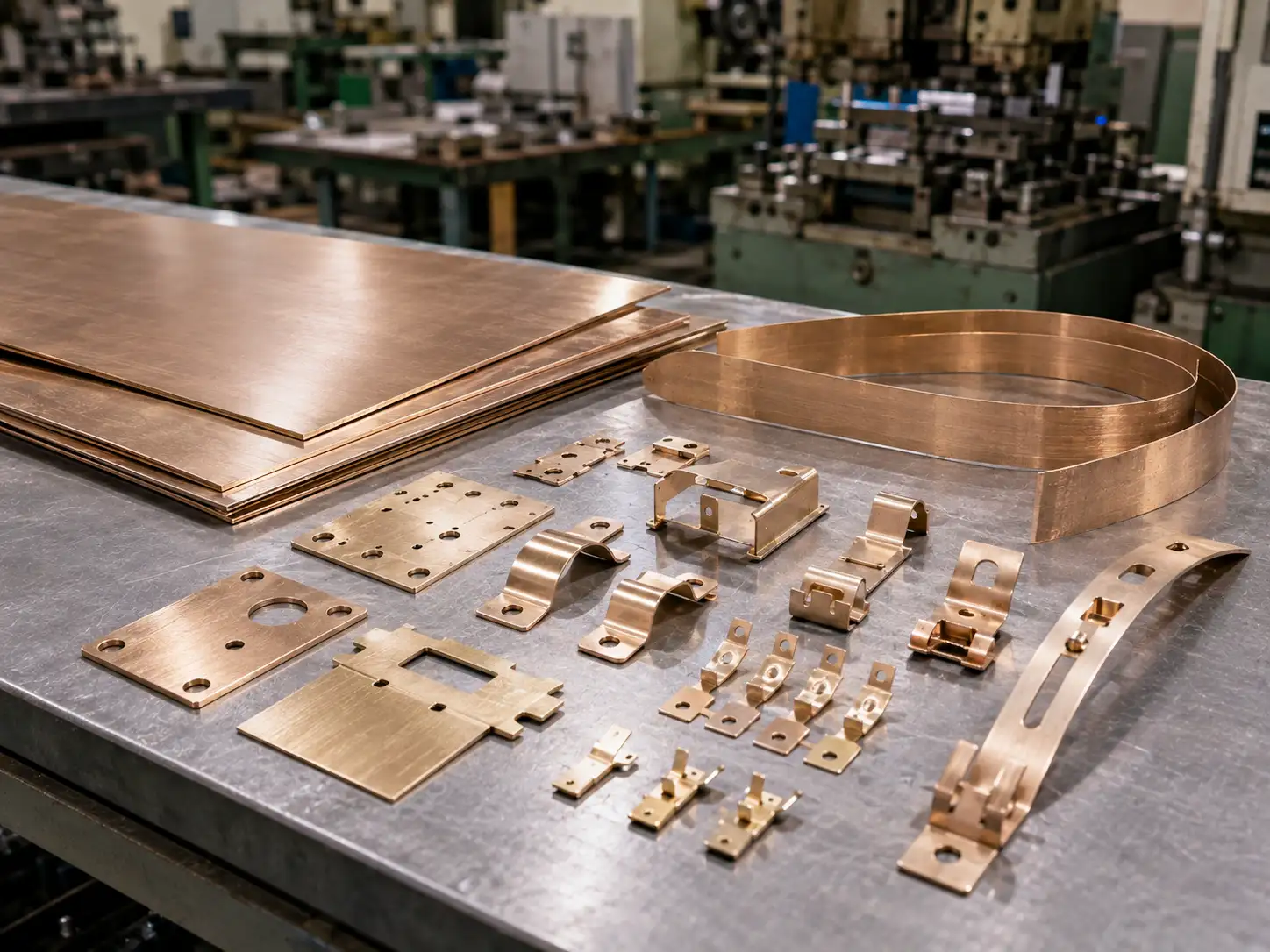
Quick Overview of QSn6.5-0.1
| Item | Details |
|---|---|
| Material category | Phosphor tin bronze (copper-tin-phosphorus alloy) |
| Main alloying elements | Tin (Sn) 6.0%–7.0%, phosphorus (P) 0.10%–0.25% |
| Typical characteristics | High strength, high elasticity, wear resistance, corrosion resistance, non-magnetic |
| Common application areas | Spring elements, wear-resistant parts, conductive spring contacts, precision instrument components |
| Key purchasing considerations | Temper, thickness range, performance requirements, and standard equivalency |
How Does QSn6.5-0.1 Compare with Common Overseas Grades?
QSn6.5-0.1 phosphor tin bronze is known by several approximate equivalents in international markets. In different countries and projects, it may appear under different grade designations, such as C5191 in the Japanese JIS system, CuSn6 in the European EN system, and C51900 in the US UNS designation system.
These grades are broadly similar in composition to QSn6.5-0.1. However, there can still be small differences from one standard system to another, especially in phosphorus range, impurity limits, temper designations, and performance requirements.
Common Grade Equivalents for QSn6.5-0.1
| Chinese Grade | Common International Equivalent | Reference Standard System | Notes on Use | Points to Confirm During Communication |
|---|---|---|---|---|
| QSn6.5-0.1 | C51900 | ASTM B103 (US standard) | Composition is broadly similar, but the exact specification should still be confirmed | Standard version, temper, thickness tolerance |
| QSn6.5-0.1 | CuSn6 | EN 12163 (European standard) | A common designation in the EU, with slight composition differences possible | Temper code, performance requirements |
| QSn6.5-0.1 | C5191 | JIS H3270 (Japanese standard) | Commonly used in the Japanese market | Standard equivalency, surface requirements |
| QSn6.5-0.1 | CuSn6 | ISO 427 (international standard) | Common international designation | Actual governing standard |
Material Properties and Key Selection Parameters
Key Parameters of QSn6.5-0.1 and What They Mean for Material Selection
| Parameter | What It Does | Why It Matters in Material Selection | Impact on Processing | Project Types That Should Focus on It |
|---|---|---|---|---|
| Tin content 6.0%–7.0% | Provides the foundation for strength and elasticity | Determines the material’s core mechanical performance level | Affects springback in stamping and the difficulty of bending and forming | Spring parts, load-bearing parts |
| Phosphorus content 0.10%–0.25% | Deoxidizes and improves elastic limit | Enhances fatigue life and elastic recovery accuracy | Influences welding process parameters | High-frequency spring elements, long-service-life parts |
| Tensile strength ≥315 MPa | Determines resistance to external loads | Helps confirm whether the part can meet load requirements | Higher strength usually increases die wear during stamping | Structural parts, spring clips |
| Elongation ≥40% | Indicates plastic deformation capability | Higher elongation provides a larger forming safety margin | Higher elongation is beneficial for deep drawing and complex bending | Housings and covers that require complex forming |
| Electrical conductivity approx. 13.5% to 17% | Reflects conductive performance | Helps determine whether contact resistance requirements can be met | Also provides guidance for plating and surface treatment choices | Connectors, contact springs |
| Density approx. 8.8 g/cm³ | Used for weight calculation | Affects part weight and cost estimation | Can also be relevant to feed stability in high-speed stamping | Weight-sensitive components |
What Types of Parts Is It Suitable For?
QSn6.5-0.1 offers a strong overall performance balance and is especially well suited to parts that need to combine multiple functions.
Common Applications of QSn6.5-0.1 and Why It Is Used
| Application | Performance Focus | Why It Is Suitable | Processing Considerations |
|---|---|---|---|
| Contact springs and spring clips | Elasticity, fatigue resistance, conductivity | Balances spring force with a useful level of conductivity | Temper, burr direction, contact surface quality |
| Connector terminals and relay spring structures | Contact stability, stress relaxation, strength | Well suited to maintaining contact pressure over long periods | Temper consistency, surface treatment, dimensional stability |
| Snap clips and retaining clips | Yield strength, springback, fatigue resistance | Suitable for repeated assembly applications | Bend radius, springback control |
| Diaphragms, corrugated parts, vibration elements | Fatigue resistance, sensitivity, dimensional stability | Suitable for cyclic deformation conditions | Thickness tolerance, forming consistency |
| Bushings and thin-wall wear parts | Wear resistance, corrosion resistance, stability | Suitable for friction and long-term service conditions | Surface roughness, fit dimensions |
| Wear-resistant parts for precision instruments | Wear resistance, corrosion resistance, strength | Suitable for small precision structural parts | Edge quality, assembly fit |
QSn6.5-0.1 phosphor tin bronze has good adaptability in sheet metal fabrication, but the material still needs to be selected and controlled according to the specific process requirements.
| Process Type | Suitability | Main Advantages | Common Risks | What Should Be Confirmed Early in the Project |
|---|---|---|---|---|
| Precision stamping | High | Good cold-forming performance, well suited to spring parts and contact parts | Burrs, die wear, dimensional variation | Temper, thickness, coil flatness, edge quality |
| Bending and standard forming | High | Can balance forming performance with elastic function | Springback variation, narrower forming window | Minimum bend radius, bend direction, temper |
| Complex forming of elastic structures | Relatively high | Suitable for spring arms, clips, and contact arms | Mass-production consistency, variation in contact force | Elastic target, fatigue life, sample validation method |
| Soft soldering / brazing | High | Mature and widely used joining method | Surface changes in the heat-affected zone | Joint location, cleanliness, post-treatment requirements |
| Resistance welding / gas-shielded welding | Applicable | Can support local joining and assembly | Dimensional and surface changes caused by heat input | Weld area, heat input, assembly tolerance |
| Surface treatment and assembly | High | Suitable for contact and assembly requirements | Variation in contact surface quality and dimensional consistency | Surface finish plan, contact area requirements, inspection standards |
What Should You Confirm When Selecting QSn6.5-0.1?
Choosing the right grade is only the first step. The temper also has to be correct. QSn6.5-0.1 is available in multiple delivery conditions, including cold-rolled and annealed tempers, and the differences in strength, hardness, and ductility can be significant. One of the most common gaps in early-stage project information is that the drawing specifies only the grade without defining the temper. If the temper is wrong, both processing results and functional performance can deviate from expectations.
A material may have adequate strength and still be difficult to form. A tensile strength of ≥315 MPa is sufficient for many structural parts, but for components that require deep drawing or small-radius bending, elongation and temper must also be considered together. Looking at strength alone can easily overlook forming-related risks.
For parts with elastic requirements, a successful one-time forming result is not enough. The key performance indicators for elastic components are elastic limit and fatigue life, and these values are not always shown explicitly in standard data sheets. If the project involves elastic performance, the RFQ should clearly define how elasticity will be verified and what acceptance criteria will apply.
For parts with conductivity requirements, structure and surface condition must also be considered. QSn6.5-0.1 has an electrical conductivity of about 13.5% to 17% IACS, which is sufficient for most electrical and electronic applications. However, if the contact area is very small or the working environment places strict demands on contact resistance, precious-metal plating may still be needed to reduce surface contact resistance.
A material may work well for samples and still require separate confirmation for production consistency. Sample-stage material is often carefully selected, with batch variation intentionally minimized. In mass production, material usually comes from standard supply batches, and some performance fluctuation within the standard range is normal. For projects with high precision or elastic-performance requirements, it is advisable to agree with the supplier in advance on batch inspection frequency and the acceptable range of performance variation before production begins.
Even if the drawing already states the material name, the standard, temper, and key performance requirements still need to be added. The same grade can have small differences in composition range and performance criteria under different standards. The grade name alone is not enough to fully define the material. Adding the governing standard and temper requirement is a necessary step to reduce delivery risk.
QSn6.5-0.1 Material Selection Checklist
| Item to Confirm | Why It Matters | Related Risk | Recommended Stage for Confirmation |
|---|---|---|---|
| Grade and standard | Defines the material system and evaluation basis | Misalignment in cross-standard communication | Drawing review stage |
| Delivery temper | Directly determines strength, elongation, and bending window | Variation in springback and forming results | Design review stage |
| Thickness and tolerance | Affects stamping, bending, and contact performance | Functional variation and assembly deviation | Before sampling |
| Elastic performance target | Determines contact force and long-term recovery behavior | Production performance drifting after sample approval | Before sampling and during sample review |
| Conductivity and contact requirements | Affects electrical performance and surface treatment choice | Variation in contact stability | Drawing and RFQ stage |
| Surface and post-treatment requirements | Affects assembly, soldering, and contact-area quality | Surface inconsistency and dimensional change | Before sampling |
| Production consistency requirements | Affects mass-production pace and quality-control method | Reduced stability after volume ramp-up | Before production launch |
What Information Should Be Provided When Sending an RFQ for QSn6.5-0.1?
QSn6.5-0.1 RFQ Information Checklist
| Information Item | Recommended Level of Detail | Impact on Evaluation | Notes |
|---|---|---|---|
| Material grade | Recommended to provide in full | Determines the material family and initial equivalency | It is best to specify QSn6.5-0.1 or the customer-designated material name |
| Applicable standard | Recommended to provide in full | Determines composition limits and evaluation basis | Suitable to state the customer standard or drawing standard |
| Material form | Recommended to provide in full | Affects process route and sourcing method | Sheet, strip, coil, slit strip, and similar forms |
| Thickness, width, and size range | Recommended to provide in full | Affects stamping, bending, tooling, and cost | The clearer the dimensions, the faster the evaluation |
| Delivery temper | Recommended to provide in full | Determines strength, elongation, and bending window | More efficient when provided together with elastic-performance targets |
| Drawing and critical tolerances | Recommended to provide in full | Determines process difficulty and inspection method | It is better to mark critical dimensions and contact areas clearly |
| Elastic-performance requirements | Recommended to provide in full | Affects temper selection and functional validation | Useful to specify targets such as restoring force or contact force |
| Conductivity or contact-performance requirements | Recommended to provide in full | Affects material judgment and surface treatment choice | Especially relevant for contacts, terminals, and contact springs |
| Surface requirements | Recommended to provide in full | Affects assembly, contact performance, and post-treatment planning | Such as plating, cleanliness, or appearance grade |
| Sample quantity and production quantity | Recommended to provide in full | Affects development pace and quotation structure | Sample and mass-production quantities are best listed separately |
| Application or assembly requirements | Recommended to provide in full | Affects functional judgment and process boundaries | Helps the supplier understand the real service conditions |
| Packaging and transportation requirements | Recommended | Affects shipment method and delivery details | Especially important for thin strip materials and cosmetic parts |
