
BZn15-20 Nickel Silver
Resistant
& Spring Properties
Formability
Conductivity
Finish
BZn15-20 Nickel Silver: Basic Overview
BZn15-20 is a zinc-containing cupronickel alloy within the copper-nickel-zinc ternary alloy family. It is commonly known as German silver or nickel silver. Its matrix consists of a single alpha solid-solution structure. The addition of zinc to the copper-nickel base significantly improves the material’s strength, hardness, and elasticity.
This grade is defined under GB/T 5231-2012, and its Chinese ISC designation is T74600.
In the grade designation, B stands for cupronickel, Zn indicates zinc as the main alloying addition, and 15 and 20 refer to the approximate percentages of nickel and zinc.
The use of this material can be traced back to the Song Dynasty, which is why it is also sometimes referred to as Chinese silver.
BZn15-20 has a silvery-white surface appearance, along with outstanding corrosion resistance and good electrical properties, making it a structurally stable material with high chemical stability.
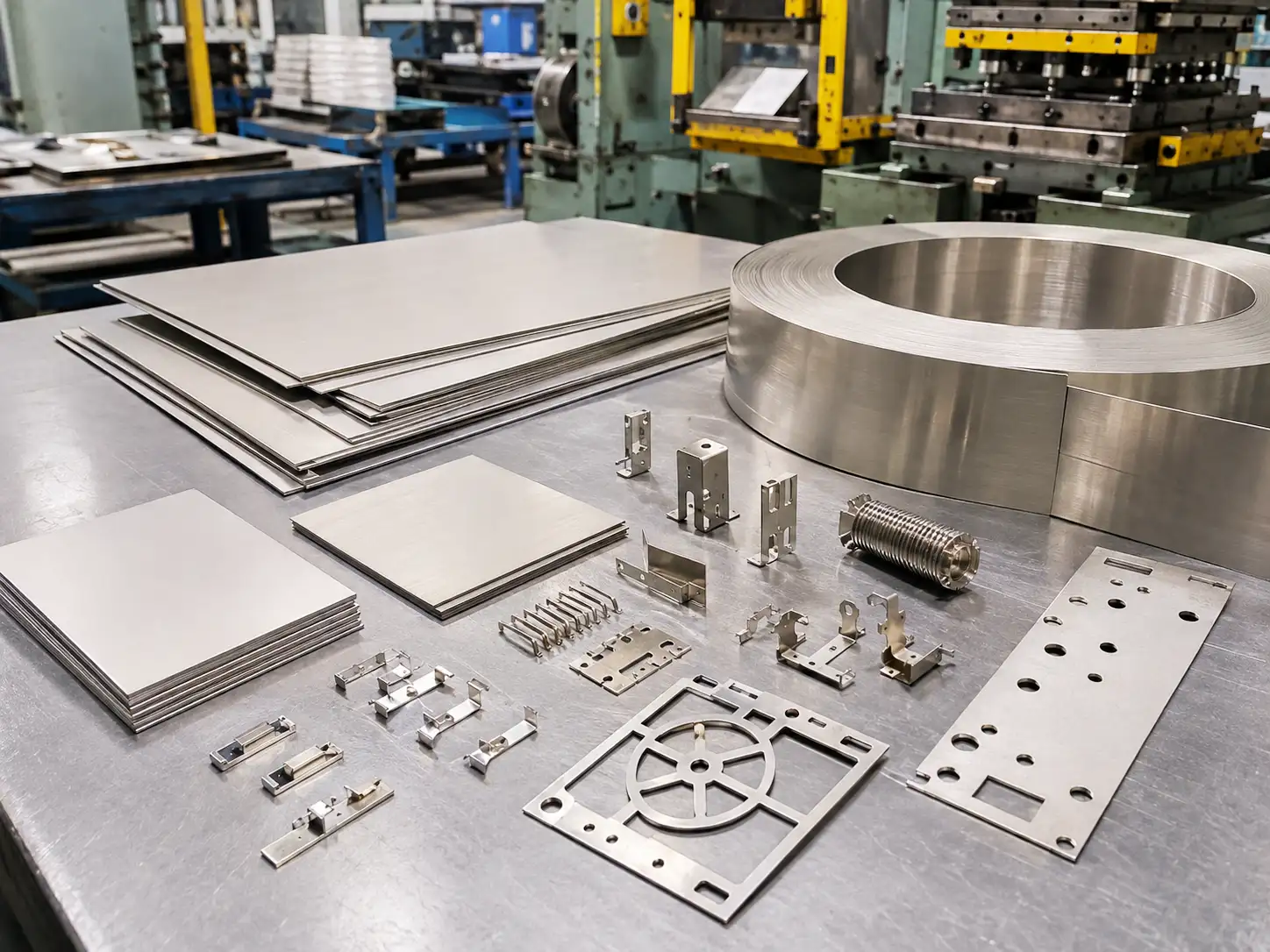
Key Performance Characteristics of BZn15-20
| Performance Characteristic | Performance Level | Core Value |
|---|---|---|
| Corrosion resistance | Excellent | Annual corrosion rate in seawater is below 0.02 mm, making it suitable for marine and chemical environments |
| Strength | Relatively high | Tensile strength ranges from 340 MPa to over 690 MPa, depending on temper |
| Elasticity | Excellent | Elastic modulus of 120–126 GPa, higher than that of most phosphor bronzes |
| Cold workability | Outstanding | Cold-rolling reduction can reach 90%, making it suitable for deep drawing and complex forming |
| Appearance | Attractive | Bright silvery-white color with long-lasting luster after polishing, with good resistance to tarnishing |
| Machinability | Good | Machinable, though cutting efficiency and tool life should still be evaluated |
| Brazability | Good | Suitable for soft soldering, brazing, and arc welding |
| Electrical conductivity | Moderate | About 7% IACS, suitable for applications that need a balance of conductivity and strength |
| Biocompatibility | Safe | Lead content is below 0.02%, making it suitable for medical and food-contact applications |
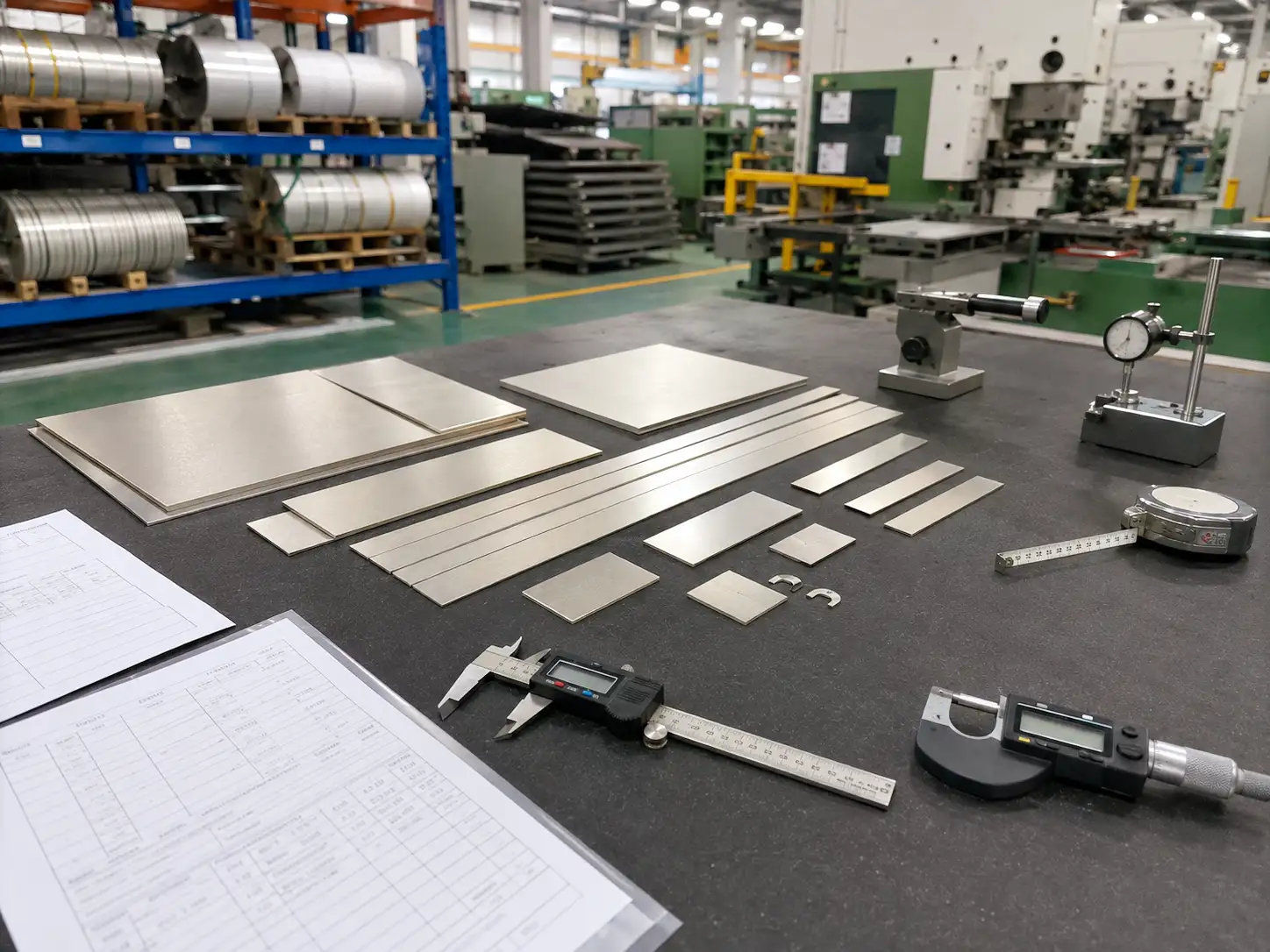
Common Grade Equivalents for BZn15-20
| Common Chinese Designation | Common Overseas Equivalent | Typical Notes |
|---|---|---|
| BZn15-20 | UNS C75400 | A common equivalent designation in North American projects |
| BZn15-20 | JIS C7541 | Frequently seen on Japanese drawings and strip-material projects |
| BZn15-20 | CuNi15Zn20 | Common in European material references and descriptions |
| BZn15-20 | NS105 | A common name used in some supply chains and commercial documents |
| Nickel silver / German silver | Nickel Silver | Standard English material name |
Chemical Composition and Detailed Specifications of BZn15-20
Chemical Composition of BZn15-20
| Element | Composition Range | Main Function |
|---|---|---|
| Copper (Cu) | 62.0%–65.0% | Base element, providing electrical and thermal conductivity as well as baseline corrosion resistance |
| Nickel + cobalt (Ni+Co) | 13.5%–16.5% | Improves corrosion resistance, stabilizes the single-phase alpha structure, and gives the alloy its silvery-white color |
| Zinc (Zn) | Balance, approx. 18%–22% | Provides solid-solution strengthening, improves strength and hardness, and helps reduce cost |
| Lead (Pb) | ≤0.02% | Impurity, a strictly controlled toxic element |
| Iron (Fe) | ≤0.5% | Impurity |
| Manganese (Mn) | ≤0.3% | Impurity |
| Phosphorus (P) | ≤0.005% | Impurity |
| Silicon (Si) | ≤0.15% | Impurity |
| Total other impurities | ≤0.9% | Strictly controlled to ensure stable performance |
Physical Properties of BZn15-20
| Property | Value |
|---|---|
| Density | 8.5–8.7 g/cm³ |
| Melting range | 1050–1100°C |
| Electrical conductivity | ≥7% IACS |
| Thermal conductivity | 25–35 W/(m·K) |
| Resistivity at 20°C | Approx. 0.246 μΩ·m |
| Coefficient of thermal expansion (20–100°C) | 16.6 × 10⁻⁶/K |
| Elastic modulus | 120–126 GPa |
| Specific heat capacity | 0.380 J/(g·K) |
| Magnetism | Non-magnetic or weakly magnetic |
Mechanical Properties of BZn15-20
| Supply Condition | Tensile Strength (MPa) | Elongation (%) | Hardness (HV) |
|---|---|---|---|
| Soft (M) | ≥340–380 | ≥25–35 | ≤110 |
| Half-hard (Y2) | 440–570 | ≥5 | 110–170 |
| Hard (Y) | 540–690 | ≥1.5 | 150–210 |
| Extra hard (T) | ≥640 | ≥1 | ≥180 |
What Sheet Metal and Precision Forming Processes Is BZn15-20 Suitable For?
BZn15-20 nickel silver is well suited to a wide range of manufacturing processes, with particularly strong performance in sheet metal fabrication and precision forming.
Its annealing temperature is 700-750°C, and its stress-relief annealing temperature is 250°C. It cannot be strengthened through heat treatment. Its strength is developed mainly through cold working.
Common Process Compatibility of BZn15-20
| Process Type | Suitability | Notes |
|---|---|---|
| Cold rolling | Excellent | Total reduction can reach 90%, allowing substantial thickness reduction |
| Deep drawing | Excellent | Well suited to cups, housings, and hollow parts, with good material flow |
| Stamping | Excellent | Suitable for blanking, forming, embossing, and coining |
| Bending | Excellent | Suitable for press brake forming and similar operations |
| Stretch forming | Good | Suitable for curved surfaces and contoured parts |
| Spinning | Good | Suitable for rotationally symmetrical parts |
| Extrusion | Good | Hot extrusion temperature is around 800°C |
| Hot rolling | Good | Typical hot rolling range is 950-970°C |
| Machining | Good | Carbide tools with proper cooling are recommended |
| Welding, brazing | Good | Compatible with silver brazing and copper brazing |
| Welding, TIG | Fair | Heat input must be controlled to prevent zinc evaporation |
| Soft soldering | Good | Suitable for both soft soldering and brazing operations |
| Industry | Typical Part Types | Main Properties Utilized |
|---|---|---|
| Electrical and electronics | Shielding cans, connector terminals, crystal oscillator caps, contact springs, EMI shielding parts | Conductivity, formability, corrosion resistance |
| Precision instruments | Springs, diaphragms, bellows, gear assemblies, shafts, optical brackets | Elasticity, dimensional stability, corrosion resistance |
| Medical devices | Surgical instruments, dental tools, diagnostic equipment components | Biocompatibility, corrosion resistance, strength |
| Marine applications | Seawater piping fittings, valve components, heat exchanger tubes | Seawater corrosion resistance, durability |
| Decorative hardware | Eyeglass frames, watch cases, jewelry, tableware, musical instrument parts | Silvery-white appearance, formability |
| Communications equipment | RF shielding parts, antenna components, connector parts | Electromagnetic shielding, conductivity |
| Automotive industry | Remote key components, electrical contacts, sensor housings | Durability, corrosion resistance, precision formability |
| Architectural decoration | Trim strips, accessories, decorative structural parts | Appearance, weather resistance |
What Should You Confirm First When Selecting BZn15-20?
BZn15-20 Material Selection Checklist
| Category | Item to Confirm | Why It Matters |
|---|---|---|
| Grade verification | Confirm the required international equivalent grade, such as C75400, C7541, or CuNi15Zn20 | Ensures compatibility with existing specifications |
| Supply temper | Define the required temper, such as M, Y2, Y, or T | Directly affects mechanical properties and formability |
| Dimensional tolerances | Define thickness, width, and length tolerance requirements | Standard tolerances may not meet precision requirements |
| Surface condition | Specify rolled finish, polished finish, or brushed finish | Affects appearance and post-processing needs |
| Chemical analysis | Request an elemental composition report | Confirms that the chemistry meets the required specification |
| Mechanical testing | Request tensile strength and elongation data | Verifies that the mechanical properties meet the requirement |
| Service environment | Record exposure conditions, such as seawater, chemicals, or temperature | Helps determine whether additional protection is needed |
| Plating or surface treatment | Confirm whether plating or coating is required | Affects base material specification and cost |
| Quantity and lead time | Define required quantity and delivery schedule | Affects pricing and supply feasibility |
| Documentation | Request a material certificate and test reports | Provides compliance support and traceability |
| Welding requirements | Confirm whether welding or brazing is involved | Affects material handling and qualification requirements |
| Special requirements | State any industry-specific certification needs | Medical or aerospace applications may require additional approval |
Common Pitfalls in Supply and Processing Evaluation for BZn15-20
Mistake 1: Treating it as a direct substitute for standard brass
Some buyers assume that BZn15-20 can be replaced directly with standard brass grades such as H62 or H65. In practice, the differences in corrosion resistance and mechanical performance are significant. The nickel content in BZn15-20 gives it much better performance than standard brass in marine and chemical environments.
Mistake 2: Assuming all product forms are readily available from stock
Stock availability for BZn15-20 varies by product form. Sheet and strip are relatively common, but special shapes or oversized dimensions may require longer lead times or dedicated production arrangements. Purchasing schedules should take these potential limitations into account.
Mistake 3: Assuming performance is unrelated to temper
The mechanical properties of BZn15-20 vary significantly with supply temper. One common mistake is placing an order without specifying the required temper, which can result in delivered material that does not meet the application needs. It is essential to define whether soft, half-hard, hard, or extra-hard temper is required.
Mistake 4: Assuming the welding process is the same as for carbon steel
Welding BZn15-20 requires a process different from the one used for carbon steel or stainless steel. Because of its zinc content, this alloy is sensitive to heat input. Improper welding parameters can lead to porosity or zinc evaporation. Copper-based or nickel-based filler materials should be used, and heat input must be carefully controlled.
Mistake 5: Assuming it is maintenance-free in every environment
BZn15-20 performs well in most environments, but it is sensitive to ammonia compounds, mercury, and highly concentrated chloride solutions. Applications involving these substances may require surface protection or a reconsideration of the material choice.
Mistake 6: Treating cost as the primary decision factor
Under cost pressure, some projects try to replace BZn15-20 with lower-cost materials. In many cases, the performance gap only becomes clear during service, leading to premature failure. When maintenance and replacement are considered as part of the total cost of ownership, the case for a sound material choice is usually much stronger.
