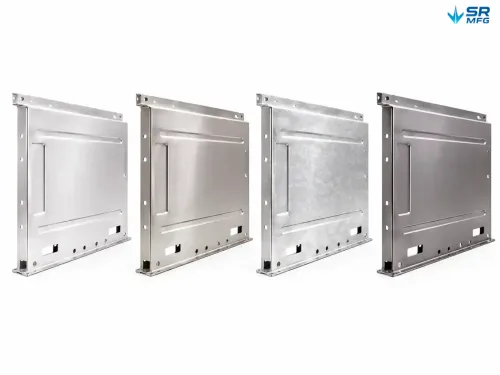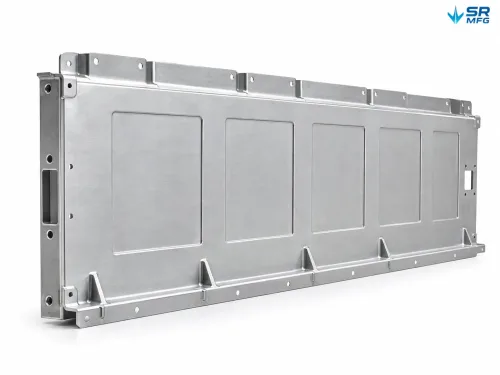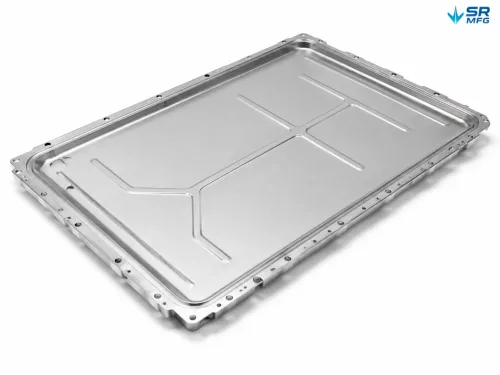
EV Battery Pack Lower Tray
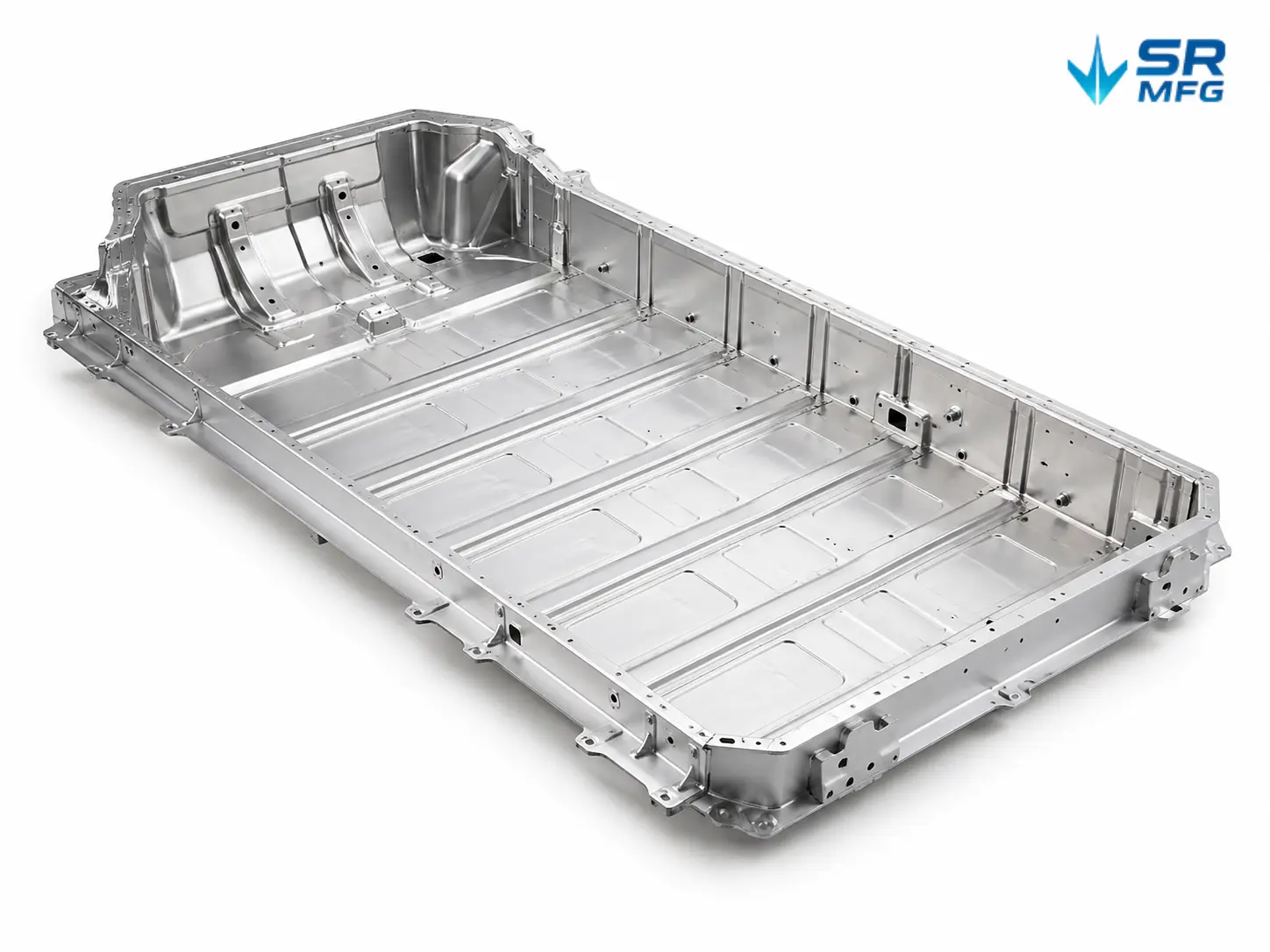
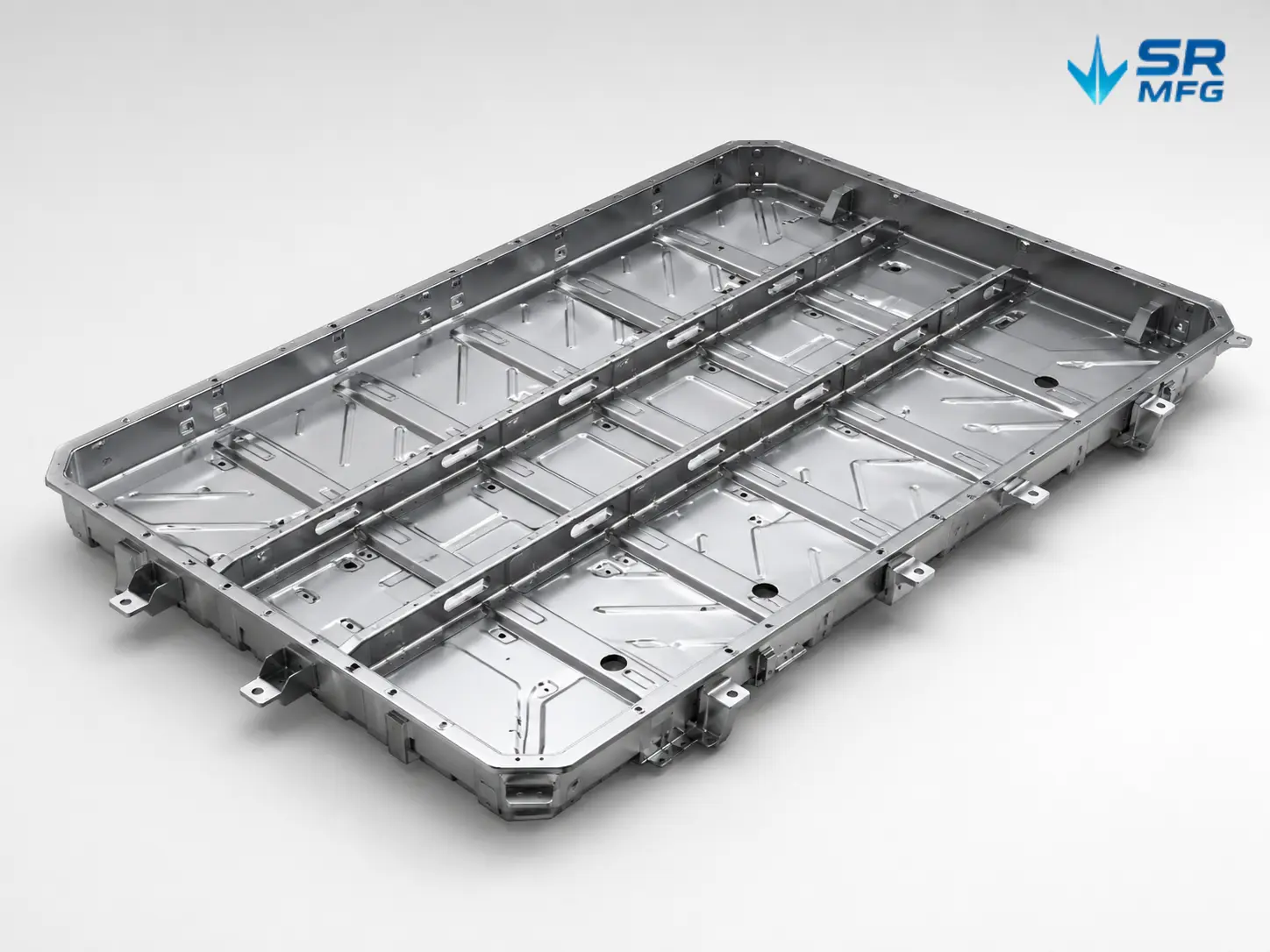
In electric vehicle projects, the battery enclosure is a critical part of the system. The lower tray sits at the core of the battery pack and must support the battery modules while also withstanding unexpected loads and impacts from road conditions. SR MFG can manufacture custom EV battery pack lower trays for your project. Whether you are developing a lightweight solution, an extruded-profile assembly concept, or a hybrid structure, we can support the development process.
- Lightweight design potential to help meet vehicle range and energy-efficiency targets
- Reliable structural support for battery modules and the full battery pack
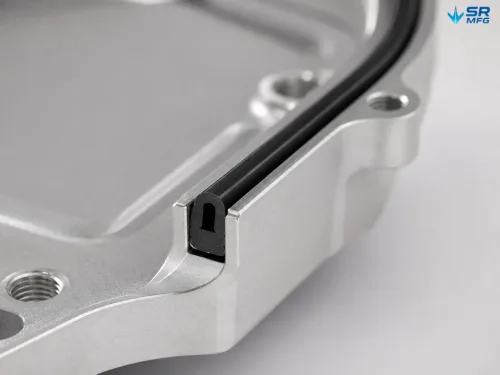
- Sealing interface surfaces prepared for dependable enclosure performance
- Project-specific customization to match your battery pack architecture and vehicle integration requirements
| Material | Aluminum, Carbon steel, Stainless steel |
|---|---|
| Surface Finish | anodizing, Electrophoresis, Powder coating |
| Process | bending, Laser cutting, stamping, welding |
Product Details
What Is an EV Battery Pack Lower Tray?
An EV battery pack lower tray is the bottom load-bearing and protective structure of the battery enclosure. It sits beneath the module or cell system and primarily provides mounting support and bottom protection. Together with the upper cover, side structures, and sealing system, it helps the full pack achieve impact resistance, intrusion protection, and dust- and water-resistance.
In a finished EV battery pack, the lower tray is typically integrated with sealing flanges, cooling-related interfaces, internal support structures, and vehicle mounting points.
The lower tray is the main load-bearing structure of the entire battery system. Its design has a direct impact on the service life of the battery pack.
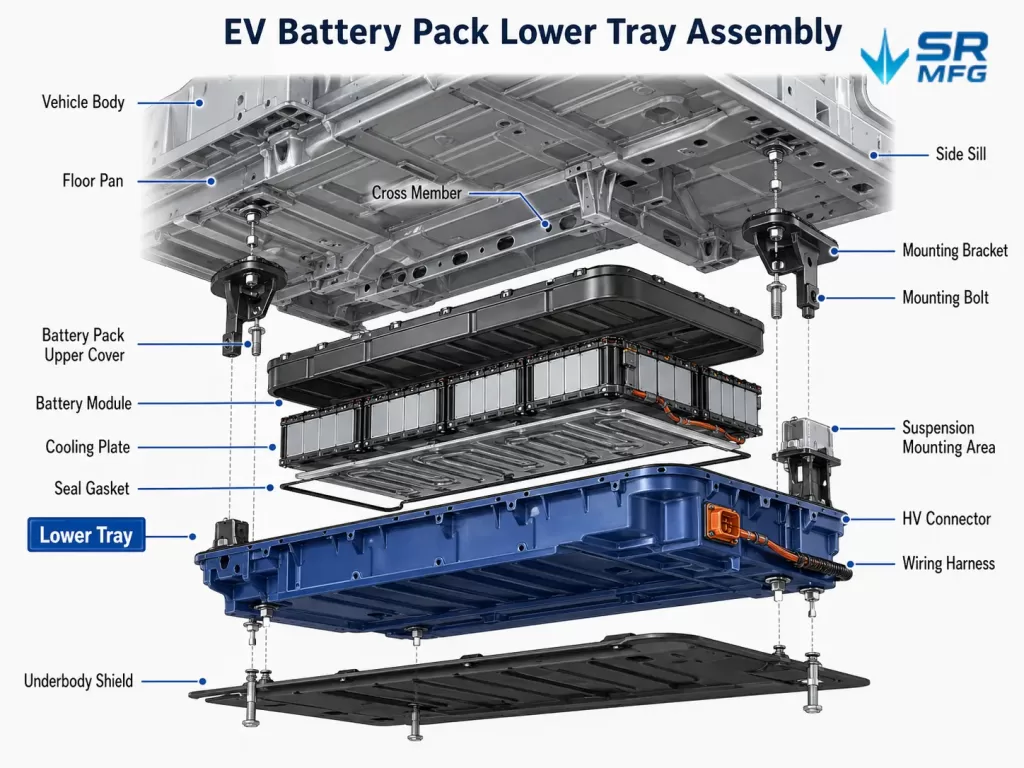
Assembly Structure Drawing of Electric Vehicle Battery Pack Lower Tray
EV Battery Pack Lower Tray Specifications
We can provide the typical specification range that is achievable for standard EV battery pack lower tray projects. The final production specification, however, still needs to be defined around your specific battery design.
| Item | Typical Range or Available Options |
|---|---|
| Material options | Aluminum alloys, 6061, 6063, 6082, 5083; carbon steel; stainless steel, 304, 316 |
| Thickness range | 1.0 mm to 6.0 mm, depending on material and structural requirements |
| Tray size | Project-specific, from small battery packs to large trays for commercial vehicles |
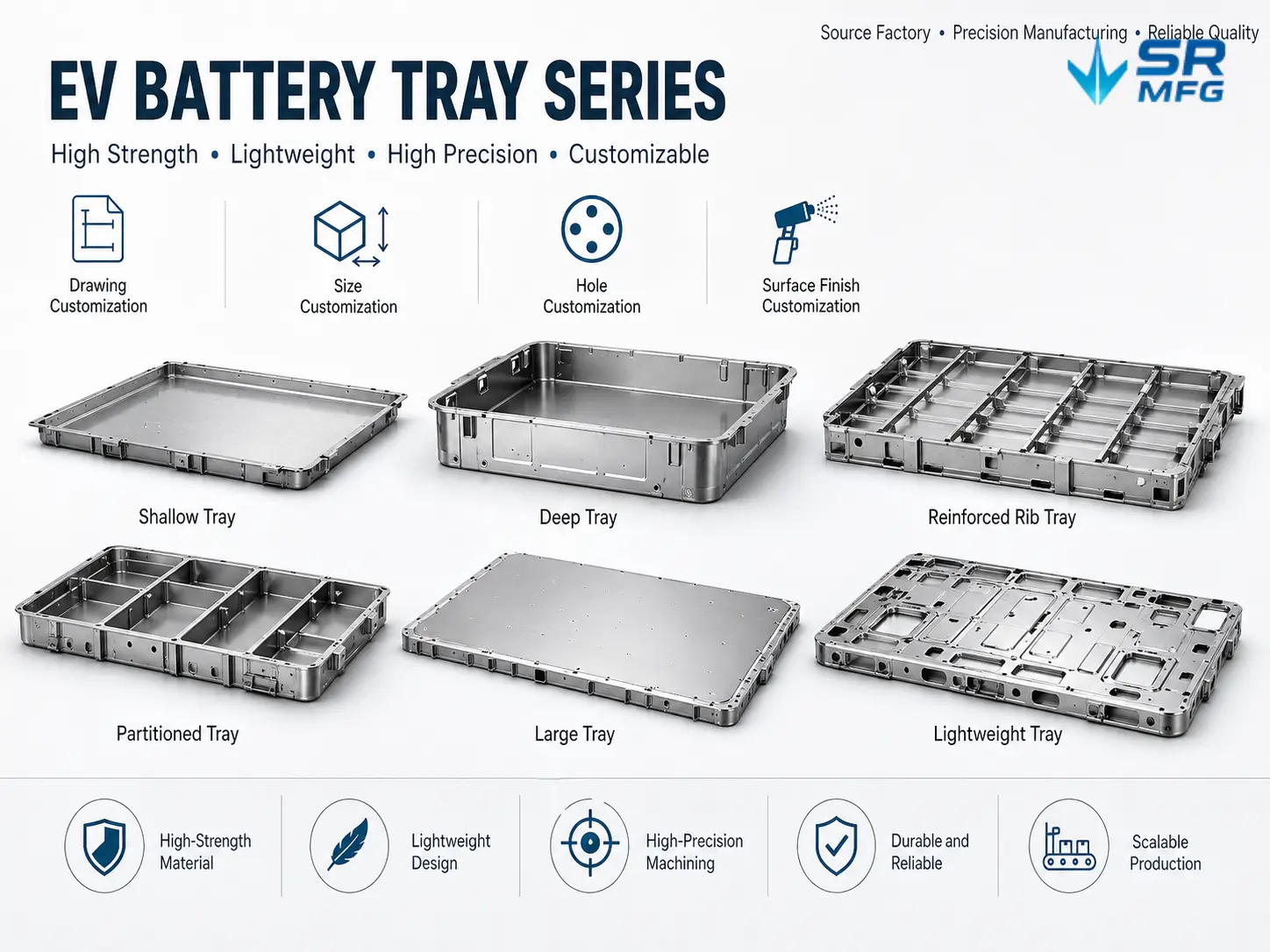
| Structural features | Ribs, stamped embossments, partitions, mounting bosses, sealing flanges, cooling channels |
| Manufacturing processes | Laser cutting, stamping, forming, bending, extrusion fabrication, CNC machining, welding, MIG, TIG, FSW, riveting, assembly |
| Surface finish options | Mill finish, chemical conversion coating, powder coating, e-coating, anodizing for aluminum alloys |
| Tolerance reference | Based on project drawings, standard tolerances per DIN ISO 2768-1, or project-specific requirements |
| Joining methods | MIG or TIG welding, friction stir welding, resistance spot welding, rivets including blind rivets, solid rivets, and flow-drill rivets, adhesive bonding |
| Prototype support | Available, from single prototypes to small pilot-production batches |
| Production capacity | From low volume to high volume, with scalable manufacturing capacity |
| Customization | Fully customized by project, manufactured to drawings or 3D files |
Material Options and Structural Approaches for EV Battery Pack Lower Trays
Material selection for EV battery tray sheet metal structures depends mainly on your project priorities. Whether your focus is lower weight, higher strength, or cost optimization, SR MFG can support the evaluation and selection process.
| Material or Structural Approach | Typical Advantages | Typical Considerations | Best Fit for Project Priorities |
|---|---|---|---|
| Aluminum alloy battery tray | Lightweight, about 50% lighter than comparable steel, good strength-to-weight ratio, excellent corrosion resistance, well suited to medium- to high-volume production | Joint locations need careful design to maintain structural continuity, and welding requirements are more demanding | Weight reduction, range improvement, and cost-effective medium-volume production |
| Aluminum extrusion plus assembly | Allows complex cross-sections, good stiffness in targeted directions, flexible geometry for easier integration | Extrusion tooling cost is higher, assembly steps are required, and joining may be needed to complete the full enclosure | Complex tray geometries, low- to medium-volume projects, and designs that prioritize flexibility |
| Steel tray solution | Carbon steel sheet metal fabrication for cost-sensitive tray structures Lower material cost, good stiffness, mature manufacturing processes | Significantly heavier than aluminum and requires protective coating against corrosion | Cost-sensitive projects, heavy-duty applications, and high-volume economy EV programs |
| Stainless steel option | Excellent corrosion resistance, strong durability, and potential for thinner gauges | Higher material cost, heavier than aluminum, and machining and welding require special consideration | Harsh environments, premium durability requirements, and chemically exposed applications |
Manufacturing Processes for EV Battery Pack Lower Trays
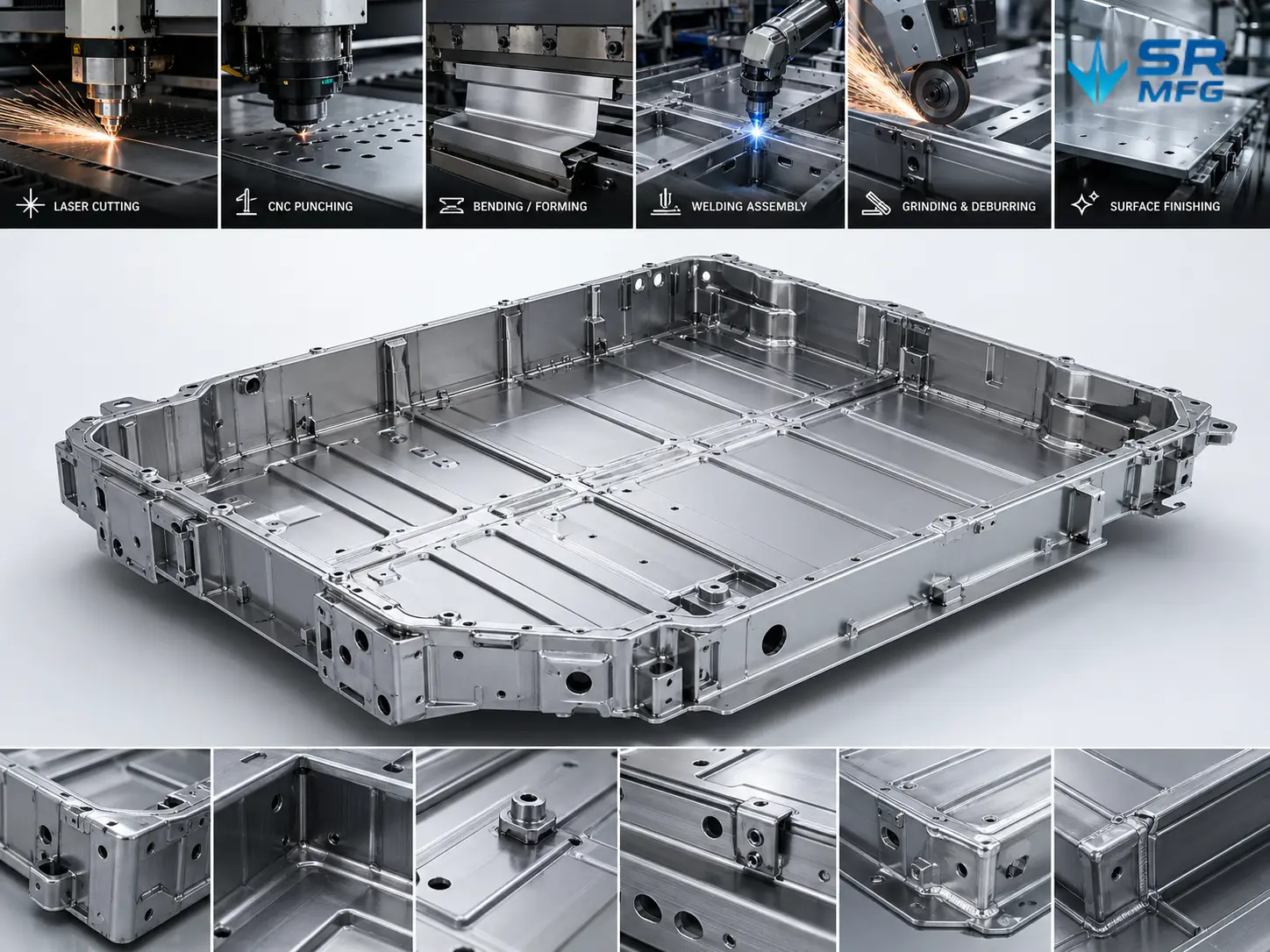
There is no fixed manufacturing template for these parts. Low-volume prototype builds before production parts may follow completely different process. SR MFG uses a range of manufacturing methods, including forming, joining and sheet metal welding and fabrication methods for structural battery trays, and can combine them flexibly to match your custom project requirements and achieve the best result.
Our core manufacturing capabilities include:
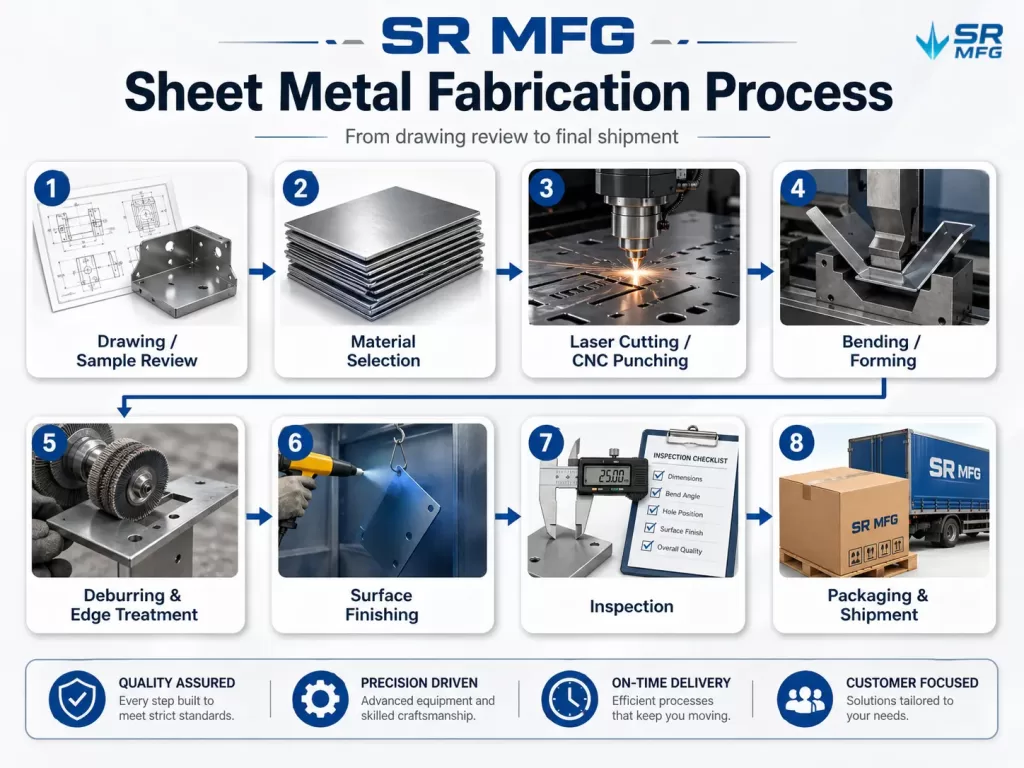
Laser cutting → stamping → bending → extrusion fabrication → welding → assembly preparation → surface finishing
Applications for EV Battery Pack Lower Trays
Our EV battery pack lower trays can be customized for a wide range of sheet metal solutions for energy and power equipment, including electric and hybrid vehicle programs.
Common applications include:
- Passenger EV battery packs
Lightweight aluminum trays for sedan, SUV, and crossover battery platforms - Commercial EV battery packs
Steel or reinforced trays for vans, trucks, and buses that require higher load capacity and durability - Hybrid vehicle battery enclosures
Compact tray designs for smaller battery packs used in hybrid and plug-in hybrid systems - Specialty vehicle electrification
Custom trays for off-road, construction, agricultural, or defense electrification projects - Prototype development programs
First-build trays, test units, and validation-stage parts for new battery platform development - Pilot production and low-volume builds
Transitional production runs before full-scale manufacturing - Mass production programs
Repeatable, inspected, and packaged trays delivered on schedule for assembly-line use
FAQ
Can SR MFG manufacture EV battery pack lower trays from customer drawings or 3D files?
Yes. We typically work from sheet metal technical drawings and 3D files, such as STEP, IGES, Parasolid, and other common formats, along with the technical specification. If you already have a design or even an early concept file, send it to us and we will review it for manufacturability.
What information should I provide to request a quote?
To prepare an accurate quote, it is best to share your drawings or 3D files, target material, estimated annual volume, required surface finish, any assembly requirements, and your project timeline. Even if you are still at an early stage and do not yet have complete documentation, feel free to contact us. We can help identify the key information needed.
Can prototypes be produced before mass production?
Yes. We support prototype builds and low-volume pilot production, including one-off parts for initial validation. This allows you to verify fit, function, and assembly before committing to full production tooling or process setup.
What materials can SR MFG use for battery tray projects?
We work with a range of materials suitable for EV battery pack lower trays, including aluminum alloys such as 6061, 6063, 6082, and 5083, as well as carbon steel and stainless steel including 304 and 316. We can also suggest material options based on your structural, weight, and corrosion-resistance requirements.
Can surface finishing and assembly support be included?
Yes. We offer a range of surface finish options, including chemical conversion coating, powder coating, e-coating, and anodizing for aluminum trays. We can also support assembly operations, including insert installation, fastener assembly, and battery-pack-level integration where required by the project.
Can export shipping packaging be customized?
Yes. We can prepare packaging based on your specific requirements, including export-grade wooden crates, palletized shipment, and any special handling instructions needed for battery enclosure components.
Does SR MFG support both low-volume and mass-production projects?
Yes. We support the full production range, from low-volume prototypes and pilot runs to high-volume mass production. Our manufacturing capacity can scale with your program as demand grows.