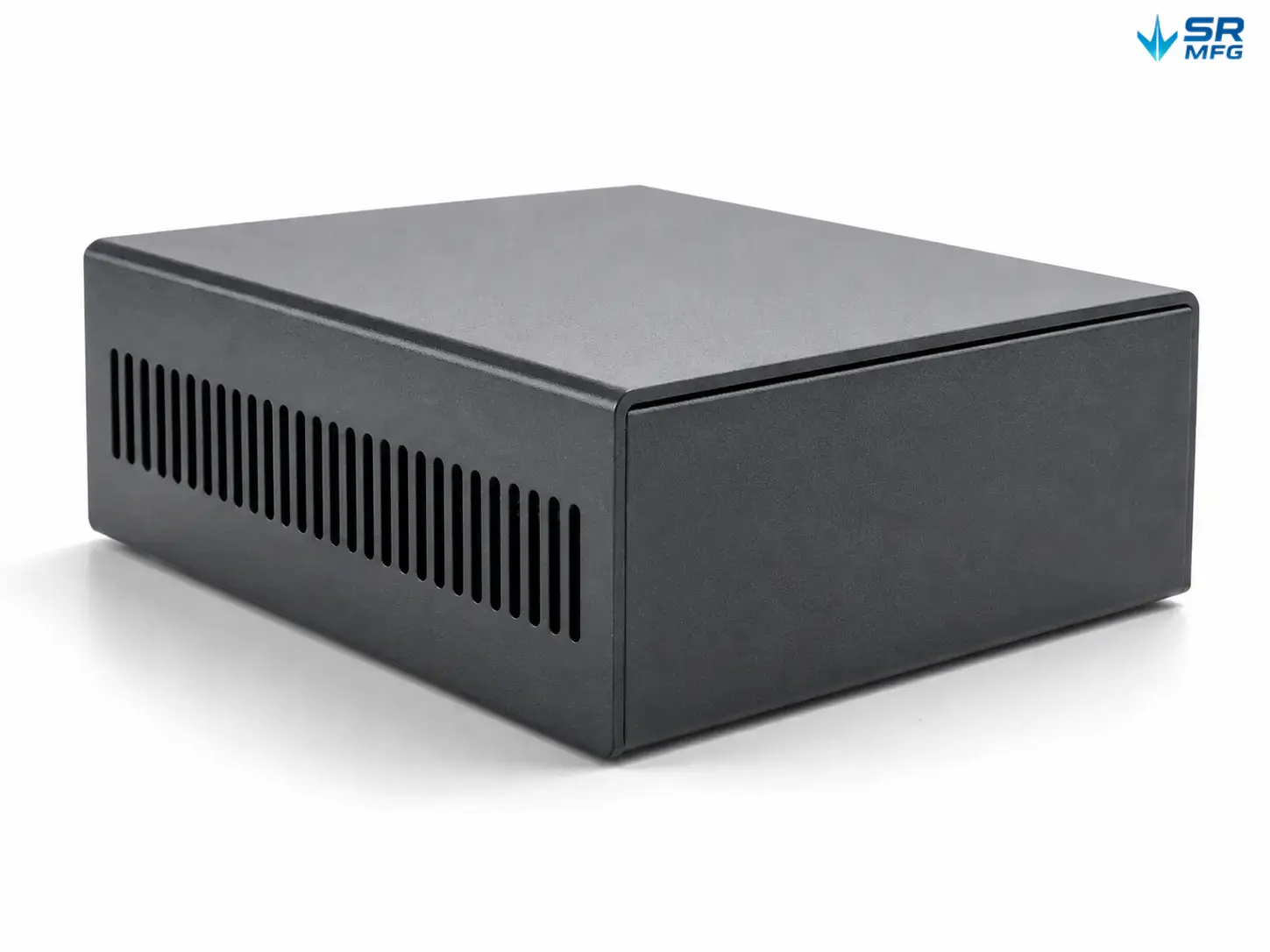
Custom WiFi Router Metal Enclosures
We manufacture custom sheet metal enclosures for WiFi routers, wireless access points, network gateways, and related networking equipment according to your drawings and technical requirements.
- Materials: Aluminum, cold-rolled steel, stainless steel, or galvanized steel selected according to the actual operating environment
- Thermal Management: Laser-cut ventilation patterns, integrated welded heat sinks, and internal airflow channels
- EMI Shielding: Conductive gasket grooves, grounding studs, and controlled overlapping seam structures
- IP Protection: Optional IP54 / IP65 / IP67 protection using silicone gaskets and sealed connector cutouts
- Internal Mounting: Self-clinching PCB standoffs, DIN rail mounting slots, and cable-management features
Product Details
| Specification | Details |
|---|---|
| Product Type | Custom sheet metal enclosures for WiFi routers and network equipment |
| Base Materials | Aluminum (5052 / 6061), cold-rolled steel (SPCC), stainless steel (304 / 316), galvanized steel |
| Material Thickness | 0.8–2.0 mm, depending on structural and thermal requirements |
| Cutting Process | Fiber laser cutting — approx. 0.1 mm kerf width, cut-edge finish Ra 3.2 μm or better |
| Bending Process | CNC press brake forming — bending angle tolerance ±0.5°, typical inside bend radius approximately 1× material thickness |
| Welding Process | TIG welding for aluminum and stainless steel, MIG welding for steel, spot welding for thin-sheet assemblies |
| Hole Position Tolerance | ±0.1 mm relative to datum |
| Flatness After Bending | ≤0.15 mm / 100 mm for mating surfaces and PCB contact areas |
| Surface Finish Options | Powder coating (60–80 μm), anodizing (Type II / Type III), e-coating, screen printing, laser engraving |
| Powder Coat Colors | Any RAL or Pantone color; custom color matching available |
| Salt Spray Resistance | Powder-coated steel: 240–500 hours per ASTM B117; anodized aluminum: 500+ hours |
| IP Protection | IP54 / IP65 / IP67 through gasket design, controlled seams, and sealed connector openings |
| EMI Shielding Features | Conductive gasket grooves, grounding studs, overlapping flange seams, shielded connector mounting features |
| Internal Mounting | Self-clinching brass standoffs (M3 / M4), threaded inserts, DIN rail slots, wall-mount keyholes |
| Thermal Management | Custom ventilation layouts, welded heat sinks, and flat contact surfaces for direct PCB-to-enclosure heat transfer |
| Logo Options | Screen printing, laser engraving, embossing, adhesive labels |
| Prototype Lead Time | 5–7 business days after drawing approval |
| Production Lead Time | 15–25 business days depending on quantity and process complexity |
| Prototype MOQ | 1 piece |
| Production MOQ | No fixed MOQ — evaluated according to material and process requirements |
| Accepted Drawing Formats | DWG, DXF, STEP, IGES, PDF, and dimensioned hand sketches |
| Quality Inspection | Dimensional inspection using CMM / calipers, coating thickness and adhesion inspection, assembly-fit checks, and visual inspection |
| Packaging | Anti-rust paper + foam inserts + corrugated cartons; custom packaging available |
Custom WiFi Router Metal Enclosures Built to Your Requirements
We manufacture sheet metal enclosures for WiFi routers, wireless access points, network gateways, and IoT edge devices.
Every enclosure is manufactured through custom sheet metal fabrication according to your drawings or developed around your specific requirements. We do not rely on catalog-standard sizes or stock enclosure designs.
Simply send us your drawings, and we can handle the rest:
DFM review, material selection, laser cutting, bending, welding, surface finishing, assembly, and inspection.
Typical equipment we support includes:
- Home and enterprise WiFi routers
- Indoor and outdoor wireless access points
- Industrial network gateways and edge-computing nodes
- IoT controllers and smart-home gateways
- 5G CPE devices and small-cell enclosures
Engineered for Thermal Management and Structural Strength
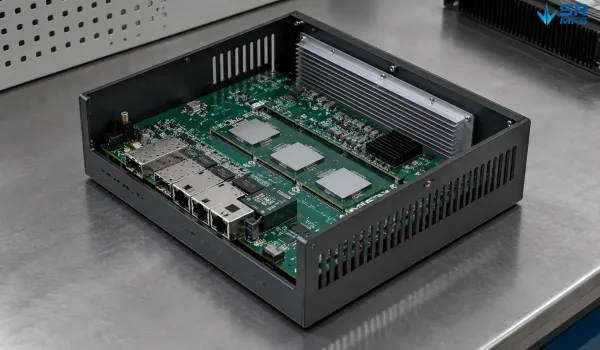
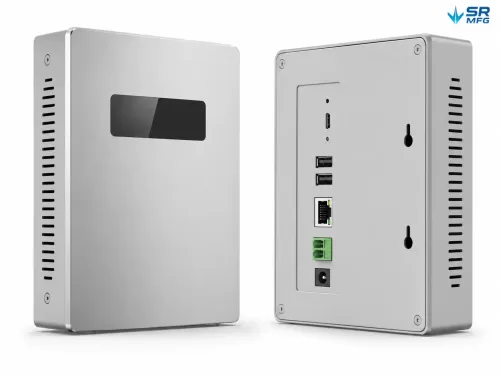
A custom aluminum router enclosure using ventilation slots, internal airflow paths, and an integrated heat sink to manage heat from the PCB.
Compared with plastic housings, metal enclosures offer two major advantages:
thermal management and mechanical protection.
A properly designed aluminum enclosure can passively dissipate approximately 15–25 W of heat through its own surface area. For many consumer-grade and medium-power enterprise routers, this can eliminate the need for an internal cooling fan.
We integrate thermal management directly into the enclosure design:
- Ventilation Layout — Laser-cut openings are positioned according to PCB heat-source locations instead of relying on generic perforation patterns
- Integrated Heat Sinks — Aluminum cooling fins can be welded or riveted to the enclosure to increase heat-dissipation area
- Internal Airflow Channels — Designed around the PCB layout to guide natural airflow from intake openings to exhaust vents
- Thermal Interface Support — Mounting surfaces can be flattened or machined to enable direct thermal conduction from the PCB to the enclosure
Structural rigidity comes primarily from the metal itself.
A 1.2 mm aluminum enclosure can withstand shipping loads, wall-mounting forces, and long-term vibration that may eventually cause thin-walled plastic housings to crack or deform.
Material Selection and Surface Finishing
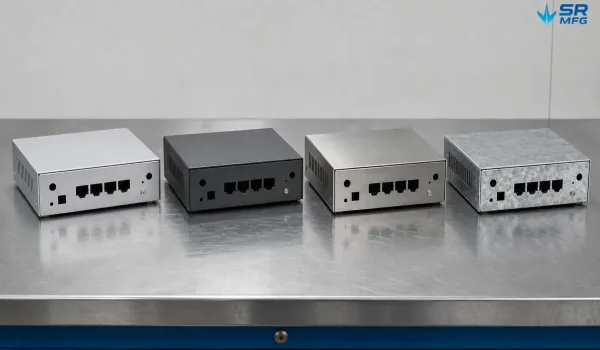
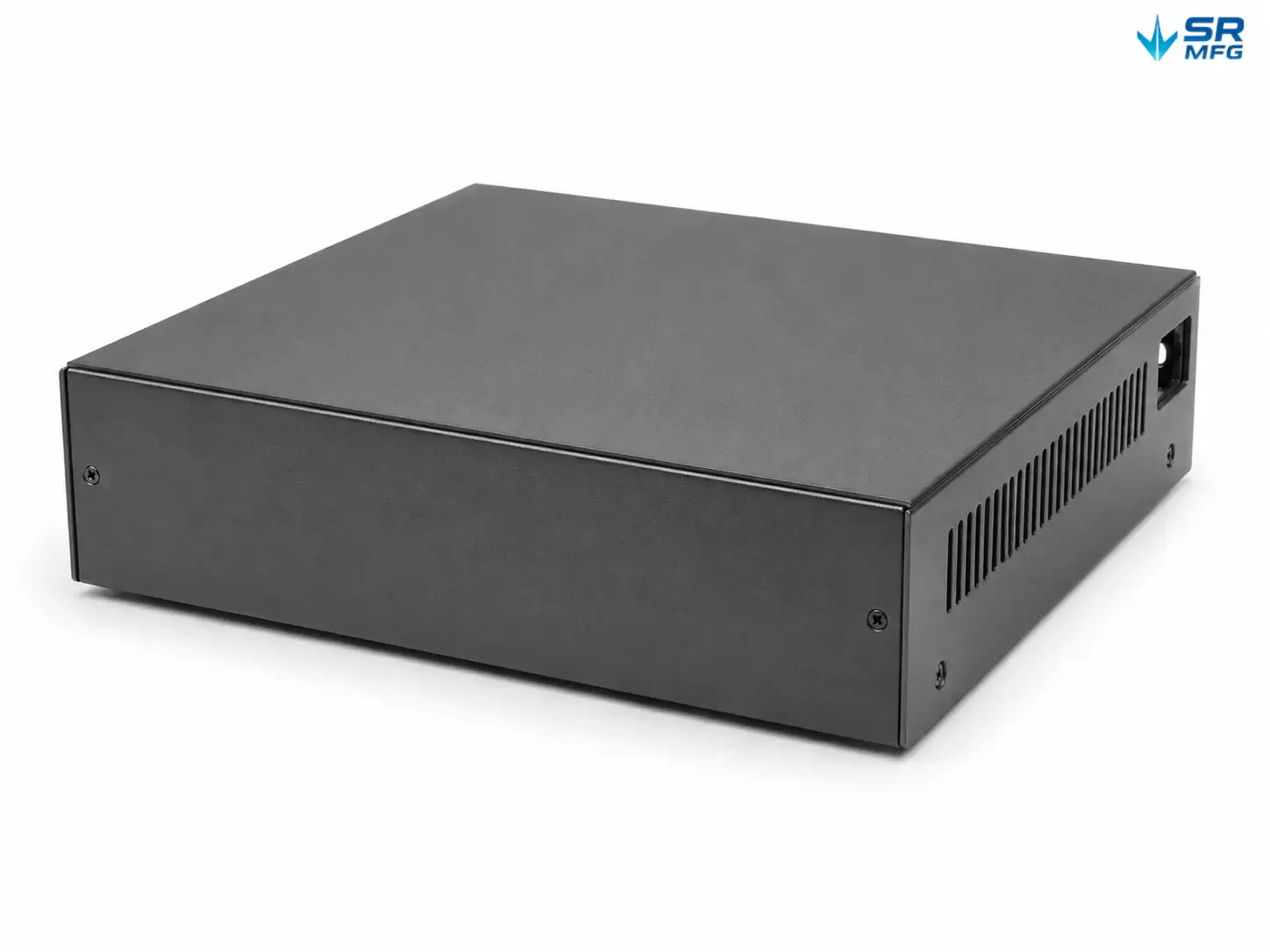
Four enclosure samples show common material options for network equipment: aluminum, cold-rolled steel, stainless steel, and galvanized steel.
The right base material depends on where the enclosure will be installed, the environmental conditions it must withstand, and the allowable product weight.
| Material | Key Properties | Recommended Applications |
|---|---|---|
| Aluminum 5052 / 6061 | Lightweight, excellent thermal conductivity, corrosion resistant | Desktop routers, wall-mounted access points, indoor equipment |
| Cold-Rolled Steel (SPCC) | High strength, cost-effective, easy to powder coat | High-volume consumer routers, indoor gateways |
| Stainless Steel 304 / 316 | Excellent corrosion resistance, suitable for demanding environments | Industrial, coastal, or humid environments |
| Galvanized Steel | Zinc-coated corrosion protection at an economical cost | Semi-outdoor equipment and cost-sensitive projects |
Surface finishing affects not only appearance but also long-term durability.
- Powder Coating — The most common option. Available in matte or semi-gloss finishes in virtually any RAL color. Typical coating thickness is 60–80 μm, providing good abrasion and chemical resistance.
- Aluminum anodizing — Available for aluminum enclosures only. Produces a hard protective oxide layer. Type II is commonly used for decorative coloring, while Type III hard anodizing provides greater wear resistance and is suitable for premium electronic equipment.
- E-Coating — Provides uniform coating coverage even on complex geometries. Commonly used on steel enclosures requiring consistent corrosion protection.
- Screen Printing / Laser Engraving — Suitable for logos, connector labels, regulatory markings, and branding information.
If your equipment operates in salt-spray or chemically aggressive environments, we can recommend an appropriate combination of base material and surface treatment based on the actual service conditions.
Internal Mounting and Assembly Options
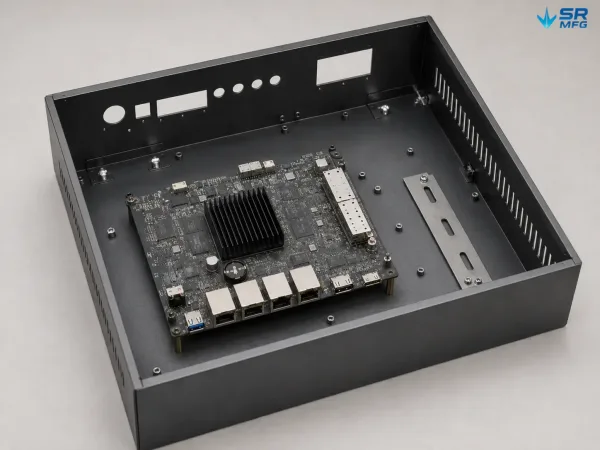
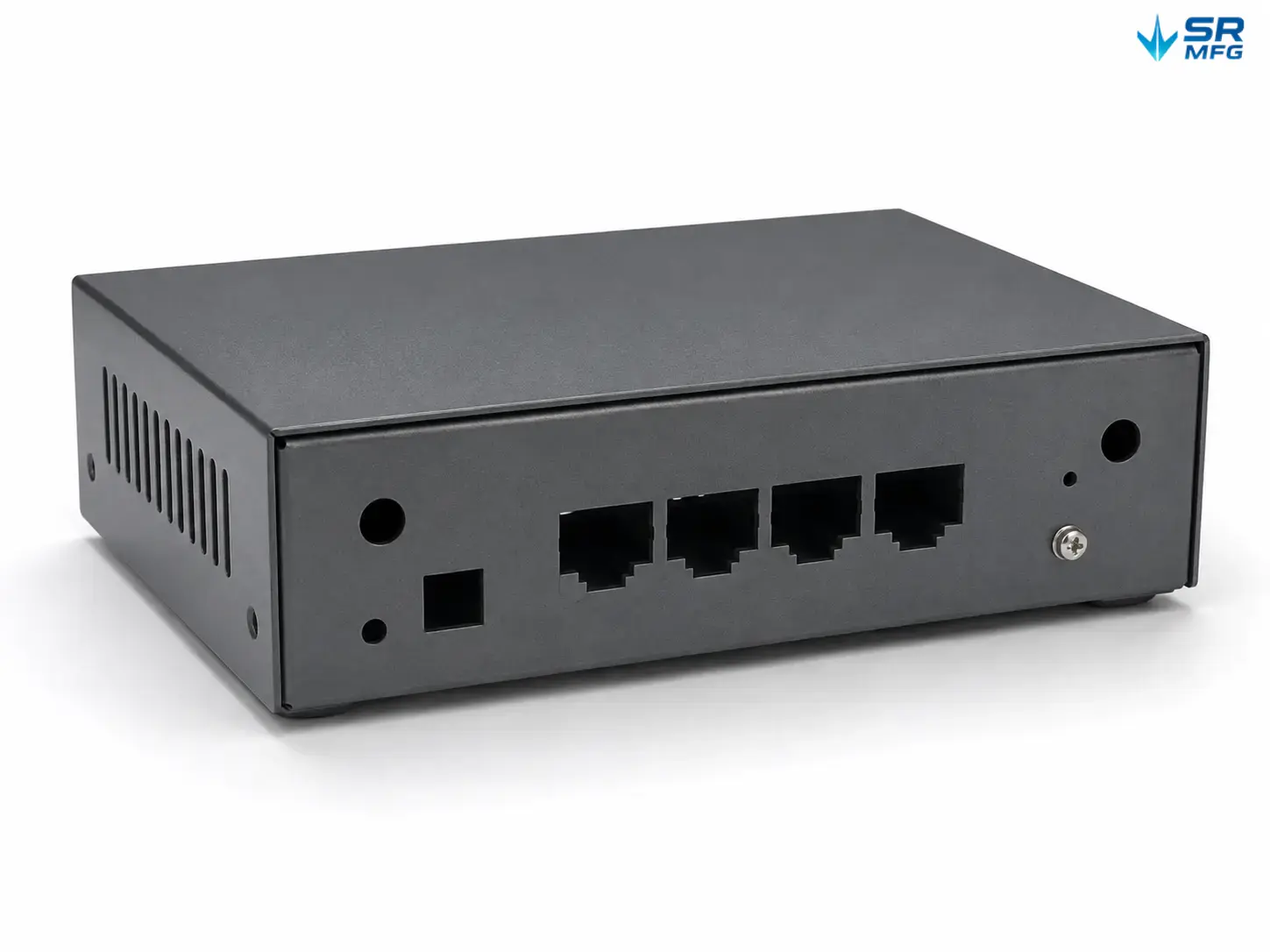
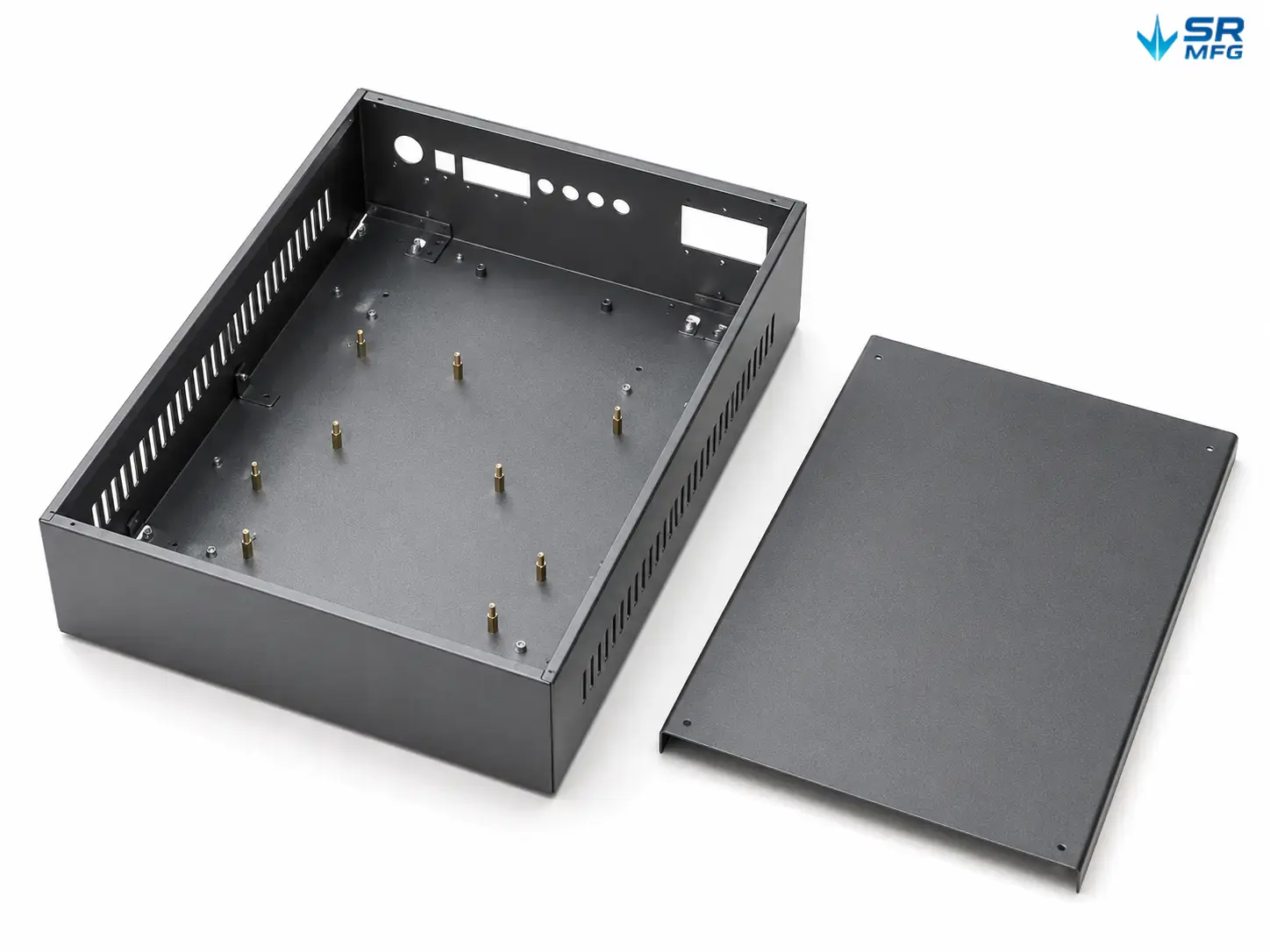
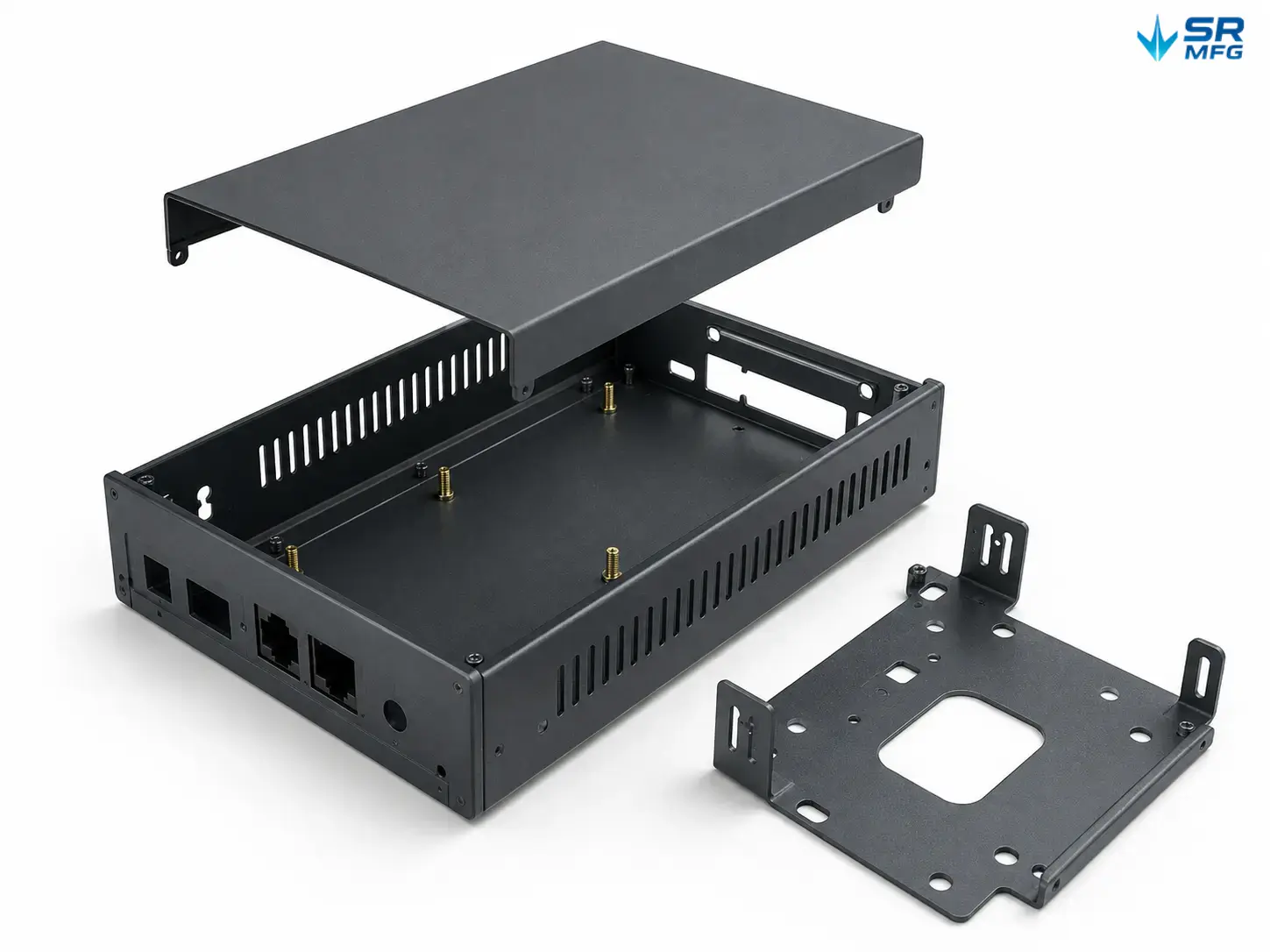
The open enclosure shows PCB standoffs, mounting features, cable-management points, and connector openings integrated into the sheet metal structure.
The internal structure of an enclosure is just as important as its exterior.
Poor internal mounting design can slow assembly, increase field failures, and lead to unnecessary service and repair work.
We integrate internal mounting features directly into the enclosure wherever possible rather than treating them as separate add-on components.
PCB Mounting
- Self-clinching brass standoffs (M3 / M4), installed using hydraulic insertion equipment with pull-out resistance exceeding 50 kgf
- Threaded inserts for PCBs that require repeated removal during maintenance
- Custom standoff heights based on PCB clearance requirements
Rail and Bracket Mounting
- 35 mm DIN rail mounting slots can be punched or laser-cut directly into the enclosure back panel
- Wall-mount keyholes allow fast installation on vertical surfaces
- Ceiling-mount flanges are available for wireless access points
Cable and Connector Management
- Strain-relief cable gland openings can be sized for standard PG or metric M-series glands
- Internal cable channels can be formed directly during the bending process
- Welded studs can be added as cable-tie anchor points for wire management
Connector Sealing
- Unused RJ45, USB, or SMA ports can be designed with openings for rubber sealing plugs
- Gasketed connector cutouts can be machined to match specified connector profiles
- Waterproof RJ45 and DC power connector openings can be incorporated for outdoor-rated assemblies
If your PCB uses a non-standard mounting-hole pattern, simply send us the board outline or PCB drawing.
We will adjust the enclosure and standoff locations to fit your PCB rather than forcing your PCB design to conform to an existing enclosure.
EMI Shielding and Environmental Protection
Network equipment often needs to comply with EMC requirements, and EMI shielding design for sheet metal enclosures can directly influence both electromagnetic emissions and immunity performance.
EMI Shielding Solutions
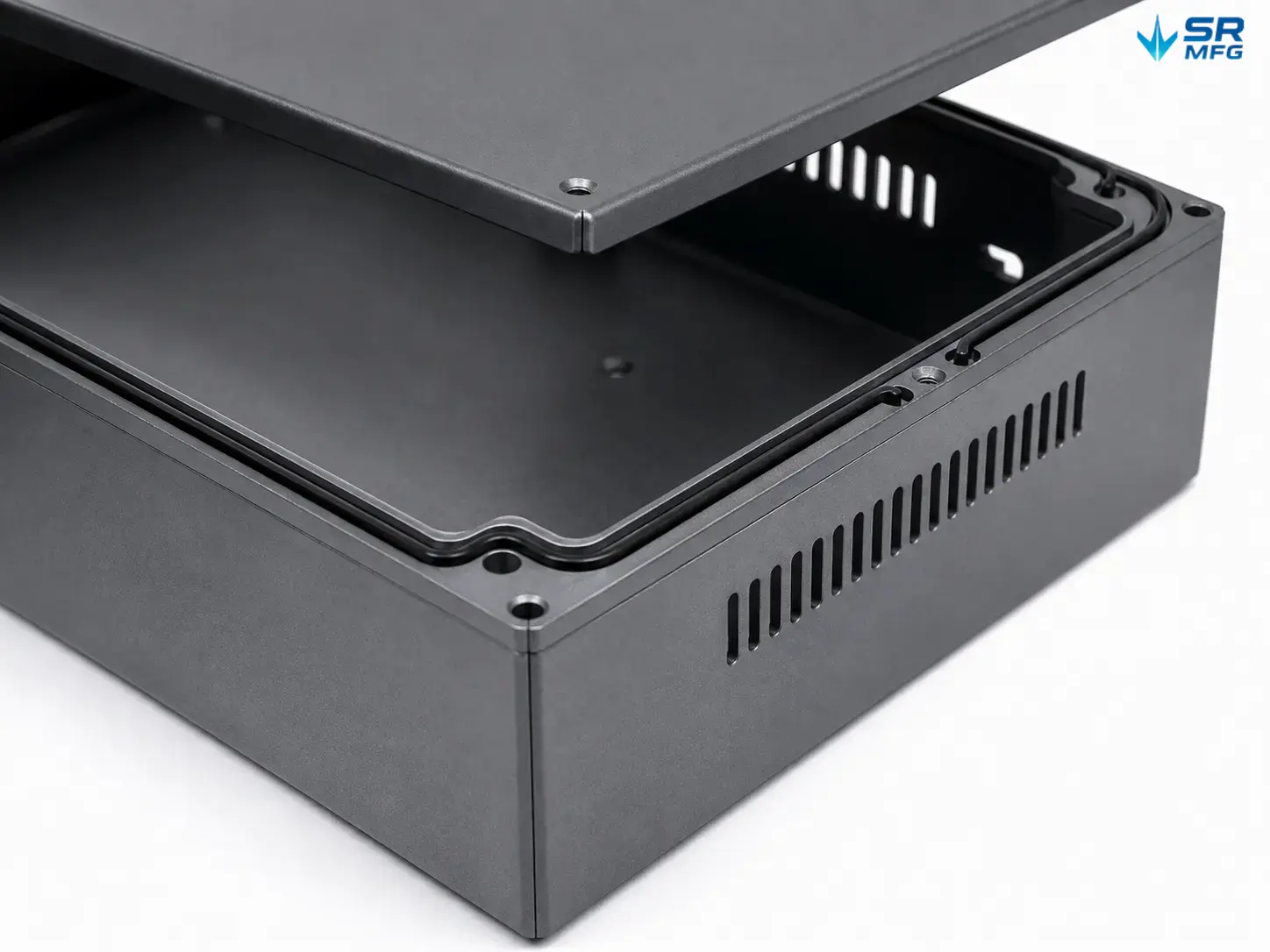
- Conductive Gasket Grooves — CNC-machined grooves around panel seams can accommodate beryllium-copper fingerstock or metal-mesh-over-silicone conductive gaskets
- Grounding Studs — Ground studs can be welded at multiple locations to create low-impedance grounding paths
- Controlled Panel Seams — Overlapping flange joints can be used with fastener spacing controlled to within 30 mm to help reduce RF leakage
- Shielded Connector Openings — D-sub, SMA, and N-type connector openings can include flange contact surfaces for grounding and shielding
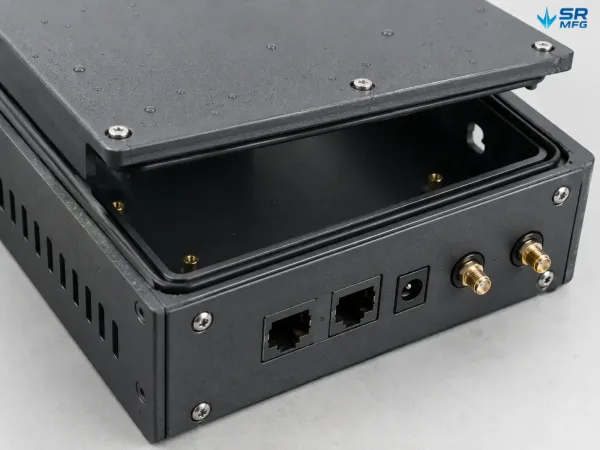
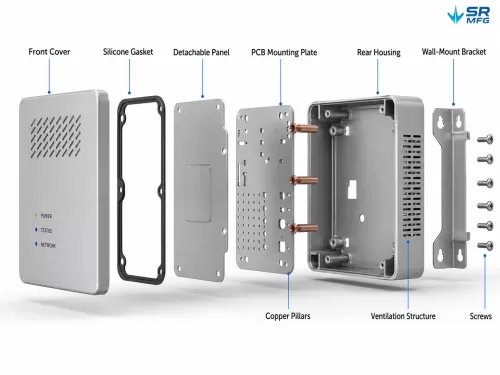
A perimeter silicone gasket, sealed mating surfaces, and waterproof connector interfaces protect the enclosure from dust and water.
Actual shielding effectiveness depends on the conductive gasket material, seam geometry, and grounding layout.
We can work with the requirements provided by your EMC engineer to adjust the enclosure structure toward the required attenuation target.
IP Sealing Options
IP54
Protected against dust ingress and splashing water. A continuous groove and silicone gasket can be used around the cover. Suitable for indoor industrial environments.
IP65
Dust-tight and protected against water jets. Typically achieved with a dual-seam sealing structure and controlled gasket compression through cover fasteners. Commonly used for outdoor wireless access points and semi-exposed installations.
IP67
Dust-tight and capable of withstanding temporary immersion. Typically uses a continuous perimeter gasket, tongue-and-groove mating surfaces, and waterproof connectors. Suitable for ground-level installations or fully exposed outdoor environments.
Actual sealing performance depends on gasket material, compression ratio, enclosure geometry, and fastener torque.
We select the appropriate gasket profile based on the target IP rating and enclosure design.
Typical Applications
These enclosures can be used across a wide range of consumer electronics and network equipment applications.
- Enterprise WiFi Access Points — Ceiling- or wall-mounted aluminum enclosures with PoE connector openings and optional integrated heat sinks
- Home WiFi Routers — Compact desktop enclosures made from powder-coated steel or aluminum with integrated ventilation slots
- Outdoor Wireless Bridges and CPE — IP65/IP67 sealed stainless steel or coated aluminum housings with antenna feed-through openings and UV-resistant finishes
- Industrial IoT Gateways — DIN rail-compatible enclosures using materials suitable for wide-temperature operation and EMI shielding designed for factory environments
- 5G CPE and Small-Cell Enclosures — Aluminum housings with integrated heat sinks, antenna mounting features, and waterproofing provisions
- NVR and DVR Enclosures — Rack-mounted or wall-mounted housings with hard-drive vibration isolation and multiple connector cutouts
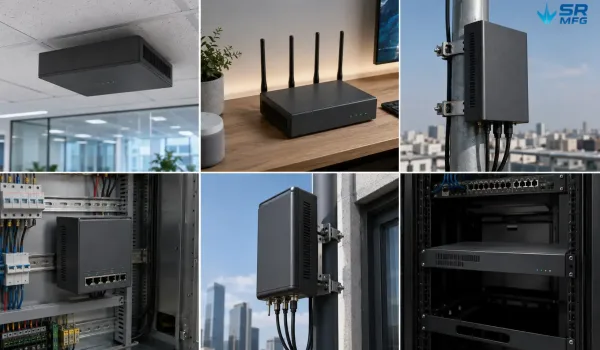
The image shows custom metal enclosures used across WiFi access points, routers, outdoor CPE, industrial IoT gateways, 5G equipment, and network recorders.
If your equipment does not fall neatly into one of these categories, simply send us your application requirements.
We can adapt the enclosure design to the actual installation environment rather than forcing your device into an existing standard housing.
How to Order a Custom Router Enclosure
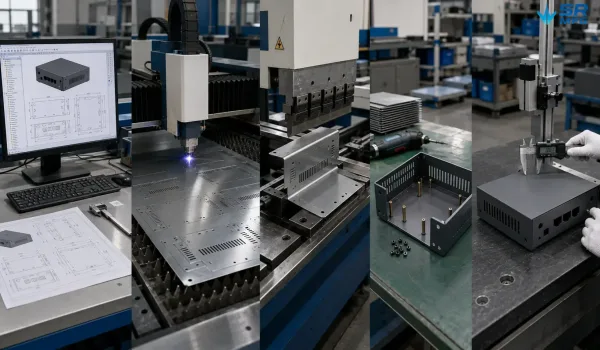
The manufacturing workflow covers drawing review, laser cutting, CNC bending, assembly, and final inspection of a custom router enclosure.
Our custom manufacturing process is straightforward:
| Step | What Happens | Typical Lead Time |
|---|---|---|
| 1. Send Drawings | Submit DWG, STEP, PDF, or a dimensioned hand sketch with your requirements | — |
| 2. DFM Review | Our engineering team reviews the design for manufacturability and provides optimization recommendations | Within 24 hours |
| 3. Quotation | We provide a detailed quote covering materials, manufacturing processes, surface finishing, and packaging | Within 24 hours after DFM review |
| 4. Prototype Production | We manufacture 1–5 prototypes for fit, appearance, assembly, and functional verification | 5–7 business days |
| 5. Mass Production | Batch manufacturing with in-process inspection at key production stages | 15–25 business days depending on quantity |
Information We Need From You
- 2D drawings in DWG / DXF / PDF format showing dimensions, tolerances, and hole locations
- A 3D model in STEP / IGES format, if available, to help us review bend sequences and manufacturing paths
- Preferred material and surface finish
- Required IP rating, if applicable
- Estimated annual usage
- Any special requirements such as logo position, packaging, labeling, or assembly
No drawings yet?
You can still send us your equipment dimensions, connector layout, and mounting requirements. We can prepare a preliminary enclosure design for your review.