
Aluminum-Zinc AlloyCoated Steel Sheet
Resistance
For demanding outdoor
and industrial use
Performance
Suitable for exposed
metal components
Fabrication-Friendly
Compatible with common
sheet metal processes
Aluminum-Zinc Alloy Coated Steel Sheet: The Basics
Aluminum-zinc alloy coated steel sheet can be understood as an upgraded coated steel product. It uses cold-rolled steel sheet as the substrate and is produced by applying an aluminum-zinc alloy coating to the surface through a continuous hot-dip coating process. The coating itself is made up of approximately 55% aluminum, 43.4% zinc, and 1.6% silicon. This alloy structure combines the barrier protection of aluminum with the sacrificial protection of zinc.
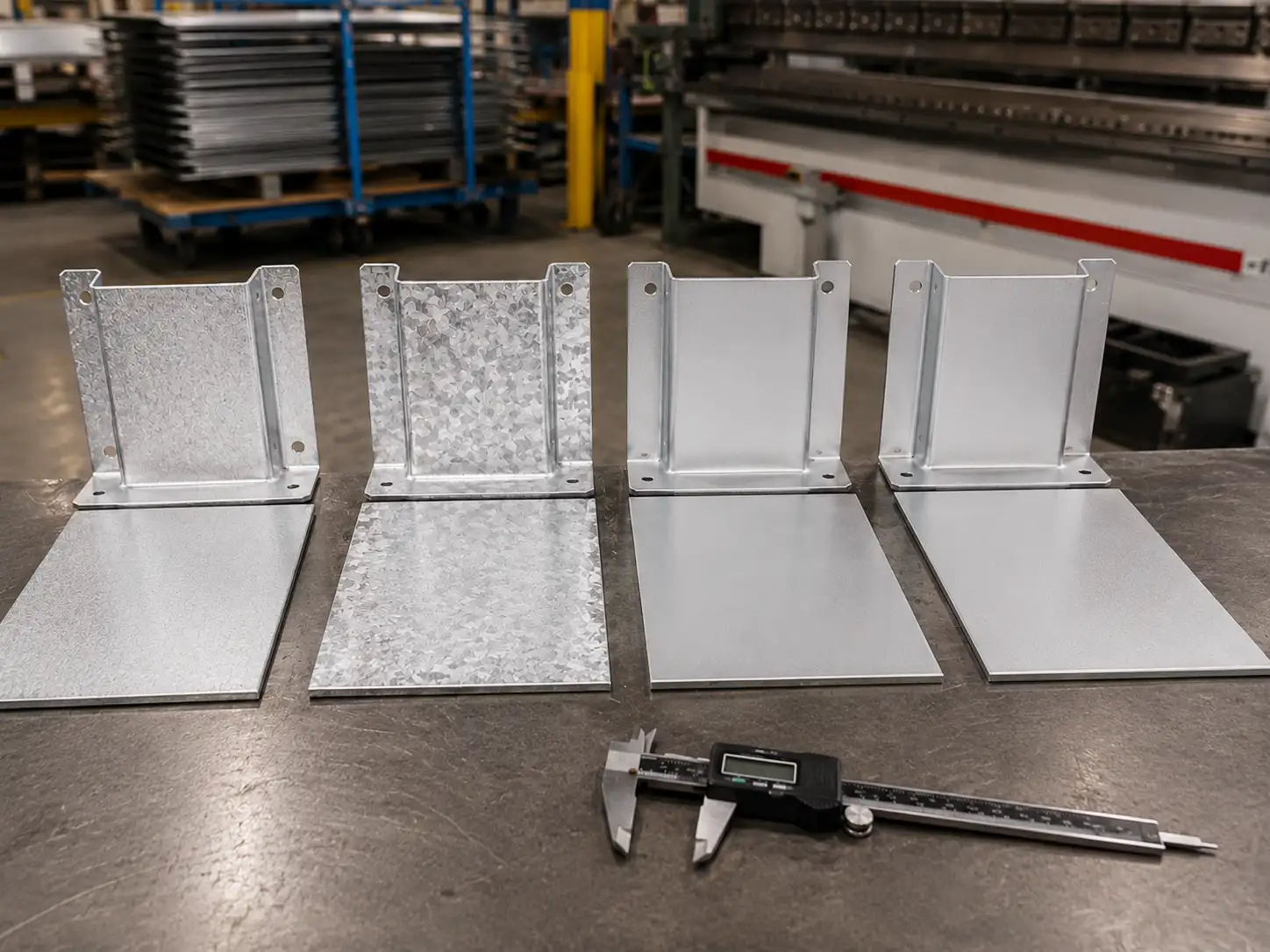
It also gives the material a distinctive appearance. The surface typically has a bright silver-gray metallic finish, and under reflected light it shows a fine, uniform spangle or textured pattern. At its core, it is still a steel sheet product, but the alloy coating gives it far better corrosion resistance than standard cold-rolled steel.
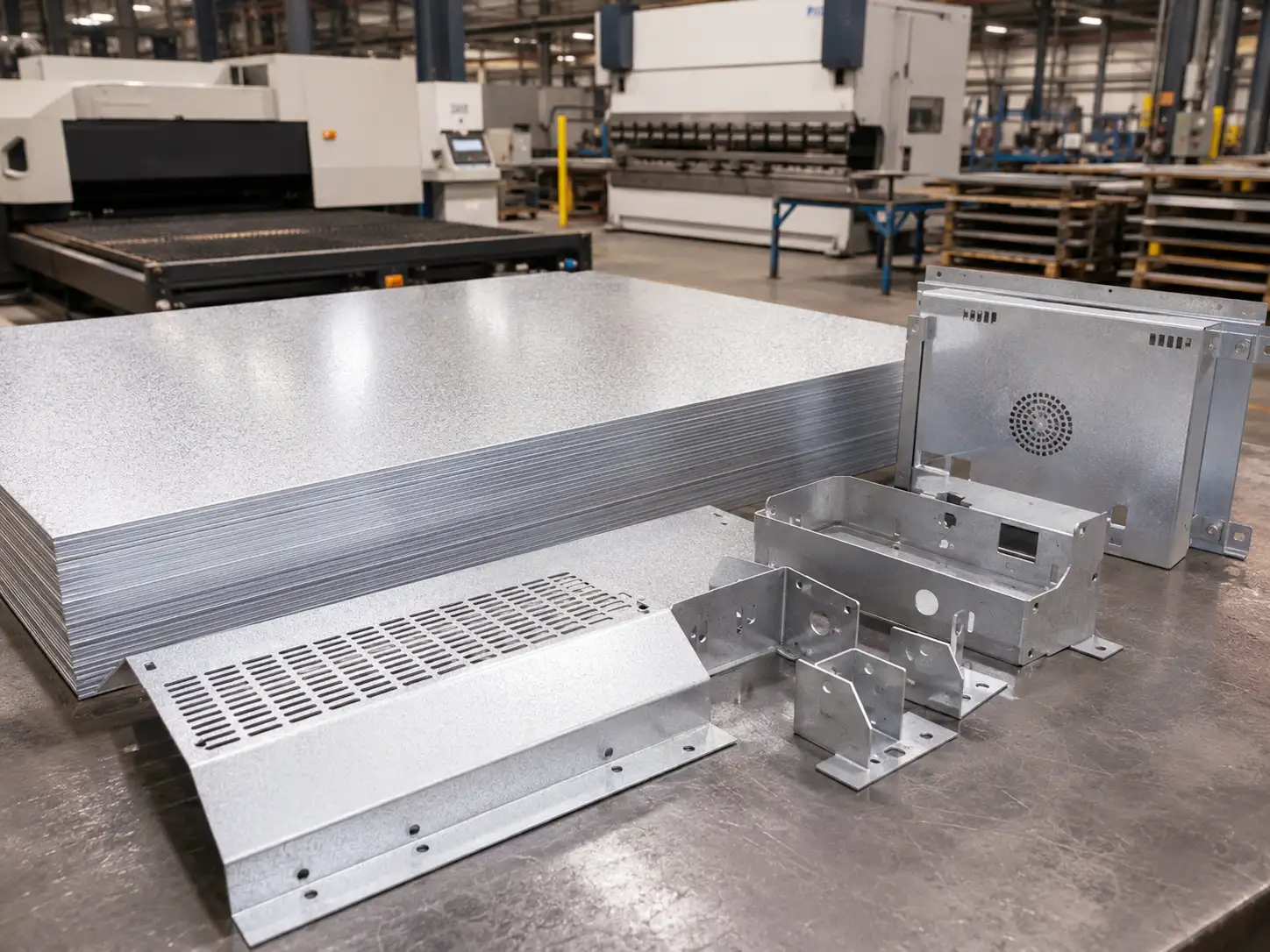
Main Features and Advantages of Aluminum-Zinc Alloy Coated Steel Sheet
Aluminum-zinc alloy coated steel is widely favored in sheet metal fabrication because it offers a strong combination of performance advantages.
How Aluminum-Zinc Coated Steel Differs from Other Common Corrosion-Resistant Sheet Metal Materials
So how does aluminum-zinc coated steel compare with other common corrosion-resistant sheet metal materials? The table below is SR MFG’s summary based on publicly available technical references, designed to help you quickly understand the differences between AZ, GI, EG, and ZM.
| Material | Coating / Surface Characteristics | Advantages | Limitations | Best-Fit Applications |
|---|---|---|---|---|
| Aluminum-zinc alloy coated steel (AZ / 55% Al-Zn) | Continuously hot-dip coated with an aluminum-dominant alloy layer | Long-term corrosion resistance on flat surfaces is often better than standard GI; excellent heat resistance and heat reflectivity; suitable for coating and conventional forming | Not ideal for contact with wet concrete, strong alkalis, or buried soil; if the main risk lies at cut edges, bent/damaged areas, or in high-ammonia environments, it should not automatically be considered the best option | Roofing, wall panels, cladding, outdoor covers, and flat panels exposed outdoors for long periods |
| Hot-dip galvanized steel (GI / HDG) | Continuously hot-dip coated with pure zinc or a zinc-dominant coating | Highly versatile, widely available, and supported by a mature cost structure; clear sacrificial protection; suitable for a wide range of forming processes | Long-term flat-surface durability and heat reflectivity are usually not as strong as AZ | General corrosion-resistant sheet metal parts, structural components, standard enclosures and cabinets, mature mass-production projects |
| Electro-galvanized steel (EG; often referred to in purchasing as SECC, etc.) | Electro-deposited zinc coating with a smoother surface and thinner coating | High surface quality; well suited to painting, electrical conductivity, appearance parts, and indoor equipment components; preserves the formability of the base steel | The thin coating means it is generally not used as a substitute for AZ in long-term exposed outdoor applications | Indoor appearance parts, appliance components, office equipment parts, conductive housings, and powder-coated enclosures |
| Zinc-aluminum-magnesium steel (ZM / Zn-Al-Mg) | Zinc-based coating alloyed with aluminum and magnesium | Many product lines perform better at cut edges, bent areas, and in ammonia-rich or harsher corrosive environments | Actual performance depends heavily on the manufacturer’s system, grade, and coating formulation, so the specific supply specification must be confirmed | Applications with many cut edges or damaged areas, livestock buildings, composting environments, and more severe corrosive conditions |
Typical Applications for Aluminum-Zinc Alloy Coated Steel Sheet
Aluminum-zinc alloy coated steel sheet is not suitable for every application. When selecting this material, both the service environment and the fabrication requirements need to be considered carefully.
Application Suitability Guide for Aluminum-Zinc Alloy Coated Steel Sheet
| Application | Suitability | Reason | Notes |
|---|---|---|---|
| Roofing, wall panels, and building envelope panels | High | AZ offers strong long-term protection on large exposed surfaces and also provides good heat reflectivity | A typical best-fit application |
| Outdoor equipment housings / protective covers | Medium to high | Long-term durability on flat surfaces is generally strong | Pay close attention to cut edges, standing water, and joints |
| External HVAC panels and components | Medium to high | Balances durability and cost well | Coastal exposure, salt buildup, and condensation should be evaluated separately |
| Outer covers for electrical enclosures and cabinets | Medium | Can be used, but if smoother appearance and more consistent coating performance are priorities, EG should also be considered | Depends on appearance grade and service environment |
| Deep-drawn housings and complex stamped parts | Medium to low | Can be processed, but is not always the first choice | In many cases, it should be compared with EG or GI |
| Direct contact with wet concrete, uncured cement, or soil | Low | Al-Zn coatings are sensitive to these environments | AZ is generally not recommended as the default choice |
| Livestock buildings, composting facilities, or high-ammonia environments | Low to medium | In these environments, many published ZM systems perform better than 55% Al-Zn | ZM should usually be evaluated first |
Note: Strong alkaline environments are not a strength of aluminum-zinc alloy coated steel sheet, so other materials should be considered first.
Standards, Grades, and Coating Designations
You do not need to memorize too much in this section. Just pay close attention to two key points:
- Under ASTM A792/A792M, ASTM states that these products are primarily intended for applications requiring corrosion resistance, heat resistance, or both.
- EN 10346 is the European standard covering continuously hot-dip coated sheet products, and it treats Z, ZF, ZA, AZ, AS, and ZM as separate coating systems.
| Standard / Designation | Common Format You Will See | How to Interpret It |
|---|---|---|
| ASTM A792/A792M | 55% Aluminum-Zinc Alloy-Coated by the Hot-Dip Process | When you see A792, you can generally assume it refers to the 55% Al-Zn coating system |
| EN 10346 | DX51D+AZ, S350GD+AZ, etc. | +AZ indicates the aluminum-zinc alloy coating family; the substrate grade and coating mass should always be considered together |
| Common North American coating designation | AZ50, AZ55 | This refers to the total coating mass per unit area, not to “55% aluminum content” |
| Commercial trade names on the market | Galvalume, ZINCALUME | In most cases, these are trade names or brand names for the 55% Al-Zn coating system |
If you have already decided to use aluminum-zinc alloy coated steel sheet for your project and are preparing to place an order, be sure to confirm the following key details with your fabrication partner. Doing so can help avoid many common problems later in the process.
| Item to Confirm | Why It Matters | Commonly Overlooked Issue |
|---|---|---|
| Base metal thickness | Affects strength, deformation, and the forming window | Only the material name is specified, while thickness tolerance is omitted |
| Coating weight / grade | Directly affects corrosion service life | The order only says “AZ sheet” without specifying AZ50, AZ55, or the equivalent coating class |
| Service environment | Determines whether AZ is actually suitable | Outdoor, coastal, chemical, livestock, and alkaline environments behave very differently |
| Whether cut edges will remain exposed long term | Edge areas are often where problems appear first | Assuming that if the flat surface performs well, the edges will perform just as well |
| Whether painting or coating is required | Affects pre-treatment requirements and the appearance route | Overlooking adhesion performance and consistency on visible surfaces |
| Bend radius and stamping depth | Determines the risk of coating damage | Applying AZ directly to complex forming without additional evaluation |
| Welding / cutting locations | Affects the need for post-process corrosion compensation | No protection plan is defined for weld zones or cut edges |
| Visible vs. non-visible surface requirements | Determines surface grade and inspection standards | Focusing only on corrosion resistance without defining appearance acceptance criteria |
| Whether the part will contact concrete, soil, or standing moisture | This is a well-known limitation of AZ | The installed equipment ends up surrounded by cement, soil, or trapped moisture over time |
When to Prioritize Aluminum-Zinc Alloy Coated Steel Sheet
You can use the following quick decision guide as a reference:
| Project Condition | Recommended First Choice | Should AZ Be Prioritized? | Notes |
|---|---|---|---|
| Outdoor exposure with high flat-surface durability requirements | AZ | Yes | This is one of AZ’s core strengths |
| Roofing, wall panels, and other exposed building envelope panels | AZ | Yes | Its durability and heat reflectivity are both a strong fit |
| Indoor appearance parts that require powder coating and a refined surface | Compare EG / SECC first | No — compare EG first | EG is usually better for surface quality and thin-coating applications |
| General corrosion-resistant parts where supply maturity is the priority | GI / HDG | Depends on budget and service life requirements | GI is more established and offers a broader range of supply options |
| Applications with many exposed cut edges or heavily damaged bend areas | Compare ZM first | Not necessarily | Many published ZM systems perform better in these situations |
| High-ammonia, composting, or livestock environments | Compare ZM first | Usually not | 55% Al-Zn is not generally the strongest option here |
| Wet concrete, strong alkali, or buried conditions | Other systems or special validation | No | These are clear limitations of AZ |
| Projects requiring heat resistance and thermal reflectivity | AZ | Yes | This is also one reason AZ is commonly used in building envelope applications |
