
HPb59-1 Leaded Brass
Machinability
Wear Performance
Turned Parts
Drilling Performance
HPb59-1 Leaded Brass: Basic Overview
HPb59-1 is a leaded brass grade defined under the Chinese standard GB/T 5231. Its designation follows a straightforward naming rule: H stands for brass, Pb stands for lead, 59 indicates that the copper content is about 59%, and 1 means the lead content is about 1%.
HPb59-1 is an alpha-plus-beta dual-phase brass. The addition of lead significantly improves machinability while maintaining good mechanical properties and corrosion resistance.
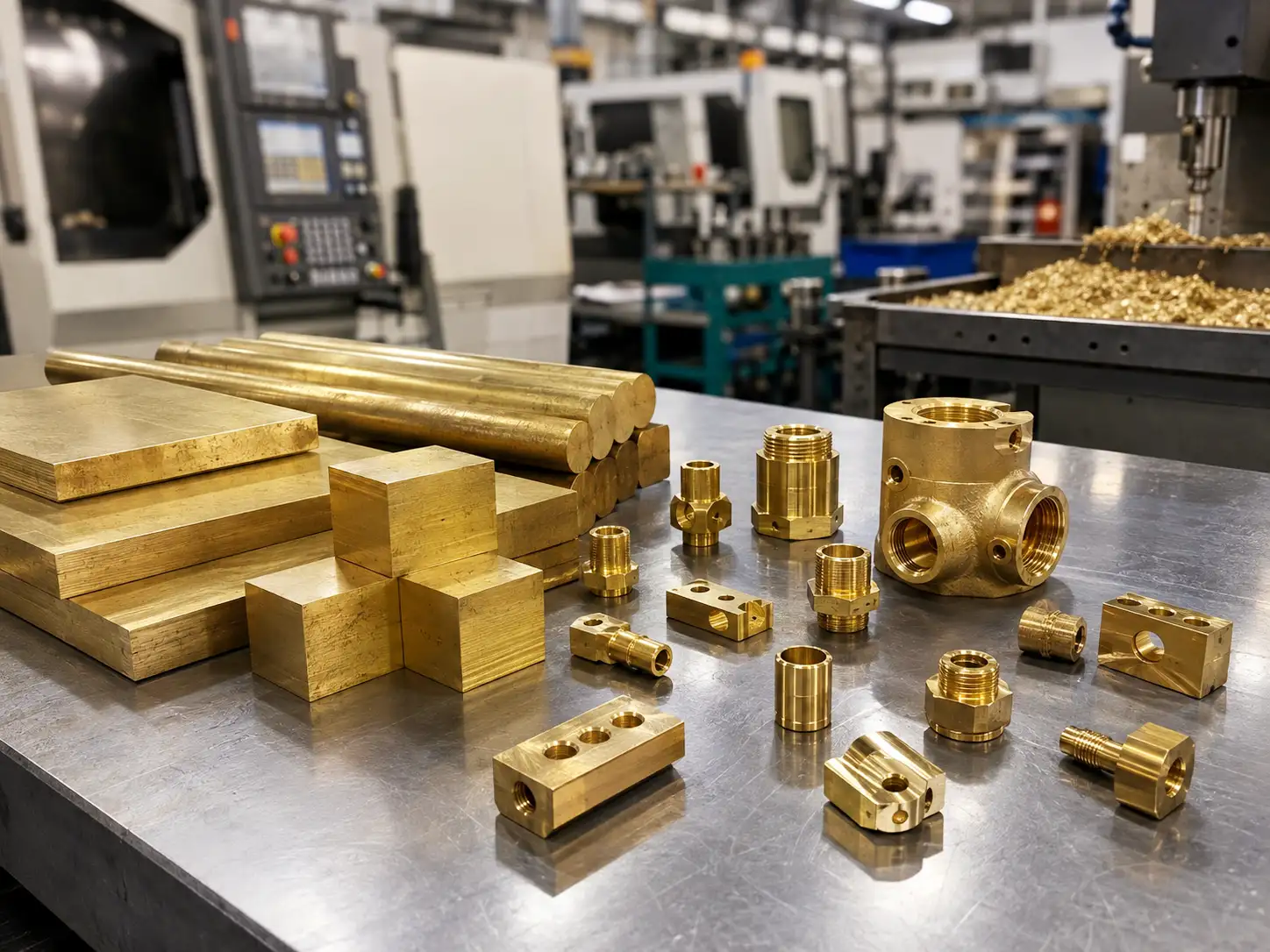
In industrial applications, HPb59-1 is often referred to as free-cutting brass or free-machining brass, and it is a highly versatile material in metal manufacturing. The lead exists as fine free particles distributed along the grain boundaries. During machining, these lead particles help with chip breaking and lubrication, which greatly improves cutting performance and reduces tool wear.
From a manufacturing standpoint, HPb59-1 is better suited to parts developed primarily for machining. If a project depends heavily on large-deformation stamping, deep drawing, or high-compliance applications involving contact with water, it may be better to consider a different copper alloy that is more appropriate for those requirements.
Quick Identification Guide for HPb59-1
| Identification Category | Details | Key Characteristics |
|---|---|---|
| Chinese grade | HPb59-1 | H = brass, Pb = lead, 59 ≈ copper content %, 1 ≈ lead content % |
| Material category | Copper-zinc-lead ternary alloy | Alpha-plus-beta dual-phase brass structure |
| Core advantage | Free-machining, high efficiency | Cutting speeds can exceed 200 m/min |
| Visual appearance | Golden-yellow metallic luster | Density about 8.5 g/cm³ |
| Standard reference | GB/T 5231-2012 | Chinese national standard for fabrication brass |
Specifications of HPb59-1
The chemical composition of HPb59-1 leaded brass is carefully balanced to optimize machinability while maintaining sound mechanical performance.
Copper serves as the base element and provides the foundation for electrical conductivity, thermal conductivity, and corrosion resistance. Zinc contributes solid-solution strengthening. Lead is the key element that improves machinability. Other impurity elements, such as iron, aluminum, and phosphorus, also need to be kept under strict control to ensure stable material performance.
HPb59-1 Specification Overview
| Parameter Category | Parameter | Value Range | Notes |
|---|---|---|---|
| Chemical composition | Copper (Cu) | 57.0%–60.0% | Alloy base, provides the foundation for corrosion resistance |
| Lead (Pb) | 0.8%–1.9% | Key functional element for improved machinability | |
| Zinc (Zn) | Balance, approx. 38%–41% | Provides solid-solution strengthening and helps balance strength and ductility | |
| Iron (Fe) | ≤ 0.5% | Impurity element, upper limit controlled | |
| Aluminum (Al) | ≤ 0.2% | Impurity element, upper limit controlled | |
| Phosphorus (P) | ≤ 0.02% | Impurity element, upper limit controlled | |
| Total impurities | ≤ 1.0% | Overall impurity control requirement | |
| Physical properties | Density | 8.5 g/cm³ | Supports lightweight design considerations |
| Electrical conductivity | Approx. 26% IACS | Better than most steel materials | |
| Thermal conductivity | 105–110 W/(m·K) | Suitable for heat-dissipation components | |
| Coefficient of linear expansion | 20.5 × 10⁻⁶/°C (20–300°C) | Good thermal stability | |
| Melting point | 900–930°C | Typical casting fluidity range | |
| Mechanical properties | Tensile strength (σb) | 380–550 MPa | Depends on material temper |
| Yield strength | 240–270 MPa | Medium strength level | |
| Elongation (δ) | 10%–25% | Good ductility | |
| Brinell hardness (HB) | 75–130 | Depends on heat-treatment condition | |
| Rockwell hardness (HRB) | 70–85 | Hardness level after machining | |
| Processing properties | Machinability index | 180%–210% | Based on free-cutting steel = 100% |
| Surface roughness | Ra 1.6 μm achievable | Suitable for precision-machined surface quality | |
| Cold deformation per pass | Up to 45% | Moderate cold-forming capability |
Common International Equivalents of HPb59-1
HPb59-1 leaded brass is a widely used free-machining brass with corresponding grades in many industrial markets around the world. Although the naming systems vary by country and region, the composition and performance are generally comparable.
Common Cross-Standard Reference Grades for HPb59-1
| Country / Region | Standard System | Reference Grade | Composition Comparison | Application Notes |
|---|---|---|---|---|
| China | GB/T | HPb59-1 | Cu: 57%–60%, Pb: 0.8%–1.9% | Original reference grade, widely used across applications |
| United States | ASTM / UNS | C37700 / C36000 | Cu: 57%–61%, Pb: 1.8%–3.7% | Commonly used grades in the North American market |
| Japan | JIS | C3710 / C3712 | Cu: 57%–61%, Pb: 0.8%–1.5% | Japanese industrial standard system |
| Europe | EN / DIN | CW612N / CuZn39Pb2 | Cu: 57%–59%, Pb: 1.5%–2.5% | Harmonized standard widely used in the EU |
| United Kingdom | BS | CZ122 / PB104 | Cu: 57%–59%, Pb: 0.5%–2.0% | Commonwealth standard system |
| Russia | GOST | C59-1 / ЛС59-1 | Cu: 57%–61%, Pb: 0.5%–1.5% | CIS standard system |
What Processing Methods Is HPb59-1 Leaded Brass Suitable For?
If free-cutting steel is used as the reference standard for machinability, with a machinability index of 100%, HPb59-1 leaded brass can reach about 180% to 210%. In practical terms, that puts it among the better-performing metallic materials for machining.
Process Compatibility of HPb59-1
| Process Type | Suitability | Recommended Process Parameters | Notes |
|---|---|---|---|
| Turning | Excellent | Cutting speed above 200 m/min, feed rate 0.1–0.3 mm/rev | Preferred process, with very good chip breaking |
| Milling | Excellent | Medium cutting speed, adequate cooling | Long tool life and good surface finish |
| Drilling | Excellent | Moderate spindle speed, effective chip evacuation | Chips break easily and are unlikely to wrap |
| Tapping | Excellent | Long tap life, high thread quality | Well suited to high-volume tapping operations |
| Sawing | Good | High-speed sawing, high efficiency | Clean cut surface and low material loss |
| Automatic lathe | Excellent | Preferred for high-speed, high-volume production | Daily output per machine can reach tens of thousands of pieces |
| CNC lathe | Excellent | Preferred for precision parts | Stable dimensional accuracy at IT8 level |
| Cold heading | Moderate | Single-pass deformation ≤ 45% | Deformation needs to be controlled carefully |
| Cold drawing | Good | Straightness tolerance ≤ 0.3 mm/m | Can achieve h9 fit accuracy |
| Stamping | Moderate | Medium deformation, with proper lubrication | Excessive deformation may lead to cracking |
| Hot forging | Good | 750–800°C, deformation ≤ 40% | Low risk of hot brittleness |
| Welding | Limited use | Oxyacetylene welding, copper-zinc filler wire | Brazing is preferred, fusion welding should generally be avoided |
| Heat treatment | Limited | Annealing at 600–650°C, stress relief at 280–300°C | Not suitable for solution treatment and aging |
HPb59-1 leaded brass is used in a wide range of applications. In projects where welding is not a key requirement and there are no strict restrictions on lead content, it offers an excellent balance of machinability, mechanical performance, and cost-effectiveness.
Typical Applications of HPb59-1
| Application Area | Typical Parts | Main Requirement Match | Material Selection Advantage |
|---|---|---|---|
| Mechanical manufacturing | Valve bodies, gears, bushings, bearings, connectors | High-precision, high-volume machining | High machining efficiency, long tool life, and high yield |
| Plumbing and sanitary hardware | Faucet cartridges, valve cores, pipe fittings, connectors | Corrosion resistance in water service, sealing performance | Good freshwater corrosion resistance, high machining precision, reliable sealing |
| Electronics and electrical equipment | Plug-in parts, terminals, electrical terminals, switch components | Conductivity and precision machining | Moderate electrical conductivity, about 26% IACS, with good surface quality |
| Automotive parts | Carburetor parts, instrument gears, brackets, decorative components | Cost-effective solution for non-critical safety systems | Clear cost advantage and high machining efficiency |
| Clocks, watches, and instruments | Watch gears, plates, metering components, precision screws | Very high surface finish and miniaturization | Surface finish down to Ra 1.6 μm, with stable IT8 dimensional accuracy |
| Architectural hardware | Lock parts, decorative parts, fasteners, connectors | Combination of decorative appearance and functional performance | Attractive golden color and good atmospheric corrosion resistance |
| Heat dissipation components | Heat sink parts, heat exchanger components, cooling tubes | Thermal conductivity and pressure resistance | Thermal conductivity of 105–110 W/(m·K) |
| Fluid control | Hydraulic valve bodies, pipe joints, instrument valves | Pressure resistance, corrosion resistance, sealing performance | Medium strength and good hot-working properties |
Note: If your project has strict limits on lead content, you may want to consider lead-free free-machining brasses such as CuZn21Si3P or CuZn38As. These alloys use elements such as bismuth, silicon, or phosphorus to improve machinability in place of lead. However, they are usually more expensive, and their machinability is generally somewhat lower than that of HPb59-1.
Export Compliance and Use Boundaries for Leaded Brass Projects
HPb59-1 is a lead-containing material and is subject to strict environmental and regulatory controls.
International rules for leaded brass vary by market. For example, the EU RoHS Directive restricts lead content in electrical and electronic equipment, but copper alloys with lead content below 4% may qualify for an exemption. Under REACH, if the lead content in a product exceeds 0.1% w/w, sufficient information must be provided to explain the product’s safe use.
Compliance Assessment for HPb59-1 Leaded Brass
| Compliance Area | Regulatory Requirement | Current Status of HPb59-1 | Risk Level | Recommended Action |
|---|---|---|---|---|
| RoHS (EU) | Lead in electrical and electronic equipment must be below 0.1%, unless exempted | Currently covered by exemption 6(c), compliant if lead content is below 4% | Low to medium | Monitor the renewal status of the exemption |
| REACH (EU) | SVHC communication required, lead above 0.1% must be declared | Lead content is about 1% to 2%, so information communication is required | Medium | Prepare SDS and related safety documentation |
| ELV (EU) | Restrictions on lead in vehicles | Industrial parts are mainly covered by exemptions | Low | Confirm the exact application scenario |
| Drinking water (US) | Lead content must be ≤ 0.25% | Exceeds the limit, not suitable for direct use | High | Use a low-lead or lead-free alternative |
| Drinking water (EU) | Strict lead migration limits | High risk | High | Use lead-free brass |
| Children’s products | Strict limits on lead content | Not suitable | High | Use lead-free materials |
| Food contact | Lead migration limits apply | Direct use is not recommended | High | Use food-grade copper alloys |
| Medical devices | Material biocompatibility must be evaluated | Must be assessed case by case | Medium | Confirm the requirements of the target market |
What Information Should Be Provided at the RFQ Stage
RFQ Checklist
| Information Category | Details | Importance | Notes |
|---|---|---|---|
| Material specification | Grade HPb59-1 or equivalent grade | Required | Any restrictions on substitute grades should be stated clearly |
| Chemical composition range | Recommended | Specify if there are any special composition requirements | |
| Mechanical property requirements | Recommended | Such as tensile strength, hardness, and similar targets | |
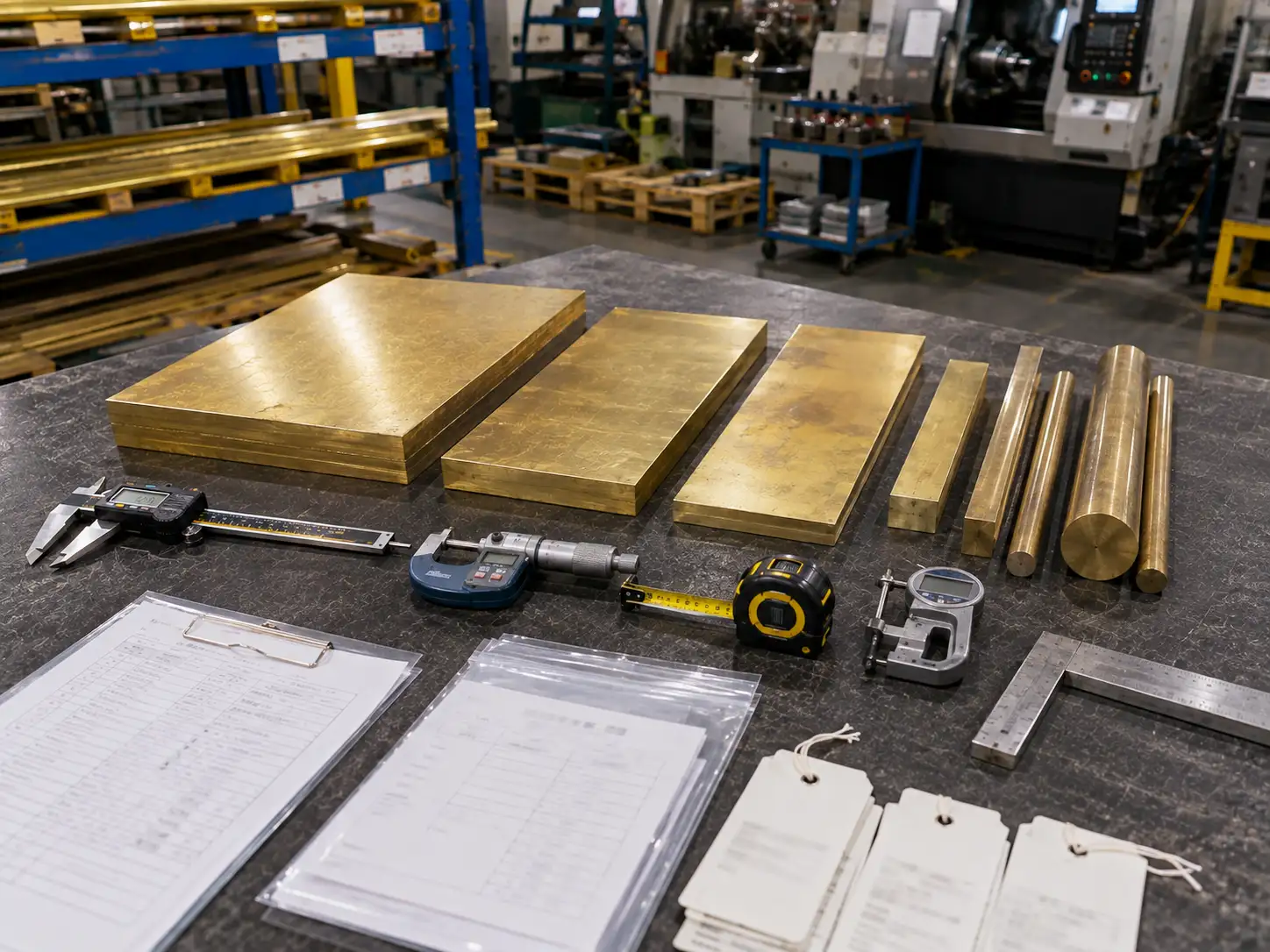
| Product form | Bar, sheet, tube, or wire | Required | Affects process selection |
| Dimensions | Required | Such as outside diameter, wall thickness, length | |
| Delivery condition | Recommended | Such as hot rolled, annealed, cold drawn | |
| Surface condition | Recommended | Such as mill finish, polished, turned finish | |
| Drawing and specification | Part drawing | Recommended | Including dimensional tolerances and surface requirements |
| Technical specification | Recommended | Referenced standards and inspection requirements | |
| Tolerance grade | Recommended | IT tolerance class requirement | |
| Quantity and schedule | Order quantity | Required | Quantity per order |
| Estimated annual demand | Recommended | Helps with volume pricing | |
| Lead time requirement | Required | Expected delivery date | |
| Quality requirements | Inspection standard | Recommended | Such as GB/T, ASTM, and others |
| Inspection items | Recommended | Composition, mechanical properties, dimensions, and more | |
| Reporting requirements | Recommended | Which material and inspection reports are needed | |
| Compliance requirements | Environmental compliance requirements | Recommended | Such as RoHS, REACH, and others |
| Origin requirements | Recommended | Domestic, imported, or designated raw material supplier | |
| Packaging requirements | Recommended | Palletized, boxed, and similar requirements |
