
Project Description
Two Products, Three Types of Sheet Metal Components
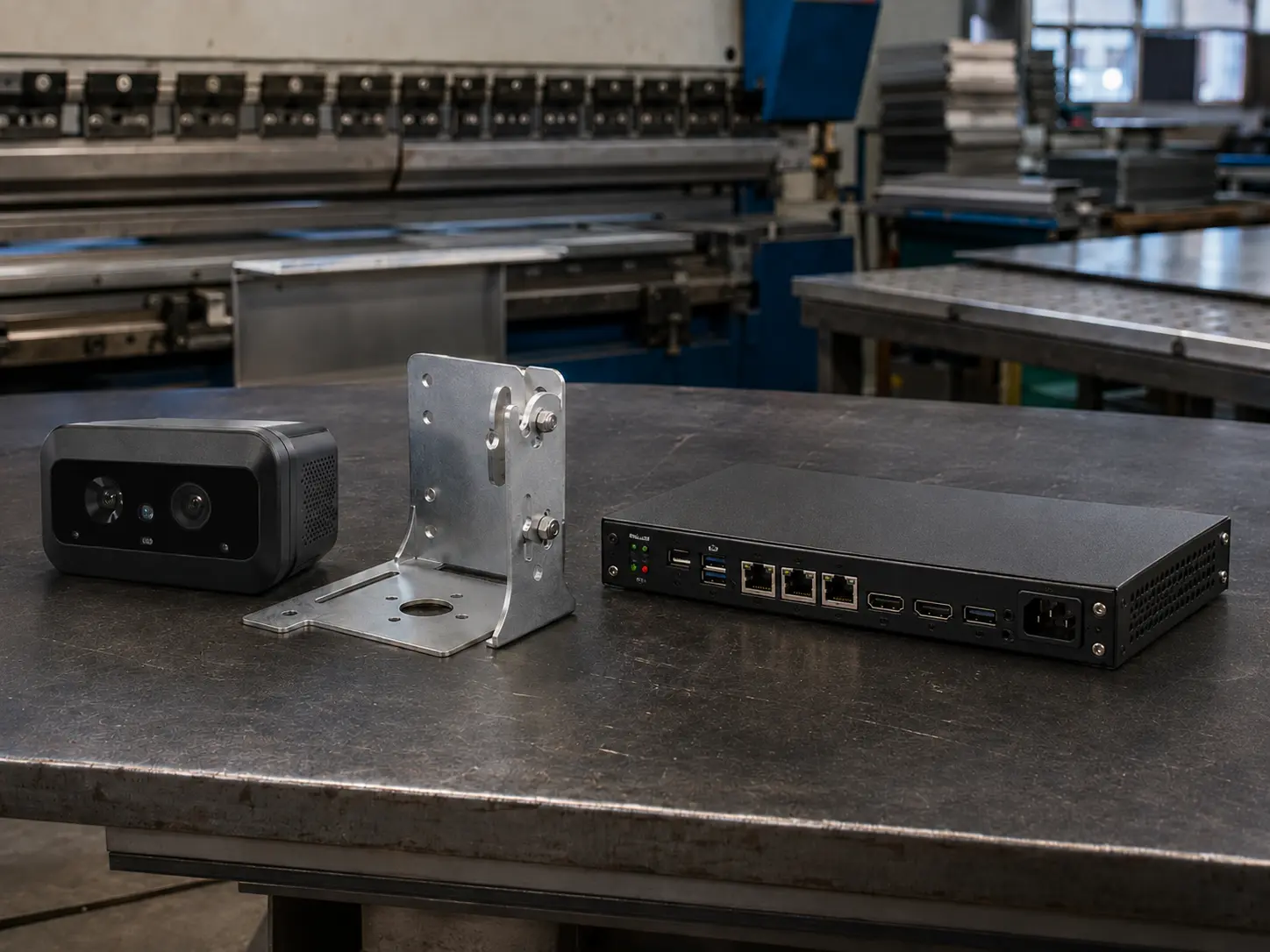
Foorir specializes in intelligent people-counting and occupancy management solutions. For this project, the two products involved were the FP221 TOF People Counter and the FH101 Occupancy Counter Host.
The FP221 uses 3D Time-of-Flight technology to detect and count pedestrian traffic, while the FH101 works with people-counting devices to manage occupancy data, display real-time traffic information, and trigger capacity warnings.
By the time the project reached us, the electronics and core product architecture had already been defined. The remaining challenge was mechanical: how do you turn the PCBs, sensors, connectors, and internal components into finished products that can be securely ceiling-mounted or installed in a rack, while remaining durable enough for everyday commercial use?
That meant developing and refining several key sheet metal components: the FP221 mounting bracket and protective cover, and the FH101 metal enclosure.
The project lasted approximately three months, involved two rounds of prototyping, and went through four drawing revisions.
Here is how the project developed.
It Started with a Ceiling Bracket
The FP221 TOF People Counter is designed for ceiling-mounted people counting. Using 3D Time-of-Flight technology, it generates depth information to detect people moving through predefined counting lines and areas.
The device itself is compact, but its installation geometry matters. According to Foorir’s product specification, the FP221 can be installed at heights between 2.0 and 3.4 meters. At that distance, even a very small angular deviation in the mounting bracket can shift the detection area significantly at floor level.
When the first prototype was installed, the engineering team mounted the bracket to the ceiling, secured the FP221 in place, powered it on, and began testing.
The count was wrong.
After repeated troubleshooting, the team discovered that the device was tilted slightly to one side.
The deviation was almost impossible to see with the naked eye. But at an installation height of 3.4 meters, that small angular error shifted the sensor’s detection line by approximately 60 mm at floor level—enough to overlap with the adjacent passageway.
The cause was eventually traced back to the sheet metal bracket:
The bend angle was off by less than 1°.
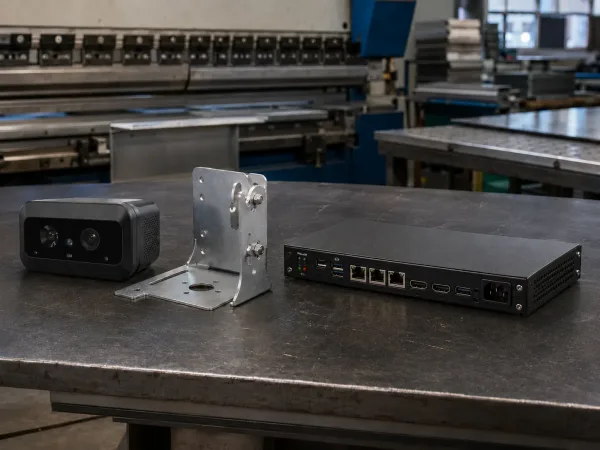
A small bend-angle error in the ceiling bracket can create a measurable detection offset at a 3.4 m installation height.
This is a classic sheet metal tolerance-stack problem.
Each individual dimension may still fall within its specified tolerance, but once the components are assembled, small deviations can accumulate and become amplified across the finished structure.
The solution was relatively simple: tighten the bend-angle tolerance from ±2° to ±1° and add an actual-device fit check to the first-article inspection process.
Without that first prototype, however, it would have been easy to underestimate how much angular accuracy a seemingly simple ceiling-mount bracket actually required.
A 370 mm Enclosure Packed with Interfaces
Once the FP221 bracket issue had been resolved, attention shifted to the FH101 Occupancy Counter Host.
The FH101 enclosure presented a completely different manufacturing challenge.
It was not primarily about bend-angle accuracy.
It was about packaging a large number of interfaces into a very compact metal enclosure.
The finished FH101 measures only 370 × 180 × 50 mm, yet its chassis has to accommodate multiple Ethernet connections, power and display interfaces, alarm connections, grounding points, indicator lights, and other functional openings.
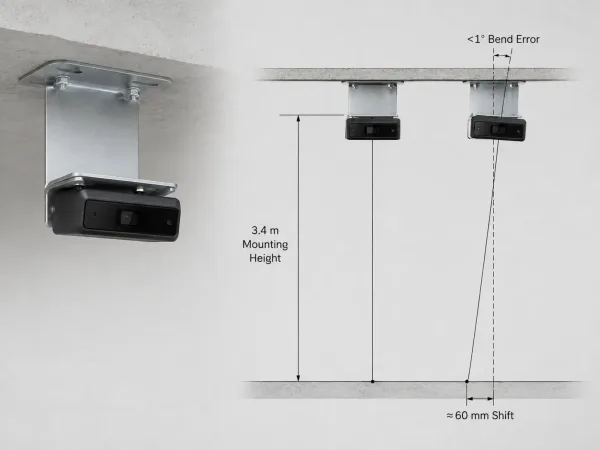
The compact FH101 enclosure packs multiple Ethernet, power, display, alarm, and grounding interfaces into a 370 × 180 × 50 mm chassis.
That creates very little unused space on the front and rear panels.
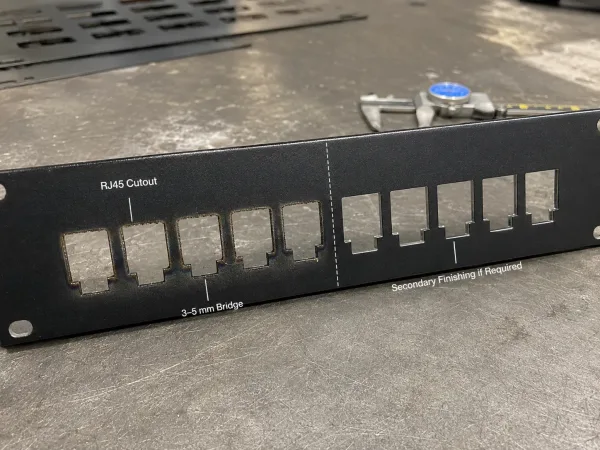
With multiple RJ45 openings arranged side by side, only a narrow strip of sheet metal remains between adjacent cutouts. During laser cutting, these narrow bridges can be affected by concentrated heat input, increasing the risk of local distortion.
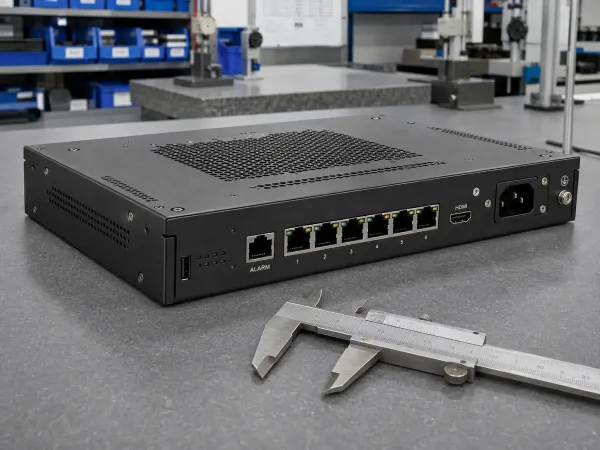
Closely spaced RJ45 cutouts leave narrow metal bridges that require careful heat and dimensional control during fabrication.
For critical openings, our approach at SR MFG was to control both the cutting sequence and the final dimensions carefully. Where necessary, the laser-cut openings could be left with machining allowance and finished in a secondary operation to maintain dimensional stability around densely packed interface areas.
The front panel required equally careful alignment.
A connector opening can be dimensionally correct on its own and still fail during assembly if its position relative to the PCB is slightly wrong.
That is why an actual-PCB fit check was performed before volume production.
An actual PCB fit check verifies connector alignment with the sheet metal openings before volume production begins.
The circuit board was installed inside the chassis and each connector was checked against its corresponding panel opening.
It looks like a small additional step.
But compared with reworking an entire production batch, it is one of the cheapest forms of quality insurance available.
