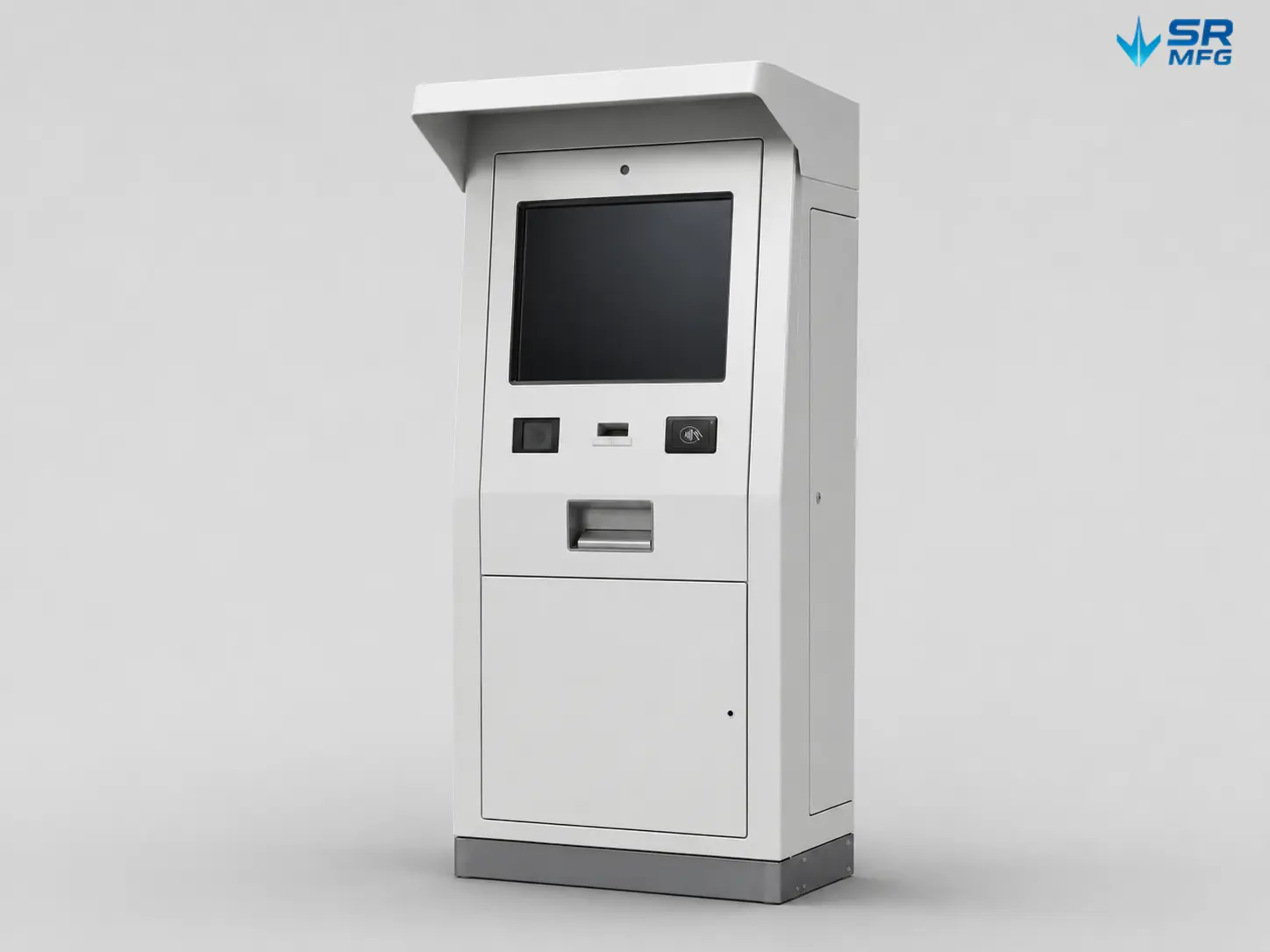
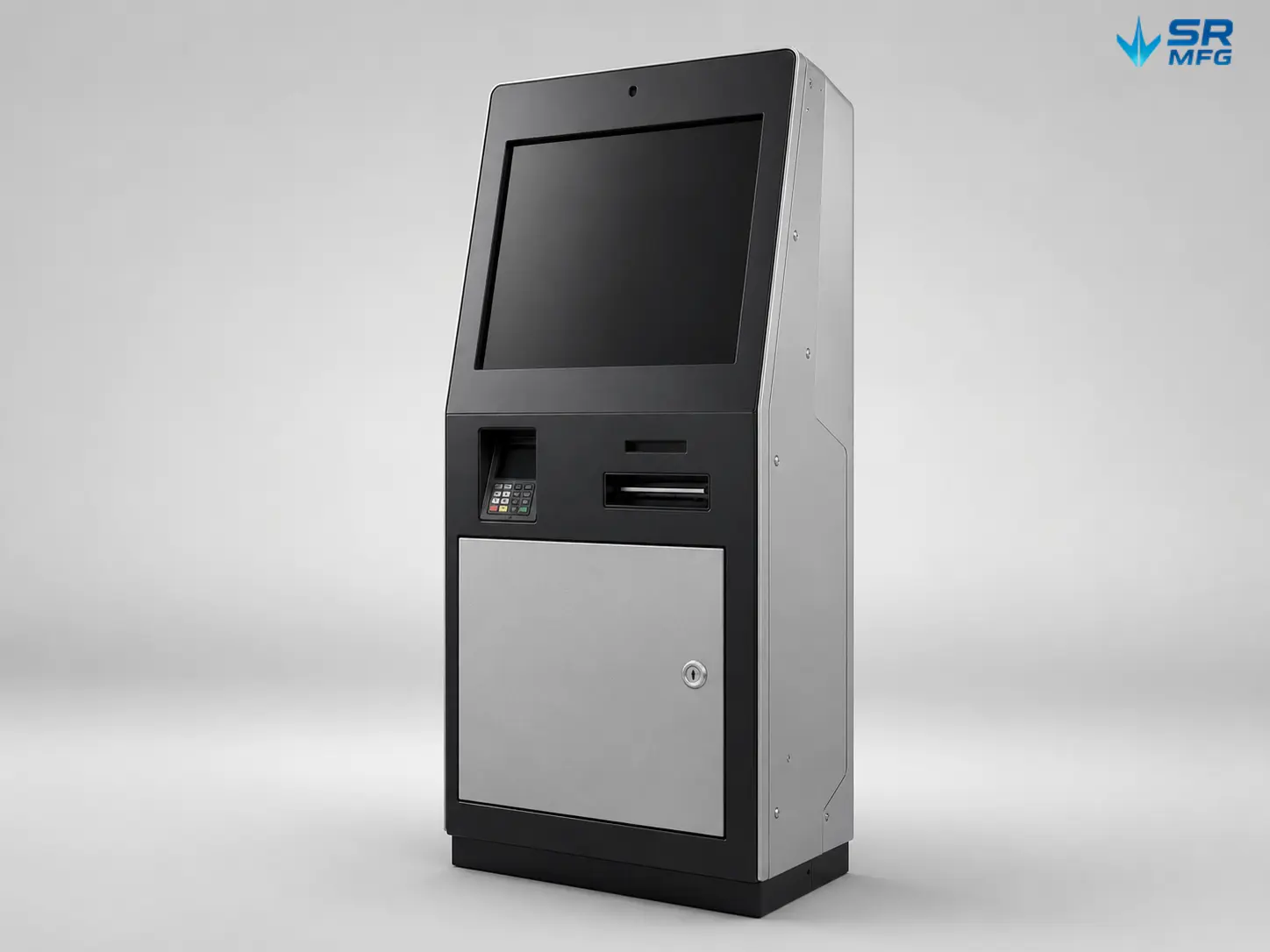
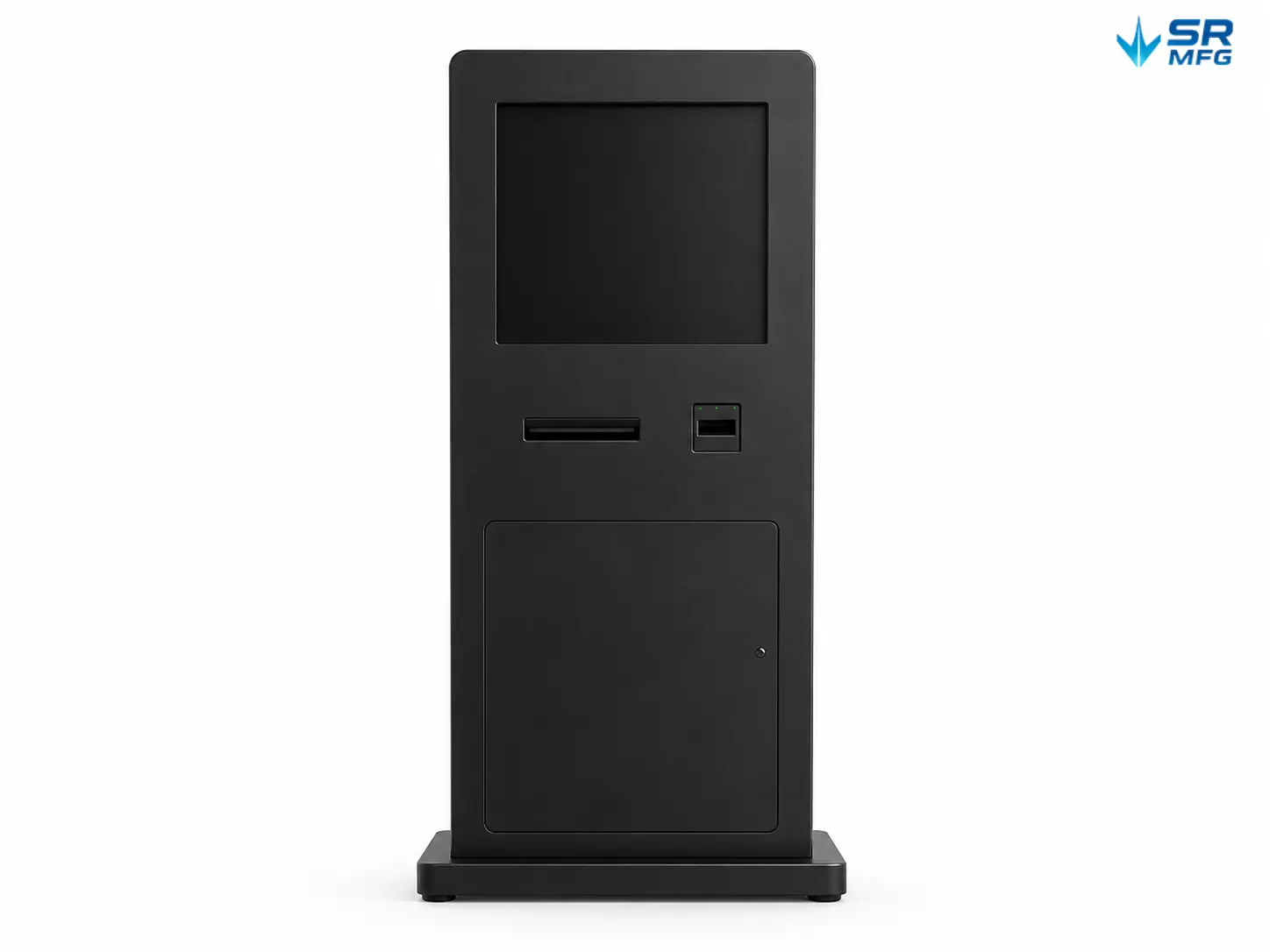
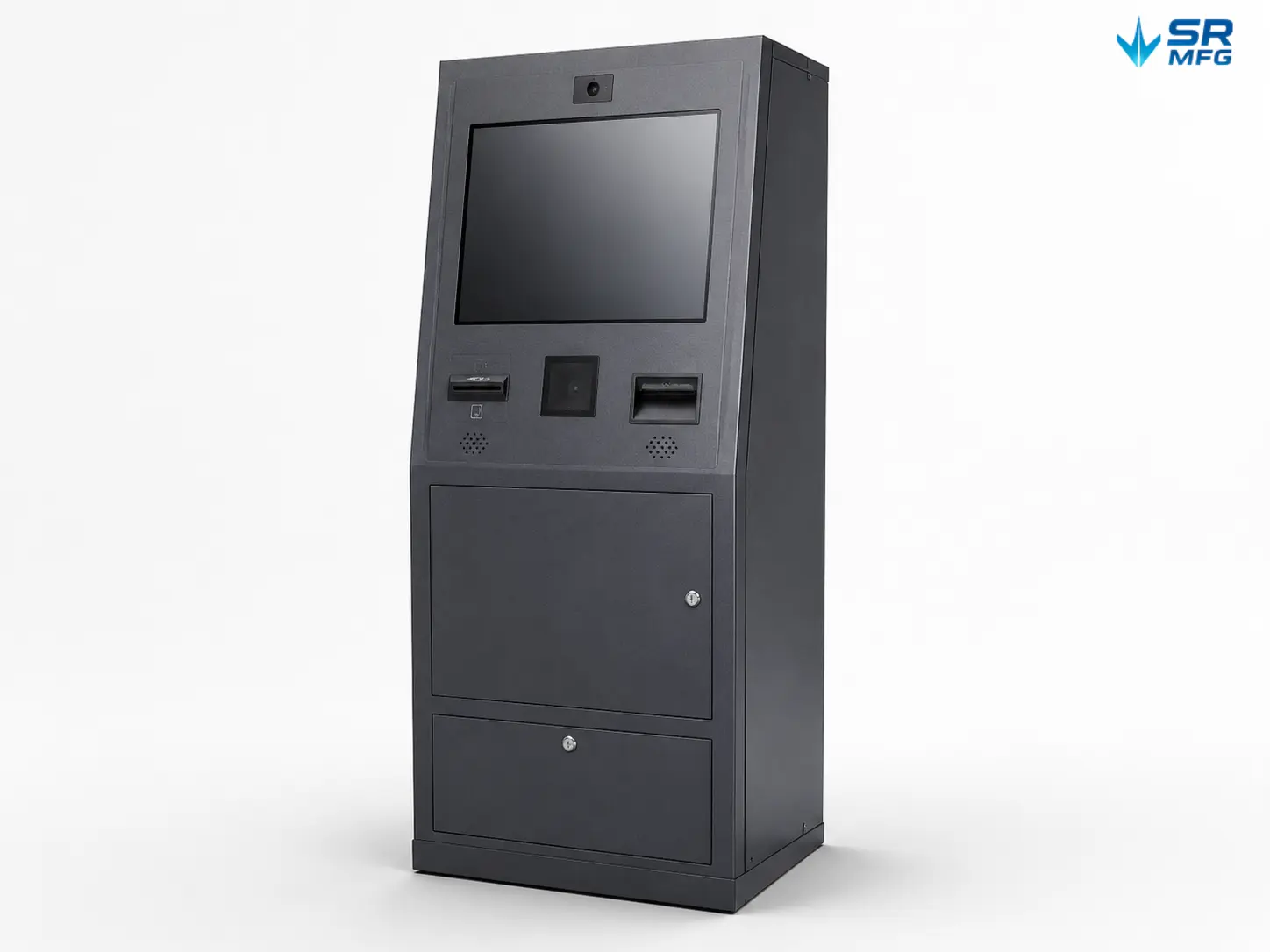
Self-Service Kiosk Metal Cabinets
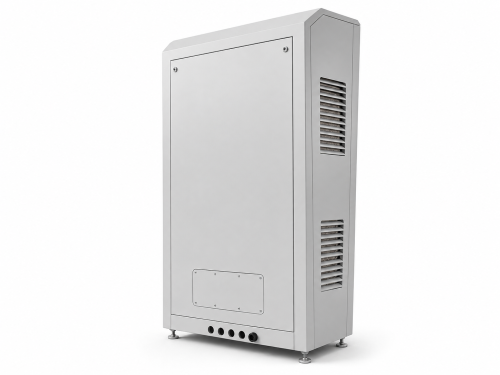
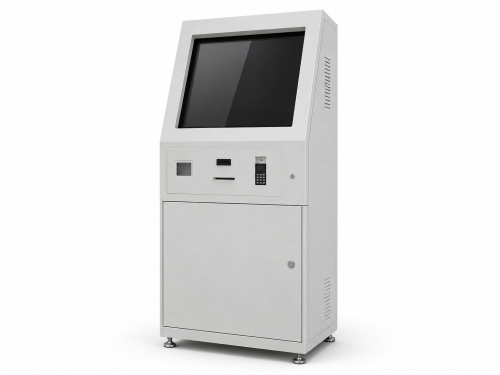
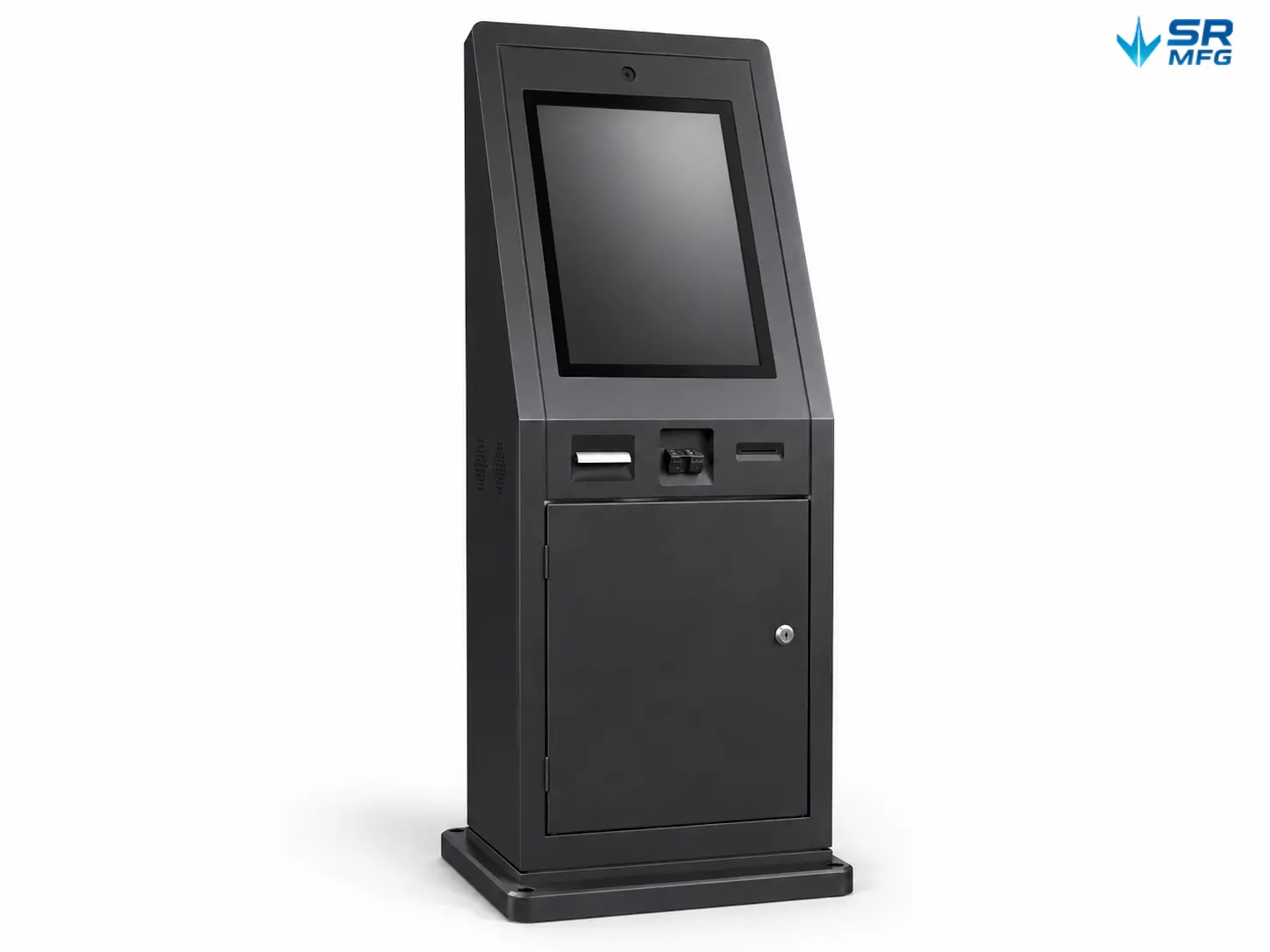
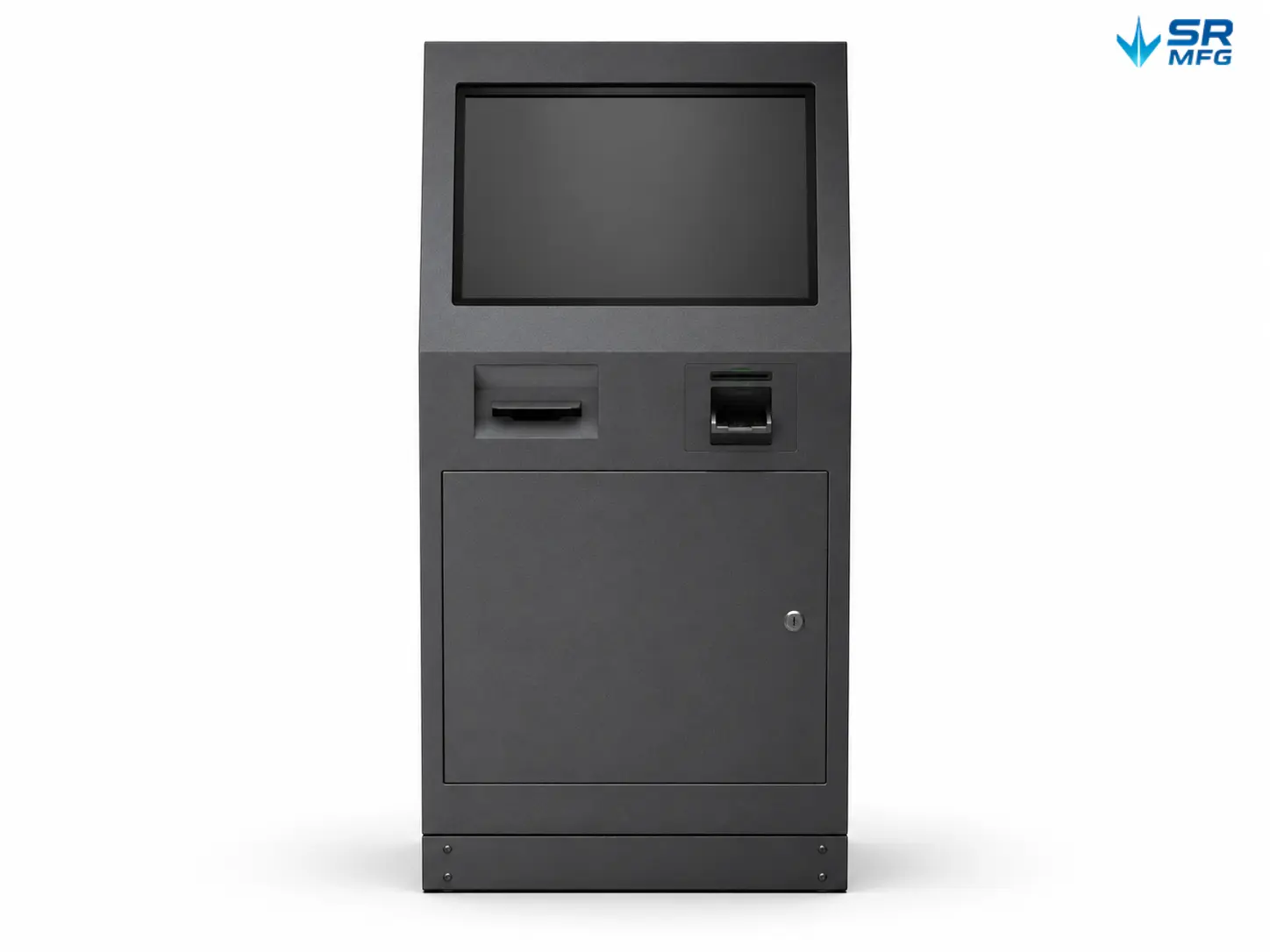
Custom metal cabinets for commercial and public self-service kiosks, designed to provide a stable structural enclosure for kiosk systems while allowing users to operate from the front and giving internal electronic components a clear, service-friendly installation space.
- Laser-cut profiles with tight dimensional tolerances
- Fully customizable dimensions, cutouts, door layouts, and internal mounting frames
- Available surface finishes include powder coating, liquid painting, brushing, and anodizing
- Indoor and outdoor protection ratings available up to IP65
- From prototype to mass production — no fixed MOQ for first orders
- Submit your drawings for a free DFM review
Product Details
Product Specifications
| Parameter | Value / Range |
|---|---|
| Laser Cutting Tolerance | ±0.1 mm |
| Bending Tolerance | ±0.3 mm per bend |
| Assembly Tolerance | ±0.5 mm overall |
| Maximum Sheet Size | 3000 mm × 1500 mm |
| Available Material Thickness | 1.0 mm – 6.0 mm |
| Sheet Metal Materials | Cold-rolled steel SPCC, galvanized steel SGCC, 304 stainless steel, 316 stainless steel, 5052 aluminum alloy |
| Welding Methods | TIG, MIG, spot welding, robotic welding |
| Powder Coating Thickness | 60 – 120 μm, adjusted according to the application environment |
| Salt Spray Test | According to ASTM B117; test duration depends on material and coating system |
| Adhesion Standard | According to ASTM D3359 cross-cut test |
| Operating Temperature Range | -20°C to +55°C standard; extended ranges available based on material selection |
| IP Rating Capability | IP20, IP54, IP65; designed according to project environment requirements |
| Compatible Display Sizes | 15″ to 55″; larger display openings can be customized |
| Structural Load Capacity | Designed by project; FEA analysis available for heavy component stacking |
| Prototype Lead Time | 5–10 working days after drawing approval |
| Production Lead Time | Quoted by project based on quantity and complexity |
| MOQ | 1 piece for prototypes; flexible small-batch production; volume pricing available for mass production |
| Packaging | Individual carton with foam insert / wooden crate for heavy-duty cabinets / palletized container shipping |
| Compliance Support | Supports ADA-accessible operating height design, reserved mounting and grounding structures for UL-certified components, and structural design support for CE, EMC, and other complete-system compliance requirements |
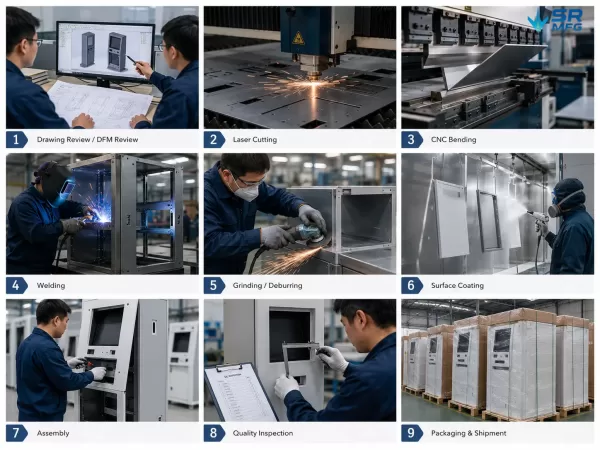
Sheet metal fabrication process for custom kiosk cabinets, including drawing review, laser cutting, CNC bending, welding, surface finishing, assembly, inspection, and export packaging.
What Is a Self-Service Kiosk Metal Cabinet?
A self-service kiosk metal cabinet is the protective metal enclosure used to house internal components in self-service terminals operating in high-traffic public environments.
Self-service kiosks are commonly installed in locations such as building lobbies, transit stations, hospitals, and shopping centers, where equipment must operate reliably over long periods. These cabinets need to withstand frequent public use, protect internal electronic components, and help maintain a safe operating temperature. Just as importantly, the cabinet must allow technicians to access and replace key parts without dismantling the entire machine.
SR MFG provides custom sheet metal fabrication for kiosk cabinet projects from the ground up. Each enclosure is built according to your design requirements and engineering specifications. We provide manufacturing services for businesses and equipment companies across North America, Europe, and the Asia-Pacific region.
Structural Design and Cabinet Construction
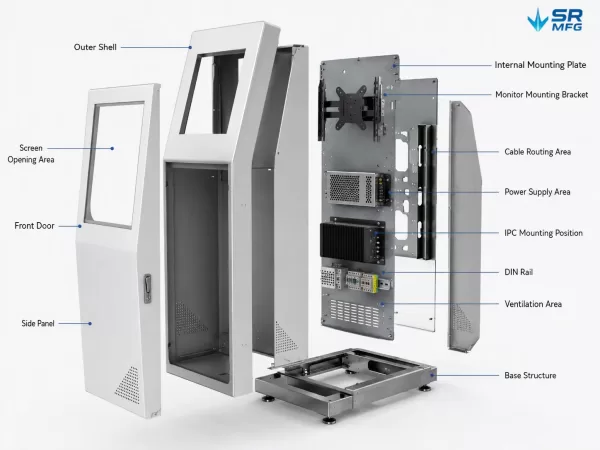
Exploded view of a custom self-service kiosk metal cabinet, showing the outer enclosure, access door, internal mounting plate, display bracket, component zones, ventilation area, and base structure.
The structural solution is usually determined by the kiosk’s overall dimensions, installation environment, and service requirements. SR MFG typically uses the following three construction methods depending on the project:
Frame and Panel Structure:An internal welded or bolted frame supports the external panels. This structure is suitable for large floor-standing kiosk cabinets, where modular assembly makes maintenance and panel replacement easier.
Integrated Bent Sheet Metal Body:The cabinet body is formed from a single sheet or a small number of sheet metal parts through precision sheet metal bending and welding.This structure provides high rigidity and clean exterior seams, making it suitable for wall-mounted kiosks and medium-sized floor-standing cabinets.
Modular Sectional Assembly:Multiple cabinet sections are connected on site. This method is used for tall floor-standing kiosks or installation environments with restricted access.
During the design stage, we focus on the following internal layout factors:
- Component separation: Heat-generating components, such as industrial PCs and power supplies, are physically separated from sensitive electronics, such as card readers and display controllers.
- Cable routing paths: Internal cable trays, tie-down points, and protected cable pass-through holes keep wiring organized and easy to maintain.
- Door opening angle: The hinge design ensures full access to internal components without removing the door. Typical opening angles range from 110° to 180°.
- Mounting plate positioning: Adjustable internal mounting plates can be used for DIN rails, PCB standoffs, or custom equipment brackets.
- Ventilation areas: Air intake and exhaust areas are designed to balance heat dissipation with enclosure protection. For IP54 or IP65 kiosk cabinets, waterproof ventilation components, sealed fan filters, heat exchangers, passive heat dissipation structures, or other thermal solutions can be selected according to the heat load and target protection rating.
For kiosks requiring sheet metal DFM planning for EMI/RFI shielding or EMC control, such as terminals with sensitive control boards, payment modules, or installations in high-interference environments, we can plan conductive gaskets, shielding panels, grounding structures, and filtered connectors during the early design stage. If the equipment includes wireless communication modules, antenna windows, external antennas, or non-shielded zones should also be considered to prevent the shielding structure from affecting signal transmission.
Material and Surface Finish Options
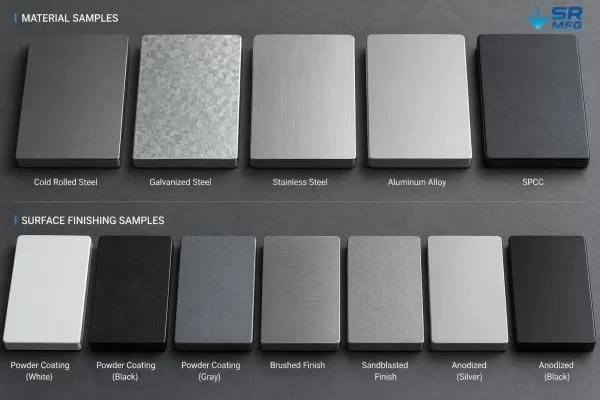
Sheet metal finishing options for custom kiosk metal enclosures can include SPCC steel, SGCC galvanized steel, stainless steel, aluminum alloy, powder coating, brushing, sandblasting, and anodizing.
The choice of material and surface finish directly affects the cabinet’s long-term durability, weight, appearance, corrosion resistance, and outdoor performance. SR MFG provides the following material and finishing options.
Material Comparison
| Material | Best Application | Key Features |
|---|---|---|
| Cold-Rolled Steel SPCC | Indoor kiosks and cost-sensitive projects | Excellent formability and weldability; requires surface treatment for corrosion protection |
| Galvanized Steel SGCC | Semi-outdoor or humid environments | Zinc coating provides basic corrosion resistance and can be combined with powder coating |
| 304 Stainless Steel | Outdoor, food service, and high-hygiene applications | Excellent corrosion resistance and maintains appearance in exposed environments |
| 316 Stainless Steel | Coastal, chemical-exposure, or offshore installations | Enhanced resistance to salt spray and chemical corrosion |
| 5052 Aluminum Alloy | Weight-sensitive or mobile kiosk applications | Approximately 65% lighter than steel, with good corrosion resistance and excellent anodizing response |
Surface Finish Options
| Finish | Process | Typical Features |
|---|---|---|
| Powder Coating | Electrostatic spraying + oven curing | Wide RAL/Pantone color options, 60–120 μm coating thickness, high wear resistance and UV resistance |
| E-Coating | Electrochemical dip coating | Uniform coverage on complex geometries and an excellent anti-corrosion base for subsequent powder coating |
| Brushing | Mechanical surface texturing | Decorative linear texture, commonly used on stainless steel or aluminum surfaces |
| Sandblasting | Abrasive media blasting | Matte surface texture, improved coating adhesion, and an industrial appearance |
| Anodizing | Electrochemical oxide layer, aluminum only | Improves surface hardness; color is integrated into the oxide layer and will not peel or powder |
Recommendation for Harsh Outdoor Environments:For demanding outdoor applications, material selection should be based on the actual project environment. SGCC galvanized steel, stainless steel, or aluminum alloy can be selected depending on corrosion exposure, weight requirements, and appearance expectations.
For SGCC or carbon steel structures, corrosion resistance can be improved through surface pretreatment, e-coating primer, and outdoor-grade powder coating for kiosk metal cabinets.. For SUS304 or SUS316 stainless steel, brushing, passivation, or powder coating can be selected according to appearance and corrosion-resistance requirements.
Application Examples
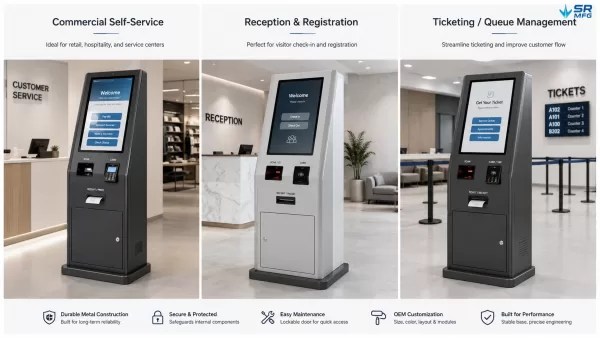
Application examples of custom self-service kiosk metal cabinets for commercial self-service, reception registration, and ticketing or queue management systems.
Commercial Self-Service Kiosks
Commercial self-service kiosks typically require a clean user interaction panel, a stable cabinet structure, and an internal layout that is easy to maintain. Depending on the project functions, the cabinet may need to integrate a display, scanning window, payment module, printer outlet, internal industrial PC tray, lower maintenance door, and reinforced base.
The front panel should remain clean and user-friendly, while the maintenance area should allow service personnel to replace consumables and inspect electronic components efficiently.
Reception and Registration Kiosks
Reception and registration kiosk cabinets usually focus on a compact footprint, easy-to-clean surface finishes, display integration, cutouts for identity verification modules, printer compartments, and stable indoor mounting structures.
The cabinet should support quick maintenance while preventing public users from accessing internal electronic components.
Ticketing and Queue Management Kiosks
Ticketing and queue management kiosk cabinets typically require a clear user interface, reliable ticket or receipt output structure, identity verification area, display support, internal cable routing, and a stable fixing method.
In high-traffic areas, lockable door panels and a robust sheet metal cabinet structure are essential for long-term operation.
Customization Options
Every self-service kiosk enclosure we manufacture can be customized according to your project specifications. The following overview shows common customization options by category. During the quotation stage, we will confirm technical feasibility based on your specific design requirements.
Structural Customization
| Custom Item | Available Options |
|---|---|
| Overall Dimensions | Width, depth, and height can be fully customized within material and equipment limits |
| Wall Thickness | 1.0 mm to 3.0 mm, selected according to structural load requirements and weight targets |
| Cutouts | Screen windows, printer openings, card reader slots, ventilation openings, cable knockouts — shape, size, and position are defined by your device layout |
| Door Configuration | Number of doors, opening direction, opening angle from 110° to 180°, and hinge type |
| Reinforcement Structure | Internal stiffeners, corner gussets, and folded edges for large-span panels |
Functional Customization
| Custom Item | Available Options |
|---|---|
| IP Sealing | Gasket material and profile, seam sealing method, and cable gland specifications |
| Thermal Management | Fan mounting positions, filter frames, convection channel layout, and heat sink connection points |
| EMI Shielding | Conductive elastomer gaskets, shielded connection panels, and filtered power inlets |
| Security | Lock type, tamper-resistant fasteners, and hinge security pins |
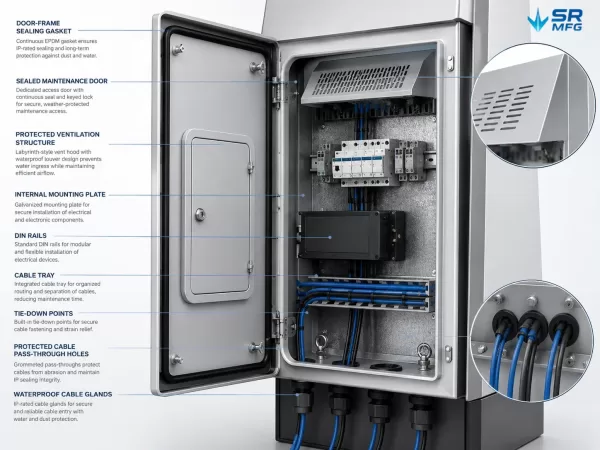
IP sealing and internal mounting details for a custom self-service kiosk enclosure, showing the door-frame gasket, sealed maintenance door, protected ventilation, DIN rail, cable tray, tie-down points, and waterproof cable glands.
Appearance Customization
| Custom Item | Available Options |
|---|---|
| Color | Powder coating with RAL or Pantone color matching |
| Texture | Smooth, semi-textured, or fine-textured surface finishes |
| Branding | Silk-screen printing, laser engraving, adhesive nameplates, embossing, or debossing |
| Surface Style | Exposed fasteners for an industrial appearance or hidden fasteners for a clean panel design |
Internal Customization
| Custom Item | Available Options |
|---|---|
| Mounting Plates | Fixed or adjustable mounting plates, drilled according to your equipment mounting hole pattern |
| DIN Rails | 35 mm standard DIN rails positioned according to your internal layout |
| Rack Rails | 19-inch standard rack rails, available in fixed or depth-adjustable designs |
| Cable Management | Cable trays, anchor points, protective grommets, and marked cable exits |
Ready to Build Your Custom Kiosk Cabinet?
Submit your drawings, 3D models, or project requirements. Our engineering team will provide a free Design for Manufacturing review and a detailed quotation within 24 hours.
Supported file formats: DWG, DXF, STEP, STP, IGES, PDF, JPG, PNG.