
You lock the enclosure model, mark the critical dimensions, and send the package out for quotes. The prices return 30–40% over budget. The sheet metal grade did not change. The design decisions that set process difficulty did.
The most effective cost reduction in sheet metal work happens before a quotation is requested—not after the number is on the table. Once a fabricator prices a job, cutting time, forming setups, joining, finishing, and inspection effort are already implied by the drawing. Design support before quotation is how engineers and buyers change those assumptions while the model is still cheap to edit.
This guide explains what that pre-quote stage actually involves: which design choices drive cost, what a fabricator can contribute at RFQ, and what to verify before you ask for a price.
The Quote Is Already Decided Before Anyone Prices It
Fabricators do not primarily price metal. They price the sequence of operations required to turn stock into a finished part: cutting, forming, joining, finishing, inspection, and packing.
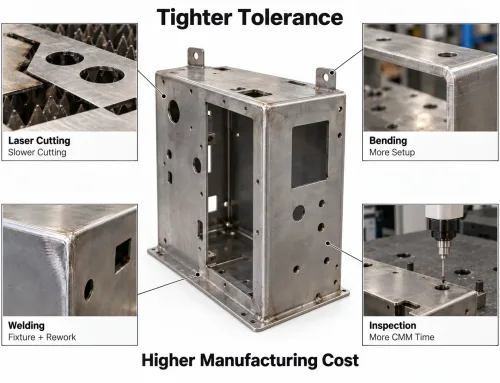
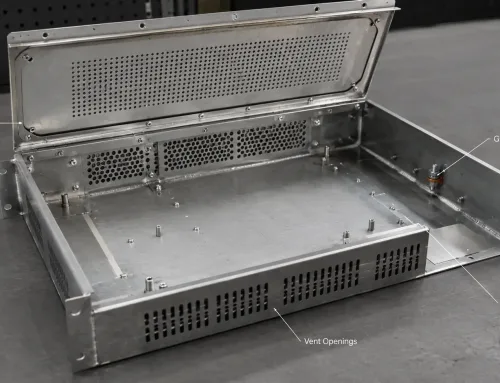
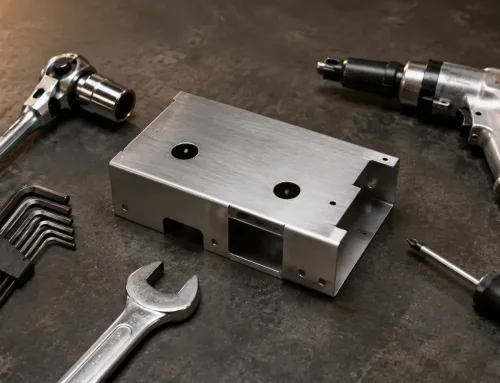
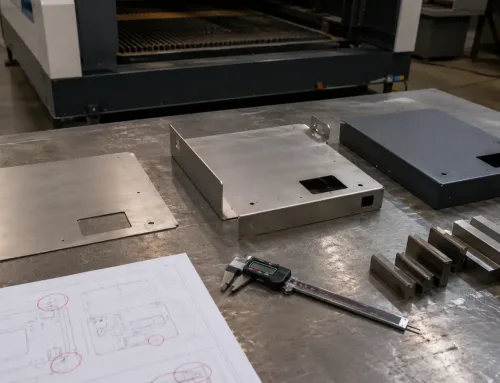
A simple folded bracket and a tightly toleranced welded chassis can share the same alloy and still land at very different prices. The difference is process difficulty, not the raw material cost per kilogram.
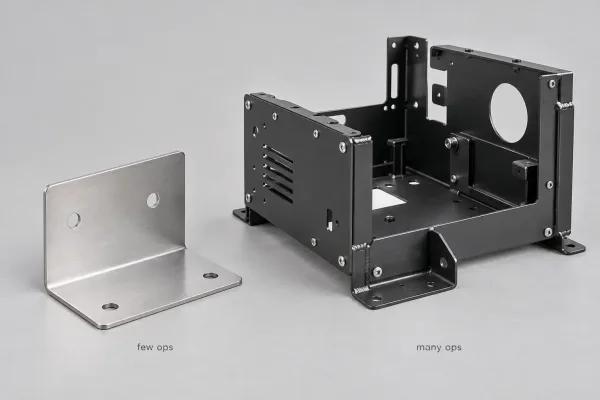
A simple folded bracket and a complex welded chassis made from similar sheet metal—illustrating how process difficulty, not material alone, drives fabrication cost.
Decisions that commonly inflate cost before the RFQ goes out:
- Tight tolerances applied to every dimension rather than to true critical features
- Non-standard bend radii or very short flanges
- Mixes of gauges and alloys inside one assembly
- Welds where a fastener or formed joint would work
- Specialty finishes, masks, or hardware specified without alternates
- CAD models loaded with unrelated assembly detail
If those choices are frozen at RFQ, negotiation is the only remaining lever. If they are reviewed first, engineering can remove cost drivers without changing function.
What a Sheet Metal Quotation Actually Reflects
A practical way to read any quote is as a stack of cost buckets. Each bucket maps back to something on the drawing.
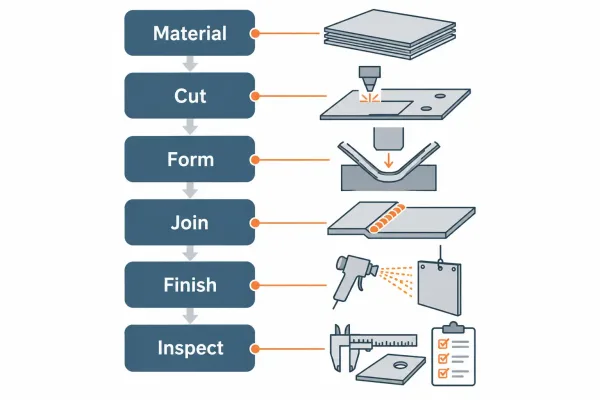
Cost buckets behind a sheet metal quotation—material, cut, form, join, finish, and inspection—mapped to what appears on the drawing.
| Cost bucket | What usually drives it in the drawing |
|---|---|
| Material | Grade, gauge, sheet size, scrap and nesting yield |
| Cutting | Hole count, cut length, non-standard contours, piercing |
| Forming | Number of bends, radius consistency, tooling changes, fixture work |
| Joining | Weld length and type, distortion control, pre-plate vs post-plate rules |
| Finishing | Coating type, masking, cosmetic class, extra handling |
| Inspection and handling | Tight CTQs, FAI, special packaging, fragile surfaces |
Buyers do not need to become estimators. They do need to ask: which bucket is large on this RFQ, and which of those drivers is functional versus arbitrary? That single question turns a total price into an engineering problem you can still solve.
Design Decisions You Can Still Control Before the RFQ
These are the levers that still move cost after the model is “done” but before the RFQ is locked. Each one trades a specific manufacturing consequence for price and lead time.
Material and gauge
Use grades and thicknesses a shop stocks routinely—common cold-rolled steel, 304 stainless, and standard aluminum gauges such as 5052 or 6061. Off-gauge stock and uncommon alloys add mill lead time, premium material cost, and sometimes process changes.
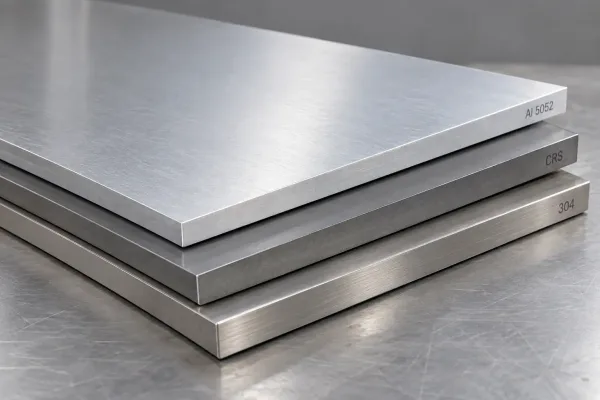
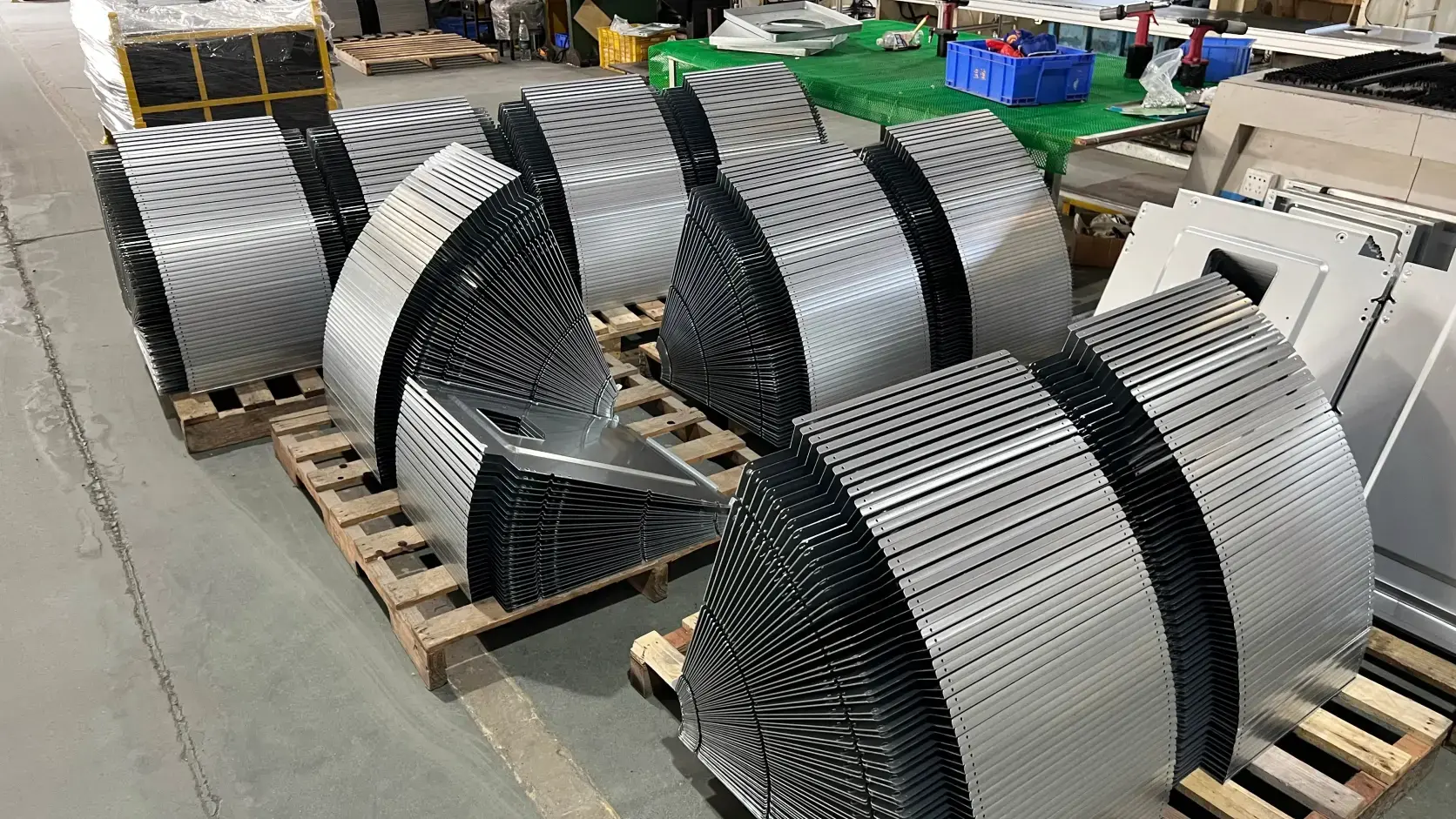
Commonly stocked sheet metals—cold-rolled steel, 304 stainless, and aluminum—used to avoid off-gauge and special-alloy cost premiums.
If corrosion is the only reason stainless was selected, check whether carbon steel plus powder coat meets the service environment. If a hard temper or thick blank was selected only for stiffness, check whether geometry—flanges, bends, or a simple rib—can carry the load at a standard gauge.
Tolerances
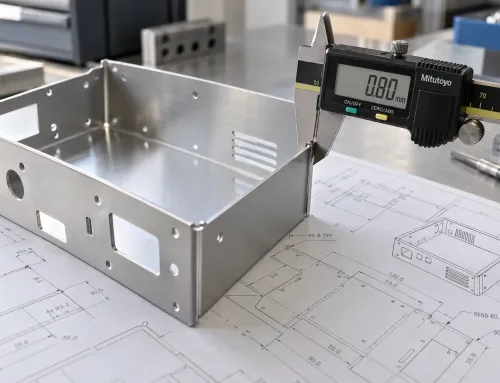
Apply tight limits only where they protect fit, sealing, motion, or safety. On non-functional edges and cosmetic faces, shop-standard cut and bend tolerances are usually sufficient.
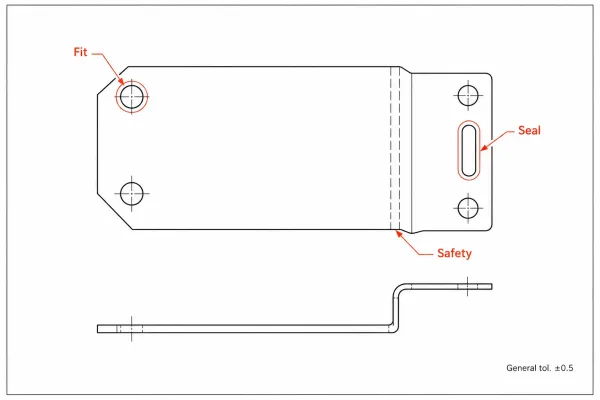
Drawing callouts applying tight tolerances to fit and sealing features while leaving non-critical edges on general tolerance.
Over-toleranced drawings force secondary machining, special fixtures, and heavier inspection. That cost is paid even when the tighter number never affects the product. A workable practice is to mark true CTQs on the drawing (or in a balloon print) and leave the rest on a general tolerance block. That also makes supplier quotes easier to compare.
Bends and formability
Predictable bends are cheaper bends. Prefer one inside-radius family on a part, ideally related to material thickness. Keep flanges long enough for standard press-brake tooling—often at least about 3–4× thickness as a starting point, then confirm with the fabricator for the chosen alloy.
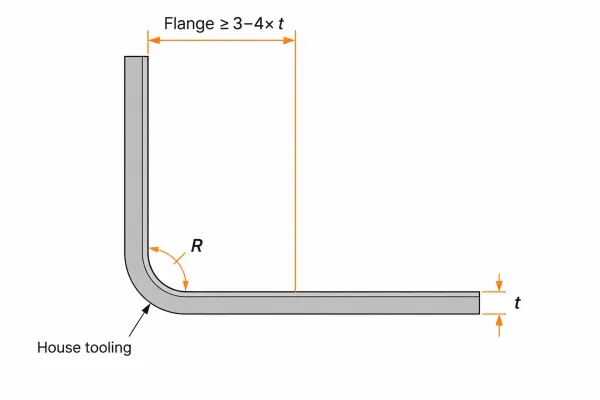
Bend geometry guideline—consistent inside radius and flange length long enough for standard press-brake tooling.
Leave clearance from holes and hardware to the bend line. Sharp internal radii, tight hems on hard material, and extreme return flanges are frequent sources of custom tooling, cracked corners, and quote spikes.
Joints, hardware, and fasteners
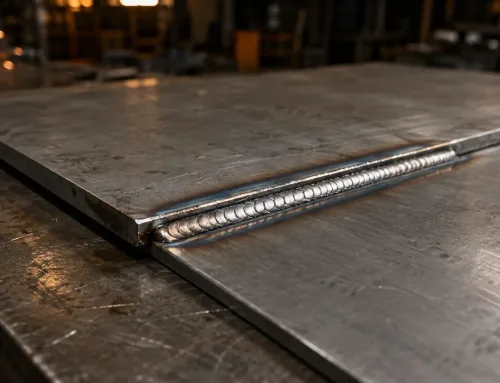
Welding is flexible but adds labor, distortion control, and finishing work. Where the design allows, consider rivets, tab-and-slot joints, or standard PEM-style fasteners.
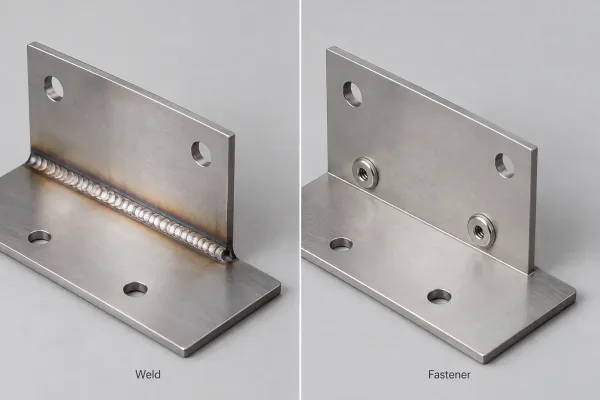
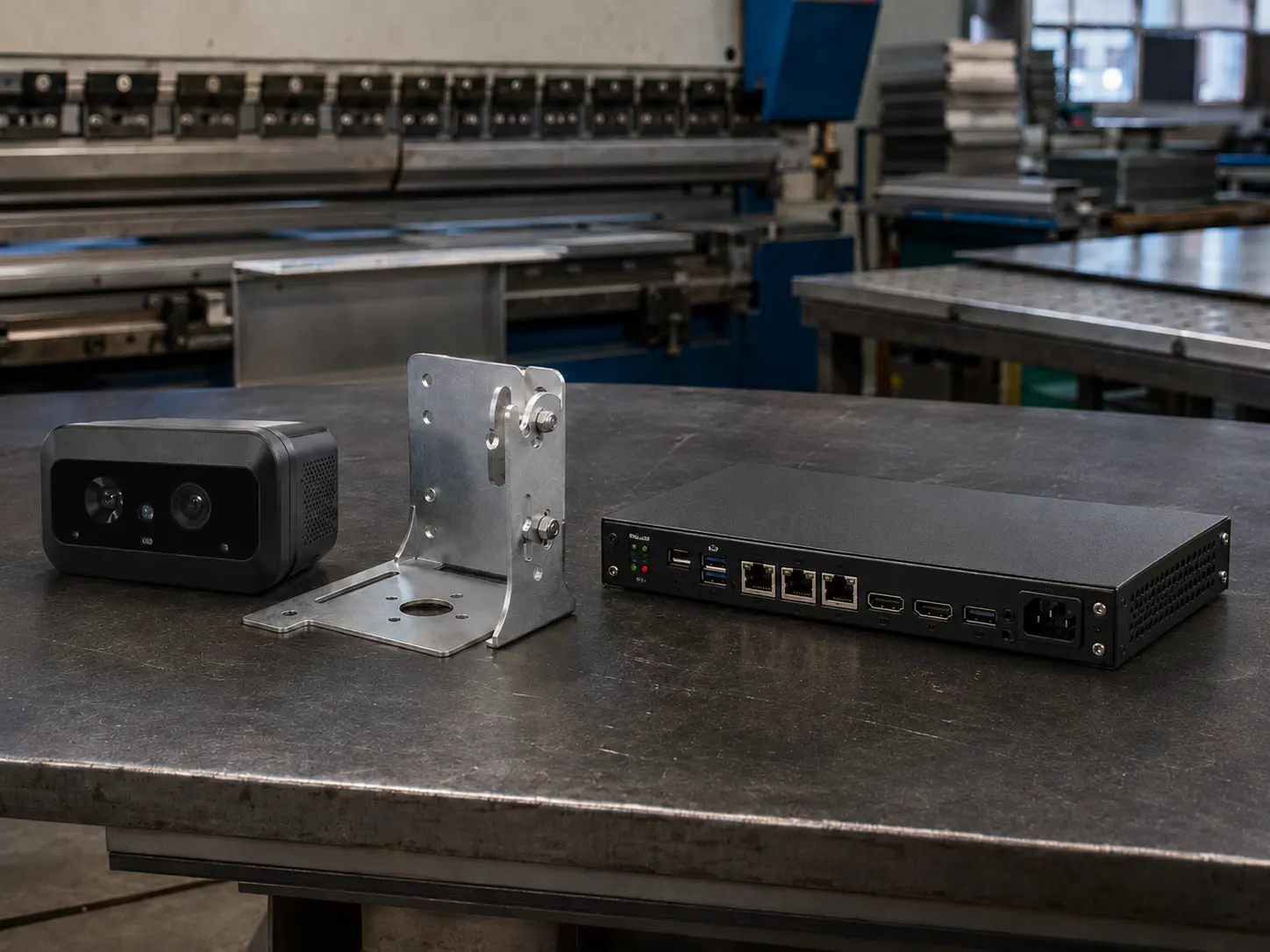
Two joining options on sheet metal—welded seam versus standard fasteners—showing labor and finishing trade-offs.
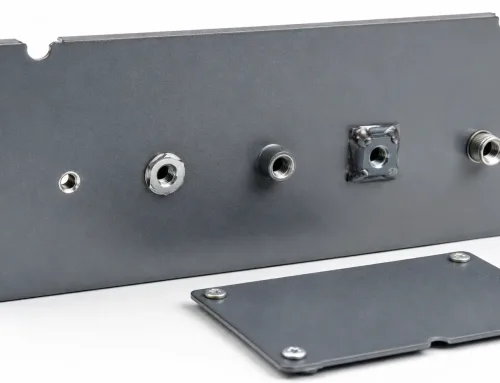
Specify catalog hardware (a known standard or an approved equivalent) and attach a short hardware BOM. Special inserts and long-lead fasteners create procurement time that shows up later as lead time and price.
Surface finish
Common finishes—zinc plating, powder coat, anodize, passivation—are usually priced predictably. Specialty coatings, multi-color cosmetic systems, tight mask boundaries, and no-scratch zones add handling steps and reject risk.
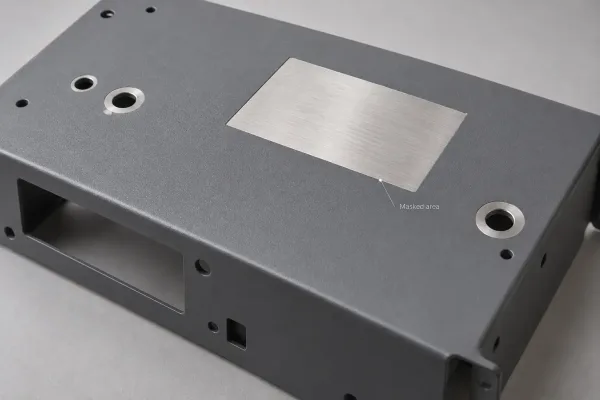
Masking on a powder-coated sheet metal part—protecting grounding or mating areas and adding handling steps that affect cost.
If appearance is not yet frozen for prototype or early builds, say so on the RFQ. Deferring silkscreen or engraving until design freeze is a normal cost control, not a quality compromise.
What Design Support Before Quotation Should Include
Pre-quote design support is collaborative and concrete. It is not a generic “we offer DFM” claim.
From the manufacturer side, expect:
- A manufacturability read of the model and drawing—whether the part can be cut, formed, joined, and finished with available capability.
- Cost-driver callouts—features forcing extra setups, special tooling, or intensive inspection.
- Suggested revisions with impact—for example, relaxing a non-critical tolerance, changing a radius to match house tooling, or replacing a custom feature with standard hardware.
- Closed-loop questions before price—material alternates, finish class, hardware source, critical dimensions, and sample versus production intent.
From the buyer or engineer side, send enough definition that the shop does not have to guess:
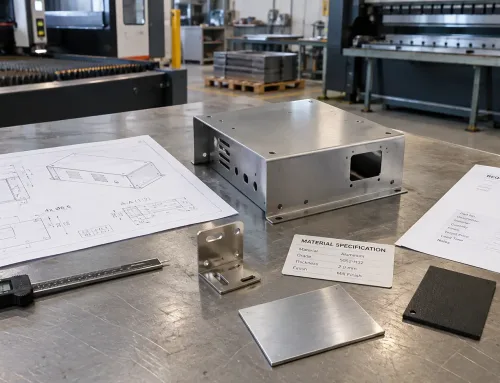
- Material grade and thickness, plus allowed alternates if any
- Finish type and cosmetic requirements
- Hardware BOM
- Quantities and expected annual volume
- CTQs and inspection expectations
- Whether the RFQ is budgetary or production-firm
Clear inputs reduce clarification loops. Fewer loops mean faster, more accurate quotes and fewer revisions after award.
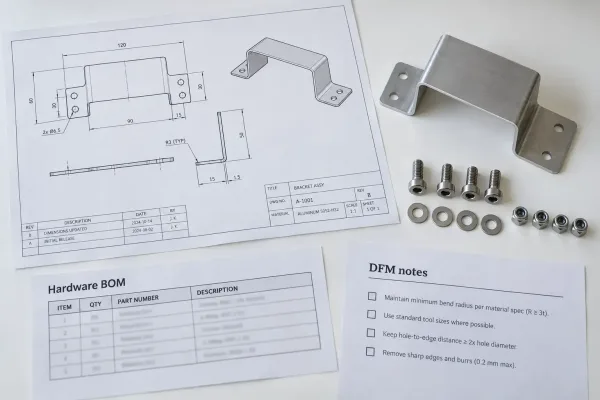
Pre-quotation package—drawing revision, hardware BOM, quantity, and fabricator DFM notes—before pricing starts.
A Pre-Quotation Checklist for Engineers and Buyers
Run this before you release an RFQ:
- Standard grades and gauges specified; alternates noted if acceptable
- Tight tolerances only on true CTQs; the general tolerance block is intentional
- Bend radii and flange lengths look manufacturable with standard tooling
- Holes and hardware have adequate edge and bend clearance
- Joining method is justified (weld vs fastener vs formed joint)
- Finish is specified with mask and cosmetic expectations where needed
- Hardware BOM is attached or fully defined on the print
- Model does not include unrelated assembly clutter
- Quantities and volume profile are stated
- Cost-sensitive open questions are listed for the fabricator, not left implicit
If three or more boxes are weak, expect clarification emails, a wide spread between quotes, or a high price that is really a risk buffer.
How to Use Fabricator Feedback Without Burning Weeks
Procurement gets better pre-quote outcomes when the RFQ package is complete on day one and feedback is handled as engineering input rather than as an open-ended debate.
Keep one revision of truth: current drawing revision and matching model. Do not mix screenshots with older PDFs. Define what is flexible—material alternates, finish class, cosmetic zones, non-critical dimensions—so suppliers do not price worst-case assumptions on every line.
Ask for cost buckets, not only a total. “Which operations drive this price?” makes the next design iteration targeted instead of a full redraw. Treat DFM comments the same way: accept, reject, or modify them in a short decision log so the same issue is not re-raised.
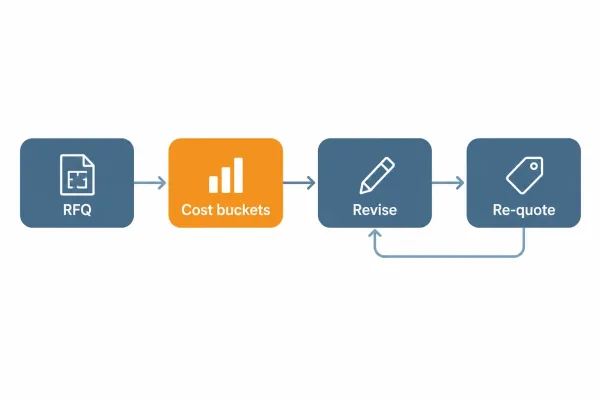
Feedback loop from quote cost buckets to a targeted design revision and re-quote—avoiding full redraws and extra weeks.
Finally, separate prototype intent from production intent. Different quantity and finish assumptions produce different prices. Mixing them wastes time on both sides.
This is not design-by-vendor. It is using manufacturing feedback while the drawing is still editable.
Key Takeaways
- Sheet metal cost is designed in before quotation through tolerances, geometry, materials, joins, and finish—not through negotiation after the fact.
- Read quotes as cost buckets and ask which drivers are functional.
- Pre-quote design support works when both sides share definition and constraints: CTQs, flexible areas, volume, and finish class.
- A short checklist before RFQ prevents most late-stage redesign that burns schedule and budget.
FAQs
Next Step for Your Next RFQ
Before the next sheet metal package goes out, run the pre-quotation checklist above and keep tight specifications only where they protect function. If you want a manufacturing read on cost drivers—tolerances, bends, joins, finish, and hardware—SR-MFG can review drawings at RFQ stage and return concrete revision notes so the quotation reflects the part you need, not the risk left in the file.
Process limits and market prices vary by equipment, material supply, and order profile. Treat numeric examples as directional planning guidance, not a fixed quote rule.