
Rolling is a pressure-forming process that changes the shape of steel ingots or slabs between rotating rolls. It is divided into hot rolling and cold rolling, with the latter commonly used to produce cold-rolled carbon steel sheet.
Hot rolling requires the raw slab to be heated to 1,100–1,250°C before high-temperature rolling. Hot-rolled carbon steel sheet and strip are typical products of this process.
Today, hot-strip rolling technology is mature, instrumentation is advanced, product quality is relatively stable, and production lines achieve high operating rates.
However, rolling is a complex process. Operating conditions and equipment status at every stage can affect final product quality, resulting in various hot-rolled steel strip defects.
Hot-Rolled Steel Strip Production Process
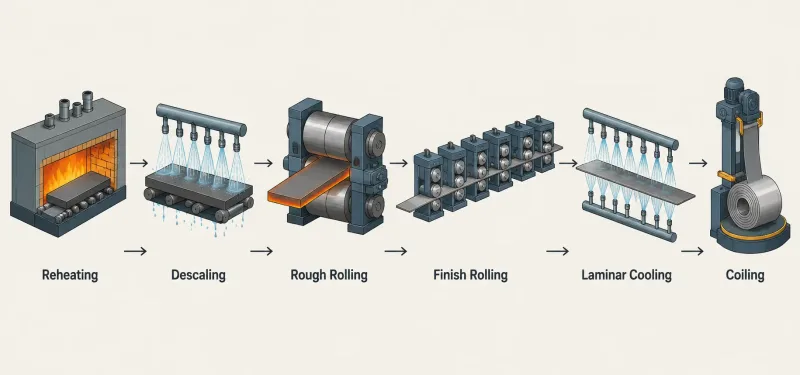
The six key stages of a hot-strip rolling line: reheating → descaling → rough rolling → finish rolling → laminar cooling → coiling. Each stage plays a critical role in determining final strip quality.
Common Hot-Rolled Steel Strip Defects
1. Rolled-In Scale
1.1 Defect Characteristics
Rolled-in scale is a surface defect formed when oxide scale is pressed into the steel strip during hot rolling.
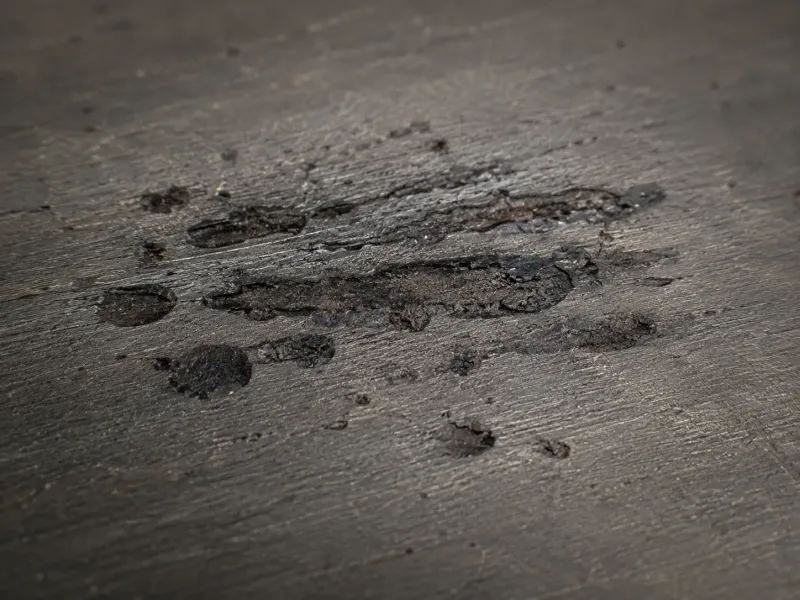
Rolled-in scale appears as dark, irregular patches of oxide embedded into the strip surface. These defects form when iron oxide scale from reheating or rolling is not fully removed and becomes pressed into the steel during subsequent passes.
Depending on its origin, it can be classified as:
- Primary scale formed in the reheating furnace;
- Secondary scale formed during rolling and pressed into the strip surface;
- Secondary scale caused by oxide film peeling from the roll surface and being pressed into the strip.
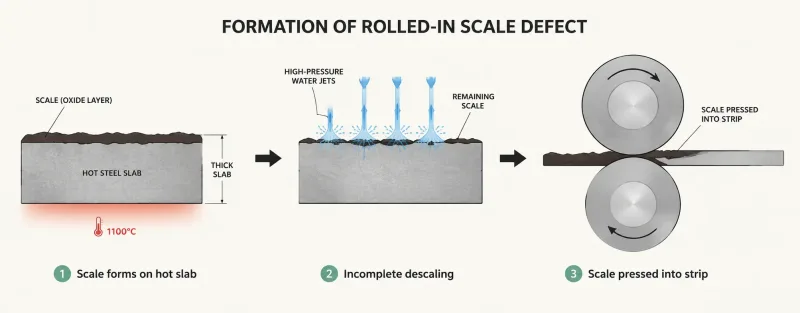
Cross-section view illustrating the mechanism of rolled-in scale: oxide scale forms on the slab surface (left), survives incomplete descaling (center), and gets mechanically pressed into the soft steel surface during roll compression (right).
1.2 Causes
- Severe longitudinal cracks on the slab surface;
- Improper slab-heating procedures or operation, making primary scale difficult to remove completely;
- Low high-pressure descaling-water pressure or blocked nozzles, allowing scale generated during rolling to be pressed into the strip surface;
- Excessive rolling speed or inadequate roll cooling, causing the oxide film on the rolls to peel off and become embedded in the strip.
1.3 Effects
It reduces the strip’s surface finish quality and affects subsequent coating performance.
1.4 Prevention and Corrective Measures
- Strengthen slab inspection against the required material specifications. Slabs with severe longitudinal cracks should be cleaned and approved before use;
- Develop suitable slab-heating procedures and follow the specified heating process;
- Regularly inspect the high-pressure descaling system, maintain adequate water pressure, and prevent nozzle blockage;
- Control the rolling pace and ensure effective roll cooling to prevent oxide film from peeling off.
2. Scabs
2.1 Defect Characteristics
A scab is an irregular, raised metal flake attached to the steel strip surface.
Scabs may appear:
- Leaf-shaped;
- Feather-shaped;
- Strip-shaped;
- Scale-shaped;
- Tongue-shaped.
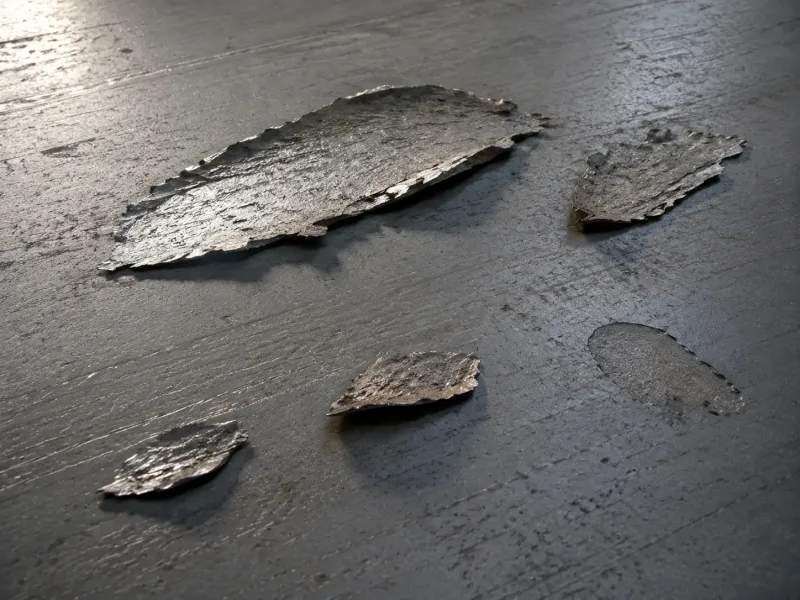
Blister defects appear as randomly distributed circular or oval bulges on the strip surface. These gas-induced defects can rupture during rolling, causing surface cracking. Some internal blisters are not visible until the strip is cross-sectioned.
Scabs are mainly divided into two types:
The first type remains connected to the base metal and is folded onto the strip surface, making it difficult to remove.
The second type is not connected to the base metal but adheres to the surface. It detaches easily and leaves a relatively smooth depression.
2.2 Causes
- Existing scabs, laps, or similar defects on the slab surface were not fully removed and remained after rolling;
- Residue from flame cleaning remained on the slab and was pressed into the strip during rolling.
2.3 Effects
Scabs may cause metal peeling or holes during subsequent processing or use.
2.4 Prevention and Corrective Measures
Strengthen slab inspection. Any scabs or flame-cleaning residue must be completely removed before rolling.
3. Blisters
3.1 Defect Characteristics
Blisters are randomly distributed circular or oval bulges on the steel strip surface.
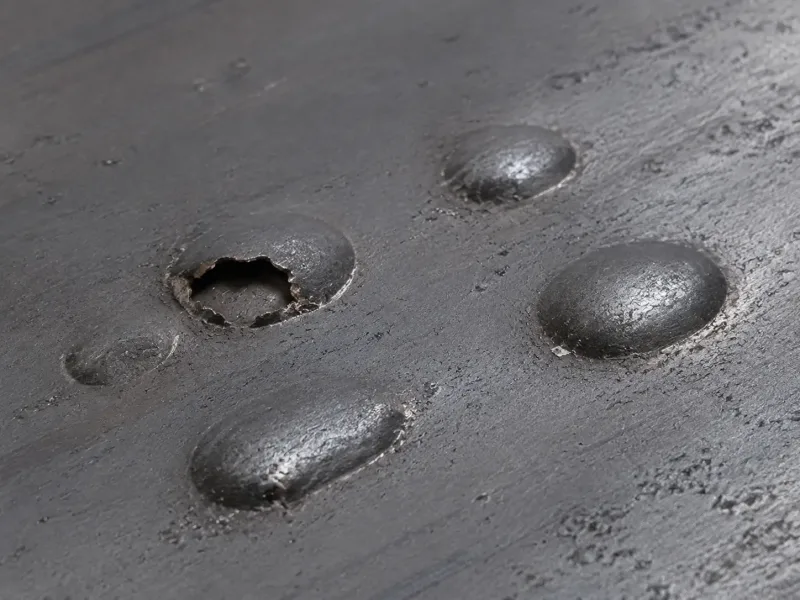
Blister defects appear as randomly distributed circular or oval bulges on the strip surface. These gas-induced defects can rupture during rolling, causing surface cracking. Some internal blisters are not visible until the strip is cross-sectioned.
Their edges are generally smooth. When a blister breaks during rolling, the strip surface may crack or peel.
Some blisters do not visibly protrude. After temper rolling, the surface may appear bright, while the cut section shows delamination.
3.2 Causes
- Poor deoxidation or improper nitrogen blowing, causing excessive gas to accumulate inside the slab;
- Excessive furnace residence time, exposing or concentrating subsurface gas pockets.
3.3 Effects
Blisters may cause delamination or poor weld quality during subsequent processing or use.
3.4 Prevention and Corrective Measures
- Strengthen slab inspection and do not use slabs with exposed blister defects;
- Heat slabs strictly according to process requirements and avoid excessive furnace residence time.
4. Cobbling
4.1 Defect Characteristics
Cobbling refers to multiple overlapping layers, rolled-through sections, or tearing on the strip surface.
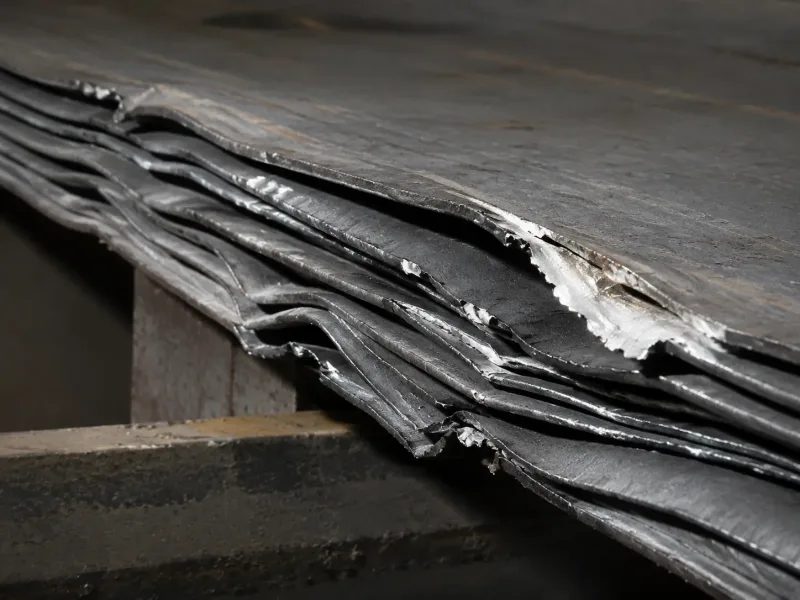
Cobbling creates multiple overlapping layers, folded sections, and tearing on the strip surface. This severe defect typically results from uneven strip elongation during finish rolling and renders the material unusable.
4.2 Causes
- Improper roll-gap adjustment or poor matching between the roll profile and incoming strip shape, causing uneven strip elongation;
- Uneven local slab-heating temperature or uneven workpiece temperature;
- Incorrect finishing-mill side-guide opening;
- Mismatched strip flow rates during finish rolling.
4.3 Effects
Cobbling may cause the strip to break during rolling. Steel plates with this defect are generally unusable.
4.4 Prevention and Corrective Measures
- Select an appropriate roll profile and adjust the roll gap correctly;
- Improve slab-heating temperature control to maintain uniform workpiece temperature;
- Set the finishing-mill side-guide opening correctly;
- Maintain consistent metal flow through all stands during continuous rolling.
5. Roll Marks
5.1 Defect Characteristics
Roll marks are periodically distributed, irregular raised or depressed defects on the steel strip surface.
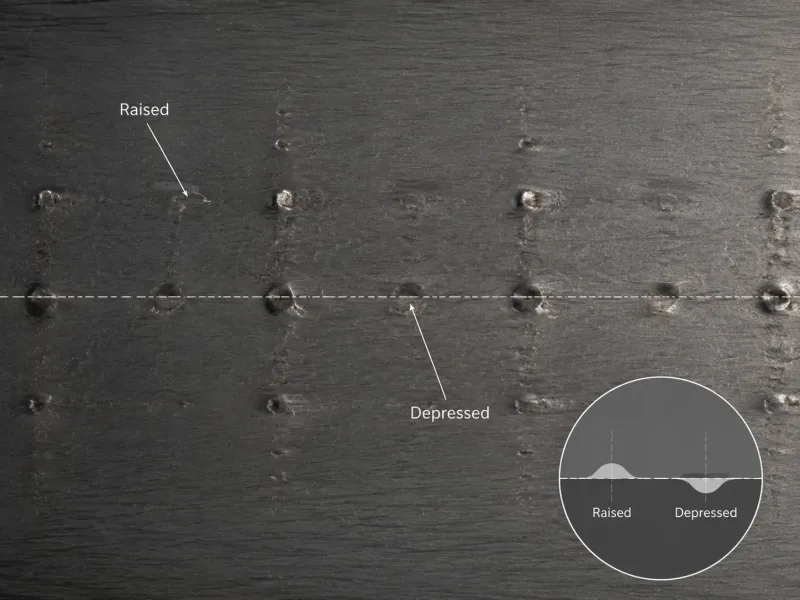
Roll marks appear as periodically spaced raised or depressed defects along the strip surface. Their regular spacing pattern directly corresponds to the circumference of the responsible work roll, making them identifiable by their rhythmic repetition.
5.2 Causes
Cracks, local material loss, or foreign matter on the roll surface create uneven areas.
During rolling or finishing, these uneven areas are imprinted onto the strip surface, forming raised or depressed defects.
5.3 Effects
- Raised roll marks may cause folding defects during subsequent rolling;
- Depressed roll marks may cause holes during subsequent rolling.
5.4 Prevention and Corrective Measures
- Regularly inspect roll-surface quality against clearly defined in-process inspection standards and promptly address local material loss or adhered foreign matter;
- After abnormal events such as strip jamming, tail whipping, or cobbling, inspect the roll surface immediately to prevent damage or foreign-matter adhesion;
- If surface checking is found on a roll, stop the mill immediately and inspect the roll surface.
6. Collapsed Coil
6.1 Defect Characteristics
A steel coil that becomes oval in shape is called a collapsed coil.
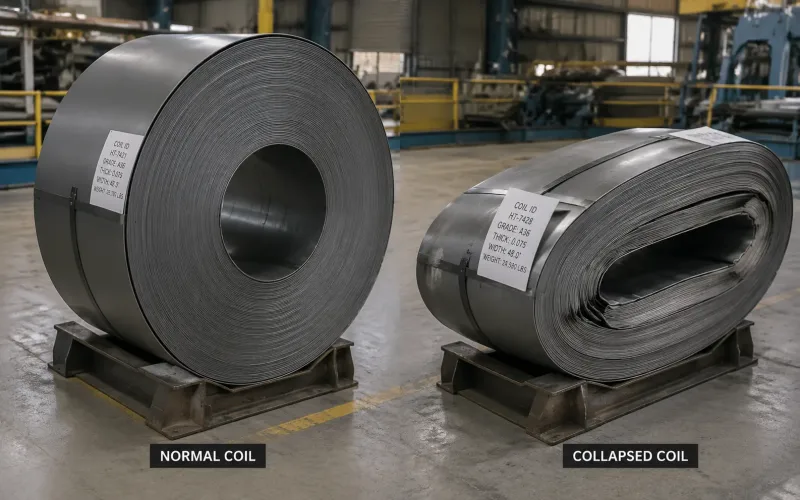
Left: a normal tightly wound steel coil with a circular cross-section. Right: a collapsed coil that has become oval-shaped due to insufficient coiling tension or excessive stacking impact. Collapsed coils are difficult to package, transport, and uncoil.
6.2 Causes
- Excessive impact during coil handling;
- Insufficient coiling tension or horizontal, multi-layer coil stacking.
6.3 Effects
It affects coil packaging and handling. A severely collapsed coil may be impossible to uncoil.
6.4 Prevention and Corrective Measures
- Handle coils carefully and avoid excessive impact;
- Set the coiling tension correctly, limit the number of horizontally stacked layers, and use vertical coil storage when necessary.