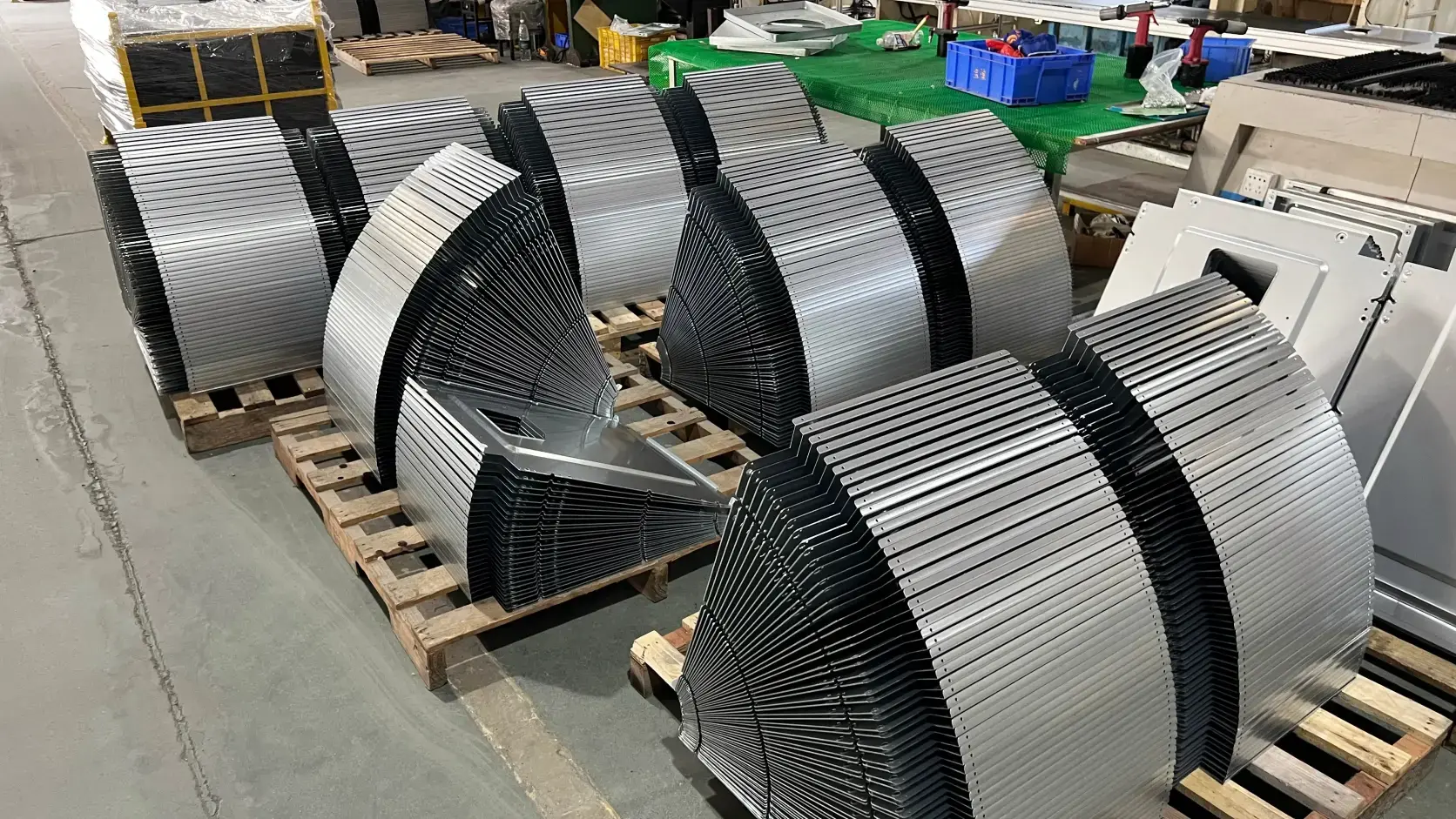

Many buyers treat the purchase contract as paperwork that follows an agreed quote. That habit is expensive when you source sheet metal from China. Once material is cut, you can no longer fix a missing tolerance, an undefined finish, or a weak inspection right through email. The contract is the last engineering control point where specifications, evidence, and responsibility still cost almost nothing to correct.
This guide is a step-by-step purchase contract review checklist for custom sheet metal parts. It assumes you have already selected a supplier or are about to award an order. It does not replace legal advice. It helps procurement and engineering teams lock manufacturing requirements into a document the factory can actually build and you can actually accept.
Contract Review Is Not Supplier Evaluation
Supplier evaluation answers one question: can this factory make the work reliably? Contract review answers a different set of questions: what exactly must be made, what proof must ship with the parts, who pays when something is wrong, and what happens when the design changes.
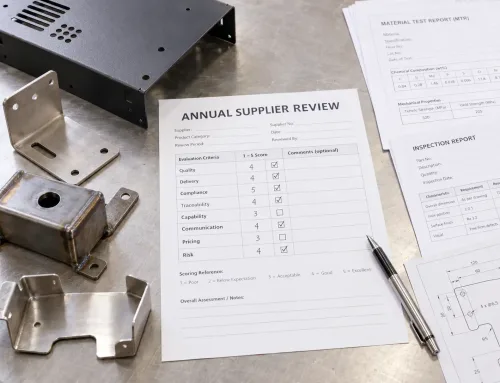
Those stages need separate checklists. A vendor scorecard may confirm laser capacity, ISO 9001, export experience, and communication quality. None of that guarantees that your purchase order (PO) states the correct material grade, the governing drawing revision, or the inspection method used at shipment.
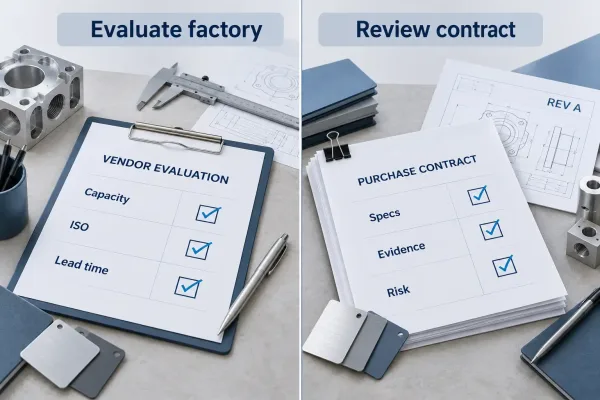
Supplier evaluation checks the factory; contract review locks part requirements, evidence, and responsibility in the PO package.
Treat contract review as translation work. Engineering requirements that live only in a quote email are not yet a manufacturing instruction. Until they sit in the PO or contract annex with a revision and a date, they are open to interpretation.
Lock the Manufacturing Basis Before You Sign
For sheet metal, the manufacturing basis is the full set of inputs that define how flat stock becomes a finished part: drawings, materials, thickness, tolerances, bends, hardware, and surface finish. Each item should appear in the contract package, not only in a sales conversation.
Which Drawing and Revision Govern the Order
State clearly which file is authoritative: PDF drawing, 3D model, or both. If both are used, say which one controls when they disagree. Sheet metal often requires a flat pattern, bend directions, and hole positions that a model alone may not call out.
Include the drawing revision (for example, Rev C) and the release date. Add a line that production may not start on a superseded revision. Without that clause, a supplier can build a correct part from the wrong file and still claim the order was followed.
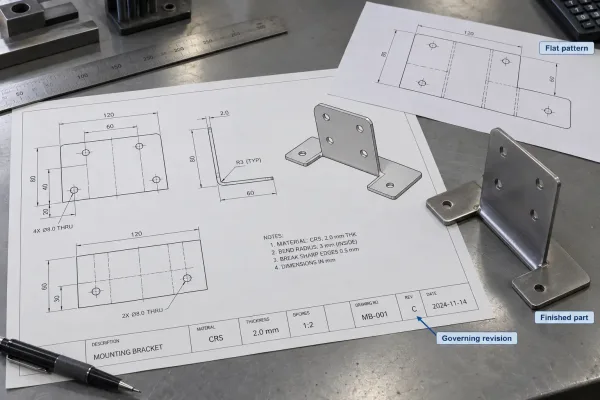
The governing drawing revision, not an uncontrolled file, defines the sheet metal part to be manufactured.
If cut files such as DXF are supplied for laser cutting, note whether they are derived data or controlling data. Many disputes start when a flat pattern is edited locally and no longer matches the dimensioned drawing.
Material, Thickness, Tolerance, and Finish Callouts
Write the material grade with a standard where possible (for example, 304 stainless per ASTM A240, or 5052-H32 aluminum). Generic labels like “stainless steel” or “aluminum sheet” allow substitution you did not approve.
Thickness should include a tolerance band, not only a nominal value. Sheet stock can vary by mill and gauge system. If the part is a structural bracket or a mating panel, thickness error can change stiffness, weld fit, or hardware engagement.
Surface finish is another common gap. “Painted” is not a callout. Specify process, color reference, dry film thickness, and whether appearance zones are cosmetic or functional. Powder coating and liquid paint build different films; both can affect hole size and bend clearance if not planned.
Practical rule: if a dimension, material, or finish would fail the part when wrong, it belongs in the contract package with a number, a standard, or a named sample.

Material grade, thickness tolerance, and finish process must be written as measurable callouts, not general labels.
Put Quality Evidence and Inspection Rights in Writing
Quality language such as “good workmanship” or “ISO quality” does not create an acceptance test. The contract should say which documents must accompany the shipment, when inspection happens, and what counts as rejection.
Certificates and Reports to Require
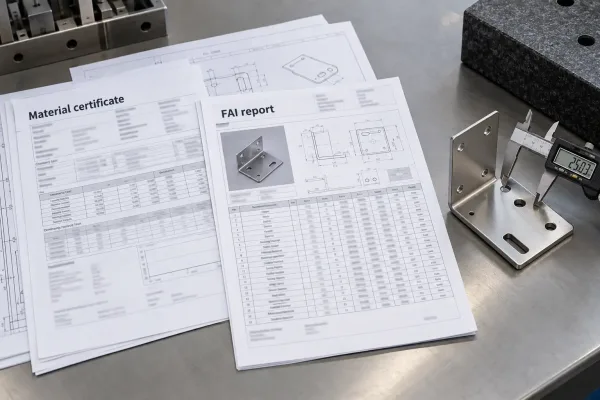
For metal parts, request a material certificate when grade and heat traceability matter (for example, an EN 10204 3.1 mill test report for pressure, structural, or regulated work). For appearance-critical finishes, note whether thickness readings or adhesion results are required.
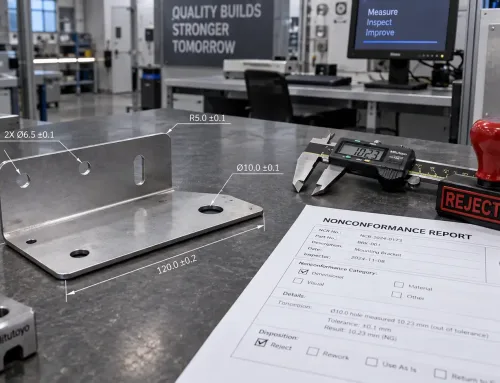
If the first production run is new to the supplier, require a first article inspection (FAI) report or an equivalent dimensional report before volume release. State the format, sample size, and which features are critical to quality (CTQ). A photograph of a caliper is not a dimensional record.
Material certificates and FAI reports are contractual evidence, not optional attachments after shipment.
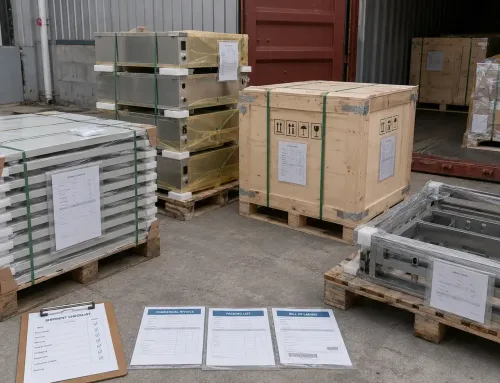
Also list packaging and preservation evidence when surfaces must arrive intact: VCI, protective film, dividers, or no-scratch zones on Class A faces. Your shipping checklist will later verify these items, but the obligation must start in the contract.
Acceptance, Rejection, and Inspection Access
Define acceptance criteria by attribute or by variable data. Attribute criteria are pass/fail (hole present, no cracks). Variable criteria are measured values (bend angle ±1°, thickness within stated band).
Include the buyer’s right to inspect before shipment, by source inspection or by retained samples, when risk justifies the cost. State response times for nonconformance reports and who decides among rework, replacement, scrap, or deviation use-as-is.
Without a clear defect path, low-volume OEMs often absorb scrap quietly and lose schedule. A short rejection and remedy clause is cheaper than a lost production week.
Allocate Cost, Payment, and Delivery Risk Clearly
Commercial terms should describe the same scope the drawings describe. Gaps between the two create change orders, unpaid secondary operations, or delayed export.
Price Scope, Tooling/NRE, and Payment Milestones
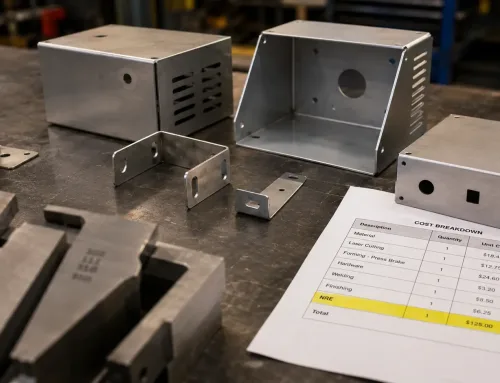
Separate piece price from non-recurring engineering (NRE) and tooling when soft tooling, forming fixtures, or check gauges are involved. State who owns the tooling after payment, and whether it may be removed or duplicated.
List included operations: laser cutting, bending, welding, hardware insertion (such as PEM studs), finishing, inspection, packing. Exclusions should be explicit. “Price includes manufacturing” is ambiguous when deburring, tapping, or passivation appears later.
Payment terms should match risk. For a new overseas supplier, many buyers hold a deposit and balance after inspection evidence, or use letter of credit for larger programs. Align milestones with proof points (approved FAI, packing list, bill of lading), not only calendar dates.
Incoterms, Packaging, and Export Documents
Name the Incoterms rule and the named place (for example, FOB Shanghai or DAP your dock). Incoterms allocate cost and risk during transport; they do not replace product specifications.
Specify export documents: commercial invoice, packing list, certificate of origin when required, and any material or test reports agreed earlier. For finished sheet metal, packaging must match surface class—especially coated, anodized, or brushed faces.
If the supplier arranges freight, confirm insurance responsibility at the same handover point as title and risk. Your pre-shipment checklist can then verify documents against the contract instead of arguing after the container leaves.

Packaging class, export documents, and Incoterms must match the surface and delivery risk stated in the contract.
Define How Changes Work After Signature
Sheet metal programs change: hole patterns move, thickness is revised, finish is upgraded for outdoor use. The contract should say how those changes enter the order.
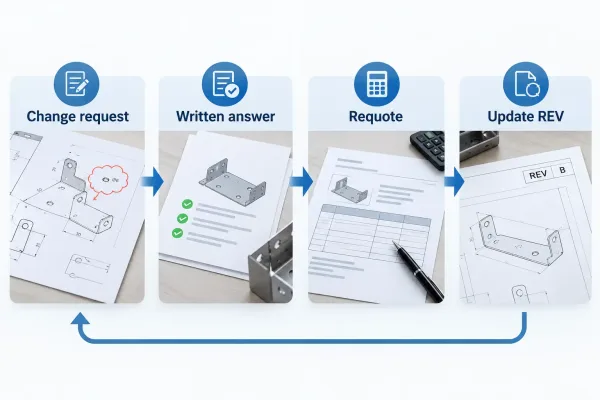
Require written change control. Email approval is acceptable if it references the PO number and the new revision. Verbal shop-floor changes should not alter geometry or process without a document trail.
State how cost and lead time are recalculated after a change. Material already cut, tools already modified, or parts already finished should not be free to rework unless the change was the supplier’s error. A simple technical clarification process—question, written answer, updated revision—reduces rework more than goodwill.
After signature, changes should move through written clarification, requote, and an updated drawing revision.
Pre-Signature Review Checklist
Use the list below on the final contract or PO package before release. Each item maps to a section above.
- Governing drawing files named, with revision and date
- Flat pattern / DXF status defined (controlling or derived)
- Material grade and standard stated; substitution rules written
- Nominal thickness plus tolerance band stated
- Critical dimensions and tolerances identified as CTQ where needed
- Surface process, color, film thickness, and cosmetic zones defined
- Required certificates listed (for example, MTR 3.1, FAI, thickness readings)
- Inspection method, sampling, and buyer inspection rights stated
- Rejection, rework, and replacement path agreed
- Piece price scope and NRE/tooling ownership separated
- Payment milestones tied to evidence, not only dates
- Incoterms, named place, packaging class, and export documents agreed
- Written change control and requote rules included
- Engineering and procurement both signed the package version
If more than two items are blank, pause the release. Incomplete packages are the most common source of preventable sheet metal disputes.
FAQ
When the package is complete, ask a manufacturing engineer to review the drawing and contract fields for manufacturability and inspectability before signature. That review is usually faster and cheaper than explaining a scrap panel after the first shipment.