
Medical sheet metal components face a unique challenge: they must survive repeated exposure to aggressive cleaning agents without degrading. A stainless steel enclosure that corrodes after six months of hospital cleaning is not just a quality failure—it is a compliance risk and a patient safety issue. This guide explains how to specify, manufacture, and validate sheet metal parts that maintain chemical resistance throughout their service life.
The Hidden Complexity of Cleaning Medical Sheet Metal
Cleaning a sheet metal part sounds straightforward. In medical applications, it is anything but.
Hospital and laboratory environments demand cleaning protocols that are far more aggressive than those in general industrial settings. Parts are exposed to concentrated disinfectants, enzymatic detergents, and high-temperature autoclave cycles—often multiple times per day. The cleaning agents that keep patients safe can rapidly degrade unprotected metal surfaces.
The consequences of getting this wrong are not abstract. Pitting corrosion on a surgical instrument tray can harbor bacteria. Surface degradation on a diagnostic equipment enclosure can compromise electromagnetic shielding. Stress corrosion cracking on a mounting bracket can lead to structural failure. Each of these failures traces back to a mismatch between the cleaning environment and the material or surface specification.
What makes this particularly challenging for engineers and buyers is that cleaning chemical resistance is not a single property you can specify on a drawing. It is a system outcome determined by material selection, surface treatment, manufacturing process, and cleaning protocol. Change any one variable, and the result shifts.
Common Cleaning Agents and Their Chemical Impact
Medical environments use four main categories of cleaning agents, each with distinct chemical mechanisms and corrosion implications.
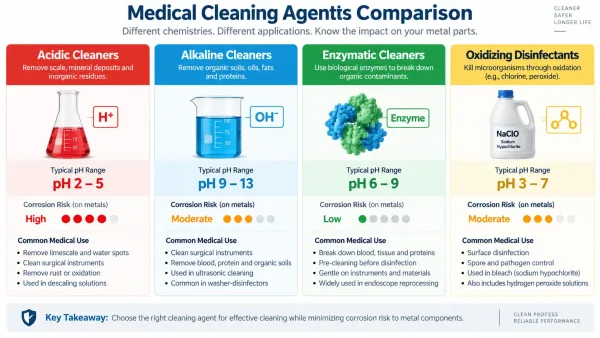
A visual comparison of four cleaning agent categories used in medical environments, showing their pH ranges and corrosion risk to stainless steel.
Acidic cleaners (citric acid, acetic acid, phosphoric acid) dissolve mineral deposits and remove oxidation. They are effective but can attack chromium oxide layers on stainless steel, particularly at concentrations above 10% or temperatures above 60°C.
Alkaline cleaners (sodium hydroxide, quaternary ammonium compounds) break down organic soils like oils and proteins. They are generally less corrosive to stainless steel than acidic agents but can cause pitting in confined areas where the solution concentrates during evaporation.
Enzymatic cleaners (protease, lipase, amylase) use biological catalysts to break down protein-based soils. Research shows these are the least aggressive category for stainless steel. A 2022 study on AISI 304 surgical instruments found that enzymatic detergents produced the lowest corrosion rates among all cleaning media tested.
Oxidizing disinfectants (sodium hypochlorite, hydrogen peroxide, peracetic acid) kill microorganisms through oxidation. They are highly effective but pose the greatest corrosion risk. Sodium hypochlorite, at the concentrations used for surface disinfection (500–5000 ppm free chlorine), can initiate pitting corrosion in stainless steel within hours if the passive layer is compromised.
| Cleaning Agent Type | pH Range | Corrosion Risk to Stainless Steel | Common Medical Use |
|---|---|---|---|
| Acidic (citric, acetic) | 2–5 | Moderate to High | Descaling, rust removal |
| Alkaline (NaOH, QAC) | 9–13 | Low to Moderate | General cleaning, degreasing |
| Enzymatic (protease, lipase) | 6–9 | Low | Instrument pre-soaking |
| Oxidizing (hypochlorite, H₂O₂) | 3–7 | High | Surface disinfection |
The practical takeaway: material selection must account for the specific cleaning agents in the facility’s protocol, not just generic “chemical resistance.”
Stainless Steel Grades for Medical Applications
Three austenitic stainless steel grades dominate medical sheet metal fabrication: 304, 316, and 316L. The differences between them matter more in cleaning environments than in most other applications.
304 (1.4301) contains 18% chromium and 8% nickel. It provides good corrosion resistance in mild environments but is vulnerable to pitting from chloride-containing cleaners. For parts that see only occasional wiping with dilute disinfectants, 304 is often adequate and cost-effective.
316 (1.4401) adds 2–3% molybdenum to the 304 composition. This significantly improves resistance to pitting and crevice corrosion, particularly in chloride environments. For parts exposed to sodium hypochlorite or high-chloride cleaning solutions, 316 is the standard choice.
316L (1.4404) is the low-carbon variant of 316, with carbon content below 0.03%. This reduces the risk of sensitization during welding—where chromium carbides precipitate at grain boundaries and deplete the surrounding area of chromium. For welded assemblies that will see aggressive cleaning, 316L is preferred over 316.
| Grade | Cr | Ni | Mo | C (max) | Pitting Resistance (PREN) | Relative Cost |
|---|---|---|---|---|---|---|
| 304 | 18% | 8% | — | 0.08% | 18 | 1.0× |
| 316 | 17% | 10% | 2.5% | 0.08% | 24 | 1.3× |
| 316L | 17% | 10% | 2.5% | 0.03% | 24 | 1.4× |
PREN (Pitting Resistance Equivalent Number) = %Cr + 3.3×%Mo + 16×%N. Higher values indicate better pitting resistance.
For medical sheet metal that will undergo repeated cleaning with oxidizing disinfectants, 316L provides the best balance of corrosion resistance, weldability, and long-term reliability. The cost premium over 304 is typically 30–40%, but it eliminates most cleaning-related corrosion failures.
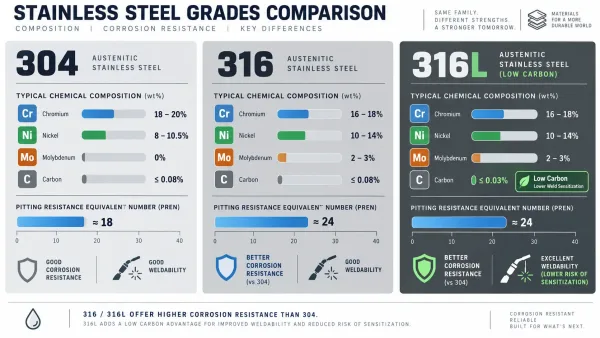
A technical comparison showing the chemical composition and pitting resistance equivalent number (PREN) for three stainless steel grades used in medical applications.
Surface Treatments That Enhance Chemical Resistance
Base material selection is necessary but not sufficient. Surface treatments can significantly extend the chemical resistance of stainless steel parts.
Passivation is the most common post-fabrication treatment for medical stainless steel. The process removes free iron and other surface contaminants from machining or welding, allowing a uniform chromium oxide layer to form. Citric acid passivation (per ASTM A967) is increasingly preferred over nitric acid passivation because it is safer to handle and produces equivalent results. A properly passivated 316L surface can withstand hundreds of cleaning cycles without degradation.
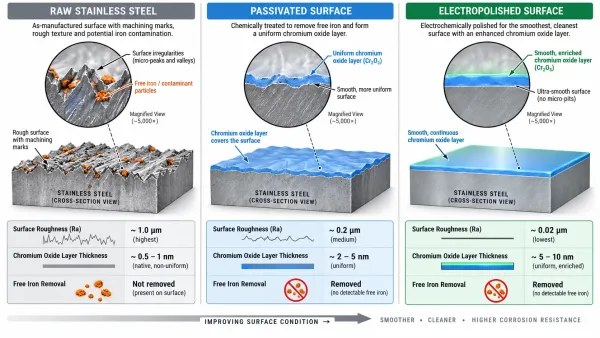
A visual comparison showing how passivation and electropolishing improve the surface quality and corrosion resistance of stainless steel medical parts.
Electropolishing removes a thin layer of surface material (typically 10–40 µm), producing a smooth, micro-pit-free surface with a chromium-enriched passive layer. Electropolished surfaces are easier to clean, shed biological residues more effectively, and resist pitting initiation better than mechanically finished surfaces. The surface roughness after electropolishing is typically Ra 0.2–0.8 µm.
Coating systems add a physical barrier between the cleaning environment and the base metal. Epoxy primers, powder coatings, and PTFE linings each have trade-offs in thickness, chemical compatibility, and durability. Coatings are most valuable when the base material cannot be changed (e.g., cost constraints mandate 304) or when the cleaning protocol is unusually aggressive.
The key interaction: surface treatment must be specified in the context of the cleaning protocol. A passivated surface provides excellent resistance to dilute cleaners but may not survive prolonged exposure to concentrated hypochlorite. An electropolished surface improves cleanability but adds cost. A coating system may crack at bend radii if not designed for the form factor.
Manufacturing Process Effects on Cleanability
How a part is made affects how well it resists cleaning chemicals and how easily it can be cleaned. Three manufacturing variables deserve particular attention.
Welding and Heat-Affected Zones
Welding creates a heat-affected zone (HAZ) where the stainless steel’s microstructure changes. In the HAZ, chromium can combine with carbon to form chromium carbides, depleting the surrounding matrix of chromium and reducing corrosion resistance—a phenomenon called sensitization.
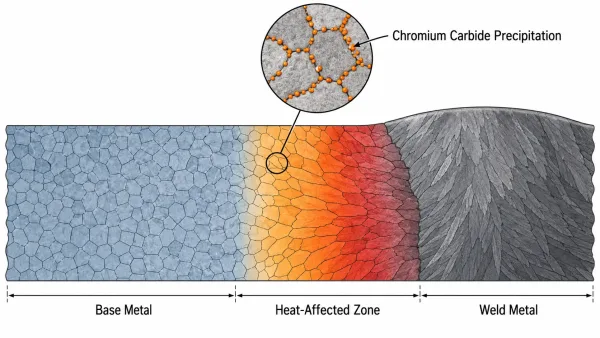
A cross-section diagram showing how welding creates a heat-affected zone where chromium carbides can precipitate, reducing corrosion resistance.
This is why 316L (low carbon) is preferred over 316 for welded medical assemblies. The lower carbon content minimizes carbide precipitation. For critical applications, post-weld passivation restores the chromium oxide layer over the HAZ.
Autogenous welds (no filler metal) produce narrower HAZs and fewer sensitization risks than filled welds. Laser welding, with its concentrated heat input and rapid cooling, typically produces less HAZ damage than TIG welding.
Bending and Forming Stresses
Cold forming introduces residual stresses into the sheet metal. These stresses, combined with exposure to chloride-containing cleaners, can cause stress corrosion cracking (SCC)—a failure mode where cracks propagate through the material without visible surface corrosion.
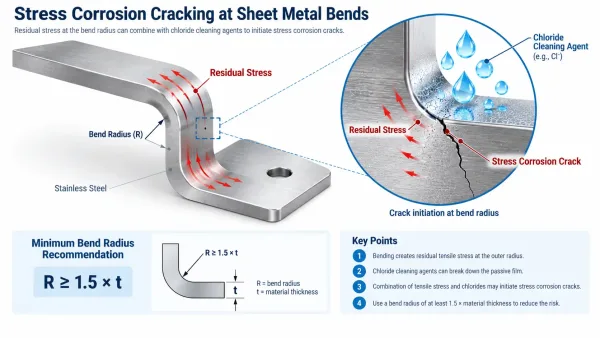
A diagram showing how residual stresses from bending combined with cleaning agent exposure can cause stress corrosion cracking.
The risk is highest at bend radii smaller than 1× material thickness. For 316L sheet, a minimum bend radius of 1.5× thickness provides a safety margin against SCC in cleaning environments.
Stress relief annealing after forming eliminates residual stresses but changes the material’s mechanical properties and surface condition. It should be specified only when the cleaning environment warrants it—for example, parts that will be immersed in hot hypochlorite solutions.
Surface Finish from Cutting and Machining
Laser-cut edges, waterjet-cut edges, and machined surfaces each have different surface roughness and microstructure characteristics. Laser cutting can produce a thin recast layer with micro-cracks that initiate pitting. Waterjet cutting leaves a clean edge but may embed abrasive particles.
For medical parts, post-cut deburring and surface finishing are not optional. Burrs, sharp edges, and rough surfaces trap cleaning agents and biological residues, creating localized corrosion cells and compromising cleanability.
Specifying Cleaning Requirements on Drawings
The drawing is the contract between the buyer and the fabricator. Cleaning and chemical resistance requirements must be explicit, measurable, and verifiable.
A complete specification includes five elements:
- Material designation with standard reference (e.g., ASTM A240 Type 316L)
- Surface treatment with process standard (e.g., passivation per ASTM A967 Method C.2)
- Surface roughness with measurement method (e.g., Ra ≤ 0.8 µm per ISO 4288)
- Cleaning agent compatibility with specific agents and concentrations (e.g., “resistant to 1000 ppm NaOCl at 25°C for 24 hours”)
- Validation test with acceptance criteria (e.g., “pass 72-hour immersion per ASTM G31, mass loss < 0.5 mg/cm²”)
Common specification errors:
- Writing “chemical resistant” without specifying which chemicals
- Calling out passivation without specifying the method (nitric vs. citric)
- Specifying surface roughness without indicating the measurement location
- Requiring “cleanroom compatible” without defining the cleanroom class
A specification that reads “316 stainless steel, passivated, Ra 0.8” is incomplete. A specification that reads “ASTM A240 Type 316L, citric acid passivation per ASTM A967 Method C.2, Ra ≤ 0.8 µm measured parallel to grain on exposed surfaces, resistant to cleaning protocol per attached Table 1” gives the fabricator a clear, verifiable target.
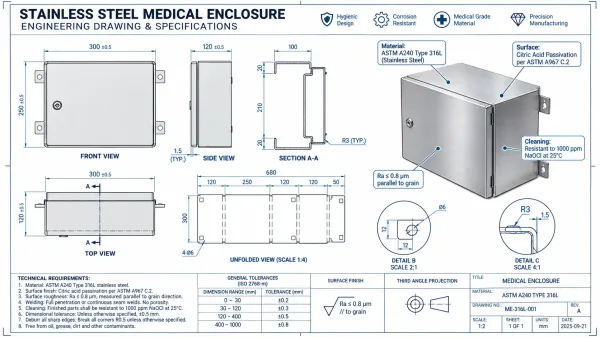
An example engineering drawing callout showing how to properly specify cleaning chemical resistance requirements on a medical sheet metal drawing.
Validation and Testing Methods
Verification that a part meets cleaning chemical resistance requirements requires testing, not just material certificates.
Immersion testing (ASTM G31) is the most direct method. Coupons or finished parts are immersed in the target cleaning agent at the specified concentration and temperature for a defined period. Mass loss, surface appearance, and pitting density are measured. For medical applications, 72-hour immersion with mass loss below 0.5 mg/cm² is a common acceptance threshold.
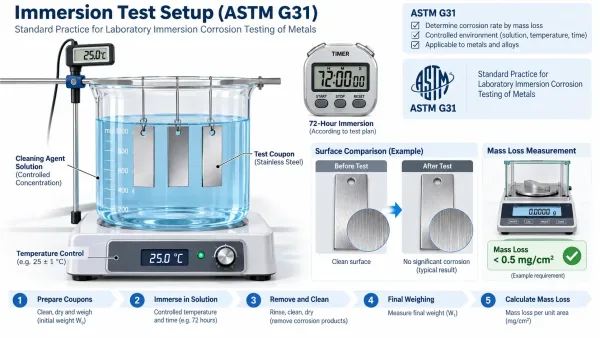
A diagram showing the standard immersion testing setup used to validate cleaning chemical resistance of stainless steel medical components.
Salt spray testing (ASTM B117) evaluates general corrosion resistance but does not directly simulate cleaning agent exposure. It is useful for comparing surface treatments but should not be the sole acceptance criterion for cleaning chemical resistance.
Electrochemical testing (potentiodynamic polarization) measures the material’s pitting potential in a specific electrolyte. Higher pitting potentials indicate better resistance. This method is faster than immersion testing but requires specialized equipment and interpretation.
Cleanliness testing (contact angle measurement, surface energy analysis) evaluates how easily a surface can be cleaned, which is distinct from chemical resistance. A surface that is easy to clean requires less aggressive cleaning agents and shorter exposure times.
For procurement, the practical approach is to require material certificates (EN 10204 Type 3.1) for base material, surface treatment certificates referencing the process standard, and a cleaning agent compatibility statement from the fabricator. Immersion testing is warranted for new suppliers, new materials, or changed cleaning protocols.
Procurement Checklist for Medical Sheet Metal Parts
When ordering sheet metal parts for medical applications with cleaning chemical resistance requirements, verify these items before confirming the order:
- Material certificate (EN 10204 Type 3.1) confirms grade, chemistry, and mechanical properties
- Surface treatment is specified with process standard (not just “passivated”)
- Surface roughness requirement is stated with measurement method and location
- Cleaning agent compatibility is defined with specific agents, concentrations, and temperatures
- Validation test method is specified with acceptance criteria
- Welding procedure (if applicable) addresses HAZ sensitization and post-weld treatment
- Minimum bend radius (if applicable) accounts for stress corrosion risk in cleaning environment
- Packaging protects the treated surface from contamination and damage during shipping
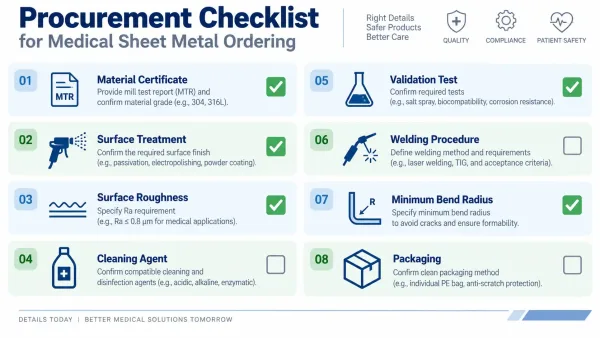
A visual checklist summarizing the eight key verification items when ordering medical sheet metal parts with cleaning chemical resistance requirements.
FAQ