
The Unique Constraints of Electronic Enclosures: Why Surface Treatment Choice Matters
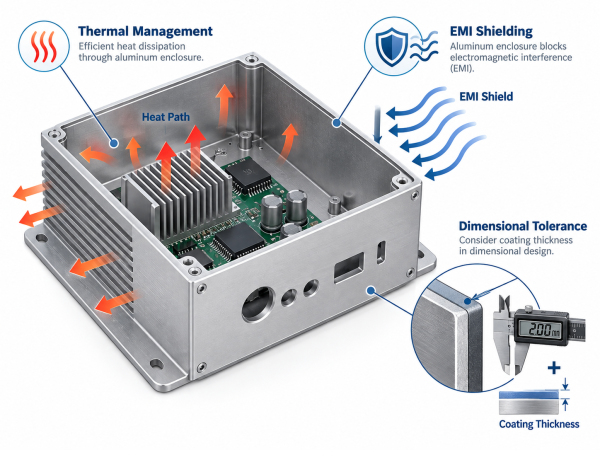
This diagram visually explains the three critical engineering requirements—thermal management, EMI shielding, and dimensional tolerance—that surface treatments for electronic enclosures must address.
Electronic enclosures are not just protective boxes; they are active components in the device’s performance. The surface treatment must address three non-negotiable engineering requirements.
First, thermal management is critical. Many electronics generate significant heat, and the enclosure often acts as a heatsink. A finish that insulates the aluminum can trap heat, reducing component lifespan and reliability.
Second, electromagnetic interference (EMI) shielding is essential for preventing both emission and susceptibility. An electrically insulating coating can break the conductive path needed for effective shielding.
Third, dimensional tolerance and assembly fit are paramount. Coatings add thickness, which can interfere with tight-fitting assemblies, gaskets, and connectors if not properly accounted for in the design.
What Is Black Anodizing? Process, Properties, and Suitability for Electronics
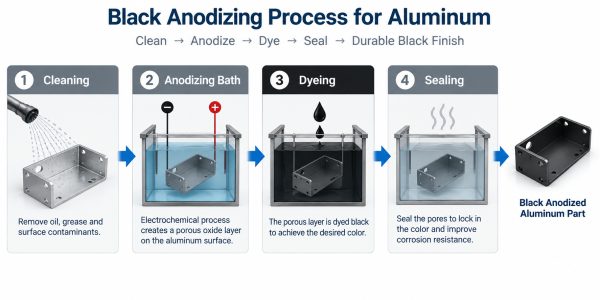
This flowchart breaks down the black anodizing process into its four primary stages, providing a clear overview of how the finish is created.
Black anodizing is a specific type of anodic oxidation process for aluminum. It involves two primary steps: first, an electrochemical process that converts the aluminum surface into a porous aluminum oxide layer; second, this layer is dyed black and then sealed to lock in the color.
The resulting finish is not a paint or plating but an integral part of the aluminum substrate itself.
Key properties relevant to electronics include high hardness (resisting scratches and abrasion), excellent corrosion resistance, and good dielectric strength. However, this dielectric property—the very reason it is a good electrical insulator—is also its main drawback for EMI shielding applications.
Evaluating the Alternatives: A Survey of Competing Finishes
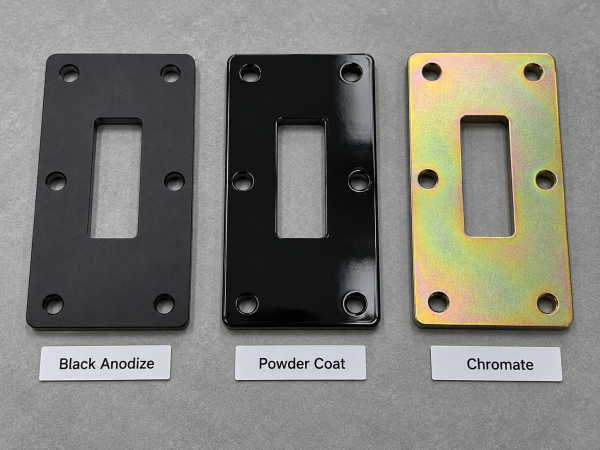
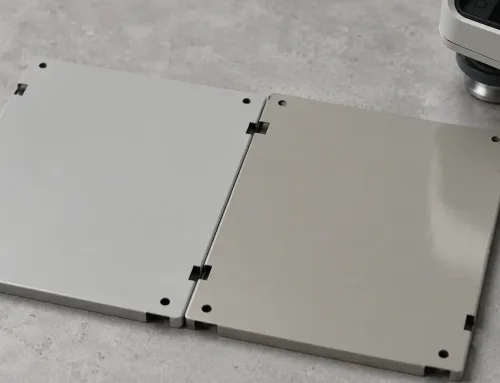
This photo provides a direct visual comparison of the three main surface treatment options discussed in the article, highlighting differences in texture, gloss, and color.
When specifying a finish for an aluminum electronic enclosure, engineers typically consider several alternatives to black anodizing.
Powder coating is a popular choice, offering a thick, durable, and aesthetically versatile finish. It can be formulated for different textures and gloss levels.
Chromate conversion coating, often called chem film or Alodine, provides good corrosion resistance and, crucially, maintains electrical conductivity.
For applications where EMI shielding is paramount, specialized conductive coatings or selective plating on mating surfaces may be required.
Each alternative presents a different balance of properties, cost, and manufacturability.
Head-to-Head Comparison: Black Anodizing vs. Key Alternatives
The following table provides a direct comparison of black anodizing against its common alternatives across critical performance dimensions for electronic enclosures.
| Property / Finish | Black Anodizing | Powder Coating | Chromate Conversion (Chem Film) |
|---|---|---|---|
| Thermal Impact | Low thermal conductivity; insulating layer adds thermal resistance. | Higher thermal resistance than anodizing due to thicker polymer layer. | Very thin layer; minimal impact on thermal performance. |
| Electrical Conductivity | Non-conductive (dielectric). Breaks EMI shielding paths. | Non-conductive unless specifically formulated with conductive fillers. | Conductive. Maintains grounding paths and EMI shielding. |
| Durability & Wear | Excellent hardness and abrasion resistance. Integral to the metal. | Good impact and abrasion resistance, but can chip or scratch. | Moderate; softer than anodizing, provides a good paint base. |
| Cost & Lead Time | Moderate cost. Requires racking; lead time can be longer for consistent color. | Generally cost-effective for high volumes. Faster cure times. | Low cost. Simple immersion process; fast turnaround. |
| Aesthetic & Color | Deep, consistent matte black. Limited color range without dye changes. | Wide range of colors, textures (smooth, textured, wrinkle). | Gold or greenish-yellow iridescent film; typically not a final aesthetic finish. |
Selection Framework: Matching the Finish to Your Product
Choosing the right finish depends on prioritizing your product’s core requirements.
For consumer electronics and aesthetic-driven products (e.g., audio equipment, premium routers), the deep matte black of anodizing is often preferred for its premium feel, provided thermal and EMI are managed through other design means (e.g., internal heatsinks, conductive gaskets).
For industrial control systems and ruggedized equipment, where durability and corrosion resistance are key, black anodizing or powder coating are strong contenders.
For outdoor telecom cabinets, military, or high-reliability applications where EMI shielding and corrosion resistance are both critical, chromate conversion coating (sometimes with a subsequent paint) or a selective finishing approach—using conductive finishes on mating surfaces and anodizing elsewhere—becomes a necessary engineering compromise.
Specifying Black Anodizing on Your Drawings: Critical Callouts
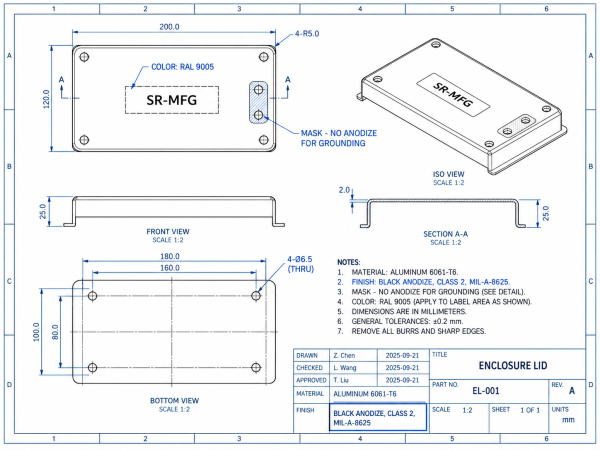
This example drawing demonstrates the proper way to call out black anodizing specifications, including thickness class, masking for grounding, and color reference, to ensure clear communication with manufacturers.
To avoid quotes delays and quality issues, your drawing must be explicit. Do not simply note “black anodize.”
Specify the thickness class (e.g., Class 1 for 0.7 mils or Class 2 for 1.0 mils per MIL-A-8625), as this affects both performance and dimensional tolerance.
Clearly mask areas that require electrical grounding, such as mounting points, connector cutouts, or EMI gasket lands, by cross-hatching and noting “NO ANODIZE” or “MASK FOR GROUNDING.”
Reference the applicable industry standard (MIL-A-8625 is common).
If color consistency is critical, provide a color chip number from a standard like RAL or Pantone.
DFM and Cost Optimization for Black Anodized Enclosures
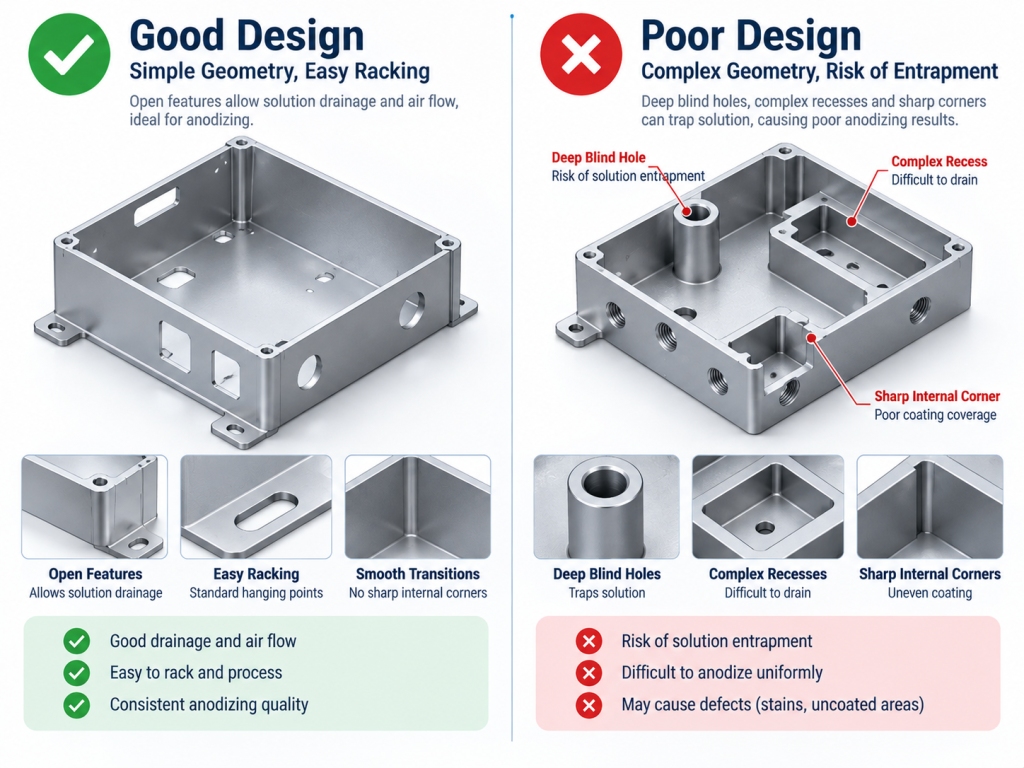
This illustration contrasts favorable and unfavorable part designs for the anodizing process, emphasizing how geometry affects coating uniformity, solution drainage, and racking efficiency.
Several design choices significantly impact the cost and quality of black anodizing.
Part geometry affects racking: deep recesses or blind holes can lead to uneven coating or solution entrapment. Design for easy racking to ensure consistent current distribution.
The choice of aluminum alloy influences the final color; 6061-T6 typically yields a darker, more consistent black than 5052-H32.
For small batch sizes, be aware that color matching between batches can be challenging and may incur a premium.
To optimize cost, standardize your coating thickness requirement across parts, avoid unnecessarily tight thickness tolerances, and ensure your design allows for efficient rinsing and drainage during the process.
FAQs
Ready to specify black anodizing for your next enclosure project?
Upload your CAD files to our platform for a free DFM review and instant quote. Our engineers will analyze your design for anodizing compatibility, suggest optimizations for cost and performance, and provide a clear breakdown of pricing and lead time. Get started today.