
When you request a quote for custom sheet metal parts, the supplier’s response often includes a minimum order quantity (MOQ). This number can feel like an arbitrary barrier—especially when you only need a small batch for prototyping or a limited production run. But MOQ is not a negotiating tactic or a sales gate. It is a cost threshold that reflects how much it actually costs the supplier to set up, produce, and deliver your order.
Understanding what drives MOQ helps you read quotes more accurately, ask better questions during the RFQ process, and make sourcing decisions based on cost structure rather than headline numbers.
What Is Minimum Order Quantity (MOQ)?
Minimum order quantity is the smallest number of units a supplier is willing to produce in a single order. If a supplier sets an MOQ of 50 pieces and you order 30, the quote will either be rejected or adjusted to reflect the higher per-unit cost of a below-MOQ run.
MOQ applies to custom manufacturing—sheet metal fabrication, CNC machining, injection molding—not to off-the-shelf products stocked in warehouses. In custom production, every order requires setup: programming the laser, loading the press brake, preparing fixtures, sourcing material. These setup costs are fixed regardless of whether the supplier makes 10 parts or 1,000. MOQ exists because suppliers need to spread those fixed costs across enough units to make the order economically viable.
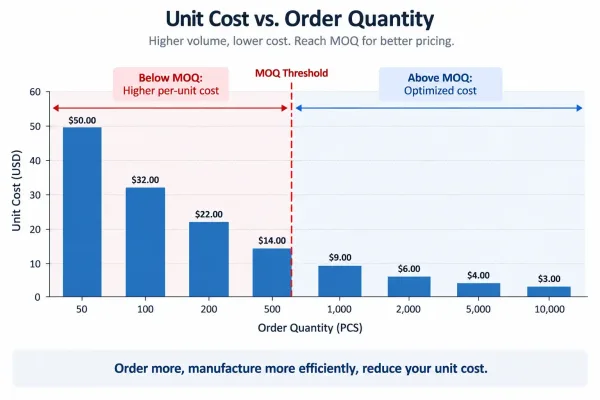
This diagram illustrates MOQ as a cost threshold, showing how per-unit cost decreases as order quantity increases above the minimum.
The concept is sometimes confused with EOQ (Economic Order Quantity), which is a buyer-side calculation for optimal reorder size. MOQ is a supplier-side threshold; EOQ is a buyer-side optimization.
Why Suppliers Set MOQ: The Cost Breakdown
Suppliers do not set MOQ to discourage small orders. They set it because below a certain quantity, the per-unit cost becomes so high that neither the buyer nor the supplier benefits. The cost structure behind MOQ includes four main components:
Setup and changeover costs. Every production run requires machine setup—loading the program, installing tools, adjusting fixtures. For a laser cutter, this might take 15–30 minutes. For a press brake with custom tooling, setup can take an hour or more. These costs are fixed per order, not per part. When you order 10 parts, the setup cost per part is 100 times higher than when you order 1,000.
Material procurement costs. Sheet metal comes in standard sheet sizes (4×8 ft, 5×10 ft) or coil widths. If your part requires a specialty alloy or a non-standard thickness, the supplier must order a full sheet or coil from the mill, often with its own minimum order. The leftover material may sit in inventory for months, tying up capital. MOQ helps suppliers recover material costs within a reasonable timeframe.
Process and labor costs. Each production step—cutting, bending, welding, finishing—requires operator time, quality checks, and documentation. Small orders consume nearly the same labor as large ones. A 5-piece order and a 500-piece order both require a first-article inspection, job traveler, and packaging.
Overhead allocation. Facilities, equipment depreciation, utilities, and indirect labor are spread across all production volume. Lower volume means higher overhead per unit. MOQ ensures the supplier can allocate overhead without operating at a loss.
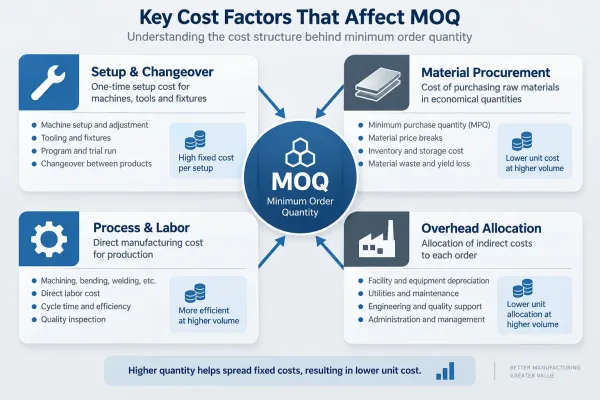
This infographic breaks down the four main cost components that drive MOQ: setup costs, material costs, process/labor costs, and overhead allocation.
How Material Costs Drive MOQ
Material is often the largest cost component in sheet metal fabrication, and it directly influences MOQ. Here is how:
Standard vs. specialty materials. Cold-rolled steel (CRS), galvanized steel, and common aluminum alloys (5052, 6061) are stocked by most suppliers in standard thicknesses. These materials have low procurement barriers—the supplier can pull from existing inventory. Specialty materials—titanium, Inconel, copper alloys, or DFARS-compliant steel—require dedicated orders from certified mills, often with minimum purchase quantities of 1,000 lbs or more. When your part requires specialty material, the supplier’s MOQ reflects the need to consume enough material to justify the purchase.
Sheet utilization and nesting. Laser cutting and turret punching use nesting software to maximize material utilization. A small order may only use 10% of a sheet, leaving 90% as scrap or inventory. Suppliers factor this waste into the MOQ. If your part has a complex shape that nests poorly, the effective material cost per unit rises, pushing MOQ higher.
Thickness and grade availability. Common thicknesses (0.060″, 0.105″, 0.187″) are stocked in high volume. Unusual thicknesses—say, 0.075″ or 0.135″—may need to be ordered from the mill with a multi-week lead time and a minimum quantity. The supplier’s MOQ for your order will reflect the cost of carrying that non-standard inventory.
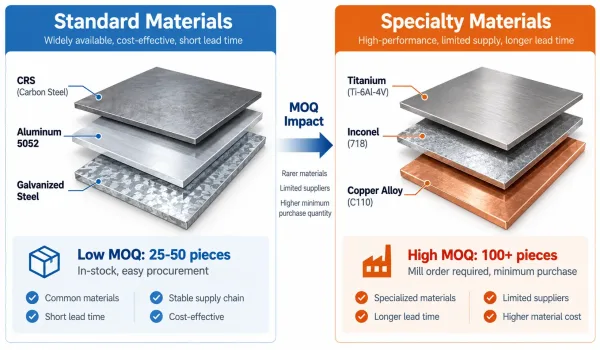
This comparison shows how standard materials like CRS and aluminum result in lower MOQs, while specialty alloys require higher MOQs due to procurement minimums.
How Setup Costs Affect MOQ
Setup costs are the most visible driver of MOQ in sheet metal fabrication. They include:
Machine programming and tooling. A laser cutting program must be created or adapted for each part geometry. A press brake requires specific punch and die sets, which may need to be installed and adjusted. These activities take 15–60 minutes per setup, depending on complexity. For a simple bracket, setup might be 20 minutes. For a multi-bend enclosure with tight tolerances, it could be 90 minutes.
Fixture preparation. Parts that require welding, assembly, or secondary operations often need custom fixtures. Fixtures ensure repeatability—every part comes out the same. Building a fixture is a one-time cost, but it adds to the first order’s NRE (non-recurring engineering). MOQ helps amortize fixture cost across enough units to keep the per-part charge reasonable.
First-article inspection. Before full production, the supplier runs a first article and inspects it against the drawing. This inspection takes time—dimensional checks, surface finish verification, material certification review. It is a fixed cost per order. For a 5-piece order, first-article inspection might add 50–100 per part. For a 500-piece order, it adds 0.10–0.20 per part.
Why small batches cost more per unit. The math is straightforward. If setup costs 200andyouorder10parts,setupadds20 per part. If you order 500 parts, setup adds $0.40 per part. Suppliers set MOQ at the point where setup cost per unit is low enough to keep the total price competitive. This is why many sheet metal suppliers set MOQ between 25 and 100 pieces—below that range, setup cost per unit becomes a significant portion of the total price.
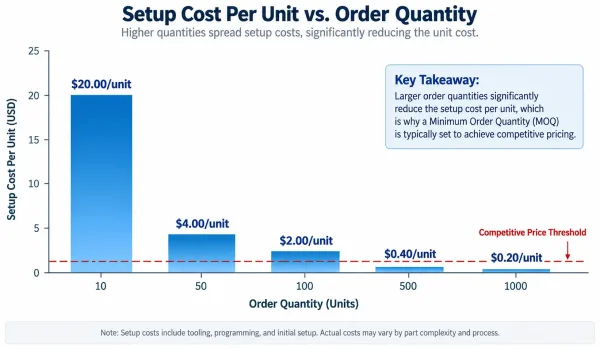
This chart demonstrates how fixed setup costs are distributed across more units in larger orders, reducing the per-unit setup cost contribution.
How Outsourced Processes Add to MOQ
Many sheet metal parts require secondary operations that the primary fabricator does not perform in-house. These outsourced processes—powder coating, anodizing, plating, heat treatment, specialty welding—each have their own MOQs, which compound the final part MOQ.
Surface finishing MOQs. Powder coating and anodizing shops typically set MOQs based on batch size, not per-part quantity. A powder coater may require a minimum batch of 50 sq ft of surface area. If your part is 1 sq ft, the effective MOQ is 50 parts—even if the fabricator’s own MOQ is lower. When your order is smaller than the finishing shop’s batch minimum, the per-part finishing cost rises sharply because the finishing shop must run a partial batch or combine your parts with other orders (which adds sorting, masking, and scheduling complexity).
Heat treatment and plating. Processes like heat treatment or zinc plating often have minimum charge thresholds—say, $150 per batch. For a small order, this fixed charge becomes a large per-part cost. The fabricator’s MOQ must account for these downstream costs, or the quote will not cover the actual production expense.
Lead time and coordination. Outsourced processes add logistics time—transport to and from the finishing shop, scheduling, quality checks at each handoff. Small orders are harder for finishing shops to schedule efficiently, which can extend lead time. Some fabricators set higher MOQs for parts requiring outsourced finishing to ensure the order is large enough to justify the coordination effort.
How this affects your MOQ. If your part requires laser cutting, bending, welding, and powder coating, the final MOQ is not the fabricator’s MOQ—it is the highest MOQ across all process steps. Ask your supplier to break down the MOQ by process step so you can see where the threshold originates. This is especially useful if you are considering design changes that might eliminate a secondary operation.
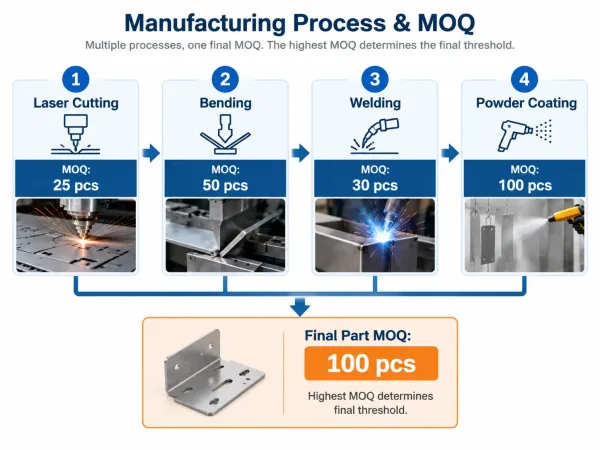
This flowchart illustrates how MOQs from each manufacturing step—laser cutting, bending, welding, and powder coating—compound to determine the final part MOQ.
Key Takeaways
MOQ is not a fixed number—it is a reflection of your part’s cost structure. Parts with simple geometry, standard materials, and no outsourced finishing will have lower MOQs. Parts with complex bends, specialty alloys, and multiple secondary operations will have higher MOQs.
When reviewing quotes, ask the supplier to explain the MOQ. A transparent supplier will break down the cost drivers: setup time, material procurement, outsourced processes, and overhead allocation. This information helps you evaluate whether the MOQ is reasonable and whether design changes could reduce it.
If your order is below the stated MOQ, expect a higher per-unit price. The supplier is not punishing you for a small order—they are covering the fixed costs that do not scale with quantity.
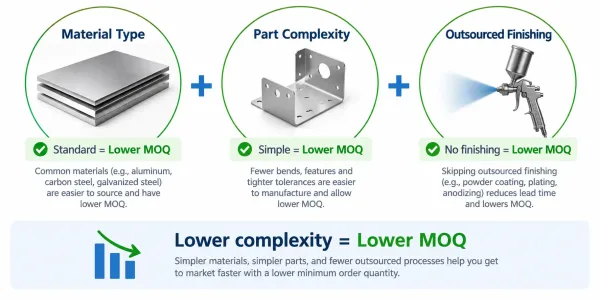
This summary infographic highlights the three main factors that determine MOQ levels: material type, part complexity, and outsourced finishing requirements.
FAQ
This content is for informational purposes only. Actual MOQ varies by supplier, part complexity, material, and process requirements. Contact your supplier for specific MOQ and pricing for your project.