
When a sheet metal prototype or small production run needs a protective or decorative finish, engineers often default to whichever process they used last time. That shortcut works—until the parts come back with chipped coating on bent edges, dimensions that no longer fit the assembly, or a per-part cost that eats half the project budget.
Powder coating and anodizing are the two most common finishing options for sheet metal parts. They both protect against corrosion and improve appearance, but they work through fundamentally different mechanisms, behave differently on sheet metal geometry, and carry very different cost structures at low volumes. Choosing the right one starts with understanding what each process actually does to your part.
What Actually Changes Between the Two Processes
The powder coating process is additive. A dry powder—typically polyester, epoxy, or a blend—is electrostatically sprayed onto the part surface, then cured in an oven at 160–200 °C. The powder melts, flows, and cross-links into a continuous film that bonds mechanically to the substrate. The coating sits on top of the metal.
Anodizing is a conversion process. The part is submerged in an acid electrolyte bath (usually sulfuric acid) and connected as the anode in an electrical circuit. The controlled current converts the aluminum surface into aluminum oxide (Al₂O₃). The oxide layer grows inward from the original surface—roughly half the layer builds into the metal, half builds outward. This means anodizing changes the surface itself rather than adding a separate layer.
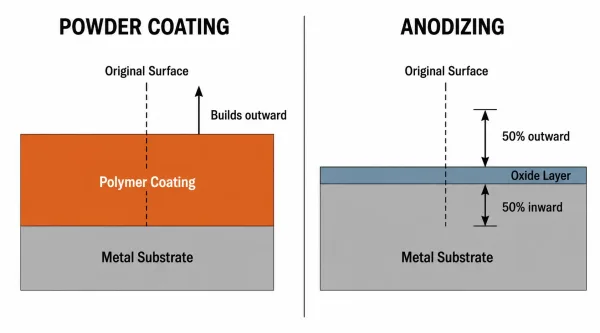
Cross-section comparison showing how powder coating builds a polymer film on top of the metal surface, while anodizing converts the aluminum surface into an aluminum oxide layer that grows partially inward.
The distinction matters for sheet metal parts. A powder-coated part becomes slightly larger in every dimension. An anodized part stays very close to its original size. That difference directly affects how parts fit together in assemblies.
Performance Comparison That Matters for Sheet Metal
Film Thickness and Dimensional Impact
Powder coating typically adds 60–120 µm (0.06–0.12 mm) per side. On sharp edges and tight bends—which are common in sheet metal—the coating can build up to 150 µm or more due to the “Faraday cage” effect, where electrostatic charge concentrates at edges and attracts excess powder.
Anodizing adds only 5–25 µm per side for Type II (standard decorative) and 25–150 µm for Type III (hardcoat). Standard sheet metal parts almost always use Type II, so the dimensional change is minimal—typically under 0.025 mm per side.
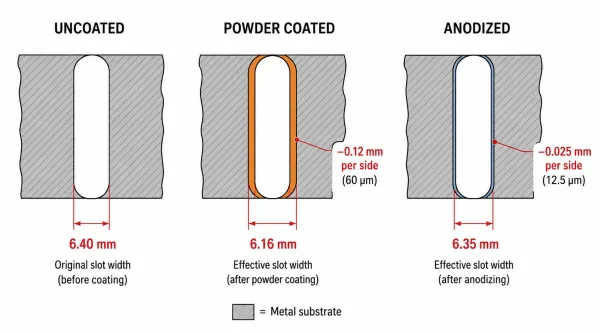
Cross-section of a sheet metal slotted hole showing how powder coating (60–120 µm per side) reduces the effective slot width by up to 0.24 mm, while anodizing (5–25 µm per side) reduces it by only 0.01–0.05 mm.
For a sheet metal bracket with a slotted hole designed for an M6 bolt, 60 µm of powder coating on each side reduces the effective slot width by 0.12 mm. On a tight-tolerance slot (±0.1 mm), that can push the part out of spec. Anodizing would reduce the same slot by only 0.01–0.025 mm—well within typical sheet metal tolerances.
Corrosion and Wear Resistance
Powder coating provides a physical barrier between the environment and the metal. A well-applied polyester powder coat on steel or aluminum can pass 1,000+ hours of salt spray testing (ASTM B117). However, once the coating is chipped or scratched, corrosion can spread underneath the film—often invisibly at first.
Anodizing creates a hard ceramic-like oxide layer that is chemically bonded to the aluminum. Type II anodizing provides good corrosion resistance for most indoor and mild outdoor environments. The oxide layer is extremely hard (around 9 on the Mohs scale, comparable to sapphire), so it resists scratching and abrasion far better than powder coating. However, anodizing only works on aluminum and titanium—it cannot be applied to steel or stainless steel.
For sheet metal parts that see handling wear (brackets, covers, chassis), powder coating is more forgiving of impact because the polymer film absorbs energy. Anodizing is harder but more brittle—a sharp impact can crack the oxide layer.
Appearance and Color Options
Powder coating offers virtually unlimited color choice. RAL, Pantone, and custom color matching are standard. The sheet metal surface finish can be smooth, textured, matte, or gloss. It also covers surface defects like machining marks and minor scratches, which is useful when cosmetic consistency matters across a batch.
Anodizing produces a metallic appearance that preserves the look of the underlying aluminum. Color options are limited—clear (silver), black, gold, bronze, and a few other tones are standard. Custom colors are possible but less predictable because the final shade depends on the aluminum alloy, surface preparation, and bath chemistry. Batch-to-batch color variation is a known issue with anodizing, especially across different production runs.
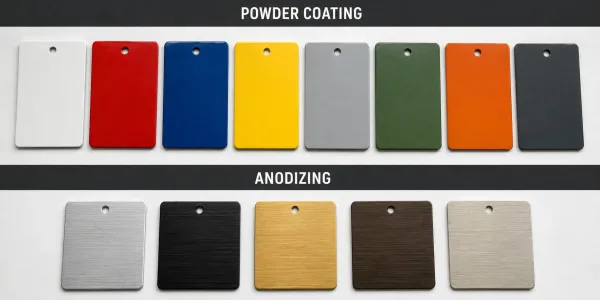
Powder coating offers a wide range of RAL and Pantone colors (top row), while anodizing is limited to metallic tones that preserve the natural aluminum appearance (bottom row).
How Low-Volume Production Changes the Cost Equation
In low-volume sheet metal fabrication, the per-part cost difference between powder coating and anodizing shifts significantly depending on batch size.
For powder coating, the main fixed costs are oven setup, masking preparation, and color changeover. A small batch (1–10 parts) might cost $15–40 per part because these setup costs spread across very few pieces. At 100+ parts, the per-part cost can drop to $3–8 because the setup is amortized. If the project requires a non-standard color, the powder manufacturer may charge a minimum order of 20–50 kg—enough for hundreds of parts, which makes small-batch custom colors disproportionately expensive.
For anodizing, the main fixed costs are racking (mounting parts on the cathode jig), bath maintenance, and masking. Small batches (1–10 parts) typically cost $20–50 per part. At 50–100 parts, the cost drops to $5–15 per part. Special requirements—like tight color matching, Type III hardcoat, or complex masking for threaded holes—add to the cost at any volume.
A practical rule of thumb: for simple aluminum sheet metal parts in standard colors, powder coating is usually cheaper above 30–50 parts. Below that threshold, costs are comparable, and the decision should be driven by function rather than price.
One factor that often gets overlooked: rework cost. If a powder-coated part fails inspection (wrong color, poor adhesion, coating damage), it must be stripped and recoated—adding another cycle of labor and oven time. An anodized part that fails inspection is harder to rework because the oxide layer must be chemically stripped, which can affect dimensions. Both processes carry rework risk at low volumes where process control is less consistent.
Design Considerations Specific to Sheet Metal Parts
Edge Coating Buildup
Sheet metal parts are cut before forming—laser cutting, punching, or shearing leaves exposed edges. Powder coating tends to build up thicker on these sharp edges, creating a visible “picture frame” effect where edges appear darker or glossier than flat surfaces. Worse, the coating on sharp edges is more prone to chipping under impact.
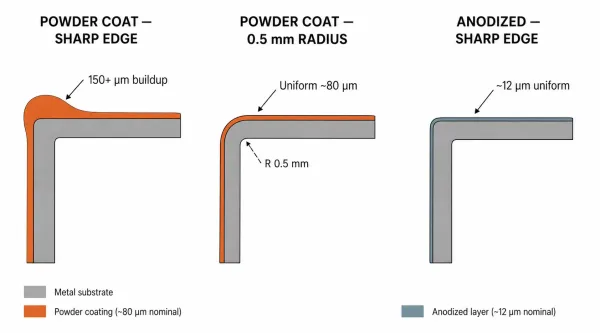
Powder coating builds up significantly on sharp sheet metal edges due to the Faraday cage effect, while anodizing maintains a more uniform thin layer across edges and flat surfaces.
To manage this, specify a minimum edge radius of 0.5 mm on powder-coated parts. A small chamfer or radius breaks the edge sharpness and allows more uniform coating thickness. For anodizing, edge buildup is far less significant because the layer is much thinner.
Weld Seams
Welds on sheet metal parts create localized surface texture changes. Powder coating can cover minor weld imperfections, but deep undercuts or spatter will show through the finish. Anodizing follows the original surface closely, so weld marks and heat-affected zones often appear as color variations after anodizing.
If the part has visible welds and cosmetic appearance matters, powder coating is more forgiving. If dimensional accuracy at the weld zone matters, anodizing preserves the original geometry more faithfully.
Threaded Holes and Assembly Surfaces
Powder coating covers everything—including threaded holes and mating surfaces. If an M5 tapped hole gets coated, the coating must be removed or the bolt will not thread properly. Options include masking (plugs inserted before coating) or post-coating re-tapping. Both add cost and time, especially at low volumes where masking labor is a larger share of the total.
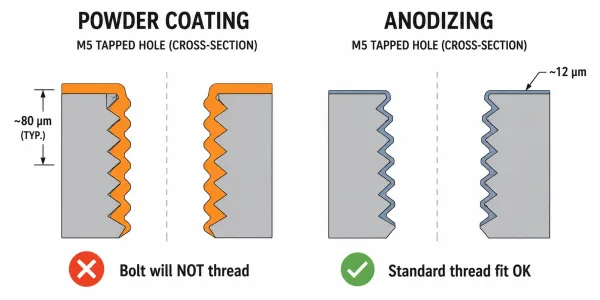
Powder coating fills and covers tapped threads requiring masking or re-tapping, while anodizing’s thin oxide layer (5–25 µm) typically does not interfere with standard thread engagement.
Aluminum anodizing also coats threaded holes, but the much thinner layer (5–25 µm) usually does not interfere with standard thread fits. For most tapped holes on sheet metal parts, anodizing does not require masking.
Thin Sheet Warping Risk
Parts under 2 mm thick are more sensitive to thermal processes. Powder coating curing at 180–200 °C can cause slight warping on large flat thin panels, especially if the part has asymmetric cutouts or stiffening features. Anodizing operates at lower temperatures (around 20 °C for the bath, with some heating during sealing), so thermal distortion risk is minimal.
For thin, flat sheet metal parts (panels, covers, enclosures), consider anodizing if dimensional flatness is critical. For formed parts with bends and flanges, the structural rigidity from forming usually prevents warping during powder coating.
When to Choose Powder Coating vs Anodizing
The table below summarizes the decision logic for sheet metal parts:
| Your Part Needs | Better Choice | Why |
|---|---|---|
| Color matching to a specific RAL/Pantone | Powder coating | Wide color range, consistent batch-to-batch |
| Aluminum part with metallic appearance | Anodizing | Preserves natural aluminum look |
| Steel or stainless steel substrate | Powder coating | Anodizing only works on aluminum/titanium |
| Tight dimensional tolerance on assembly fits | Anodizing | Minimal thickness addition (5–25 µm) |
| Impact resistance (parts see handling/mounting) | Powder coating | Polymer film absorbs impact better |
| Scratch and abrasion resistance | Anodizing (Type III) | Harder surface (Mohs ~9) |
| Large flat panels where flatness matters | Anodizing | No high-temperature curing step |
| Cost-sensitive batch of 100+ parts | Powder coating | Better economy of scale |
| Low volume (1–20 parts) in standard color | Either—compare quotes | Setup costs are comparable |
| Parts with many tapped holes | Anodizing | Usually no masking needed |
If the part is aluminum and the primary concern is cosmetic appearance in a specific color, powder coating is the default. If the part is aluminum and the primary concern is dimensional precision or wear resistance, anodizing is the default. If the part is steel or stainless steel, powder coating is the only option of the two.
How to Verify Finish Quality on Incoming Parts
For low-volume production where every part counts, a pre-shipment inspection before incoming QC is worth the effort. Here is what to check:
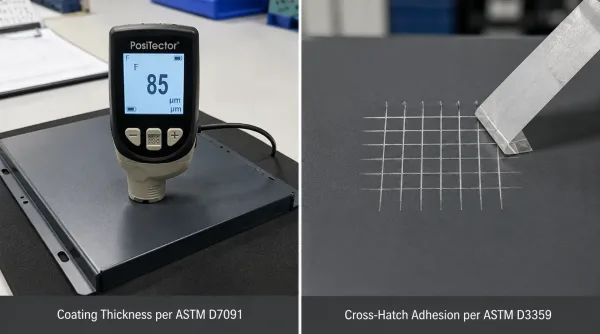
Key incoming inspection methods for finished sheet metal parts: coating thickness measurement with an eddy-current gauge (left) and cross-hatch adhesion test per ASTM D3359 (right).
Powder coating:
- Film thickness: Measure with a magnetic or eddy-current gauge per ASTM D7091. Target range: 60–120 µm on flat surfaces, no more than 150 µm on edges.
- Adhesion: Perform a cross-hatch (grid) test per ASTM D3359. Rating 4B or 5B is acceptable—no more than 5% coating removal.
- Visual inspection: Check for orange peel texture, runs, sags, pinholes, and bare spots—especially on inside corners and edges.
Anodizing:
- Film thickness: Measure with an eddy-current gauge. Type II target: 5–25 µm.
- Seal quality: A dye spot test (ASTM B136) checks whether the anodic layer is properly sealed. Poor sealing leads to premature corrosion.
- Color consistency: Compare against a reference sample if color matching is specified. Accept that minor batch variation is inherent to anodizing.
For both processes:
- Salt spray resistance: If the parts are for outdoor or marine environments, request salt spray test results per ASTM B117. Common requirements: 500 hours (indoor use), 1,000 hours (outdoor), 2,000+ hours (marine/coastal).
Key Takeaways
- Powder coating adds a polymer film on top of the metal; anodizing converts the aluminum surface into an oxide layer. The mechanism difference drives everything else.
- Film thickness matters for sheet metal assemblies. Powder coating adds 60–120 µm per side; anodizing adds 5–25 µm. Design your tolerances accordingly.
- At low volumes (1–20 parts), cost differences are driven by setup and masking, not material. Get quotes from both processes before deciding.
- For steel and stainless steel sheet metal, powder coating is the only option. Anodizing is limited to aluminum and titanium.
- Sheet metal-specific issues—edge buildup, weld appearance, tapped hole masking, and thin-panel warping—should influence your choice as much as material and color.
Looking for a finish recommendation for your sheet metal parts? Upload your drawing for a free DFM review, and we will advise on the best finishing option based on your material, geometry, and volume requirements.