
Unit price and tooling cost alone will not tell you which process is cheaper. Teams that compare a sheet metal quote to a die casting quote line by line often pick the wrong path—not because the numbers are wrong, but because the two quotes do not describe the same finished part. Total cost is what matters: every dollar spent from raw stock or molten metal through a part you can install. This guide compares sheet metal fabrication and die casting on that basis so you can decide with a clear cost model before you commit to a process.
What “Total Cost” Means for These Two Processes
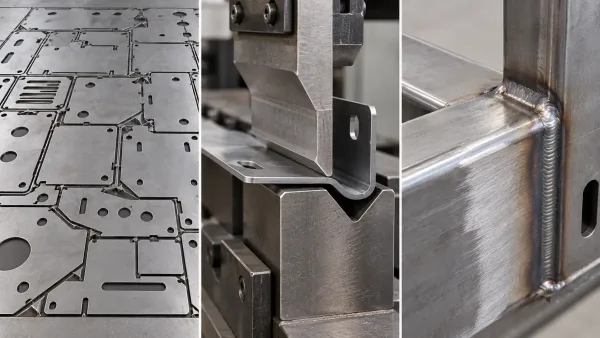
This diagram lists the shared total-cost buckets—fixed investment, material, core manufacturing, secondary ops, finishing, assembly, and quality—so readers can compare both processes on the same cost scope.
Total cost, in this comparison, is the cost of a ready-to-assemble component—not the cost of a flat blank or a raw casting. It includes fixed and variable spend that often sits on different purchase orders.
A practical total-cost frame for both processes looks like this:
- Fixed process investment: soft tooling, press fixtures, and setup for sheet metal; die and NRE (non-recurring engineering) for die casting
- Material: sheet stock and nesting yield versus alloy and runner/gate scrap
- Core manufacturing: cutting, bending, welding or fastening versus shot cycle, trim, and ejection
- Secondary operations: machining, tapping, and insertion either way
- Surface treatment: paint, powder coat, anodize, or as-cast / as-fabricated condition
- Assembly and handling: number of parts, joints, and touch labor
- Quality and risk: scrap, rework, and dimensional disputes
Why Unit Price and Tooling Cost Alone Mislead Buyers
A lower unit price on a welded sheet metal assembly can hide hours of fit-up, grinding, and coating. A high die mold cost can look prohibitive until you divide it across tens of thousands of parts and remove machining steps the casting already forms. If the two quotes do not both describe a finished, coated, inspected component, you are not comparing total cost—you are comparing accounting lines.
How Sheet Metal Fabrication Builds Cost
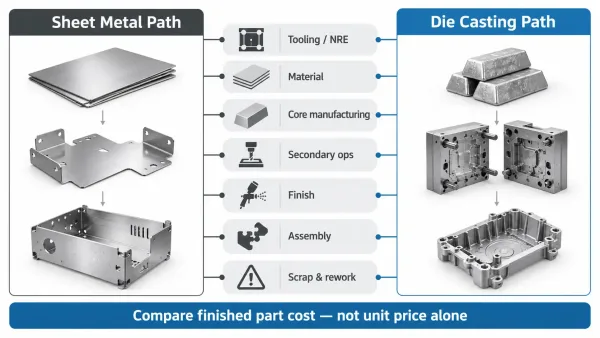
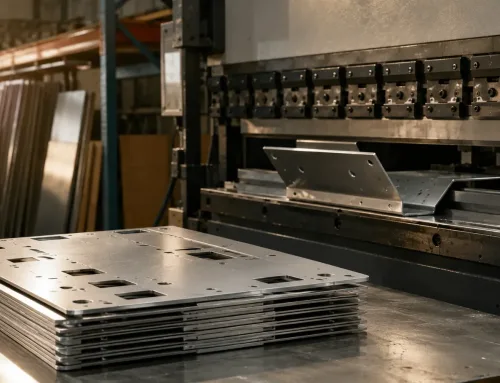
This composite image shows three sheet metal cost drivers—nested flat parts on raw sheet, a bend being formed, and a welded joint on an assembly—representing material use, forming, and joining labor.
Sheet metal fabrication forms parts from flat stock: laser or punch cutting, bending on a press brake, then joining and finishing. There is usually little or no hard tooling for low and medium volumes, which is why fabrication often wins early in a product life.
Material, Thickness, and Nesting
Material is a large share of fabricated cost. Nesting efficiency—how tightly parts pack on a sheet—drives scrap. Simple brackets nest well; large, irregular panels do not. Thickness affects more than pounds of steel: thicker stock needs more cut energy, higher bend tonnage, and can limit inside bend radii. Specifying a thicker sheet “to be safe” can raise material, cutting, and finishing cost without buying the stiffness you need if the geometry is wrong.
Joining, Finishing, and Assembly Labor
Most fabricated enclosures and frames are multi-piece. Every weld, rivet, or fastener adds labor, inspection, and distortion risk. Grinding and re-coating after welding are common hidden lines. Surface area drives paint or powder cost, and cut edges and weld zones need prep. As piece count or joint count rises, fabrication’s low-tooling advantage can erode in labor and rework.
How Die Casting Builds Cost
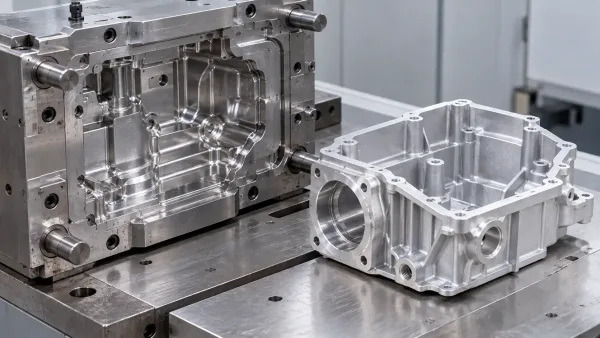
This image pairs a production die tool with a die cast aluminum part that still shows CNC machining on critical faces, illustrating tooling investment and post-cast finishing.
Die casting injects molten metal—often aluminum, zinc, or magnesium—into a steel die under pressure. The economics center on tooling amortization and near-net-shape parts.
Tooling and NRE
A production die is a major fixed cost and a long-lead item. That cost only pays back when volume is high enough and the design is stable enough to run the die for its intended life. Engineering the die—parting lines, gates, slides, and ejection—is NRE on top of the steel. Design changes after cutting metal are expensive, so die casting assumes a frozen or near-frozen design.
Secondary Machining and Finishing After Casting
Castings are near net shape, not always finished parts. Critical faces, bores, and threads may still need CNC. Flash removal, surface prep, and coating still apply. If a cast housing still needs extensive machining or cosmetic sorting, part of the unit-cost advantage disappears. Material and wall thickness also matter: thicker sections raise cycle time and mass; very thin walls can raise scrap.
Where Total Cost Curves Cross
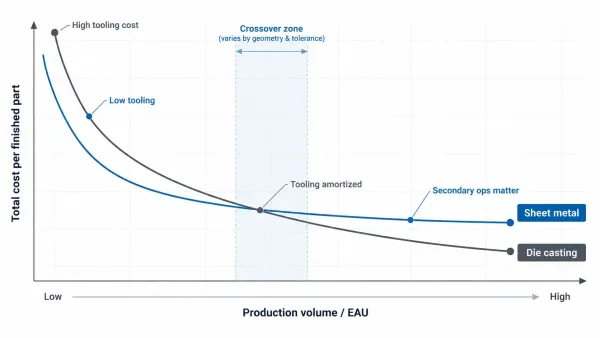
This chart shows sheet metal starting lower at low volume and die casting becoming cheaper after a crossover region driven by tooling amortization and volume.
Sheet metal usually starts cheaper because fixed cost is low. Die casting usually gets cheaper per part as volume grows because the die is paid once and cycle time is short. The crossover is not a single universal number—it shifts with geometry, tolerance, and finishing.
Volume (EAU)
Effective annual usage (EAU) is the volume that actually justifies tooling. Prototypes, pilot builds, and low EAU favor fabrication or non-tooled paths. Stable mid-to-high EAU, with room to amortize the die over years, favors die casting. If demand is uncertain, a high die cost is a forecast bet; if demand is firm and repeatable, it is a capital allocation.
Geometry and Tolerance
Large, flat, or primarily bent parts with a few holes suit sheet metal. Deep three-dimensional shells with ribs, bosses, and integrated mounts often suit die casting—especially when casting replaces a multi-part weldment. Tight tolerances on both paths may still need machining. If die casting requires a lot of secondary work to hit print, compare that full path to a well-designed fabrication, not to an as-cast ideal.
Drawing Features That Point to Sheet Metal or Die Casting
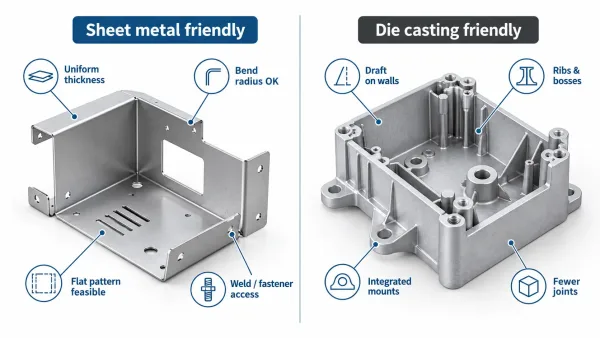
This comparison diagram lists drawing features that favor sheet metal on one side and features that favor die casting on the other, helping engineers read process fit from a drawing.
From a drawing review standpoint, features quietly select a process.
Sheet metal–friendly features include uniform thickness, bend radii consistent with material and press rules, access for welding or fasteners, and designs that stay flat-pattern feasible. Large panels, ventilation patterns, and modular SKUs often fabricate efficiently.
Die casting–friendly features include draft on vertical walls, cored cavities, ribs for stiffness without extra parts, and bosses that replace brackets. Weldments that can become one casting reduce part count, fixtures, and leak paths. If the drawing shows many brackets, standoffs, and seams on a single assembly, ask whether a cast body removes joints and touch labor.
Process-difficulty signals also matter. Extremely tight bend radii, heavy stitch welds, or cosmetic Class-A faces on fabricated assemblies add cost. On castings, zero-draft walls, isolated heavy sections, or tight tolerances on every face add die complexity and machining.
How to Compare the Two Options Before You Request a Quote
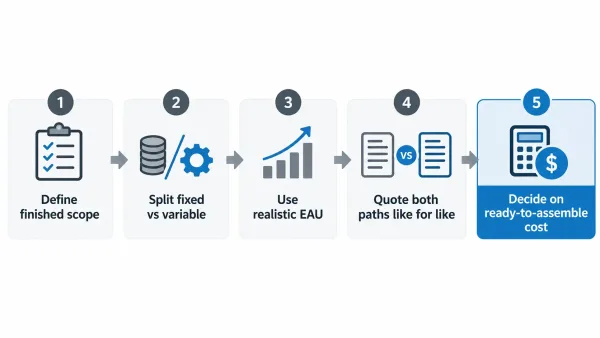
This flowchart walks through defining finished scope, splitting fixed and variable cost, using realistic EAU, and quoting both paths like for like.
Before RFQ, put both options on the same cost definition. A short pre-quote checklist:
- Define finished scope: material, finish, inspection level, and whether machining is included.
- Separate fixed and variable: tooling/NRE versus per-piece manufacturing and finishing.
- Use realistic EAU: firm volume plus service spares, not a best-case launch number alone.
- List secondary ops on both sides: weld and grind on fabrication; machine and trim on casting.
- Flag design freeze risk: if the part will change, tooling-heavy paths need a buffer.
- Quote like for like: same finish, same critical dimensions, same acceptance criteria.
When possible, evaluate ready-to-assemble cost. A cheaper fabrication that needs more hardware and fit time is not cheaper in the building.
A Practical Decision Path
Use the constraints in front of you—not a slogan that one process is always better.
- Stay with sheet metal fabrication when EAU is low or uncertain, the part is primarily bent plate, tooling must stay light, or the design will iterate.
- Evaluate die casting when EAU is stable and high, the geometry is a true 3D shell or a multi-part weldment you can consolidate, and you can freeze the design long enough to pay back the die.
- Run a side-by-side total-cost comparison when you are in the gray zone: medium volume, mixed geometry, or finish and tolerance that could go either way.
Next step for your project: take the current drawing, mark joint count, finish, and critical dimensions, then request both paths quoted to the same finished scope. That single step usually reveals which process actually has the lower total cost—and where design changes would move the crossover.
FAQ