
When a quality issue appears on a shipment of sheet metal parts, someone has to answer a simple question: exactly which parts are affected? Without a clear production batch, that question has no clean answer. Teams quarantine more stock than necessary, argue over certificates, or release parts that should have been held.
This glossary entry defines production batch as a management object—not a production method—and explains four controls that make a batch usable: batch numbering, batch quantity, traceability, and quality isolation.
When “Production Batch” Gets Confused with Batch Production
Many online results for “production batch” describe batch production—a method of making goods in groups rather than in a continuous stream. That is a process model. A production batch is the group itself.
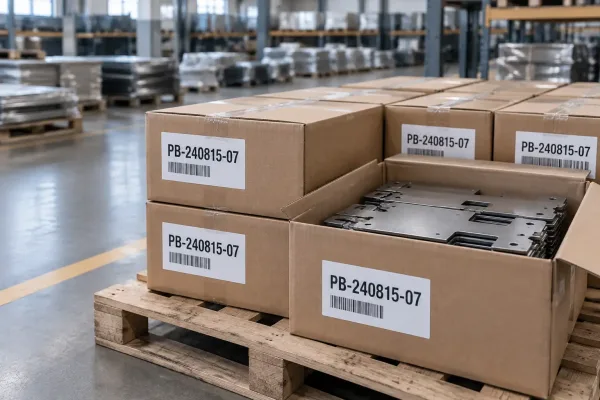
Side-by-side diagram: left panel shows a labeled group of parts as a production batch; right panel shows grouped machine runs as batch production.
The mix-up causes real damage. Purchase orders call for “batch production” but never define how parts will be grouped or numbered. Inspection reports reference a job number that does not match the carton label. After a nonconformance, the supplier cannot say whether 12 parts or 1,200 parts share the same history.
Hold, rework, scrap, and release decisions apply to a defined group of parts—not to a production style.
What a Production Batch Actually Is
Definition: same conditions, one managed group of parts
A production batch is a quantity of parts produced in a single run under uniform conditions and managed as one unit for identification, inspection, and disposition. “Uniform conditions” usually means the same material lot or heat, the same primary process settings, and one operation sequence within a defined time window.
The batch is a control boundary. Inside it, process history is assumed shared. Outside it, treat history as potentially different until evidence proves otherwise.
Production batch vs batch production vs batch manufacturing
| Concept | What it is | What it controls | Typical question it answers |
|---|---|---|---|
| Production batch | A managed group of parts | Identity, quantity, records, isolation | Which parts share the same history? |
| Batch production | A manufacturing method (group runs vs continuous flow) | How work is scheduled and released | How does the plant organize output? |
| Batch manufacturing | Often used interchangeably with batch production in process industries | Plant-level process flow | How does material move through stages? |
You can run batch production and still fail to control production batches—for example, by mixing two material heats without a split. Method and management unit are separate decisions.
Production batch and lot / lot number
In many quality systems, lot and batch are synonyms, and a lot number acts as the batch identifier. Some organizations reserve “lot” for raw material and “batch” for the fabrication run.
What matters is the link. If your CoC (certificate of conformity), mill certificate, inspection report, and shipping labels point to the same identifier, the group is under control. Three different numbers with no cross-reference is not a usable production batch.
Batch Number: How a Group of Parts Gets an Identity
A batch number (or lot number) is the durable identity of the group. Without it, traceability is reconstructed after the fact.
What a batch number should encode
Keep the format short enough to print on a small label and stable enough to survive ERP exports. A practical pattern includes the job or PO reference, part number or family code, a date or sequence code, and a unique serial segment so two runs on the same day do not collide.
For sheet metal, the raw material heat or lot code is valuable when the supplier commits to single-heat production. The number is a key into the records, not the records themselves.
Where the number appears
The same batch number should appear in at least four places:
- The label or mark on the bag, carton, or protected part surface
- The inspection or FAI (first article inspection) report for that run
- The material certificate reference when a specific heat is claimed
- The packing list and invoice lines for that shipment
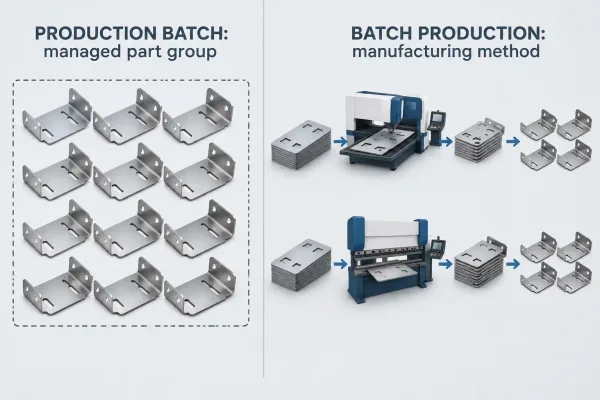
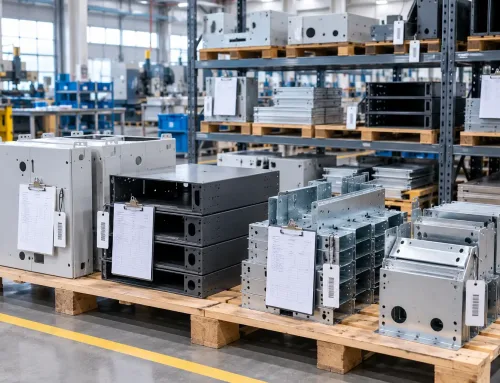
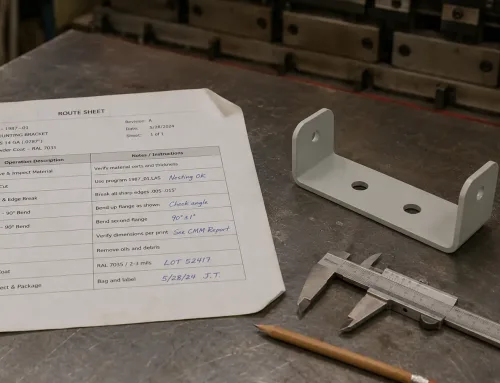
One batch number appears on a part label, a carton tag, and an inspection report sheet.
Confirm that laser, etch, or stamp marks will not violate cosmetic or fatigue requirements. For no-scratch surfaces, mark the packaging and map carton IDs to part counts.
Batch Quantity: How Many Parts Belong in One Batch
Batch quantity sets the blast radius of a quality event and the cost of proving conformity.
Why batch size is a trade-off, not a target
A very large batch reduces setup and paperwork per part, but one nonconformance can quarantine the entire group. A very small batch improves containment precision but multiplies labels and handling time—and in low-volume sheet metal, inspection cost can dominate the order.
There is no universal correct size. The right quantity is the largest group for which you can still defend this claim: every part shares the same material and process history.
When to split or merge a batch
Split whenever a controlled condition changes: a new material heat enters the run, a critical process window shifts (weld parameters, laser program revision, coating cure lot), outside processing returns on different dates, or a changeover forces re-setup. Record the split when it happens—retroactive splits are weaker evidence in an audit.
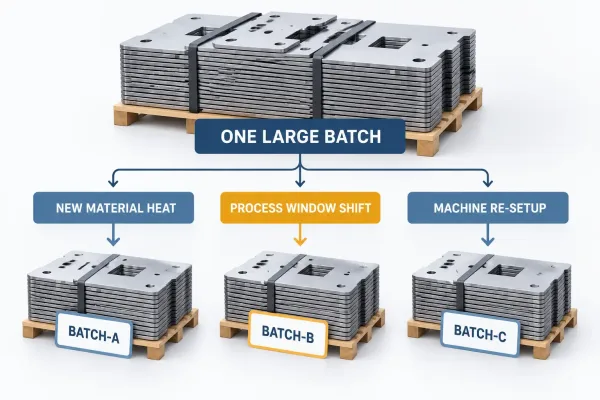
Flow diagram: one large batch splits when material heat, process window, or setup changes.
Merge only when histories are equivalent and the merge is documented. Merging reduces granularity: a later defect can no longer be limited to the original subgroup. For welded pressure boundaries, EMI gasket surfaces, or cosmetic A-surfaces, keep sub-batches distinct.
Traceability: From Raw Material Lot to Finished Parts
Traceability is the ability to follow a finished part back to its material lot and process records, and forward from a material lot to every part that used it. The production batch makes that walk practical.
The trace chain on a sheet metal order
A defensible chain usually looks like this:
- Raw material: mill or supplier lot/heat number on the material certificate
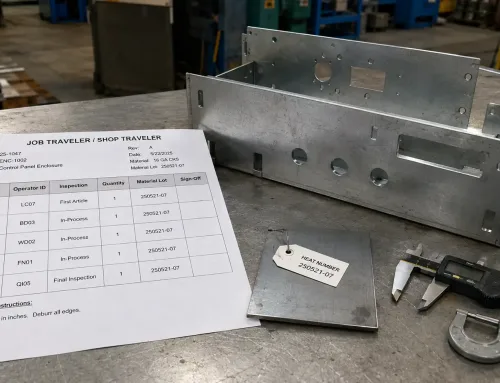
- Cutting and forming: traveler or route sheet referencing the batch number
- Joining and secondary ops: weld map, hardware insertion, or outside-process receipts tied to the same batch
- Finish: pretreatment and coating lot, cure record, thickness checks if specified
- Final inspection: dimensional and visual results for that batch
- Shipment: packing list lines that name the batch and quantity shipped
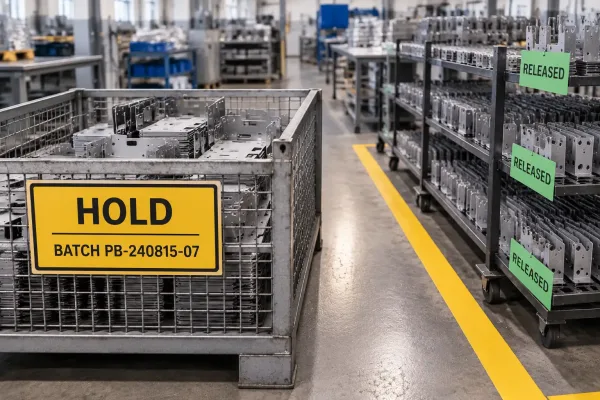
Six-step trace chain: material certificate, cutting/forming, joining, finish, final inspection, shipment.
What must be linked to the batch number
At minimum: material certificate ID, drawing revision, inspection report ID, and quantity produced versus quantity shipped. For critical ops, also keep cell or operator ID and any concession number.
A common failure is “certificate for the order” rather than “certificate for the batch.” If one PO contains two production batches, each batch needs its own material and inspection linkage.
Quality Isolation: Holding, Segregating, and Releasing a Batch
Quality isolation (quarantine or hold) means stopping a defined group of parts from being used, further processed, or shipped until a disposition is made.
When a batch goes on hold
Typical triggers: failed dimensional or visual criteria, missing or mismatched certificates, suspected mixed material, a complaint linked to a serial range, or a process deviation found after production. The hold should name the batch number and quantity—not “the parts from last week.”
Physical and documentary isolation—both are required
Physical separation prevents accidental use: marked bins, taped areas, or locked racks with a clear HOLD status. Documentary isolation prevents accidental release: ERP/QMS flags, open nonconformance reports, and a named disposition owner. Parts in a taped-off bin with no system status will eventually ship. System-blocked parts stacked with good stock will be mixed.
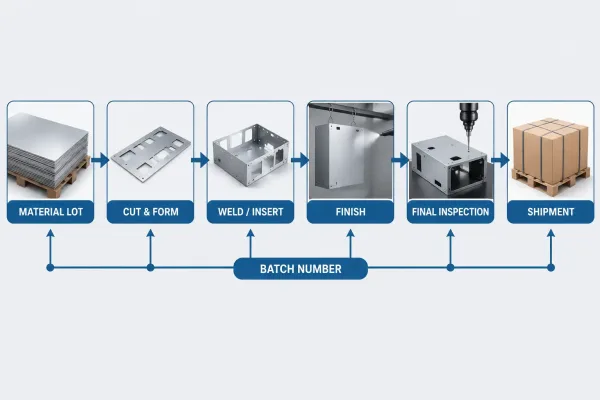
Quarantine bin with HOLD signage holds suspect parts away from released production batch stock.
Disposition options and schedule impact
| Disposition | Meaning | Typical schedule effect |
|---|---|---|
| Use-as-is / concession | Accepted against documented deviation | Minimal delay if approved in writing |
| Rework | Corrected and re-inspected | Adds rework and re-inspection time |
| Scrap | Rejected and destroyed or returned | Replacement lead time from a new batch |
| Return to supplier | Rejected upstream | Depends on replacement logistics |
Sample and prototype parts should not silently inherit a production batch number. Mark same-run samples as a subset, or give them a separate identity so field issues do not drag the production batch into quarantine.
How to Specify Production Batch Requirements on POs and Drawings
Most batch disputes are created before metal is cut. State the rules while the order can still be quoted and planned.
What to state before the order is placed
In the RFQ, PO quality notes, or drawing package, define how batches will be formed (for example: one batch per material heat per shift, or one batch per shipment), a maximum parts per batch if containment cost matters, the batch number format and mark location, whether single-heat material is required, which documents must carry the batch number, and isolation rules if a nonconformance is found.
What to verify at receipt
Use this checklist when the shipment arrives:
- Carton or bag labels show a batch number that matches the packing list
- Shipped quantity per batch matches the PO line and any split-shipment note
- Inspection reports name the same batch number as the labels
- Material certificate references the claimed heat/lot for that batch
- Any concession or deviation number is visible and approved
- Hold status is clear for any parts not released for use
- Drawing revision on the reports is the revision you intended to order
If a supplier cannot explain how a batch was defined, treat that as a process capability gap—not only a paperwork gap.
FAQ
Next Steps
For the next RFQ or drawing package, define the production batch before you negotiate unit price: one identifier, a maximum quantity rule, required document links, and a hold procedure. Those four items limit risk to a known group of parts instead of the entire order.
If you want a second pair of eyes on batch notes or shipping splits, include them in your RFQ package and ask the manufacturing engineering team to review the batch plan with the quote.