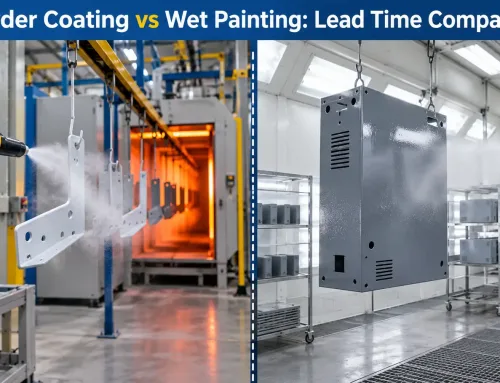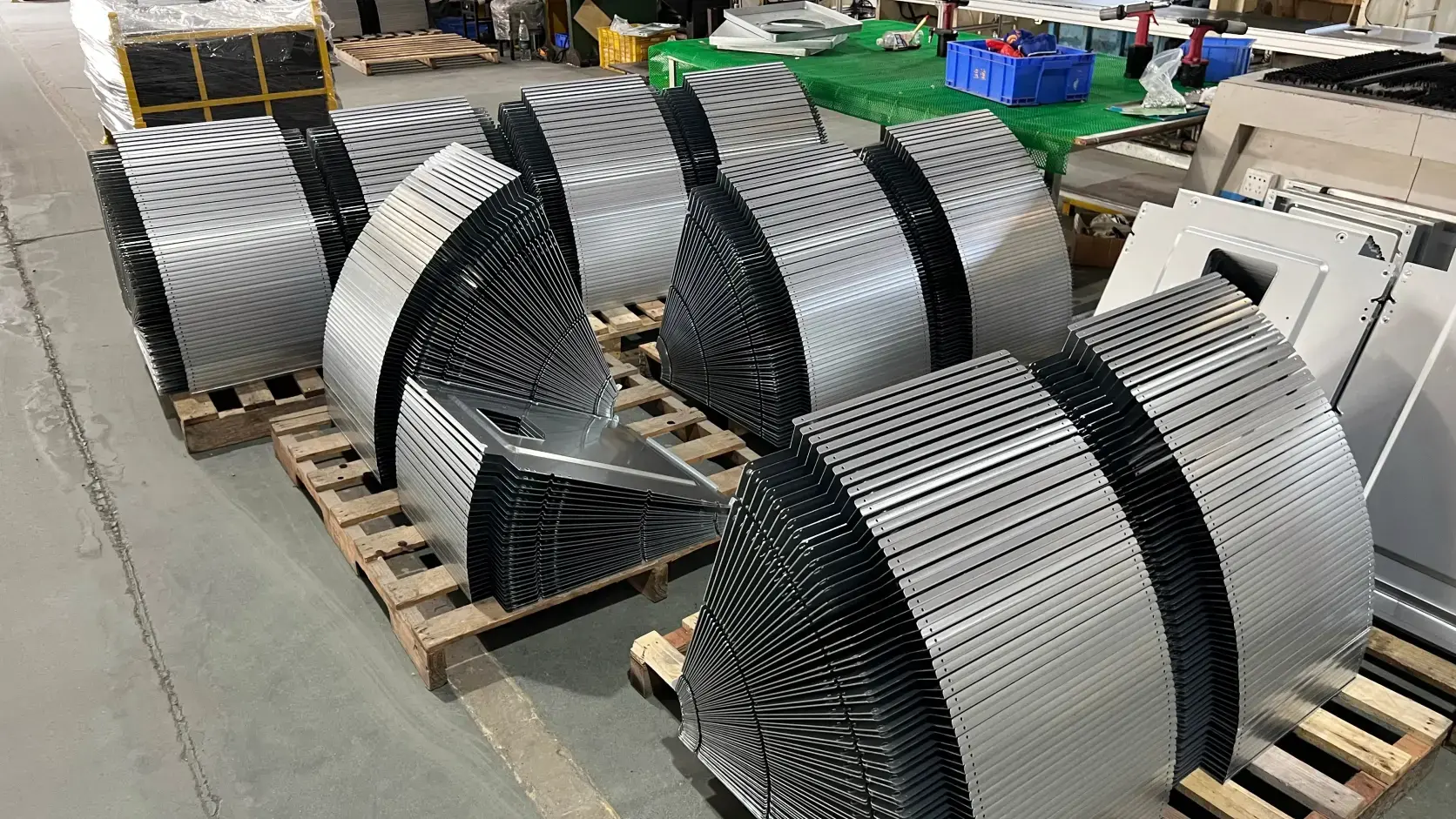

Specifying the “faster” surface finish to protect a ship date sounds like a simple schedule decision. In practice, the finish that looks quicker on paper is often the one that slips—custom color queues, masking rework, and a late change to the finish callout routinely push delivery more than the process chemistry ever does.
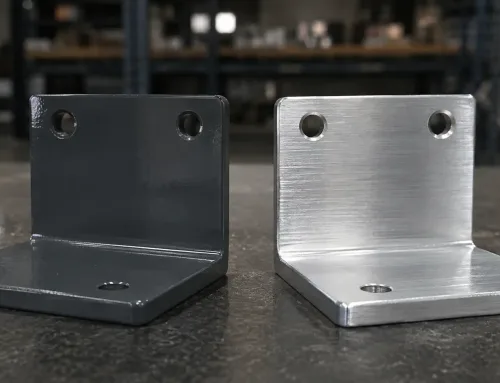
Powder coating and anodizing are both proven protective finishes for metal parts. Powder coating applies a dry polymer powder electrostatically, then cures it in an oven into a continuous film on the surface. Anodizing is an electrochemical process that grows a hard aluminum oxide layer from the aluminum itself. Neither process has a fixed lead time. The answer to “which ships faster?” depends on color, masking, process type, batch queue, and rework risk.
One constraint is absolute: steel and stainless steel cannot be anodized. If the part is ferrous, powder coating (or another coating system) is the only path, and the lead-time comparison starts and ends there.
What Finish Lead Time Actually Covers
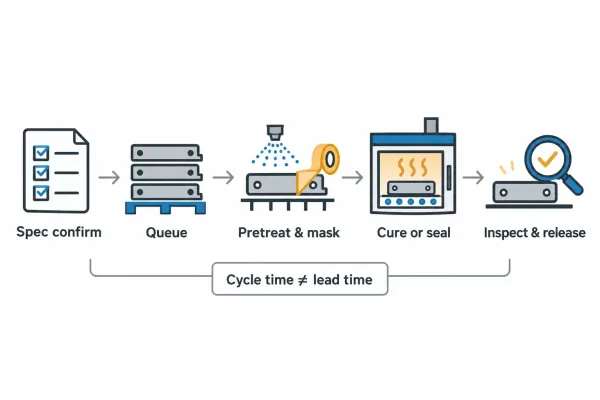
Finish lead time is the full calendar path from released specification to inspected parts, not just oven or bath time.
Finish lead time is not the same as process cycle time. Cycle time is the hours a part spends in a spray line or an anodizing tank. Lead time is the calendar span from a released specification to inspected, shippable parts.
In sheet metal fabrication, that span typically includes:
- Spec confirmation and any color or sample approval
- Queue time at the finisher (in-house or outsourced)
- Pretreatment, masking, and racking
- Film build or oxide growth, then cure or seal
- Inspection, touch-up, and release
Most schedule failures sit in steps 1–3 and 5—not in the oven or the bath. A standard-color powder job with simple masking can move in days once it is in line. A Type III hard anodize job with tight masking and an external anodizer can sit longer waiting for a tank slot than it spends in process. Compare ship dates only after both options are broken into the same stages.
Where Powder Coating Lead Time Comes From
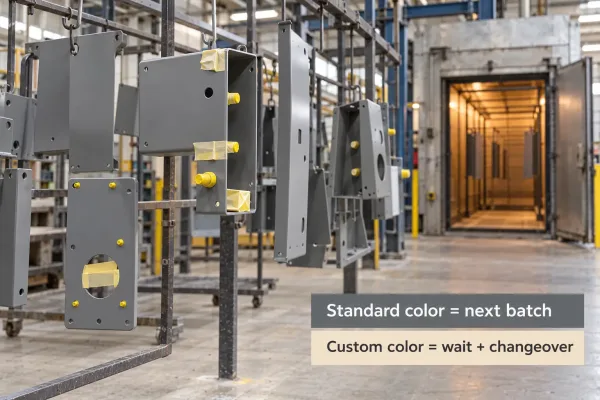
Powder coating schedule risk comes from color choice, masking load, and batch racking—not from the spray gun alone.
Powder coating is often the shorter path for industrial sheet metal, but only when the specification stays standard. The main drivers are color, masking load, and whether the parts can run in a continuous batch.
Standard vs custom color. Stock RAL or supplier-standard colors usually run on the next available batch. Custom matches, metallics, or low-volume specialty powders can add days for material and a dedicated color change on the line.
Masking and racking. Threads, ground points, bearing surfaces, and tight fits often need plugs or tape. Each masked feature adds labor and inspection. Dense racking is efficient; delicate or deep-formed parts need space and slower handling.
Cure and recoat risk. Powder builds a thicker film—often on the order of 50–125 µm (0.002–0.005″)—which helps coverage but can close holes or foul threads if masking fails. A recoat after a holiday or chip is a full re-entry into pretreatment and cure, not a quick touch-up on the shelf.
For mixed-metal assemblies (steel frame plus aluminum covers), powder is usually the schedule-friendly default because one line can cover both substrates in one pass.
Where Anodizing Lead Time Comes From
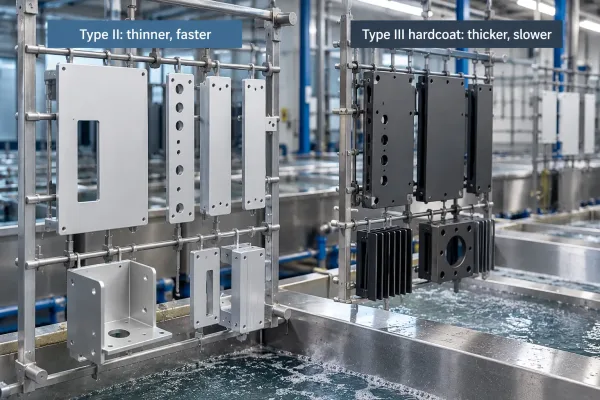
Anodizing lead time depends on bath access, Type II vs Type III cycle, and how much of the part must stay bare.
Anodizing lead time is driven by bath access, coating type, and how much of the part must stay bare. The oxide layer is thin—typically 5–25 µm for Type II, and thicker for hardcoat—so dimensional risk is lower, but scheduling is less forgiving.
Type II vs Type III. Standard Type II (sulfuric) anodizing is the common decorative and corrosion-protection build. Type III hardcoat is slower: lower bath temperature, longer cycle, thicker oxide, and stricter control. If the drawing calls hardcoat by default, you have already chosen the longer path.
Racking, dye, and sealing. Parts must make electrical contact on the rack. Complex sheet-metal forms with deep recesses or thin walls need careful spacing to avoid burning or uneven color. Dyed colors add a step and can vary by alloy. Sealing closes the oxide pores and is not optional if corrosion performance matters.
Outsourced bath queue. Many fabricators do not anodize in-house. Shipping, receiving, and the anodizer’s tank calendar become part of your lead time. A two-day process can become a two-week wait if the shop batches only once a week or if the job needs a special run.
Alloy choice also matters on schedule and yield: 5000- and 6000-series aluminum (for example 5052 and 6061) anodize predictably; high-copper or high-zinc alloys can need process care and more rework.
Side-by-Side: When Powder Is Faster and When Anodizing Is
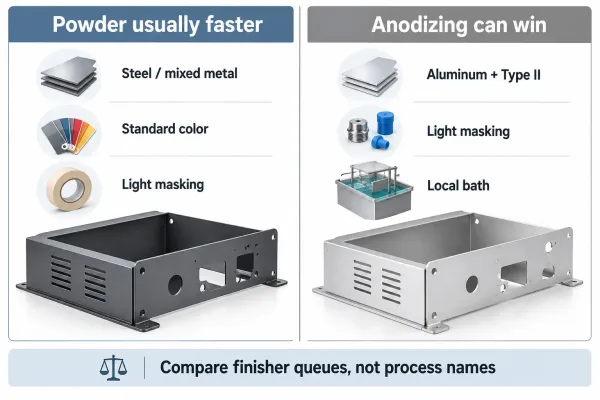
Which finish ships faster flips with material, color, masking, and coating type—use the condition chart, not a one-size answer.
Use the table below as a schedule decision aid, not as a performance ranking. Function still has to meet the drawing.
| Condition | Usually shorter lead time | Why |
|---|---|---|
| Steel or stainless part | Powder coating | Anodizing is not available |
| Standard color, simple masking, aluminum or steel | Powder coating | Continuous batch, common materials |
| Mixed-metal assembly finished together | Powder coating | One process covers both substrates |
| Tight dimensional fit, thin Type II oxide only | Anodizing (Type II) | Less masking, less film build, less fit risk |
| Custom powder color or specialty texture | Anodizing (if aluminum and Type II) or plan extra powder days | Color change and material wait dominate |
| Type III hardcoat required for wear | Often powder for date only if wear spec can be relaxed | Hardcoat cycle and queue are longer |
| Heavy masking on threads/ports either way | Compare finisher queues, not process names | Labor and inspection dominate both |
In short: powder is usually faster for standard industrial sheet metal; anodizing is competitive when the part is aluminum, Type II is enough, masking is light, and a local or in-house bath is available. Hardcoat, custom dye, or complex masking reverses the “powder is always faster” assumption.
Choosing for Schedule Without Losing Function
When the ship date is binding, decide in this order:
- Material hard stop. Ferrous parts go to powder (or another coating). Do not plan anodizing for steel.
- Functional minimum. If the drawing needs hardcoat wear resistance or a metallic sealed oxide, powder is not a substitute—even if it is faster.
- Schedule path. If both finishes meet function, pick the one with the shorter total timeline at your actual finisher, including queue and sample approval.
- Risk buffer. Add rework time for masking and color match; those are the most common schedule surprises on both processes.
Do not swap finishes only to save calendar days if the part will fail in service. A missed wear or corrosion requirement costs more than a short delay. When schedule is tight and both options work, a standard-color powder job on steel or on simple aluminum brackets is usually the more predictable ship date.
RFQ and Drawing Fields That Protect the Finish Date
Finish lead time is locked at RFQ more often than at production. Put these fields on the drawing or in the quote request so the supplier can schedule against a real date:
- Finish type and specification (for example, powder color and gloss, or anodize Type II / Type III to the applicable standard)
- Color standard (RAL code, sample, or “supplier standard”)
- Masking list: threads, ground points, datum faces, sealing surfaces
- Acceptance notes (color match, film thickness, rack-mark allowance)
- Required ship date and whether partial shipments are allowed
- Whether the finisher may propose an equivalent color or process for schedule
A clear callout does not speed up chemistry, but it removes clarification loops and late changes—the two events that most often extend finish lead time.
Key takeaways
- Lead time is quote-to-ship, not oven or bath time.
- Powder is usually faster for standard colors and mixed metals; anodizing competes on aluminum with light masking and Type II.
- Type III, custom dye, and heavy masking slow anodizing; custom color and recoat risk slow powder.
- Lock finish type, color, masking, and ship date in the RFQ before the schedule is baseline.
Next step: If you are holding a drawing and a ship date and still cannot tell which finish path is safer, ask the fabricator for a finish-path check at quote—stage breakdown, queue assumptions, and masking load—before you commit the baseline.
FAQs