
Search “order quantity” and the first page of results will teach you how to calculate an economic order quantity (EOQ) — a formula that balances ordering costs against inventory holding costs. That concept is real, but it describes a stock-replenishment decision. If you are reading the term on a custom sheet metal request for quotation (RFQ) or a supplier’s price sheet, it means something much simpler: how many parts you are asking a manufacturer to build in one release.
That single number quietly controls the three things a buyer cares about most — how the quote is structured, how the parts get made, and when they ship. This entry defines order quantity in a manufacturing context, separates it from the inventory terms it gets confused with, and explains what each quantity tier changes on the supplier’s side.
Order Quantity Defined
In custom manufacturing, the order quantity is the number of units of a single part number that you commit to on one purchase order (PO). It is an input, not an outcome: you state it, and the supplier builds the quote, the production plan, and the delivery schedule around it.
Because custom parts are made to your drawing, the manufacturer has no demand history to guess from. The order quantity is the first figure the estimator uses to decide which cost assumptions apply — how setup time is amortized, which production route is economical, how much material to buy, and how inspection will be performed. Getting it right at the RFQ stage is far cheaper than correcting it after quotes are issued.
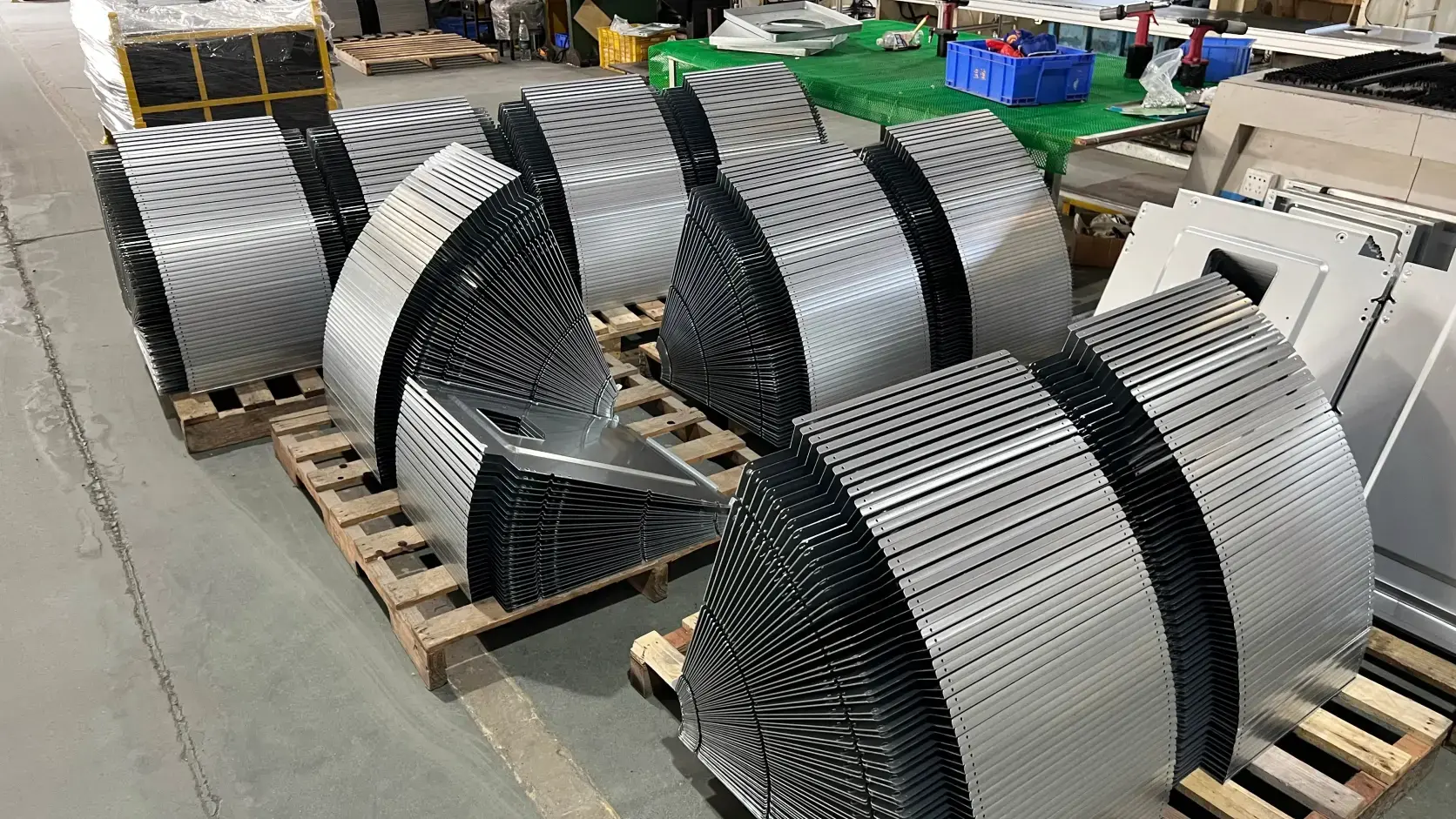
Note the scope: one part number, one release. A program that buys 10,000 units per year in four shipments has an order quantity of 2,500 — not 10,000.
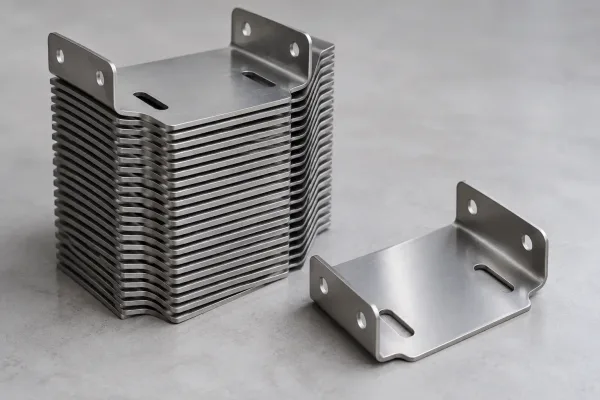
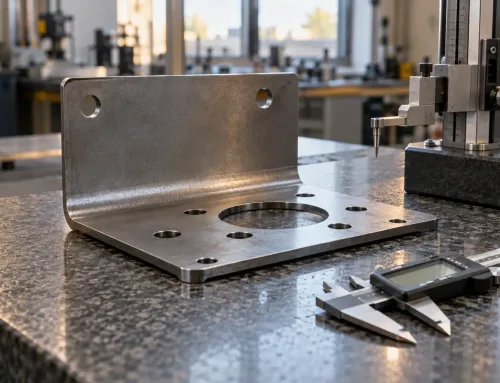
One part number, one release: a single stack of identical brackets as the quantity committed on one purchase order.
Order Quantity vs. EOQ, MOQ, and Annual Volume
Four quantity-related terms circulate in B2B purchasing, and mixing them up is expensive. The table below draws the boundaries:
| Term | Definition | Set By | What It Drives |
|---|---|---|---|
| Order quantity | Parts ordered on a single PO, for one part number | Buyer | This quote, this production run, this delivery |
| Economic order quantity (EOQ) | Formula output: the replenishment size that minimizes ordering plus holding costs | Calculated for stocked inventory | Restocking of catalog items — not applicable to made-to-order parts |
| Minimum order quantity (MOQ) | The smallest quantity a supplier will accept on one order | Supplier | The floor you must clear before a quote exists |
| Annual volume | Total parts contracted per year across all releases | Buyer and supplier, by agreement | Framework pricing discussions — not a single PO |
An EOQ calculation assumes repeat demand for a stocked item; custom sheet metal parts have neither. The more common commercial error is quoting against annual volume: a unit price discussed for 50,000 parts a year means little if your first PO is for 500, because the costs behind that price were never allocated to one release.
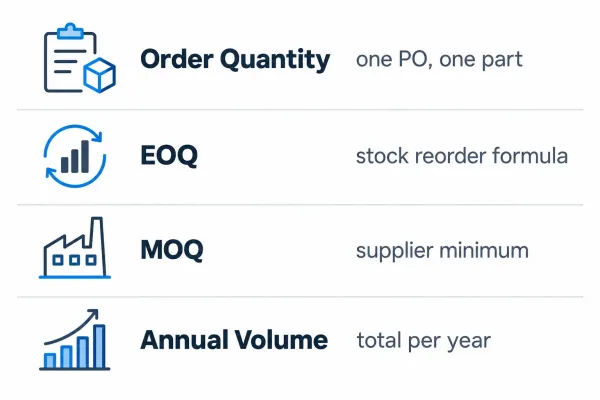
Four purchasing terms compared by definition, who sets them, and what each one drives.
How Order Quantity Shapes Your Quote
Every custom quote contains fixed costs: machine setup, cutting program development, first-article inspection (FAI — a documented check that the first part meets the drawing), and often fixture or gauge preparation. These are incurred once per production run, no matter how many parts follow.
They are then divided across the order quantity. A 600setupandprogrammingburdenspreadover100partsadds6.00 per part; the same burden over 2,000 parts adds $0.30. This is why unit prices fall in steps rather than smooth curves, and why suppliers quote in price tiers anchored to the quantity you declare.
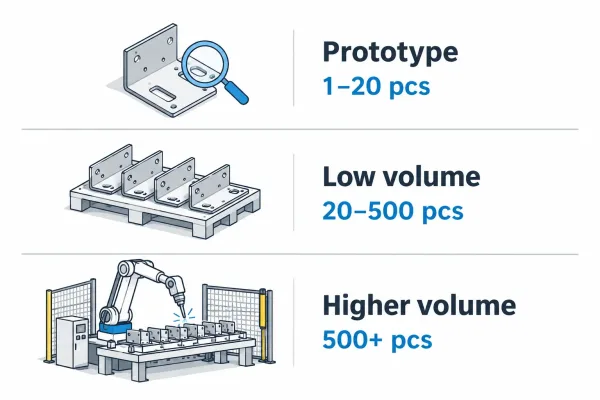
Unit price decreases in steps as order quantity increases, because fixed setup costs are spread over more parts.
Material purchasing works the same way. Small orders may be cut from stock sheet remnants at a premium, while larger orders buy full sheets and nest parts — arrange them on the sheet to minimize scrap — which lowers material cost per unit.
Two quotes are only comparable at the same order quantity. Before comparing bids, confirm that each supplier quoted the same quantity, the same release schedule, and the same spare-part assumption. Otherwise the unit prices are measuring different jobs.
How Order Quantity Determines the Production Route
Quantity does not only change the price; it changes the route the parts take through the shop floor. In practice, orders sort into three bands:
- Prototype and sample quantities (typically 1–20 parts). Work runs on engineering time: laser cutting, manual bending, hand welding, full first-article inspection. No tooling is justified, and every setup is a one-time event. The goal is design validation, not unit cost.
- Low-volume production (roughly 20–500 parts). Standard tooling and repeatable fixtures appear, but machines are still loaded manually, and welding and finishing run in batches. Control leans on first-article approval followed by checks at each batch boundary.
- Higher volumes (hundreds to thousands of parts). Tooling investment — dies, dedicated cutting nests, robotic welding fixtures — starts to pay back, and control shifts from inspecting the first part to statistical sampling during the run. Turret punching may replace laser cutting where hit counts justify dedicated tools; robotic welding replaces manual stations where cycle time demands it.
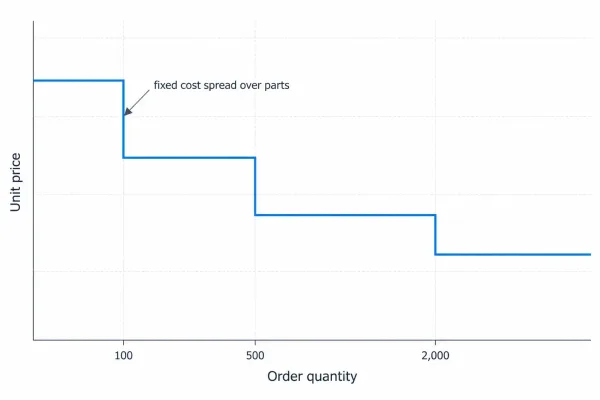
Orders split into three quantity bands — prototype, low-volume, and higher-volume — each with a different production route.
One nuance keeps this honest: for laser-cut, formed sheet metal parts, tooling is minimal, so higher quantity mostly buys labor efficiency and cleaner scheduling rather than a different machine. The jump to expensive tooling happens when the part design itself supports stamping or progressive dies. The DFM (design for manufacturability) feedback you receive at quote stage usually says which side of that line your part is on.
How Order Quantity Affects Lead Time
Lead time quoted at the RFQ stage assumes the stated order quantity. Change the quantity, and the schedule changes with it, for three concrete reasons:
- Scheduling. Machine hours scale roughly with part count. A 5,000-part order occupies the laser and brake cells longer, pushing its start date behind work already in the queue.
- Material. Larger orders may exceed stock on hand, triggering distributor or mill orders. Non-standard grades or thicknesses can add days to weeks before cutting begins.
- Finishing. Powder coating, plating, and painting run in batch loads — racks and tanks. Larger quantities take more loads, and loads are scheduled together rather than continuously.
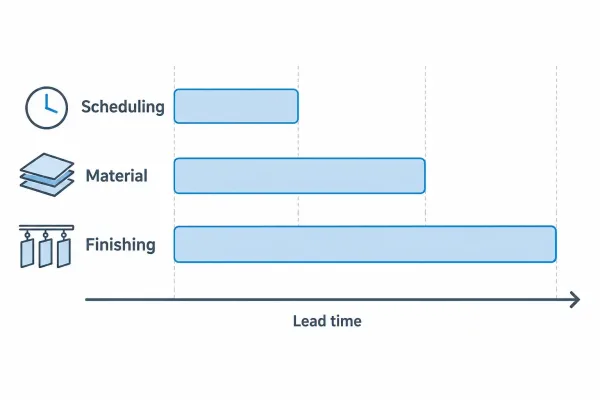
Lead time is built from three quantity-driven factors: machine scheduling, material purchasing, and batch finishing.
Splitting an order into releases does not automatically remove these costs: each release re-incurs setup, material handling, and finishing loads. If you plan multiple releases, say so before quoting, so the supplier can price and schedule the sequence as a whole.
Specifying Order Quantity on Your RFQ
Most quantity-related disputes trace back to an RFQ that stated a number without its context. To keep quotes comparable and production unambiguous, specify the following on every RFQ:
- The quantity per part number, per release
- The planned release schedule, if orders will be split (for example, 500 now and 500 in Q3)
- Whether split shipments are acceptable, and who covers the extra handling
- A spare or over-run allowance for testing and attrition (a common pattern is 2–5% on high-value enclosures)
- The acceptable quantity tolerance on delivery — short and over shipment limits
Each line removes an assumption the supplier would otherwise make for you, and every silent assumption is a place where two suppliers can quietly quote different jobs under the same unit price.
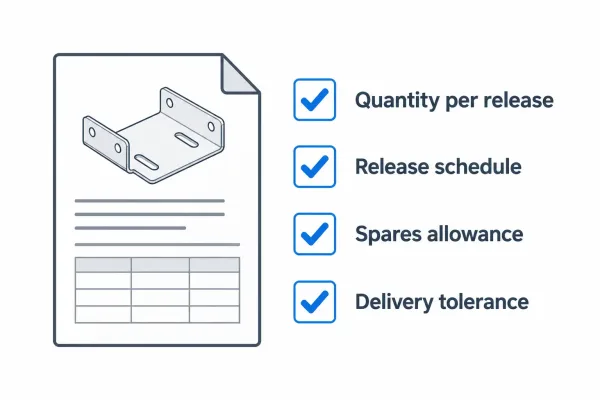
The quantity-related fields to state on an RFQ: quantity per release, release schedule, spare allowance, and delivery tolerance.
Key Takeaways
- Order quantity is the part count on one PO — an input to the quote, not the output of a formula.
- It drives price through fixed-cost amortization, so unit prices move in steps at quantity tiers.
- It drives the production route through tooling and process-control decisions that only pay back at certain volumes.
- It drives lead time through machine scheduling, material purchasing, and batch finishing.
- When in doubt, send the drawing together with your target quantity and release plan; a quick engineering review of both is faster than reconciling three quotes built on different assumptions.