
The sample passed its dimension check and left the shop on Tuesday. Three weeks later it is still “in approval,” and nobody can tell you when bulk production will start. Sample approval time is usually filed as a supplier metric. In practice, most of that clock runs on the buyer’s side — and every required revision starts it over.
What Sample Approval Time Actually Covers
Sample approval time is the interval between two agreed events: submission of a finished sample to the customer, and the customer’s formal approval decision. The endpoint is rarely disputed — it is a signed report, a stamped first-article record, or an email that states plainly that the sample is accepted.
The starting point is where most disagreements begin. Some teams count from the day the sample arrives on the buyer’s desk; others count from the day it ships. Neither is wrong, but the anchor must be written down. One line in the purchase order — “the approval window begins on sample receipt” — prevents an argument later about whose delay belongs on whose invoice.
Two exclusions keep the definition clean. Sample build time — cutting, forming, welding, and finishing the prototype itself — belongs to sample lead time, not approval time. Inbound transit is also excluded unless both sides agree otherwise, because shipping schedules vary by lane and carrier.
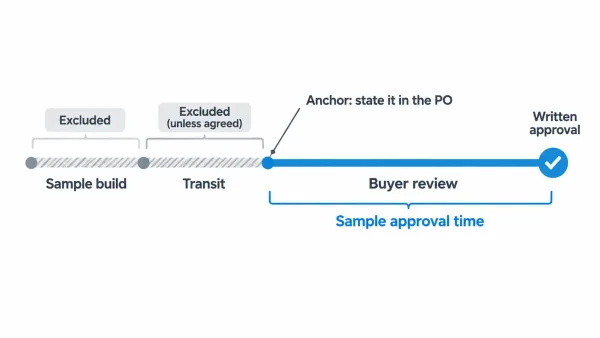
This diagram shows a horizontal timeline running from sample submission to written approval, with a bracket marking the included approval window and separate segments marked as excluded (sample build time and inbound transit).
Why draw the line so precisely? Because lead-time promises and project schedules only add up when everyone counts the days the same way. An approval window that means three different things to three parties cannot be planned against.
Where the Waiting Time Actually Goes
Once the sample ships, the factory has almost no influence on the calendar. The approval window is consumed almost entirely by buyer-side variables: how many people must review the sample, whether one person owns the sign-off, whether comments arrive in a single pass or in drips, and whether the sample is reviewed at one location or passed between sites.
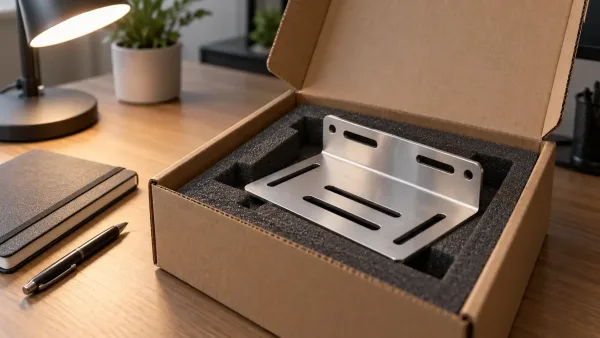
This photo shows a newly opened shipping box with foam inserts on an office desk, a sheet metal sample freshly unpacked from it, illustrating the moment a sample reaches the buyer and the approval clock starts running.
For custom sheet metal parts, a structured review — criteria agreed before the sample ships, one signatory, consolidated comments — typically closes in 3–10 working days. Reviews that wait for committee consensus, or stall because the sample sits on one desk while another stakeholder is traveling, commonly stretch to two to four weeks.
The difference is not diligence. It is process. A factory cannot act on an informal “looks fine, let me check one more thing,” and it will not risk a production slot on a verbal opinion. Until the written approval arrives, every downstream decision stays unlocked.
Why Each Revision Multiplies the Schedule
A revision is not a patch on the sample you already have. It replays the entire loop: consolidated feedback goes back to engineering, drawings and programs are updated, the sample is rebuilt through the same cutting, bending, and finishing operations, and the new sample re-enters an approval window of the same length as the first.
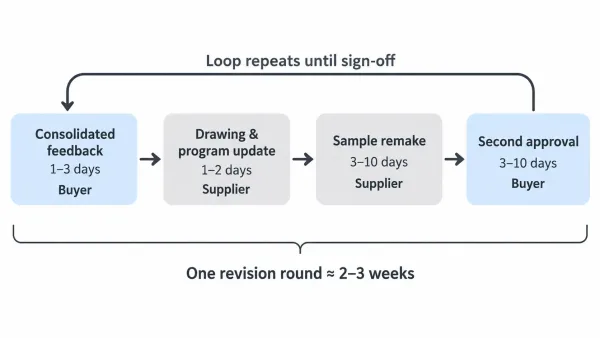
This flow diagram shows the four stages a single revision replays — consolidated feedback, drawing update, sample remake, and second approval — connected by arrows, with typical duration labels and a total of two to three weeks.
The critical distinction is between two kinds of comment. A must-fix item fails a critical-to-quality (CTQ) characteristic — hole positions out of tolerance, a mounting face on the wrong plane, the wrong surface finish — and forces a full replay. A waive-with-note item accepts a minor imperfection in writing, records the acceptance for bulk production, and costs a sentence in the inspection report instead of a week on the calendar.
One revision round, replayed end to end, looks like this:
| Stage | Typical duration | Owner |
|---|---|---|
| Consolidated feedback | 1–3 days | Buyer |
| Drawing and program update | 1–2 days | Supplier |
| Sample remake (same processes) | 3–10 days | Supplier |
| Second approval window | 3–10 days | Buyer |
Add it up and one avoidable round lands at roughly two to three weeks — and the two largest blocks belong to the approval ends, not to the shop floor. This is why a sample that “only needs a small tweak” can quietly push a launch date by a month.
Approval Status Is the Gate on Your Production Schedule
Pending approval is not a passive state for the factory. Until sign-off arrives, the shop does not lock a production slot, commit material orders for a specific grade and thickness, or freeze the surface treatment standard — color, gloss, masking requirements. Each of these is a scheduling decision that has to stay reversible until the sample is accepted.

This photo shows stacks of sheet metal blanks and partially finished enclosures staged on industrial shelving and pallets in a workshop, with an idle press brake in the background, illustrating production held pending sample approval.
Capacity is planned against confirmed jobs, not pending ones. If the approval window overruns by weeks, the reserved slot is typically reassigned to the next confirmed order. When approval finally lands, the job re-enters the queue — and that re-entry, not the review itself, is where most of the surprise delay comes from.
How Buyers Close Approval in One Round
Most multi-round approvals trace back to how feedback is delivered, not to how poor the sample was. Buyers who close approval in a single pass usually work the same way:
- Consolidate every comment — dimensional, cosmetic, and functional — into one document instead of a chain of emails.
- Tie each comment to a drawing zone or feature identifier and include the measured value (“hole spacing at B4: 24.8 mm measured, 25.0 mm specified”), so the supplier does not have to interpret adjectives.
- Agree on acceptance criteria before the sample ships, so must-fix and waive-with-note items can be judged against an agreed line rather than a mood.
- Name one signatory and one deadline; if several departments must see the sample, arrange parallel review instead of sequential hand-offs.
- Record waived items in writing and reference them on the bulk production purchase order (PO), so an accepted sample imperfection does not resurface as a dispute after delivery.
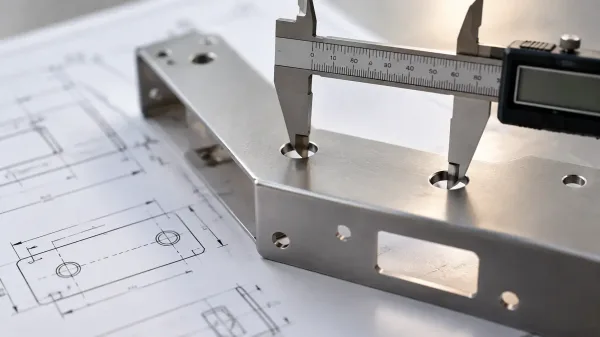
This close-up photo shows digital calipers measuring a hole position on a sheet metal sample part placed on top of an engineering drawing, representing the measured, drawing-referenced feedback that closes approval in one round.
Feedback written this way gives the supplier one unambiguous instruction set. The result is fewer loops, not just faster ones.
Building Approval Windows into Your Project Plan
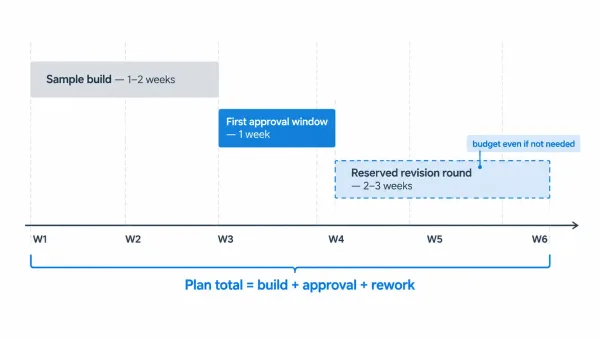
This diagram plots three stacked bars on one project timeline — sample build, first approval window, and a reserved revision round — showing how approval windows should be planned into the total schedule alongside sample production.
Treat approval as scheduled work with an owner and a date, not as an open-ended review. A workable plan estimates the full chain before the first sample is ordered:
Total project time ≈ sample build + first approval window + Σ(rework + re-approval)
Reserve a realistic first window — one working week is a fair default — and budget for one revision round even if you expect none. Put both assumptions into the RFQ (request for quotation, the buyer’s formal request for pricing) so the supplier’s quoted lead time is anchored to the same starting point you are planning against. Then state the overdue handling in the PO: a reminder at the deadline, followed by re-planning if the window slips.
For best results, assign the approval window an owner and a date on your own calendar the day the sample ships. When the schedule is built around a commitment rather than an open review, the clock stays where it belongs — and walking the drawing and approval assumptions through with your supplier before quoting costs an hour, while recovering the delay costs weeks.
FAQs