
While most buyers rely on certifications and test reports to evaluate a supplier’s powder coating capability, those documents answer a different question than the one that actually matters. A Qualicoat license confirms that a coater’s facility meets certain process standards. A salt spray test certificate confirms that a specific batch of coated panels survived a controlled corrosion test. Neither tells you whether the supplier read your drawing correctly, understood what you intended by each callout, or will catch a missing specification before it becomes a production problem.
The real indicator of coating competence shows up much earlier — in how a supplier responds to your drawing during the RFQ stage. A supplier that silently accepts a vague callout like “powder coat black” without asking follow-up questions is not being efficient. They are either not reviewing your callouts at all, or they are making assumptions that will surface later as rework, delays, or disputes. This article explains how to evaluate a sheet metal supplier’s powder coating callout review capability — the ability to read, interpret, and flag issues with your finishing specifications before production begins.
Why Test Reports Alone Cannot Confirm Callout Competence
Certifications and test reports verify different things than callout review capability, and conflating them leads to costly blind spots.
A coating certification — Qualicoat, GSB, AAMA — confirms that the supplier’s facility, equipment, and process controls meet a recognized standard. It tells you the coater can produce quality coatings under controlled conditions. It does not tell you whether the coater understood what your specific part requires. A certified coater can still apply the wrong resin system to an outdoor part, skip masking on threaded inserts, or cure at a temperature that conflicts with your powder manufacturer’s TDS (Technical Data Sheet) — simply because nobody checked the callout against the production plan.
Test reports — salt spray per ASTM B117, adhesion per ASTM D3359, cure verification per ASTM D5402 — validate a specific result from a specific test run. They confirm that the coating on those panels performed within specification. They do not confirm that the supplier’s interpretation of your drawing was correct. A part can pass adhesion testing and still fail to meet your intent if the supplier used a satin finish when you specified matte, or coated an area you wanted masked.
Callout review capability is a separate competence. It sits upstream of both certification and testing, in the engineering communication layer between your technical drawing and the supplier’s production floor. A supplier with strong callout review capability will identify ambiguities, confirm critical parameters, and flag conflicts before quoting — not after the first batch arrives with problems.
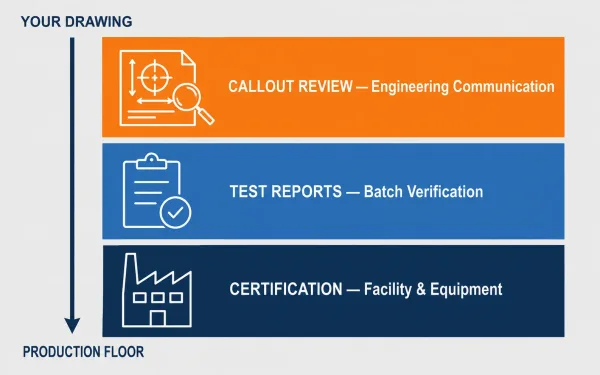
Callout review sits upstream of certification and testing in the engineering communication layer between your drawing and production.
What a Complete Powder Coating Callout Should Include
Before you can evaluate a supplier’s response, you need a baseline for what a complete callout looks like. If your drawing does not give the supplier enough information to work from, even the most capable reviewer has nothing to review.
A complete powder coating specification on a sheet metal drawing should include the following elements:
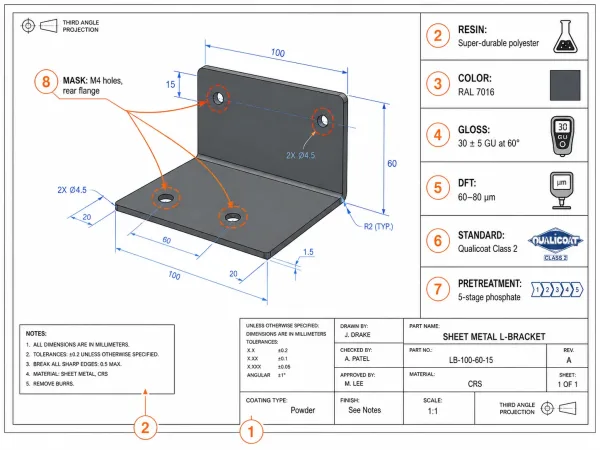
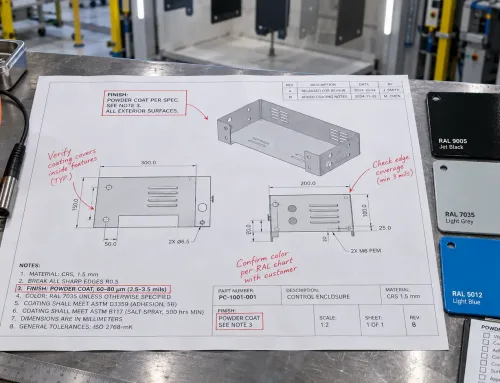
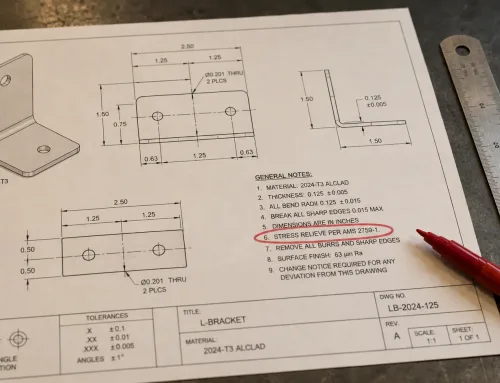
All eight elements of a complete powder coating callout as they should appear on a sheet metal engineering drawing.
- Coating type — “Powder coating” distinguishes it from liquid paint, anodizing, or plating. This seems obvious, but drawings that say only “finish: black” leave the method unspecified.
- Resin system — Polyester, epoxy, hybrid, super-durable polyester, or fluoropolymer. This determines UV resistance, chemical resistance, and flexibility. Specifying the resin system matters especially for outdoor applications where epoxy will chalk and degrade under sunlight.
- Color — A recognized color standard with a specific number. “RAL 9005 jet black” is a specification; “black” is not. Pantone codes are acceptable when brand color matching is critical, but Pantone colors may require custom powder mixing and longer lead times.
- Gloss level — A target value with tolerance at a defined measurement angle. “30 ± 5 GU at 60°” is precise; “satin” is not. If left unspecified, fabricators will typically use whatever gloss level is in stock.
- Film thickness (DFT) — Minimum and maximum dry film thickness in microns. “DFT 60–80 μm” gives the applicator a measurable range. Specifying only a minimum (“min. 60 μm”) without a maximum risks over-application, which causes texture problems and adds unnecessary material cost.
- Performance standard — The applicable quality standard or test requirement: Qualicoat Class 1 or 2, AAMA 2603/2604/2605, GSB Standard or Master, or project-specific test criteria. Referencing a standard incorporates its full set of pretreatment, application, and testing requirements by reference.
- Pretreatment requirement — Either specified separately or included by reference through the performance standard. For steel substrates, a multi-stage pretreatment line (alkaline degrease → rinse → phosphate conversion → DI rinse → dry) is the minimum for reliable adhesion.
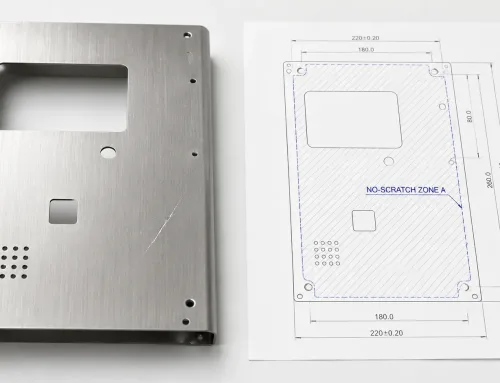
- Masking areas — Threaded holes, mating surfaces, ground contact points, weld zones, and any area that must remain uncoated. Masking requirements that are not on the drawing will not be in the production plan.
A callout that reads “Powder coating: super-durable polyester, RAL 7016, 30 ± 5 GU at 60°, DFT 60–80 μm, to Qualicoat Class 2. Mask: M4 threaded inserts, rear mounting flange” communicates everything the supplier needs. A callout that reads “powder coat grey” communicates almost nothing.
The gap between those two callouts is where callout review capability becomes visible — because a capable supplier will ask you to close that gap before they quote, while an incapable one will fill it with assumptions.
What to Look for in a Supplier’s RFQ Response
The RFQ response is the most revealing document in the evaluation process. It is the first and often only chance a supplier gets to demonstrate that they reviewed your callout, understood it, and identified anything that needs clarification.
A supplier with genuine callout review capability will typically do the following in their RFQ response:
- Confirm critical parameters explicitly. Rather than simply listing “powder coating” as a line item, they will restate the color standard, film thickness range, and performance standard in their quote. This confirms they read the callout and are committing to specific values — not a generic finishing operation.
- Ask clarifying questions when the callout is incomplete. If your drawing says “powder coat black” without specifying a color system, a capable supplier will ask whether you mean RAL 9005, RAL 9011, or something else. If you specify a film thickness but no maximum, they will ask about the upper limit. These questions are not signs of incompetence — they are the clearest evidence of it.
- Flag conflicts between your callout and the part geometry. If your drawing specifies powder coating on a part with tight-tolerance threaded holes or press-fit surfaces, a capable supplier will note that those areas should be masked — even if your drawing does not say so. If the part has sharp internal bends where film thickness will be uneven, they will raise it.
- Reference the powder manufacturer’s TDS. A supplier that cross-references your callout against the specific powder product’s curing temperature, recommended film thickness, and application parameters is demonstrating a process-aware review — not just a visual scan of your drawing.
The following contrast illustrates the difference between a qualified and an unqualified RFQ response:
| RFQ Element | Capable Supplier Response | Red-Flag Response |
|---|---|---|
| Color | “RAL 9005 confirmed, matte 15 ± 5 GU at 60°” | “Black powder coating” |
| Film thickness | “DFT 60–80 μm per drawing, verified with Elcometer” | “Standard thickness” |
| Performance standard | “Qualicoat Class 1 — please confirm if Class 2 is required for outdoor exposure” | No mention |
| Masking | “M4 threaded holes and rear flange to be masked per drawing callout” | No mention |
| Pretreatment | “5-stage pretreatment line: degrease → rinse → iron phosphate → DI rinse → dry” | No mention |
| Clarification | “Drawing specifies coating on all surfaces — confirm whether interior surfaces of enclosure require coating or only exterior” | No questions asked |
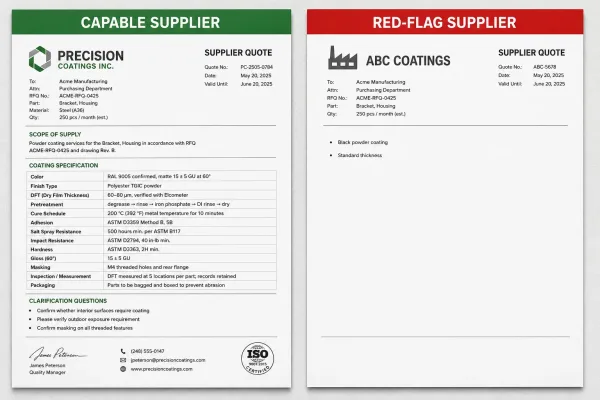
A capable supplier restates your parameters and asks questions; a red-flag supplier returns a vague quote with no clarifications.
A supplier that returns a quote with no questions, no parameter confirmation, and no masking reference has either not reviewed your drawing or does not understand what to look for. Either way, that gap will become your problem during production.
Sheet Metal–Specific Coating Callout Concerns
Powder coating on sheet metal parts introduces challenges that do not apply to castings, extrusions, or machined parts. A supplier’s callout review should account for these sheet metal–specific factors.
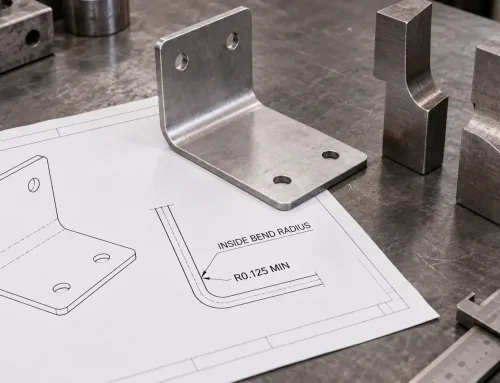
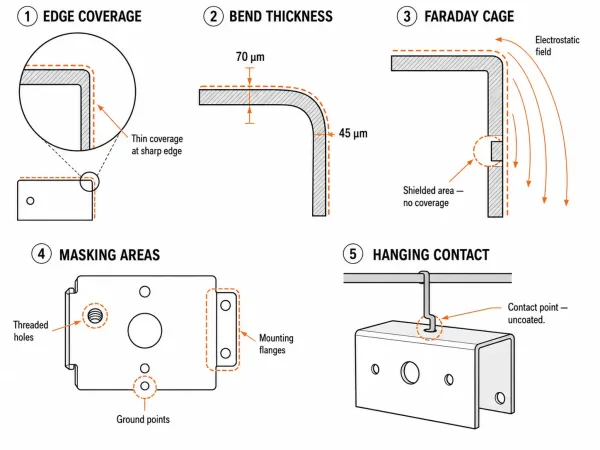
- Edge coverage. Sheared, laser-cut, or punched edges on sheet metal are sharp and often carry a burr. Powder coating does not wrap well around sharp edges — the electrostatic charge concentrates on flat surfaces, leaving edges with thin or no coverage. A capable supplier will note that sharp edges need to be broken or deburred before coating, and will flag this as a pretreatment concern if your drawing does not address it.
- Bend area thickness variation. On bent sheet metal parts, the outer surface of the bend is stretched and the inner surface is compressed. Film thickness can vary across the bend radius, especially on tight bends. If your callout specifies a narrow DFT range (e.g., 60–80 μm), a capable supplier should confirm whether the tolerance applies uniformly or whether bend areas are measured separately.
- Masking complexity. Sheet metal enclosures and assemblies often have multiple features that require maThe first-article inspection (FAI) report is where callout interpretation meets physical evidence. It is the last checkpoint before you commit to a production run — and the most concrete way to verify that the supplier understood your callout correctly.sking — threaded inserts, PEM fasteners, grounding points, mating flanges, weld joints, and hinge locations. The more masking areas your drawing specifies, the more a supplier needs to understand the functional reason behind each mask. A supplier that asks “why does this surface need to be masked?” is not questioning your design — they are confirming they understand the assembly intent.
- Faraday cage effect. Internal corners, deep recesses, and enclosed areas of sheet metal parts create electrostatic shielding that prevents powder from reaching the surface. Parts with deep channels or partially enclosed geometries may require specialized gun settings or manual touch-up. A supplier reviewing a complex enclosure drawing should flag areas where the Faraday cage effect will cause thin coverage — not wait for you to discover bare spots during incoming inspection.
- Hanging and racking. How a sheet metal part is hung or racked on the coating line determines where the contact points are — and contact points are uncoated areas. A capable supplier will confirm the hanging method with you, especially if the contact point location affects cosmetic appearance or function. If your drawing does not specify acceptable contact points, the supplier should ask.
Five sheet metal–specific coating challenges that a capable supplier should identify during callout review.
These factors are not exotic engineering problems. They are routine in sheet metal fabrication. A supplier that does not raise them during callout review is either not experienced with sheet metal parts or not reviewing your drawing with manufacturing intent.
Verifying Callout Interpretation Through First-Article Inspection
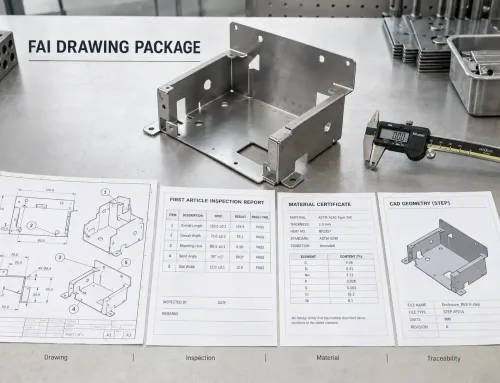
The first-article inspection (FAI) report is where callout interpretation meets physical evidence. It is the last checkpoint before you commit to a production run — and the most concrete way to verify that the supplier understood your callout correctly.
A thorough FAI report for a powder-coated sheet metal part should include the following data points:
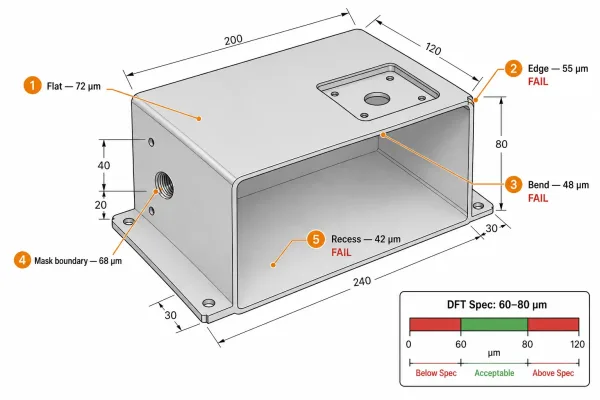
- Dry film thickness measurements — Multiple measurements across different surfaces of the part: flat areas, edges, bends, recesses, and near masking boundaries. A single measurement on a flat panel does not tell you whether the coating is consistent across the geometry.
- Adhesion test result — Cross-hatch adhesion per ASTM D3359 or ISO 2409, with the classification rating recorded. For most industrial applications, a 4B rating (ASTM) or Class 1 (ISO 2409) is the minimum acceptance criterion.
- Color and gloss verification — Visual comparison against the specified color standard (RAL chip or Pantone swatch) and gloss measurement at the specified angle. This confirms the supplier used the correct powder product, not a generic substitute.
- Masking verification — Photographs or dimensional checks confirming that masked areas are clean and uncoated. This is especially critical for threaded holes and press-fit surfaces where coating would interfere with assembly.
- Surface condition assessment — Visual inspection for defects: fish eyes (oil contamination), pinholes (moisture or outgassing), orange peel (excessive film thickness or incorrect cure), and thin coverage at edges.
First-article inspection should measure DFT at multiple locations — edges, bends, and recesses are where failures most commonly occur.
When reviewing the FAI report, look for two things. First, does the data match your callout? If you specified DFT 60–80 μm and the report shows 55–95 μm, the process is not under control — even if the average falls within range. Second, did the supplier measure the right locations? A report that shows only flat-area readings ignores the areas most likely to fail — edges, bends, and masking boundaries.
A supplier that submits a complete, well-documented FAI report without being asked is demonstrating callout review capability in action. A supplier that submits a single-page certificate with no measurement data is demonstrating the opposite.
The Full Review Chain: From Drawing Callout to Batch Consistency
Callout review is not a single event. It is a chain of verification steps that runs from the initial drawing through production release, and each link in that chain depends on the one before it.
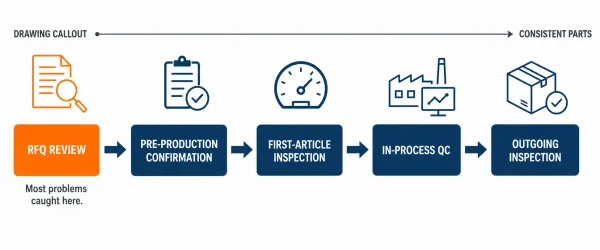
The five-stage review chain runs from initial drawing callout to batch consistency, with RFQ review as the first and most critical link.
Stage 1: RFQ Review. The supplier reads your callout, confirms parameters, asks clarifying questions, and flags potential issues. This is where most callout problems should be caught — before any material is ordered or production is scheduled. The output is a quote that reflects a clear understanding of your coating requirements.
Stage 2: Pre-Production Confirmation. After order placement, the supplier confirms the powder product (manufacturer, product code, lot number), the pretreatment process, the masking plan, and the cure schedule. This confirmation should cross-reference your callout against the powder manufacturer’s TDS. Any discrepancies between your callout and the TDS should be resolved at this stage.
Stage 3: First-Article Inspection. The supplier produces a small number of parts and inspects them against your callout. The FAI report (covered in the previous section) documents conformance or flags deviations. This is the gate between quoting and production.
Stage 4: In-Process Quality Control. During production, the supplier monitors film thickness, cure temperature, pretreatment chemistry, and masking integrity at defined intervals. The frequency and method of in-process checks should be documented in the supplier’s quality plan — not left to operator discretion.
Stage 5: Outgoing Inspection and Documentation. Before shipment, the supplier verifies that finished parts meet your callout and provides documentation — typically a Certificate of Conformance (CoC) with key measurement data, or a full inspection report if your quality requirements specify one.
The strength of this chain is only as good as its weakest link. A supplier with strong RFQ review but weak in-process control will produce a perfect first article followed by inconsistent batches. A supplier with strong testing capability but no RFQ review will deliver parts that pass testing but fail to meet your intent. When evaluating callout review capability, you are evaluating the first link in a chain that must hold through all five stages.
FAQs
A supplier’s powder coating callout review capability is not a soft skill or a nice-to-have. It is the earliest and most reliable indicator of how that supplier will perform across every stage of your project — from quoting through production to delivery. Certifications verify that the equipment is capable. Test reports verify that a batch passed. But callout review capability verifies that the supplier’s engineering team understands what you need, catches what you missed, and communicates clearly before problems reach the production floor. That is the difference between a supplier that delivers consistent parts and one that delivers consistent surprises.