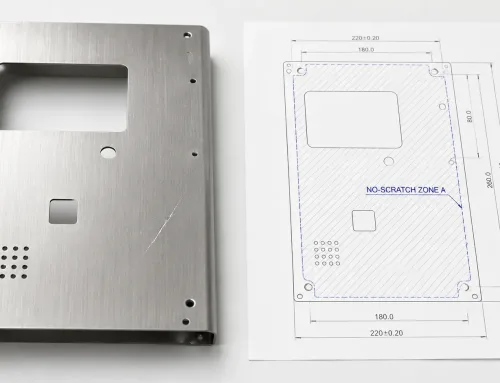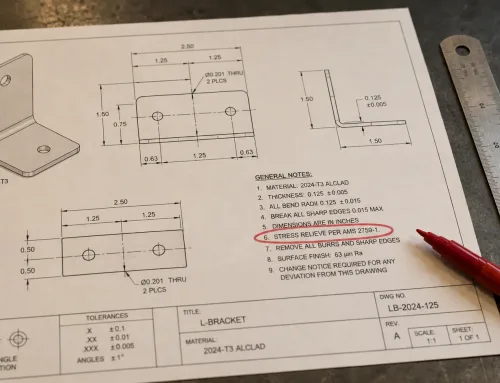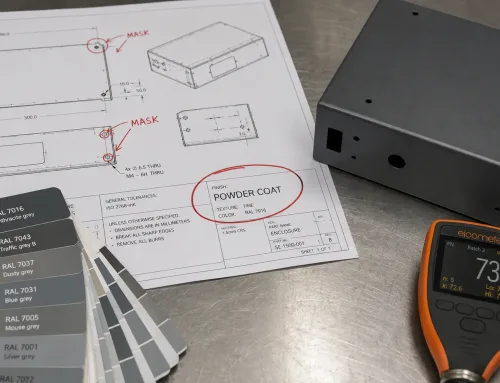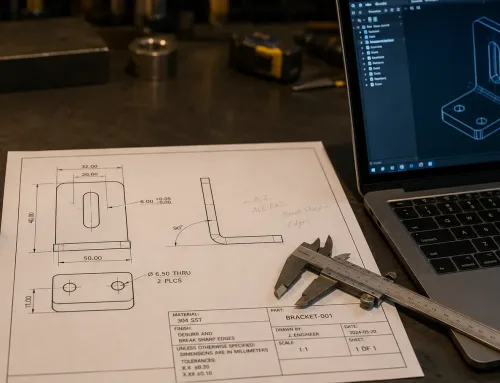

When a powder coating specification is missing a tolerance, a surface preparation requirement, or a test method, the result is rarely a polite clarification email. More often, it is a batch of parts held at the supplier’s facility, a production line waiting for components, or a costly rework order that eats into your project margin. For engineers and procurement teams outsourcing sheet metal fabrication, reviewing powder coating callouts is not a box-ticking exercise—it is the last chance to catch specification gaps before they become manufacturing problems.
Why Powder Coating Callout Review Matters for Outsourced Manufacturing
Powder coating is a dry finishing process where electrostatically charged powder particles are sprayed onto a grounded metal surface, then cured in an oven to form a hard, durable coating. Unlike liquid paint, powder coating produces a uniform thickness with minimal waste, making it a standard finish for sheet metal enclosures, brackets, and panels in industrial, automotive, and consumer electronics applications.
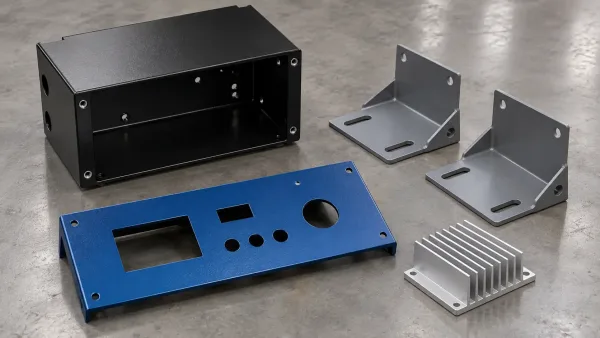
This image displays a collection of finished powder-coated sheet metal components commonly used in industrial applications.
When you outsource sheet metal parts, the powder coating specification on your drawing becomes the contract between you and your supplier. If that specification is incomplete, ambiguous, or technically unrealistic, you absorb the risk—not the supplier. A callout that simply reads “powder coat, RAL 9005” leaves critical decisions about surface preparation, coating thickness, adhesion testing, and cure verification to the supplier’s interpretation. If their interpretation differs from your functional requirements, the parts may meet the letter of the specification while failing your actual needs.
The review process is your opportunity to ensure that every powder coating requirement is clear, measurable, and achievable given your supplier’s capabilities. It is also where you can identify potential cost drivers, lead time risks, and quality issues before they affect your production schedule.
What You Need Before Starting the Review
Before examining the powder coating callouts on your drawing, gather the following documents and information. This preparation ensures your review is grounded in facts, not assumptions.
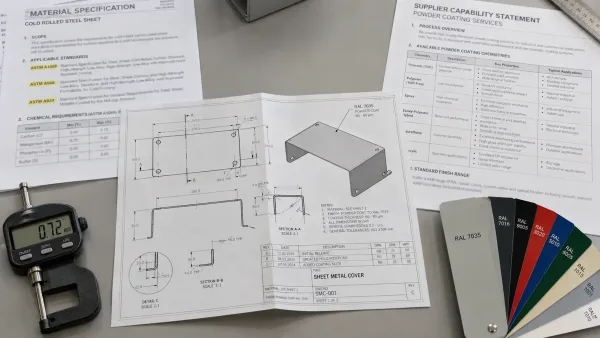
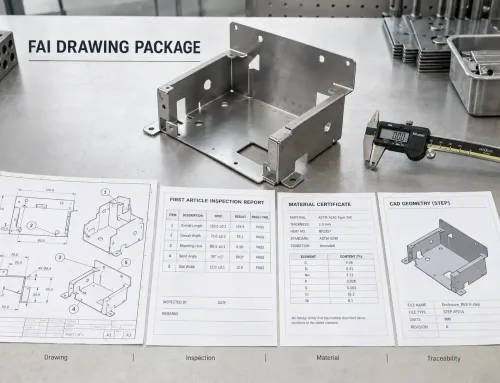
This image shows the essential documents required before starting a powder coating callout review: engineering drawing, material specification, and supplier capability statement.
Required Documents and Information
The latest engineering drawing with all revision notes and change orders. If you have multiple revisions, confirm you are reviewing the current version—a common source of specification errors is reviewing an outdated drawing.
The material specification for the base metal. Powder coating adhesion, corrosion resistance, and cure temperature compatibility depend on the substrate. A callout that works on cold-rolled steel may fail on aluminum or galvanized surfaces without adjusted surface preparation.
A functional requirements document or design intent statement. This does not need to be formal; even a brief email outlining the part’s operating environment (indoor/outdoor, chemical exposure, UV exposure, temperature range) helps you evaluate whether the specification is adequate.
Your supplier’s capability statement or a recent quality audit report. Knowing their powder coating line capacity, available colors, maximum part size, and testing equipment helps you identify specifications they cannot meet or will struggle to achieve consistently.
Understanding Your Supplier’s Capabilities
Not all powder coating suppliers have the same capabilities. Some operate small batch lines with limited color options; others run high-volume automated systems with extensive testing equipment. Before your review, confirm:
- Maximum part dimensions that fit their oven and spray booth
- Available powder chemistries (polyester, epoxy, polyurethane, hybrid)
- Surface preparation options (phosphating, chromate conversion, sandblasting)
- Testing capabilities (thickness gauges, adhesion testers, salt spray chambers)
- Color matching services (standard RAL/Pantone vs. custom color matching)
If your supplier lacks a specific capability, your callout must either be adjusted to match what they can deliver, or you must source that capability separately—adding cost and lead time.
Key Inspection Points in Powder Coating Callouts
A complete powder coating callout specifies five elements: coating type, thickness, surface preparation, color, and performance requirements. Review each against the following criteria.
Coating Thickness and Tolerance
Powder coating thickness is measured in mils (thousandths of an inch) or microns. A typical specification is 2.0–4.0 mils (50–100 µm) for functional parts, though decorative applications may specify 1.5–3.0 mils.
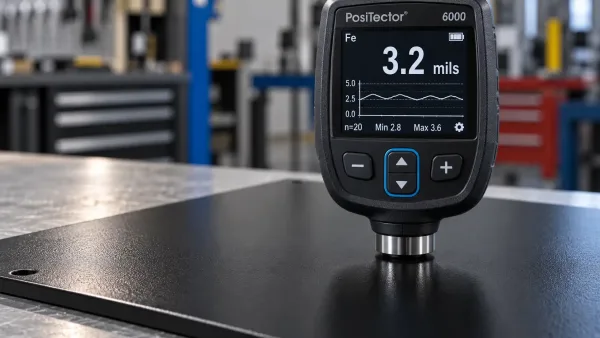
This image shows a digital thickness gauge measuring powder coating thickness on a test panel, displaying a reading of 3.2 mils.
What to check:
- Is the thickness range realistic for the part geometry? Complex shapes with recesses, corners, or internal surfaces may not achieve uniform thickness without specialized fixturing.
- Is the tolerance achievable? A specification of 2.0 ± 0.5 mils is standard; 2.0 ± 0.2 mils requires tight process control and may increase cost.
- Are there areas where thickness is critical? If mating surfaces, threaded holes, or press-fit features exist, specify whether those areas should be masked or have different thickness requirements.
Common error: Specifying a single thickness value (e.g., “2.0 mils”) without a tolerance range. This leaves the acceptable variation undefined and invites disputes during inspection.
Surface Preparation Requirements
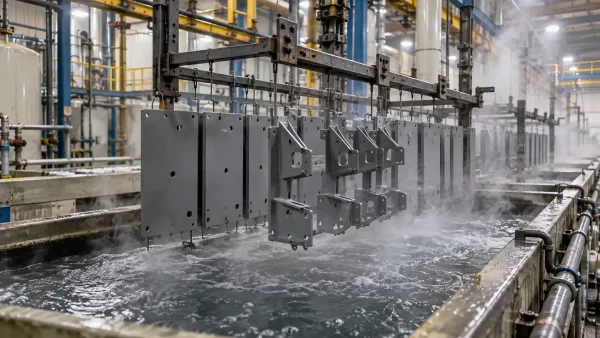
This image shows sheet metal components in a phosphating bath, a critical surface preparation step before powder coating application.
Surface preparation is the most critical factor in powder coating adhesion and corrosion resistance. The callout should specify the cleaning and conversion coating process before powder application.
Standard preparation sequence:
- Cleaning: Alkaline degreasing or solvent cleaning to remove oils, greases, and contaminants
- Rinsing: Deionized water rinse to remove cleaning residues
- Conversion coating: Iron phosphate (for mild corrosion protection) or zinc phosphate (for enhanced adhesion and corrosion resistance)
- Final rinse: Sealing rinse or chromate-free sealer
What to check:
- Is the conversion coating type specified? “Clean and coat” is insufficient; specify “iron phosphate” or “zinc phosphate” at minimum.
- Is the surface preparation standard referenced? Industry standards like ASTM D7396 (phosphating) or MIL-DTL-5541 (chromate conversion) provide measurable requirements.
- Are there substrate-specific requirements? Aluminum, galvanized steel, and stainless steel each require different preparation chemistry.
Common error: Omitting surface preparation entirely. The supplier will apply their default process, which may not match your corrosion resistance requirements.
Color and Gloss Specifications
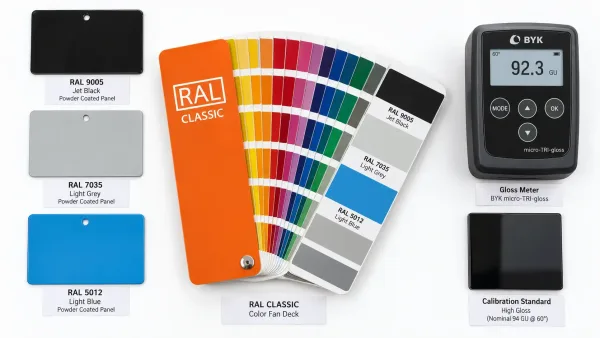
This image shows RAL color swatches and gloss measurement standards used to specify powder coating colors and finishes.
Color is specified using industry-standard systems: RAL (European), Pantone (design), or custom color chips. Gloss is measured in gloss units (GU) at a specified angle (typically 60°).
What to check:
- Is the color specification precise? “Black” is ambiguous; “RAL 9005, jet black” is specific.
- Is the gloss level specified? Matte, satin, and glossy finishes have different GU ranges. A matte finish might be 10–25 GU at 60°; a glossy finish might be 80+ GU.
- Is color matching required? If matching an existing part or a specific brand color, specify the tolerance (ΔE value) and provide a physical sample or color chip.
Common error: Specifying a color without a gloss level. Two suppliers can both apply “RAL 7035” and produce visibly different results if one applies a matte finish and the other a semi-gloss.
Adhesion and Durability Standards
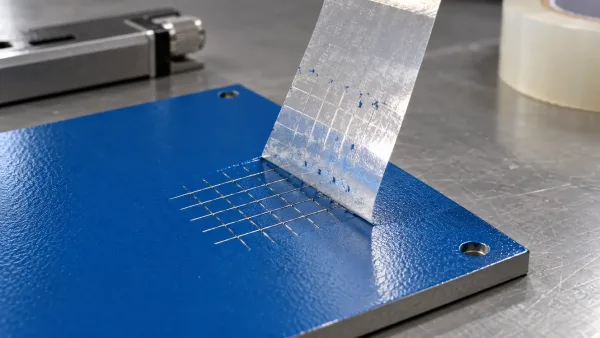
This image shows a cross-cut adhesion test being performed on a powder-coated panel according to ASTM D3359, with tape being removed to assess coating adhesion.
Adhesion testing verifies that the powder coating bonds properly to the substrate. Durability testing confirms the coating withstands the part’s operating environment.
Standard tests:
- Cross-cut adhesion test (ASTM D3359): A grid is scribed through the coating; tape is applied and removed; coating loss is rated 0B (complete failure) to 5B (no failure).
- Mandrel bend test (ASTM D522): The coated panel is bent around a cylinder; cracking or delamination indicates poor adhesion.
- Salt spray test (ASTM B117): The coated panel is exposed to salt fog; hours to first corrosion indicate corrosion resistance. Typical requirements range from 250 hours (indoor use) to 1,000+ hours (outdoor marine environments).
What to check:
- Are specific test methods referenced? “Good adhesion” is not measurable; “ASTM D3359, 4B or better” is.
- Are test frequency and sampling specified? Will every part be tested, or only first-article samples?
- Are acceptance criteria clear? What constitutes a failure—is it any visible corrosion, or only red rust exceeding a specified area?
Common Mistakes in Powder Coating Callouts and How to Avoid Them
Incomplete or Ambiguous Specifications
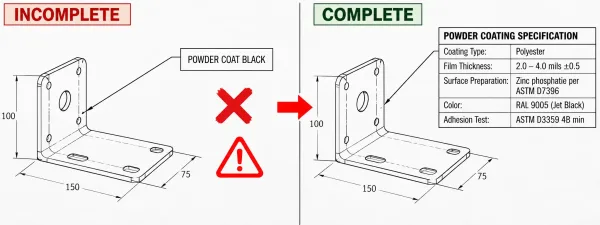
This image compares an incomplete powder coating callout (left) with a complete specification (right), highlighting the critical missing information.
The most frequent error is a callout that lacks the detail needed for consistent execution. “Powder coat per supplier standard” transfers all decisions to the supplier, which may produce acceptable parts today but inconsistent results across batches or suppliers.
How to avoid: Use a specification template that requires coating type, thickness range, surface preparation, color reference, and at least one performance test. If you do not know what to specify, ask your supplier for their standard offering and document it as your baseline.
Mismatched Requirements and Manufacturing Capabilities
Specifying a powder coating requirement that your supplier cannot achieve consistently leads to either rejected parts or a quiet deviation from your specification. For example, specifying a 1.0 mil thickness tolerance on a complex bent part may be physically impossible without masking or selective coating.
How to avoid: Review your supplier’s capability statement before finalizing the callout. If a requirement is at the edge of their capability, discuss it explicitly and document any agreed deviations.
Missing Critical Information
Some callouts specify the coating but omit the preparation, testing, or inspection requirements. Others specify performance criteria (e.g., “1,000 hours salt spray”) without specifying the test method, which leaves interpretation to the testing laboratory.
How to avoid: Use a callout checklist (see H2-5) to verify that every critical element is included. If a requirement is not applicable, note it as “N/A” rather than omitting it entirely—this signals intentional omission rather than oversight.
Review Checklist for Powder Coating Callouts
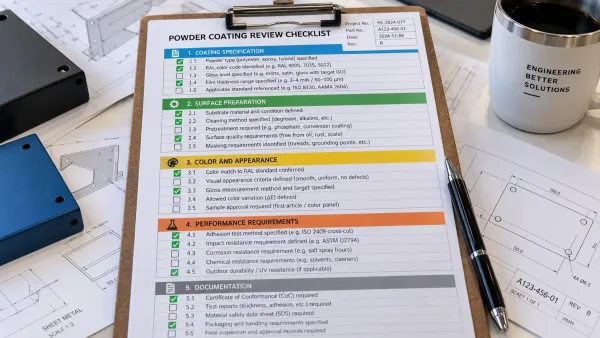
This image presents a visual checklist for powder coating callout review, organized into five main categories with key verification items.
Use this checklist when reviewing powder coating callouts on your engineering drawings. Each item addresses a specification element that, if missing or unclear, can lead to manufacturing issues.
Coating Specification
- Coating type specified (polyester, epoxy, polyurethane, hybrid)
- Thickness range with tolerance (e.g., 2.0–4.0 mils ± 0.5 mils)
- Areas to be masked or excluded (threaded holes, mating surfaces, labels)
Surface Preparation
- Cleaning method specified (alkaline degreasing, solvent cleaning)
- Conversion coating type specified (iron phosphate, zinc phosphate)
- Applicable standard referenced (ASTM D7396, MIL-DTL-5541)
Color and Appearance
- Color reference with system (RAL 9005, Pantone 432C, custom chip)
- Gloss level specified (matte, satin, glossy with GU range if critical)
- Color matching tolerance if applicable (ΔE ≤ 2.0, physical sample provided)
Performance Requirements
- Adhesion test method and acceptance criteria (ASTM D3359, 4B minimum)
- Corrosion resistance test if applicable (ASTM B117, hours to failure)
- Test frequency specified (first article, every lot, sample size)
Documentation and Communication
- Supplier acknowledgment required before production
- Inspection report requirements specified (CMM data, thickness readings)
- Non-conformance handling procedure agreed (reject, rework, use-as-is)
Communicating Powder Coating Requirements to Your Supplier
Clear Documentation Practices
The powder coating callout on your drawing is the primary communication tool, but it is not the only one. For complex or critical applications, supplement the callout with:
- A coating specification sheet that details all requirements in a single document, referenced on the drawing
- A physical sample or approved color chip for color and gloss verification
- A supplier questionnaire that confirms their understanding of each requirement
Avoid relying on verbal communication or email chains for specification details. If a requirement is not in writing and referenced on the drawing, it does not exist from a quality control perspective.
Supplier Confirmation Process
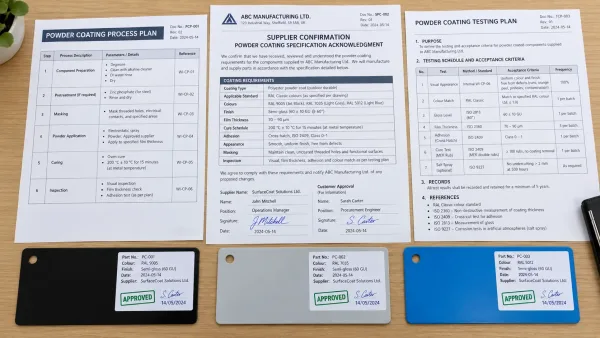
This image shows the key documents in a supplier confirmation process for powder coating specifications: specification acknowledgment, process plan, and testing plan.
Before production begins, require your supplier to confirm their understanding of the powder coating requirements. This confirmation should include:
- Acknowledgment of the specification: “We confirm receipt and understanding of the coating requirements per Drawing ABC-123, Rev C.”
- Process plan: A brief description of their intended process sequence (cleaning, conversion coating, powder application, cure temperature and time)
- Testing plan: Which tests they will perform, at what frequency, and how results will be reported
This confirmation step catches misunderstandings before they become non-conforming parts. It also creates a documented agreement that protects both parties if disputes arise later.
Key Takeaways and Next Steps
Powder coating callout review is a systematic process, not a quick glance at the drawing. The key principles are:
- Specify what you need, not what sounds good. Every requirement should be traceable to a functional need—corrosion resistance, appearance, adhesion, or chemical resistance.
- Be precise and measurable. Replace subjective terms (“good adhesion,” “smooth finish”) with test methods and acceptance criteria.
- Match specifications to capabilities. Confirm your supplier can achieve what you specify before committing to production.
- Document everything. The drawing, the specification sheet, and the supplier confirmation form a three-part communication system that prevents most coating-related disputes.
If you are outsourcing sheet metal parts with powder coating requirements, consider having your coating specifications reviewed by an engineer familiar with your supplier’s capabilities. A 30-minute review at the quotation stage can prevent weeks of delay and thousands of dollars in rework costs.
FAQs
This article is intended for informational purposes only. SR-MFG provides powder coating callout review as part of our engineering support services for outsourced sheet metal manufacturing. For specific project requirements, contact our engineering team.