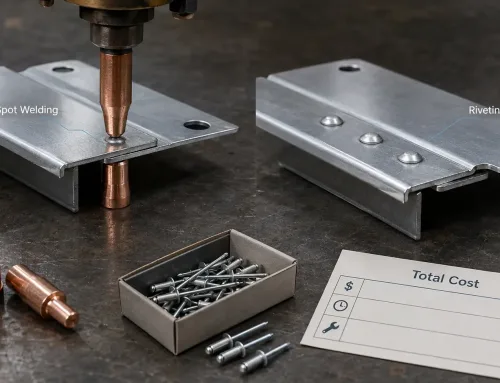

“Powder coating is cheaper than anodizing.” Nearly every comparison page repeats some version of that sentence, and on a per-piece quote it usually holds. As a statement about total cost, it is frequently wrong enough to cost a project real money.
A quote captures one layer. It does not capture masking labor on forty threaded holes, a fit tolerance closed by film thickness, or a recoat scheduled for year nine. Those items decide what the part actually costs.
This comparison treats the two finishes as a cost ledger rather than a feature list. The question is not which process sounds better. It is which one leaves less money on the table over the life of the part.
What Does “Total Cost” Actually Include?
The four cost layers behind a finished part
Total cost of ownership (TCO) for a coated part stacks in four layers:
- Invoice price — the quoted number: pretreatment, coating or anodizing, cure or seal, and standard handling.
- Manufacturing process cost — masking, racking, fixturing, extra inspection, and any rework the finish demands inside the shop.
- Dispute and rejection cost — failed thickness checks, color mismatches, and the engineering hours spent closing them.
- Service-life cost — maintenance, recoats, downtime, and early replacement in the part’s real environment.
Most side-by-side comparisons stop at layer one and call it cost.
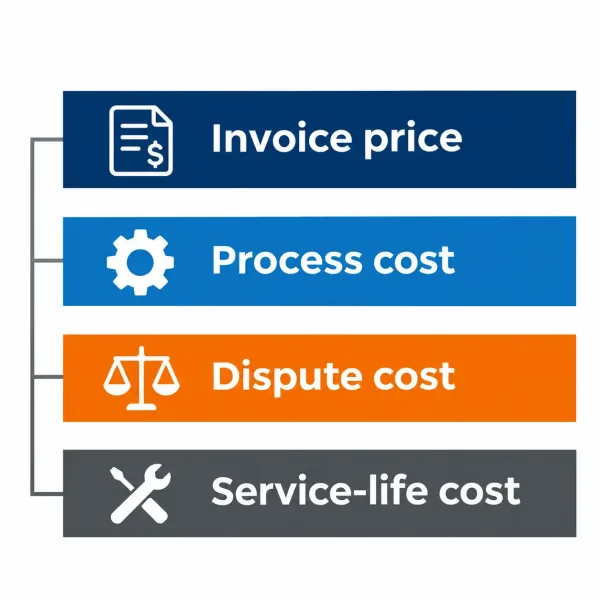
A stacked diagram showing the four cost layers that make up the total cost of a finished part.
Why the cheapest quote is often not the cheapest part
Consider a sheet metal enclosure with forty threaded holes, three weld seams, and a press-fit rail. On paper, powder coating looks clearly cheaper. If those holes must be masked, if weld color drives a rejection, or if the rail needs a secondary operation because of film build-up, layers two and three quietly take the difference back.
That is the pattern to watch: a finish that wins the quote can lose the ledger.
Where the Upfront Price Gap Comes From
What each process charges for
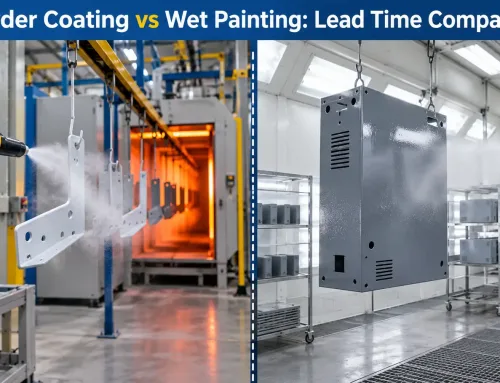
Powder coating is a batch-friendly line process. Parts are pretreated, electrostatically sprayed, and cured at roughly 180–200 °C. Overspray can be reclaimed, and mixed part sizes share a rack.
Anodizing is an immersion process with tighter physics. Aluminum parts are cleaned, etched, and run through a sulfuric acid bath, then optionally colored and sealed. Only aluminum forms the oxide layer this process depends on.
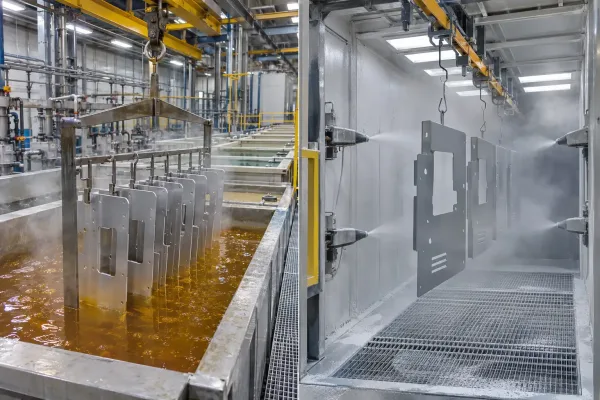
Left: aluminum parts on a rack entering a sulfuric acid anodizing bath. Right: steel parts hanging in a powder coating spray booth.
The table below summarizes where the per-piece gap actually comes from.
| Cost driver | Powder coating | Anodizing |
|---|---|---|
| Base metals | Steel, aluminum, stainless, mixed | Aluminum only |
| Typical film | 60–120 μm (0.002–0.005 in) | 5–25 μm Type II; 25–50 μm Type III |
| Process shape | Spray and cure line, batch flexible | Immersion bath, rack dependent |
| Main labor driver | Masking, racking, touch-up | Masking, racking, fixturing |
| Material recovery | Overspray reclaimable | Bath chemistry controlled; no reclaim |
Powder usually quotes lower per piece because of cycle time, reclaimable material, and coverage across multiple metals.
Anodizing’s two cost multipliers
Two factors move anodizing quotes more than any other.
First, anodizing type. Type II (standard, 5–25 μm) is the baseline. Type III hard anodizing (25–50 μm) runs colder, longer, and at higher current density, and it typically prices at 1.5–2.5× Type II on the same part.
Second, masking. Every threaded hole, grounding face, and press-fit bore that must stay bare takes labor on every piece. Where masking would be excessive, many shops machine the feature after anodizing instead — that adds tooling and handling cost but gives dimensional certainty.
The Sheet Metal Cost Drivers Generic Comparisons Miss
Welds and heat-affected zones
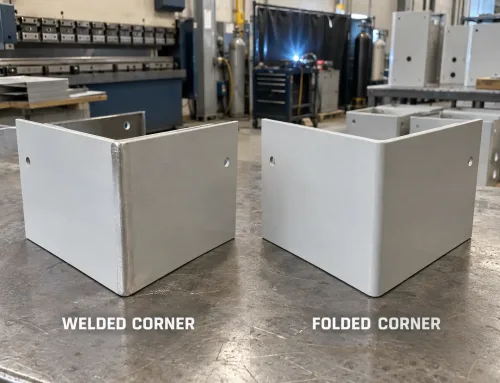
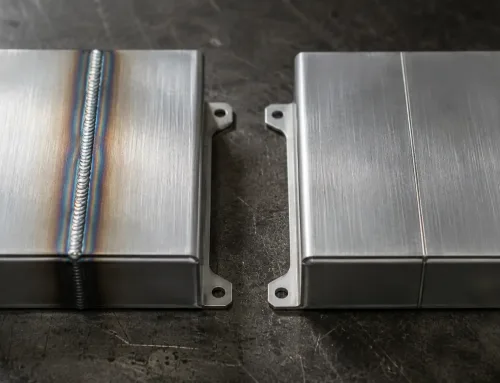
A weld seam does not disappear under a finish. Anodizing reads metallurgy: the weld and its heat-affected zone (HAZ — the band of metal whose properties were altered by welding heat) often anodize a different shade than the parent sheet. Cosmetic assemblies may need grinding and blending before the bath, and that is real labor on every unit.
Powder coating hides minor surface variation under 60–120 μm of film, but spatter and deep grinding marks telegraph through. Both routes charge for weld dressing. They simply charge in different places.
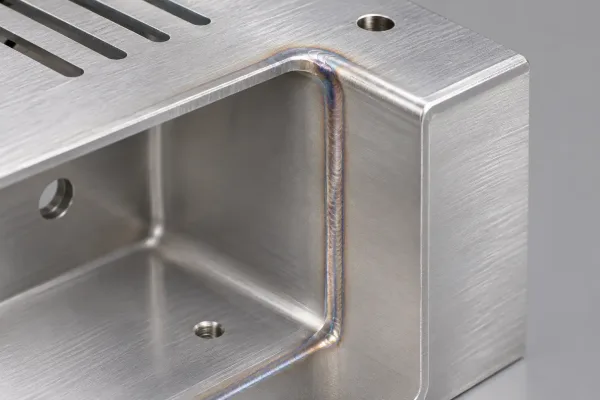
Close-up of a fabricated sheet metal corner showing the weld seam with heat tint, the bend inside radius, and a laser-cut edge.
Bends, cut edges, and fit-critical dimensions
Film thickness is a dimensional event.
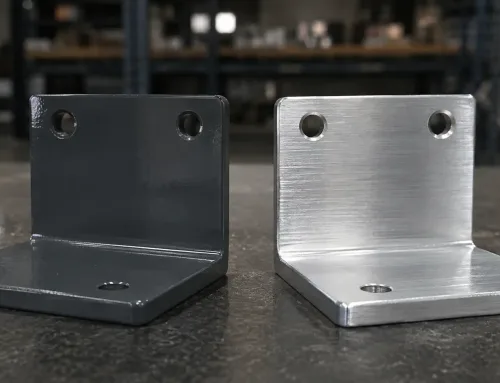
A standard Type II anodize layer grows both into the metal and above it. Roughly half the film builds above the original surface, so a 20 μm coating raises an external face by about 10 μm per side and closes a bore by a similar amount per side. Predictable, and usually compensated in machining.
Powder sits entirely above the surface. At 60–120 μm per side, an unmasked 10 mm bore loses 0.12–0.24 mm of diameter. On sharp laser-cut edges, powder film commonly runs 30–50% thinner than on the face; on tight bend radii it can crack or orange-peel. Hard anodize has the opposite edge problem — it can burn at sharp corners if current density is not managed.
Both processes punish unmanaged geometry. Sheet metal just has more of it.
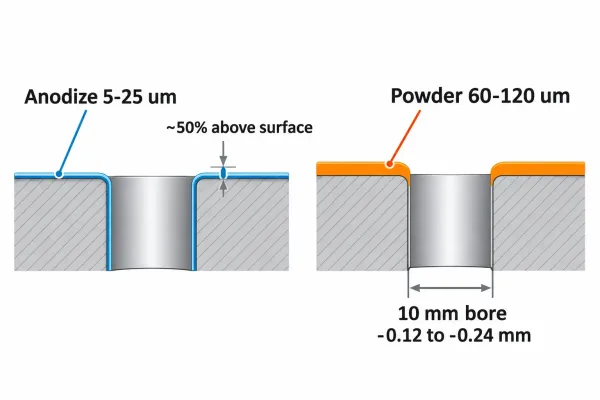
Cross-section of a bore showing anodize film half inside the metal and powder film fully above the surface, with thickness and bore-loss values.
When the Cheaper Finish Becomes the Expensive One
Base material decides what is even possible
Anodizing is aluminum-only. If the design mixes steel brackets with an aluminum housing, powder coating is the only finish that covers the set. The comparison then changes from “which is cheaper” to “how do we finish one assembly with one process” — and mixed-metal assemblies make that decision for you.
Volume changes the labor share
At ten pieces, masking and racking dominate the quote. A heavy masking job can make anodizing the cheaper call even on parts where powder wins at a thousand pieces. As volume rises, line throughput pulls powder’s unit cost down, while bath capacity pulls anodizing’s down.
The crossover point is part-specific. It lives in the labor content, not in the chemistry.
Service environment and recoat cycles
The final reversal happens after delivery. In aggressive outdoor or coastal exposure, a standard powder system may need maintenance or recoating well before an anodized surface does. A recoat means stripping or overcoating, handling, and downtime.
If the part is easy to pull and refinish, powder’s low entry price survives. If it is installed at height, welded into place, or tied to production uptime, the finish that avoids the second visit wins the ledger regardless of the first invoice.
The Decision Rule: Which Finish Wins on Total Cost?
The levers above collapse into one matrix.
| Condition | Favored on total cost | Why |
|---|---|---|
| Aluminum, tight fits, long service life | Anodizing | Thin, stable film; low maintenance |
| Steel or mixed metals | Powder coating | Only compatible route |
| Small batch, heavy masking either side | Compare labor line by line | Masking dominates; chemistry decides less |
| Large batch, cosmetic, many colors | Powder coating | Line speed and color flexibility |
| Installed in place, hard to recoat | Anodizing (if aluminum) | Avoids a second mobilization |
| Aggressive outdoor, recoat access easy | Powder coating | Low entry cost; planned recoats acceptable |
Read it in three steps: check base metal first, then service environment, then batch size and fit complexity. When two rows conflict, price the labor — masking and fixturing — not the process names.
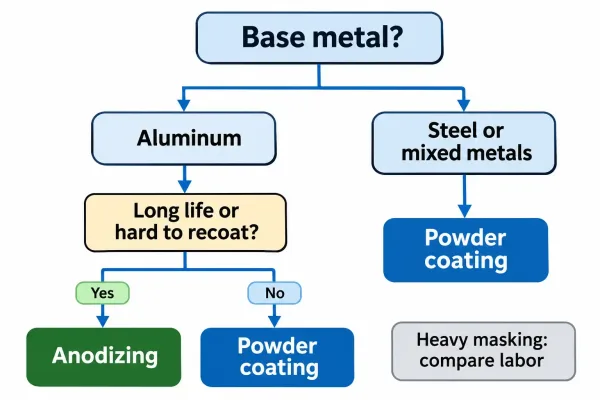
A flowchart that routes base metal, service life, and recoat access to the finish favored on total cost.
How to Lock the Lower Total Cost on Your Drawing
Five callouts that prevent cost creep
Quotes diverge when drawings are quiet. Five callouts (explicit drawing notes that instruct the supplier) do most of the work:
- Film thickness range with a measurement method, for example eddy current per ASTM D7091.
- Color tolerance — a master panel or a ΔE limit (ΔE is a numeric color difference), with viewing conditions stated.
- Masking list — every thread, grounding face, datum surface, and press fit that must stay uncoated.
- Appearance class for weld zones and cut edges: as-welded, ground flush, or cosmetic.
- Defect limits — what is acceptable on non-cosmetic surfaces.
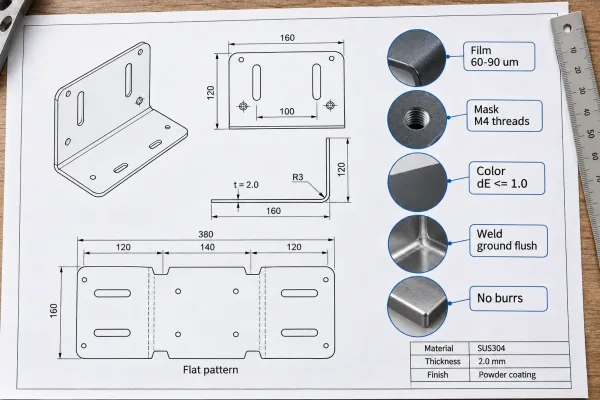
A sheet metal bracket drawing carrying five finish callouts: film thickness, thread masking, color tolerance, weld appearance, and edge condition.
What to ask suppliers to quote separately
When the request for quotation (RFQ) goes out, ask for masking, pretreatment upgrades, first-article inspection, and repair rates as separate line items. Bundled finishing prices hide the very numbers that decide the comparison.
When both finishes are quoted against the same line-item structure, the total cost answer usually becomes obvious.
FAQs
For fabricated assemblies, most of the total cost is decided before anyone pays for finishing — at the drawing stage. Having the fabricator review masking, fit, and weld requirements before RFQs go out costs less than any recoat ever will.