
Why “Which Is Cheaper?” Is the Wrong Question
Engineers and procurement teams often ask whether spot welding or riveting costs less. The honest answer is: it depends on what you mean by “cost.”
A single rivet costs a few cents. A single spot weld consumes a few cents’ worth of electricity. Neither number tells you anything useful about the total manufacturing cost of joining two pieces of sheet metal. The real expense lies in everything surrounding those operations—equipment depreciation, labor rates, training and certification, inspection time, rework, scrap, and how each choice ripples through downstream processes such as surface finishing and final assembly.
This article breaks down the full cost structure of both methods so you can make a decision based on your project’s specific requirements rather than a general assumption.
What Drives the Cost of Spot Welding
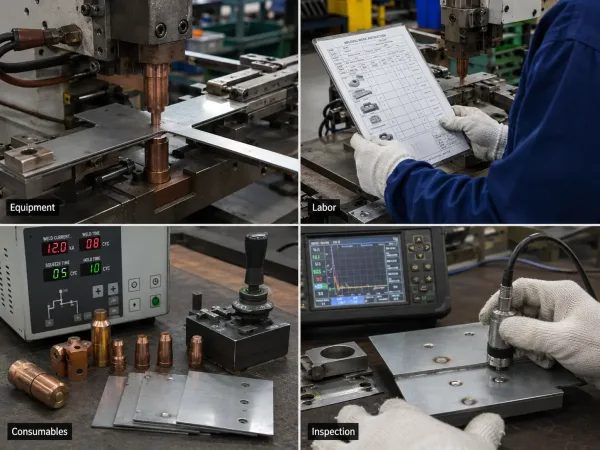
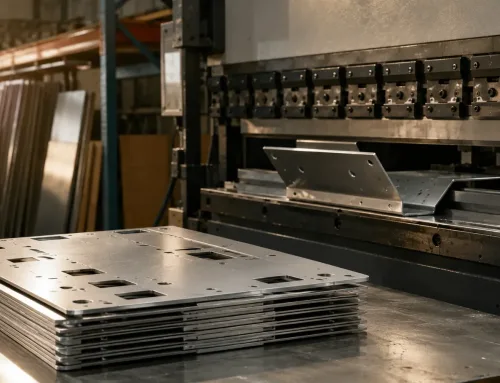
This image shows the main cost elements of spot welding, including equipment, labor, consumables, and inspection.
Sheet metal spot welding uses electrical resistance to generate heat at the interface between two metal sheets, fusing them without filler material. The process is fast and reliable for similar metals, but the cost structure involves more than the machine itself.
Equipment and Setup
A basic manual spot welding setup costs $500–$2,000. Automated cells with robotic arms start around $15,000 and can exceed $50,000 depending on complexity. Tooling costs are relatively low compared to other joining methods, but electrode maintenance adds ongoing expense—copper alloy electrodes wear down with use and need regular dressing or replacement, typically every 5,000–10,000 welds.
Labor and Certification
Spot welding requires a skilled operator who understands electrode force, current settings, and weld time parameters. In many markets, welders need specific certifications (such as AWS D8.1 for automotive sheet metal), which cost money to obtain and maintain. The labor rate for a certified spot welding operator is typically 20–40% higher than for a general assembly worker.
Consumables
The main consumables are electrodes, electricity, and sometimes shielding gas. Electricity costs are modest, but shielding gas (when required) adds $0.01–$0.05 per weld. Over a production run of 10,000 parts, these consumables accumulate into a meaningful line item that’s easy to underestimate during quoting.
Inspection and Quality Control
A sheet metal inspection plan for spot welds may include visual checks for expulsion, indentation, and nugget size, while structural applications often require destructive testing (peel tests, chisel tests) or ultrasonic inspection. A single ultrasonic inspection can cost $2–$5 per weld. If your part has 20 weld points, that’s $40–$100 per part just for inspection—a cost that’s easy to overlook when comparing “a few cents per weld.”
What Drives the Cost of Riveting
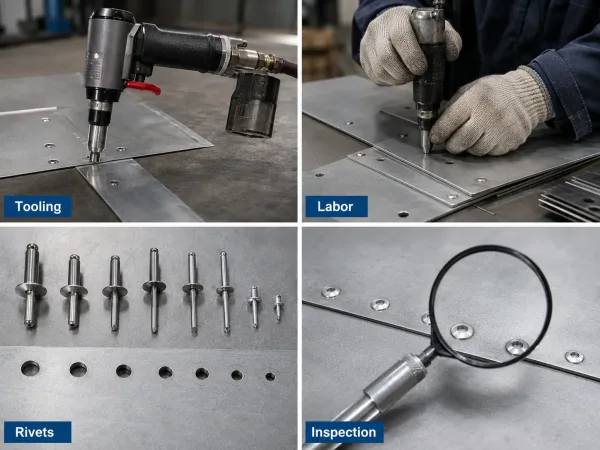
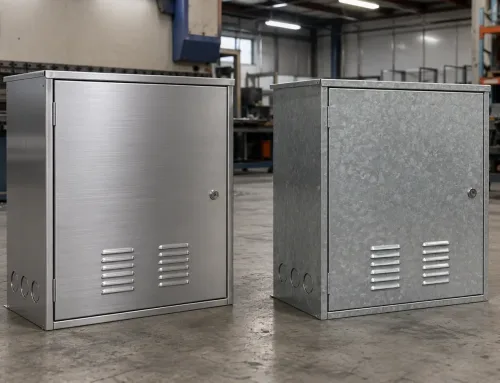
This image explains the main cost elements of riveting, including tooling, labor, rivets, and inspection.
Sheet metal assembly with rivets uses mechanical fasteners to join sheets by deforming the rivet body to create a permanent joint. The process is straightforward and doesn’t require heat, but the cost structure has its own complexities.
Equipment and Tooling
Manual riveting tools cost $20–$100 for hand riveters, while pneumatic or hydraulic systems run $200–$2,000. The equipment investment is significantly lower than spot welding, which is one reason riveting is often perceived as the cheaper option. However, if your design requires drilled holes, add the cost of drill bits, jigs, and hole-deburring tools to the total.
Labor and Training
Riveting requires less specialized training—an operator can learn the basics in a few hours rather than weeks. This lowers the labor rate per hour, but riveting is often slower per joint than spot welding. For a part with 15 connection points, the total labor time may exceed the time for 15 spot welds, partially offsetting the lower hourly rate.
Consumables
The primary consumable is the rivet itself. Standard aluminum pop rivets cost $0.02–$0.10 each, while structural blind rivets can cost $0.15–$0.50 each. Drill bits wear out and need periodic replacement. The rivet cost per part is predictable and easy to calculate, which makes budgeting straightforward—but it is not zero, and it scales linearly with the number of joints.
Inspection and Quality Control
Rivet inspection is primarily visual and mechanical—checking for proper setting, mandrel retention, and joint tightness. This is simpler and cheaper than spot weld inspection, typically costing $0.50–$2.00 per joint. For structural applications, pull testing or shear testing on sample parts adds to the overall QC budget, but the per-part cost remains lower than ultrasonic weld inspection.
How Batch Size Changes the Equation
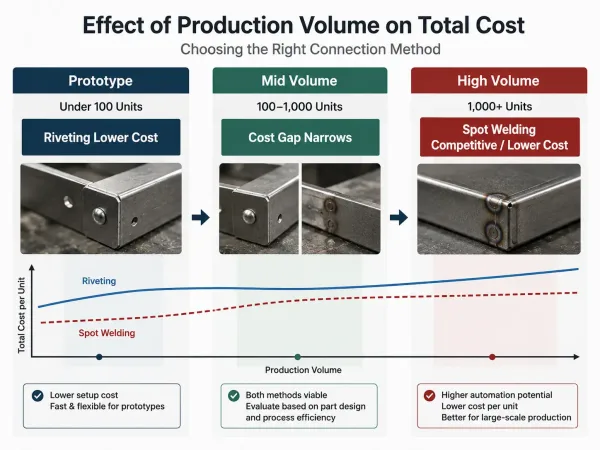
Production volume changes the cost relationship between spot welding and riveting.
The cost relationship between spot welding and riveting is not linear—it shifts as production volume changes. Understanding this shift is essential for making the right decision at the quoting stage.
Prototype and Low-Volume Runs (Under 100 Units)
At prototype volumes, riveting almost always costs less. The equipment investment is minimal, no welding certification is required, and setup time is short. A spot welding setup for a prototype run requires programming, electrode preparation, and test welds—all of which add non-recurring cost that gets amortized over very few parts.
Mid-Volume Production (100–1,000 Units)
In this range, the cost gap narrows. Spot welding’s higher setup cost is spread across more parts, and the faster per-joint cycle time starts to offset the higher labor rate. For parts with many connection points (10 or more), spot welding may become competitive with or even cheaper than riveting in this volume range.
High-Volume Production (1,000+ Units)
At high volumes, spot welding often wins on total cost—especially when automated. A robotic spot welding cell can produce 200–500 welds per hour with consistent quality, dramatically reducing per-unit labor cost. Riveting automation exists but is less common and more limited in speed. For most sheet metal assemblies with moderate complexity, spot welding becomes the lower-cost option somewhere between 500 and 2,000 units.
Hidden Costs That Change the Outcome
The obvious costs—equipment, labor, consumables—are only part of the picture. Several hidden costs can shift the total cost comparison in unexpected ways.
Rework and Scrap Rates
Spot welding on thin sheet metal (under 1.0 mm) carries a risk of burn-through, which creates scrap. A 2–5% scrap rate on a 10,000-part run means 200–500 parts that need rework or replacement. Riveting avoids this risk, but misdriven rivets or off-center holes can also create scrap—typically at a lower rate (1–2%) but not zero.
Thermal Distortion and Downstream Processing
Spot welding generates heat that can distort thin sheet metal parts, especially aluminum. If the part requires tight flatness tolerances (under 0.5 mm/m), post-weld straightening may be needed—adding $0.50–$2.00 per part. Riveting avoids thermal distortion entirely, which can be a significant cost advantage for parts that go directly to assembly without further processing.
Fastener Inventory and Lead Time
Rivets are commodity items, but if your part requires a specific type, size, or material (such as stainless steel structural rivets), lead times can stretch to 4–8 weeks. Stockouts halt production. Spot welding doesn’t have this dependency—electrodes and electricity are always available. For just-in-time production environments, this supply chain risk is a real cost factor that’s difficult to quantify but important to acknowledge.
Inspection Time and Cycle Impact
Spot weld inspection for structural applications adds to cycle time. If each part requires ultrasonic inspection of 10 weld points at 30 seconds per point, that’s 5 minutes of inspection per part—time that compounds quickly at high volumes. Riveting inspection is faster, but the cumulative cost difference depends on your quality requirements and production volume.
Sheet Metal–Specific Factors That Affect Total Cost
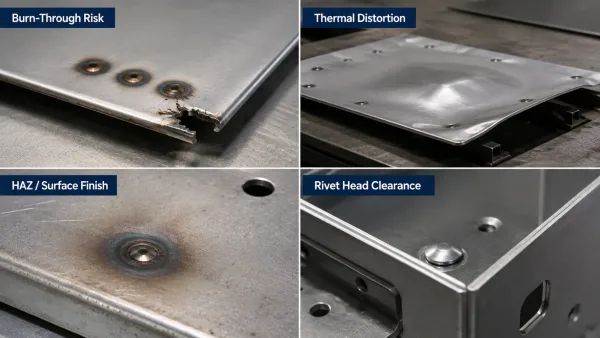
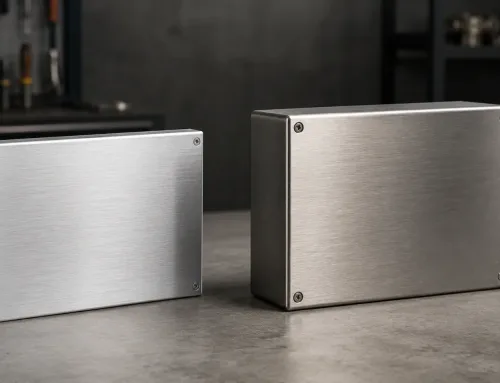
Key hidden cost factors such as burn-through, distortion, inspection, and rivet head clearance are shown for sheet metal joining.
Sheet metal fabrication has unique constraints that affect the cost equation differently than thicker plate or structural steel work. These factors are often overlooked in generic welding-vs-riveting comparisons.
Material Thickness and Burn-Through Risk
For sheet metal under 1.0 mm thick, spot welding requires precise control of current and time to avoid burn-through. This often means slower cycle times, more frequent electrode dressing, and higher scrap rates—all of which increase cost. Riveting doesn’t have this limitation, but very thin sheets (under 0.5 mm) may not have enough material to support a rivet properly, leading to pull-through under load.
Joint Strength Requirements
In sheet metal joint design, spot welds excel in shear strength but are weaker in tension and peeling. If your part experiences tensile or peel loads, you may need more weld points to compensate—increasing cost. Rivets handle shear loads well and can be designed for specific tension loads using structural rivet types, but each rivet introduces a stress concentration point around the hole that must be accounted for in the design.
Surface Finish and Post-Processing
Spot welding creates a heat-affected zone (HAZ) around each weld point that may discolor or alter the surface finish. If the part requires painting or powder coating, the HAZ may need additional preparation. Riveting doesn’t affect the surface finish, but rivet heads are visible and may not be acceptable for cosmetic parts unless countersunk rivets are used—which require a countersinking operation and add cost.
Assembly Space and Rivet Head Clearance
Rivet heads protrude above the sheet surface, typically by 1–3 mm. If the part assembles into a tight enclosure, this protrusion may interfere with other components, requiring design changes or spacer shims. Spot welds are flush with the surface, which can simplify assembly and reduce the need for additional clearance provisions.
A Decision Framework: When to Choose Spot Welding vs. Riveting
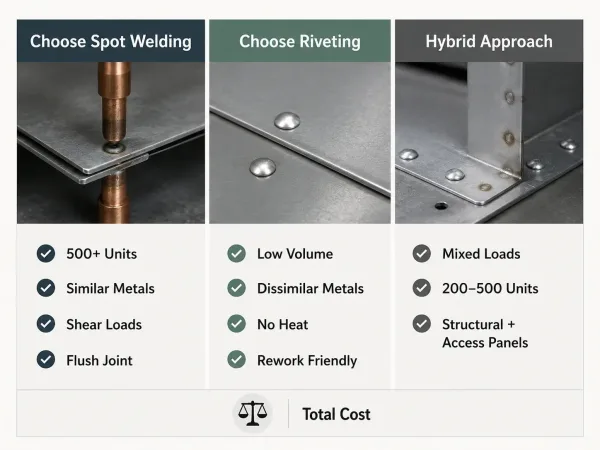
This decision framework helps readers choose spot welding, riveting, or a hybrid approach based on project conditions.
Rather than declaring one method universally cheaper, use this framework to match your project’s characteristics to the lower-cost option.
Choose spot welding when:
- Production volume exceeds 500 units and automation is feasible
- Parts are made of similar metals (steel-to-steel or aluminum-to-aluminum)
- Surface finish requirements are moderate (no flush cosmetic finish needed)
- The joint experiences primarily shear loads
- Assembly space is limited and flush joints are preferred
Choose riveting when:
- Production volume is under 200 units or the project is at prototype stage
- Parts are made of dissimilar metals (e.g., aluminum to steel)
- Thermal distortion is a concern (tight flatness tolerances required)
- The assembly environment doesn’t allow electrical equipment
- Disassembly or rework is expected during the product lifecycle
Consider a hybrid approach when:
- Parts have mixed load requirements (some joints in shear, others in tension)
- Production volume is in the 200–500 unit range where the cost difference is marginal
- The design allows for spot welding on structural joints and riveting on access panels or removable covers
FAQs
Need help evaluating which joining method fits your sheet metal project? Our engineering team can review your drawings and provide a cost comparison based on your specific part geometry, material, and volume requirements. [Request a DFM review →]