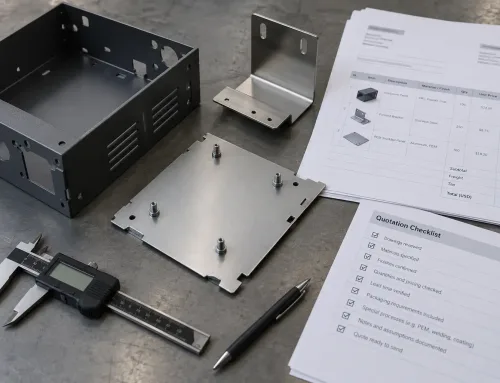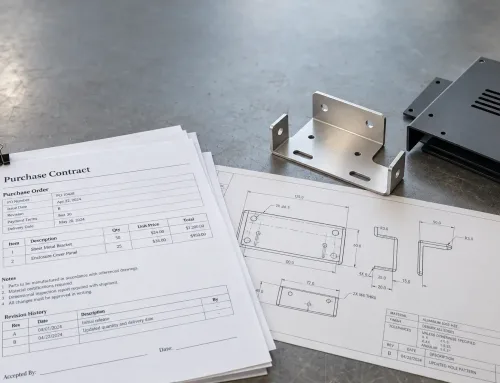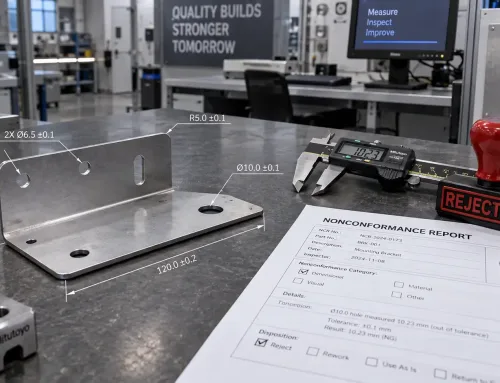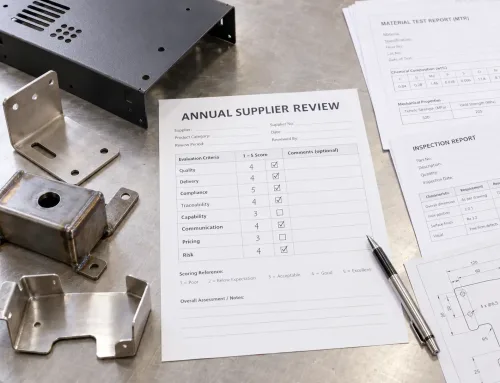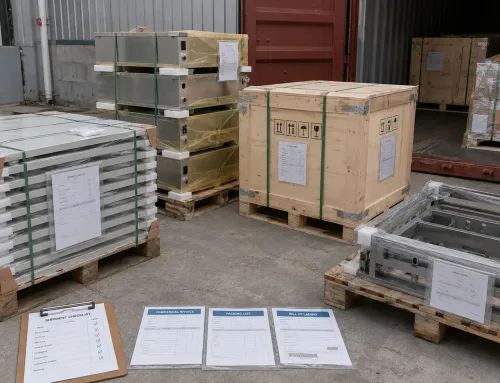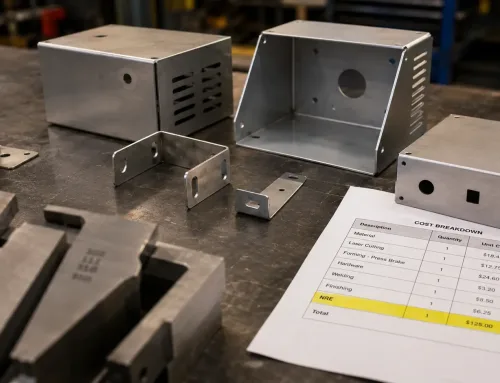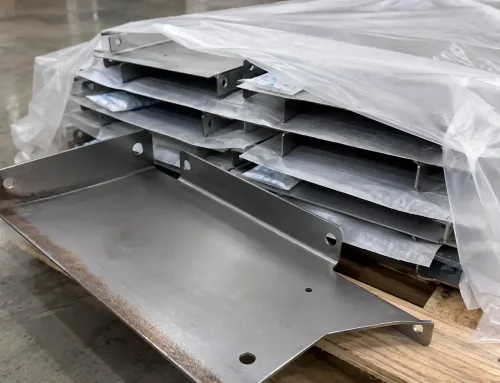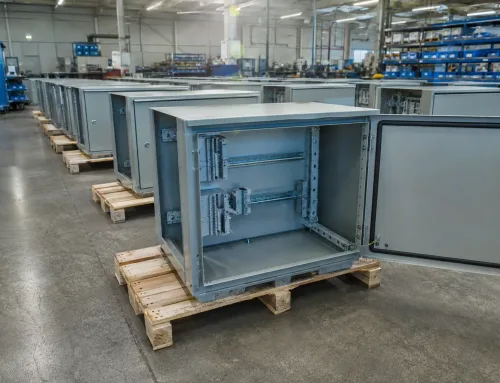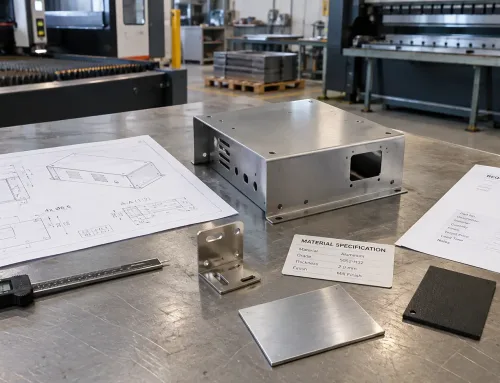

Tooling and NRE usually appear on a supplier quote as one number near the bottom. Many buyers negotiate that number down, sign the purchase order, and move on. That saves money on paper. It leaves the real exposure — tooling ownership, amortization assumptions, and change liability — untouched.
A tooling charge is not a fee to shrink. It is a cost structure to review.
On an OEM metal enclosure program, tooling and NRE cover the forming dies, fixtures, gauges, machine programs, and engineering hours that make repeat production possible. What you pay matters less than what you own, what happens when volumes move, and who funds a drawing change after the dies are cut. This checklist works through each of those questions before the purchase order is released.
What Sits Inside Tooling and NRE — and Where the Line Falls
NRE (non-recurring engineering) is the one-time engineering effort required before the first production part ships. Tooling is the physical asset set built to form, join, inspect, and finish the parts. Suppliers quote them together, but they carry different risks.
Tooling is a durable asset with a finite lifespan. It can be owned, moved, modified, or worn out. NRE is consumed effort — engineering hours that leave behind deliverables: flat patterns, CNC programs, fixture drawings, inspection plans.
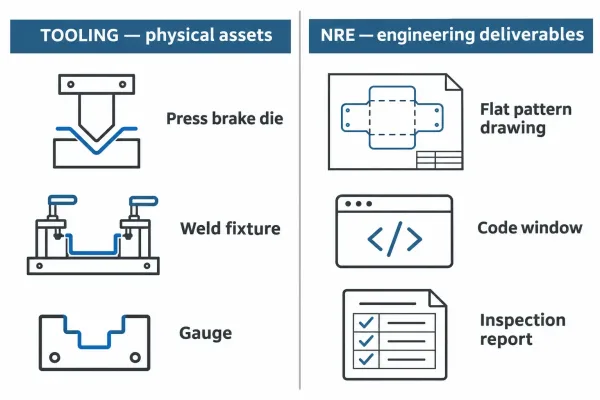
A two-column diagram: tooling covers physical assets such as dies, fixtures, and gauges; NRE covers one-time engineering deliverables such as flat patterns, CNC programs, and FAI reports.
Where an item lands changes who pays for it when the design changes. Some suppliers fold programming and fixture design into NRE; others quote them as separate setup charges. Agree on the classification before you compare numbers.
Tooling: the physical assets
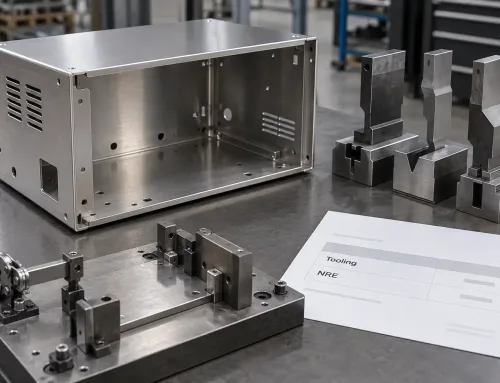
On a metal enclosure program, tooling typically means press-brake form tools or custom dies, punch tooling for blanking and perforation, weld fixtures and check gauges for assembly verification, and finishing fixtures such as paint racks and masking plugs. Each item has a build cost, a lead time, and a wear life measured in cycles or hits.
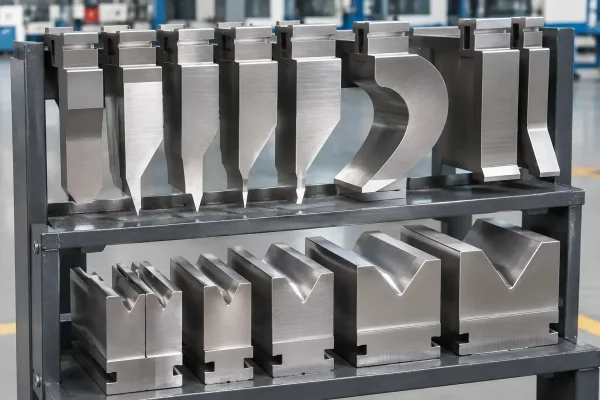
A set of press brake punches and V-dies with different openings — the main tooling used to form enclosure bends.
NRE: engineering time and deliverables
NRE covers the work a supplier cannot repeat on every part: DFM (design for manufacturability) review of your drawings, flat-pattern and bend development, CNC and press-brake programming, tooling design, first-article inspection planning, and process documentation. Legitimate NRE produces something you can point to.
The gray zone: setup, programming, fixtures, and gauges
Setup fees, program edits, and gauge builds sit in a gray zone. A one-time program edit on a part that will run for years is NRE. A per-batch machine setup is a production cost that belongs in piece price. A gauge built specifically for your part is tooling; general CMM (coordinate measuring machine) time is overhead. Ask which bucket each item falls into before you sign off on the quote.
The Tooling Behind an OEM Metal Enclosure
An enclosure program rarely needs one tool. It needs a set, and each element in that set is driven by a different drawing decision.
Form tooling: dies and press-brake tooling
Bending is usually the largest tooling driver on a sheet-metal enclosure. Standard V-die openings cover most air bends at no extra cost. Custom form tools appear when a drawing calls for a tight inside radius, a hem, a joggle, or a flange geometry the standard tool cannot produce. Deep-drawn corners and embossed features require dedicated dies with their own lead time.
Joining, inspection, and finishing tooling
Weld fixtures hold enclosure seams in position during joining and are the difference between a repeatable corner and a rework loop. Check gauges verify hole patterns and critical interfaces at production speed. Finishing fixtures — paint racks, masking plugs for threaded holes, anodizing racks — are often underestimated at quoting and discovered at the first production run.
Design features that multiply tooling cost
Several drawing decisions quietly add tooling line items:
- Non-standard bend radii or acute flange angles that need custom form tools
- Dense or irregular hole patterns that require punch tooling instead of laser cutting
- Tight flatness or positional tolerances that mandate dedicated gauges
- Enclosure families that share no common blank or bend strategy, forcing multiple die sets
Reviewing these features before the RFQ (request for quotation) stage lets you either simplify the drawing or accept the tooling cost knowingly.
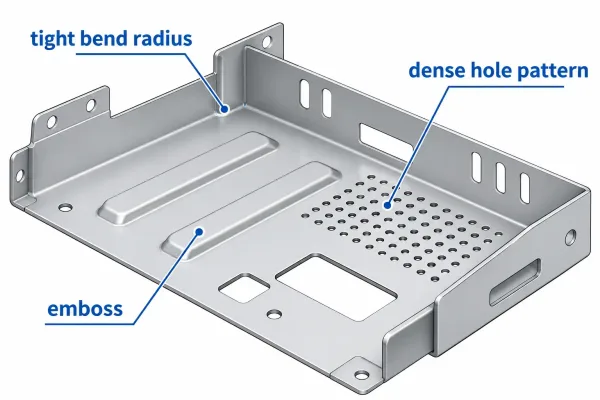
An enclosure panel diagram with callouts marking three tooling cost drivers: tight bend radius, dense hole pattern, and embossed feature.
Which NRE Charges Are Legitimate — and Which Are Not
Not every NRE line is equal. The test is simple: does the charge map to a deliverable you will receive?
What legitimate NRE buys you
Defensible NRE charges tie to concrete outputs — DFM feedback with specific revisions, verified flat patterns, posted machine programs, tooling drawings you can review, FAI (first article inspection) reports, and process sheets that travel with the parts. If the supplier can show what the hours produced, the charge is auditable.
Red flags in bundled NRE lines
Watch for a lump-sum “setup and engineering” charge with no breakdown, NRE that reappears on every order instead of being one-time, tooling quoted at a flat fee with no tool list, and per-part “tooling amortization” with no stated volume basis. These are not automatically wrong. They are unverifiable until the supplier itemizes them.
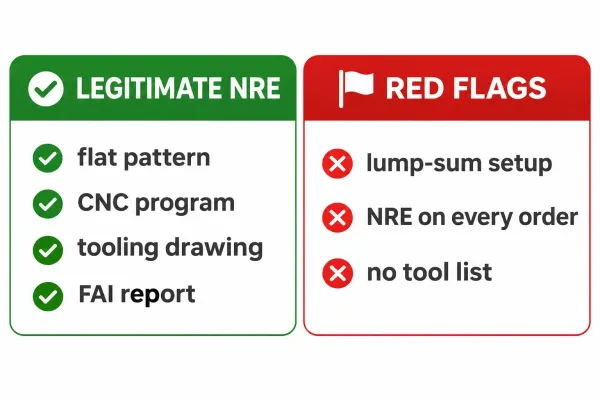
A side-by-side comparison: legitimate NRE maps to deliverables like flat patterns and FAI reports; red flags include lump-sum setup lines and recurring NRE charges.
Ownership, Amortization, and Volume Assumptions
The quoted number means little until three terms are settled: who owns the tooling, how the cost is recovered, and what happens when the program changes.
Who owns the tooling
On OEM programs, the buyer normally owns dedicated tooling once it is paid for. This matters for second sourcing, supplier transitions, and end-of-life recovery. If the supplier retains ownership, you are renting access to the asset, and your options narrow sharply if the relationship ends. Get tool ownership stated in writing, including spare components and tooling drawings.
How amortization behaves when volumes move
Amortization spreads tooling cost across units. If a supplier amortizes $20,000 of tooling over a 10,000-unit forecast, each unit absorbs$2. When actual volume reaches 25,000, the tooling is already paid for — but only if the contract says so. Define whether amortization stops at the agreed quantity, whether the per-unit charge drops after payback, and how the remaining balance is handled at program end.
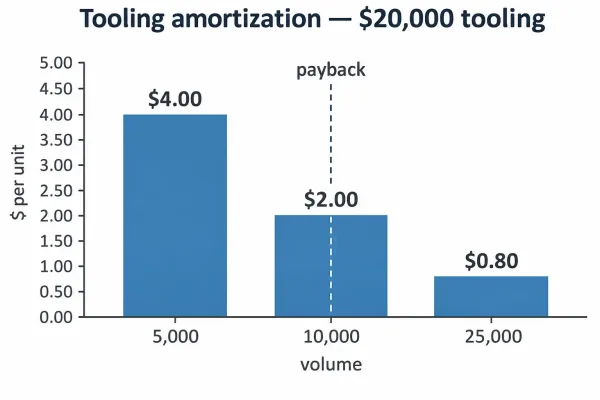
A chart showing tooling cost per unit falling from $4 at 5,000 units to$0.80 at 25,000 units, with a marked payback point.
Program transfer and shutdown scenarios
Plan the exit before it happens. A transfer agreement should cover tool condition at handover, which drawings and spare parts accompany the tools, and who pays for refurbishment or re-qualification at the receiving supplier. A program that ends without a transfer clause often ends with tooling held as leverage or scrapped at your cost.
Design Changes and NRE Re-Estimation
After tooling is cut, drawing changes stop being paperwork and start being metalwork.
Which drawing changes trigger tooling work
Hole size or position changes, bend angle or radius revisions, material or thickness substitutions, and flange geometry edits all touch existing tools. A cosmetic change confined to a label or coating callout usually does not. The question is not whether the change looks small on paper; it is whether the die, fixture, or program can absorb it.
Who pays: cost responsibility by timing
Cost responsibility should follow the timing of the change. A change issued before tooling release is design iteration and belongs to the buyer’s development budget. A change issued after tooling approval is a revision request, and the supplier is entitled to re-quote the affected NRE. An ECO (engineering change order) process that records tooling impact per change keeps month-twelve conversations from becoming disputes.
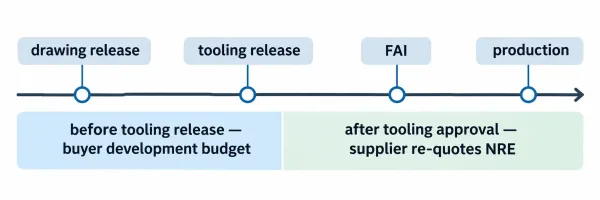
A timeline dividing change cost responsibility: before tooling release, changes fall under the buyer’s development budget; after tooling approval, the supplier re-quotes NRE.
Where NRE Coverage Ends: Sample, FAI, and Production
One-time engineering fees do not cover an entire program. Knowing the boundary prevents surprise invoices later.
What NRE covers through FAI
Standard NRE builds the process and proves it on the first article. It typically includes tooling design support, program creation, and one round of FAI — dimensional verification against drawing, material and finish confirmation, and documented results. Rework cycles after FAI, tooling re-cuts caused by drawing changes, and additional qualification runs fall outside standard NRE and should be quoted separately.
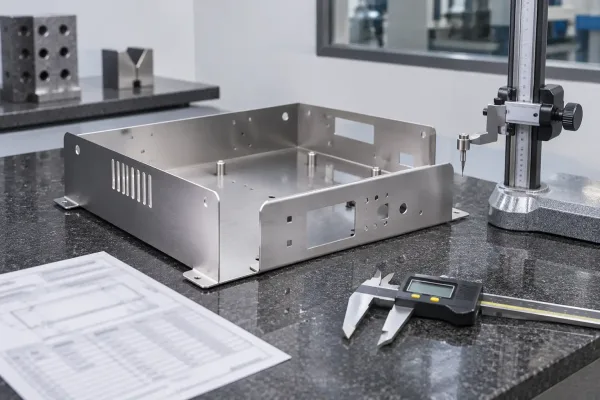
A formed enclosure panel on a granite inspection plate with calipers and a height gauge — first article inspection against the drawing.
Production-stage tooling costs
Once production starts, tooling carries maintenance cost: sharpening, polishing, insert replacement, and eventual rebuild. The agreement should state who pays for normal wear versus damage, whether preventive maintenance is scheduled, and how tool condition is verified at lot acceptance. For enclosures expected to run over several years, tooling life is a program cost, not a footnote.
Pre-PO Tooling and NRE Review Checklist
Before the purchase order is released, confirm each item below in writing.
- Itemized cost breakdown — tooling and NRE quoted separately, with a tool list and a deliverable list
- Tool ownership — dedicated tooling belongs to the buyer upon payment, with drawings and spares
- Amortization basis — stated volume, payback point, and per-unit charge after payback
- NRE one-time scope — what is included through FAI, and what is excluded
- Change liability — cost responsibility defined by change timing
- Tool life and maintenance — expected cycles, wear policy, and rebuild responsibility
- Transfer terms — tool condition, documentation, and re-qualification cost at handover
- Price basis — the material, volume, and process assumptions the tooling price rests on
- Deliverables list — programs, drawings, gauges, and process sheets to be provided
- Sample-to-production boundary — which costs carry over to production and which do not
FAQs
Tooling and NRE Review Scorecard
The table below condenses the review points for use in quote comparison meetings.
| Review area | Verify | Green flag | Red flag |
|---|---|---|---|
| Cost breakdown | Tooling and NRE itemized separately | Tool list and deliverable list attached | Single lump-sum line |
| Ownership | Buyer owns dedicated tooling | Ownership clause with drawings and spares | Supplier retains the tools |
| Amortization | Volume basis and payback point stated | Per-unit charge drops after payback | Open-ended amortization |
| Change terms | Cost split defined by change timing | ECO process records tooling impact | “All changes extra” with no rules |
| Phase boundary | NRE scope ends at FAI or a defined milestone | Exclusions listed explicitly | NRE reappears on every order |
| Deliverables | Programs, gauges, and process sheets listed | Files transferable on request | Deliverables undefined |