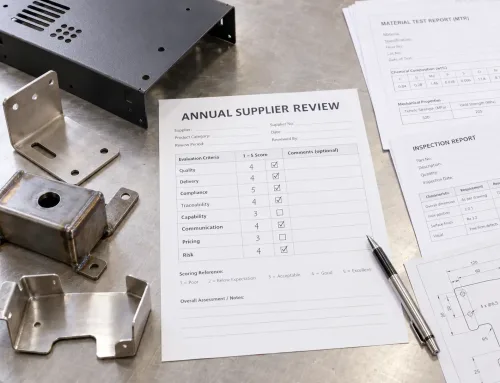

You open two quotations for the same formed steel enclosure. The totals differ by 35%. One shop looks expensive. The other looks like a bargain. Neither number is wrong yet—because the two packages were never defined the same way.
That is the real failure mode in sheet metal sourcing. A quotation checklist is not a shopping list of drawing fields. It is a two-sided control: lock the manufacturing scope before you request price, then audit the quote that comes back before you award. Only after those steps are aligned does unit price mean anything.
Why similar-looking sheet metal quotes are often not comparable
A sheet metal quotation is a price for a defined scope of work. If that scope is incomplete, suppliers either add contingency or leave items out. Both outcomes look like a price. Only one of them matches what you need to buy.
One fabricator may quote cut, bend, and bare parts. Another may include hardware insertion, powder coating, first-article inspection, and export packing. The lower total is not cheaper production. It is a shorter job.
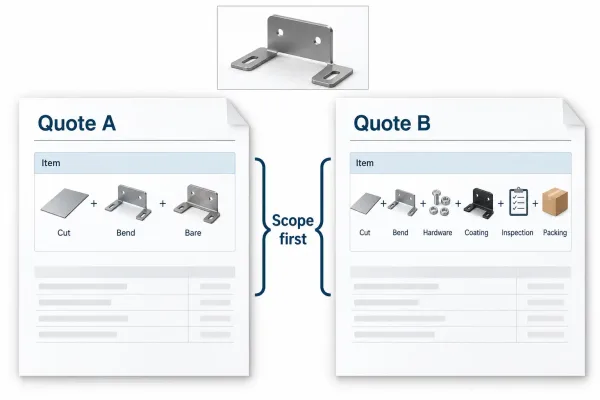
Side-by-side quotation sheets showing different included scope before unit prices are compared.
The practical rule is simple: compare exclusions and assumptions first, then compare the numbers. This checklist follows that order—what to fix before the RFQ, what to verify on the returned quote, and when two quotes are truly comparable.
RFQ package checklist: what to lock before you request a quote
Give every bidder the same definition of the finished deliverable. When the package is complete, suppliers can price the real work instead of guessing. Use the items below as a pre-send gate.
Drawings, CAD, and revision alignment
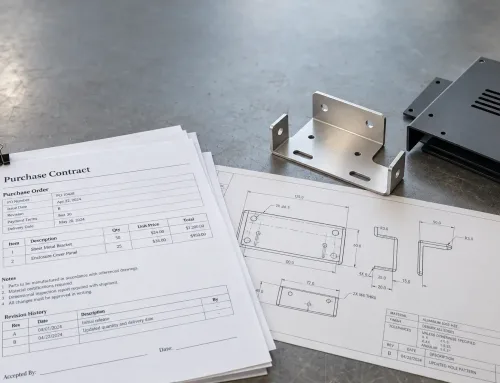
Send a readable 2D drawing and the available 3D model (typically STEP for formed geometry and DXF for flat profiles). Match part numbers and revision letters across the drawing, model, BOM, and RFQ line list. If the drawing and model disagree, state which document governs—or resolve the conflict before a firm quote is requested.
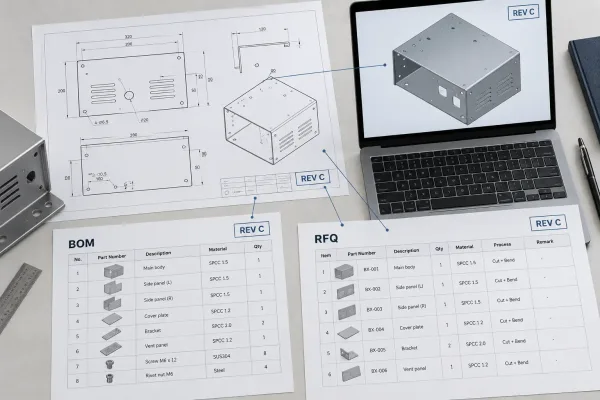
Controlled RFQ package: 2D drawing, 3D model, BOM, and RFQ list sharing the same revision.
Units, general tolerances, and the drawing standard (for example ASME Y14.5 for GD&T) should be explicit. A model alone is often enough for a budgetary number, but production control and inspection still rely on controlled drawings.
Material, thickness, and approved substitutions
Write material at grade level: “304 stainless steel, 1.5 mm” is actionable; “stainless steel” is not. Include temper or condition where it affects forming (for example 5052-H32 aluminum versus annealed stock). State whether substitutions are allowed and who may approve them.
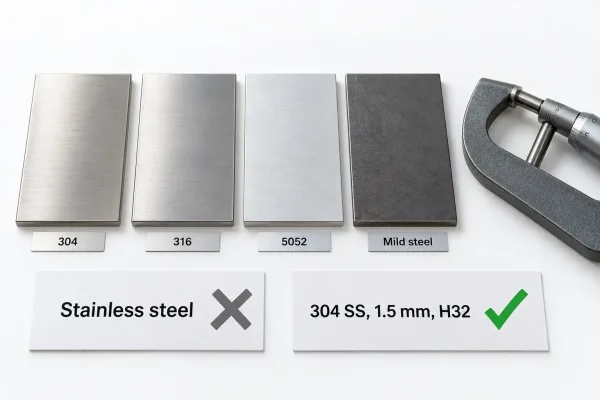
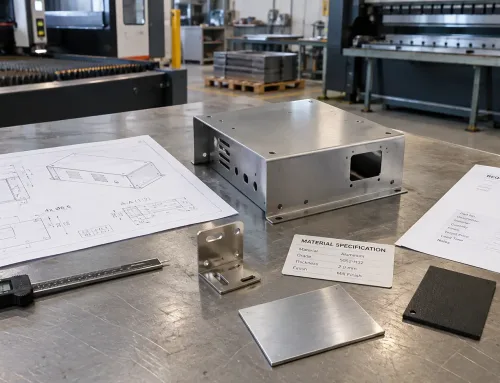
Material callouts written at grade and thickness level instead of a generic metal name.
If you supply material, list size, condition, quantity, and delivery timing, and ask the supplier to identify setup or process loss allowance. Unusable or short customer-supplied stock is a common late-stage dispute.
Process scope and delivery state
Define what leaves the shop: a single part, a welded assembly, a finished enclosure, or a production-ready kit. List required operations—laser cutting or punching, bending, welding, hardware insertion, finishing, assembly, inspection—and who owns each one (you, the fabricator, or a nominated processor).
For assemblies, include a BOM with part numbers, quantities per assembly, and responsibility for purchased hardware. If the design is still open, label the request as a budgetary estimate and list unresolved items. A preliminary price supports planning; it is not a production commitment.
Quantity pattern and commercial inputs
Provide prototype or sample quantity, expected order quantity, and any forecast or price-break volume. Mark forecasts as forecasts. State whether you need one shipment or staged releases.
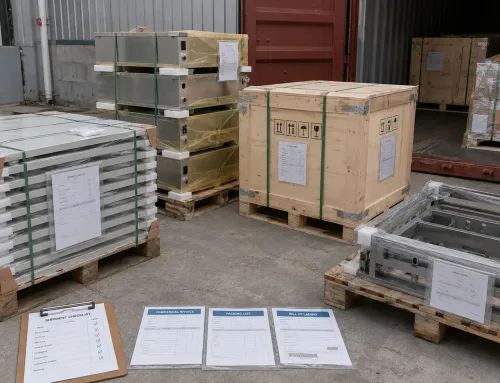
Add the required delivery date, destination, packaging needs, and whether freight and duties are in scope. Clarify what starts the lead-time clock and which approvals can pause it (drawing release, first-article acceptance, customer-supplied components).
Drawing callouts that quietly change the number
Some notes do not just document intent—they change process, inspection, and cost. Write them as requirements suppliers can price, not as adjectives.
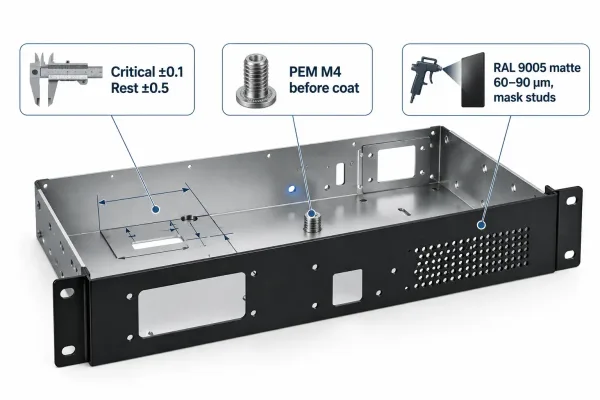
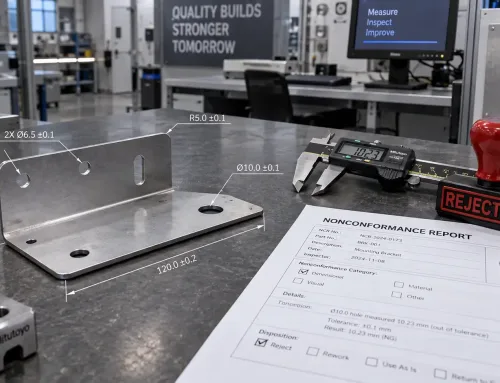
Drawing callouts that change cost: critical dimensions, hardware inserts, and finish requirements.
Critical dimensions versus blanket tolerances
Identify the dimensions that control fit, alignment, sealing, or access. A tight general tolerance block copied from machined parts forces extra forming, welding, and inspection effort on sheet metal without improving the product. Conversely, a mounting pattern or mating interface may need a tighter requirement than the default block.
State whether dimensions apply before or after finishing. Ask the supplier to flag features that are difficult to hold and propose alternatives for engineering review rather than silently relaxing the drawing.
Hardware, welds, and cosmetic zones
If hardware is installed, specify PEM or equivalent part numbers, thread size, installation side, height, and whether insertion happens before or after coating. Leave grounding studs, threads, and contact surfaces clear when required.
For welds, identify joint locations, weld size or length expectations, visible versus structural seams, and finishing of appearance welds. Define cosmetic faces so inspection and packing know what “good” looks like.
Finish as a system, not a color name
“Black powder coat” does not establish gloss, texture, film thickness, masking, or corrosion environment. Specify coating type, color reference (for example RAL), gloss or texture, nominal thickness, masking points, and cosmetic acceptance criteria. Include testing or certificates only if you need them priced.
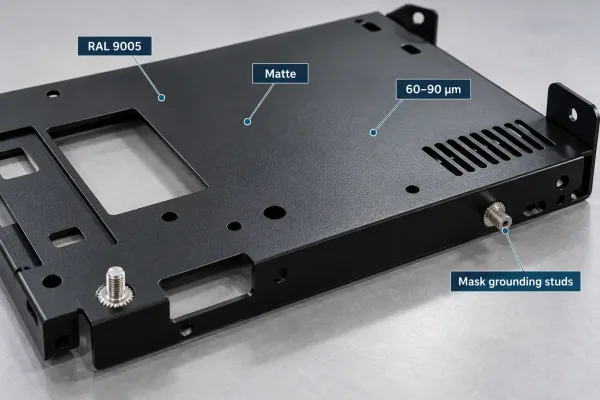
Finish specified as a system: color reference, gloss, film thickness, and masking points.
Indoor electrical gear, washdown equipment, outdoor telecom cabinets, and coastal battery enclosures need different material and coating strategies. Environment belongs in the RFQ when corrosion performance matters.
Quotation review checklist: what to verify on the quote you received
When the quote arrives, read it as a scope document before you read it as a price. The items below catch the gaps that create purchase-order changes later.
Line items versus one-time charges
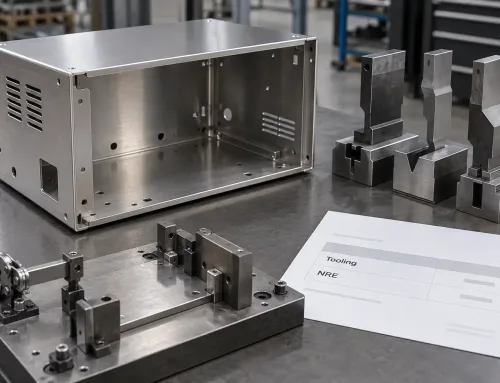
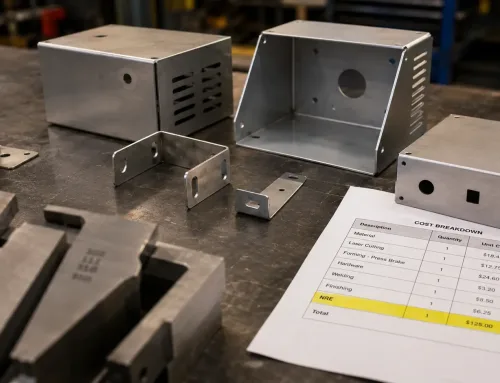
Separate recurring unit cost from setup, tooling, fixtures, finishing, inspection, packaging, and freight. Confirm which operations are inside the unit price and which are shown as separate lines. Compare like with like: a unit price that excludes coating is not lower than one that includes it.
Check that quoted part numbers, revisions, quantities, and finish match your RFQ. A clean quote mirrors your package. If it does not, the difference is an assumption you have not agreed yet.
Assumptions, exclusions, and lead-time clocks
List every stated assumption and exclusion: material grade or substitution, process route, inspection records, packaging, export documentation, and who buys hardware. Identify what begins lead time and which events pause it.
Sample and production quotes often differ in structure—setup amortization, tooling, and inspection load change with volume. Keep those tiers separate so you are not comparing a prototype total to a production unit rate.
Validity, revision, and documentation trail
Confirm quote validity period, the drawing revision priced, and which certificates or reports ship with the parts (for example material certificates, FAI, inspection reports). If the revision on the quote is not the revision you control, stop and correct it before award.
Document responsibility for future drawing changes: who re-prices, how quickly, and whether existing stock or WIP is consumed first.
When two quotations are actually comparable
Two quotes are comparable when they describe the same deliverable, the same acceptance evidence, and the same commercial terms. If any of those differ, the totals are not a ranking.
Use a simple alignment sheet with three columns for each bidder: included scope, assumptions, and exclusions. Fill it from the quote text—not from memory or a sales email. Where a cell is empty, ask. Do not award on a blank.
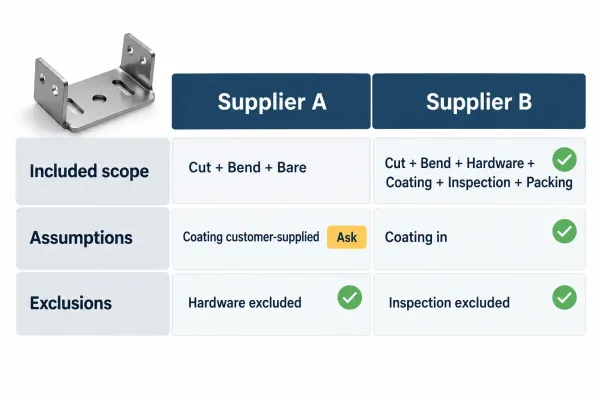
Alignment sheet used to make two supplier quotations comparable before award.
A wide price gap after alignment usually means one of three things: different process routes, different quality or documentation load, or a genuine cost advantage. Only the third is a reason to choose the lower number.
Questions to send back before you award
If a cell in the alignment sheet is unclear, send a short written question set before you decide. Clear answers are cheaper than change orders.
- Which operations and documents are included in the quoted unit price?
- What is explicitly excluded?
- What starts lead time, and what can pause it?
- Which drawing revision is priced?
- Are material substitutions proposed, and what is the effect on cost and performance?
- Which inspection records ship with the parts?
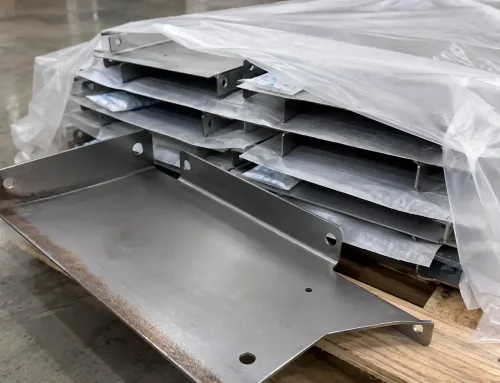
- How will finished surfaces be protected in packaging?
- Which one-time charges apply at sample versus production?
A supplier that answers these in writing is easier to manage than one that returns only a unit price.
FAQ
Key checklist summary
Before you send the RFQ
- Controlled drawing + 3D model + matching revision
- Material grade, thickness, and substitution rules
- Delivery state and process scope (including hardware and finish)
- Quantity pattern, target date, packaging, and inspection evidence
Before you award
- Unit price versus one-time charges split out
- Assumptions and exclusions written down
- Lead-time clock and validity understood
- Same revision, finish, and documentation across bids
If your package is ready and you want a manufacturing-side review of drawing notes, finish callouts, or quote assumptions before release, SR-MFG engineering can flag scope gaps at the RFQ stage so the numbers you compare actually match the parts you need.