
When a quote or purchase order lists a “batch quantity,” it is not describing how many parts you buy in a year, and it is not the same field as the order total. Batch quantity is the number of parts agreed for one production run or one delivery shipment. Mixing it up with order quantity or annual volume is one of the fastest ways to get incomparable quotes, split-shipment confusion, and delivery disputes after the parts are already on the floor.
This glossary entry defines batch quantity in custom manufacturing, separates it from the other quantity terms buyers see every day, and shows how to state it clearly on an RFQ or PO.
What Batch Quantity Means in Manufacturing
Batch quantity is the count of parts that move through the shop as one controlled unit—either one production batch (made under the same setup and process conditions) or one delivery batch (shipped together under the same packing list and lot marking).
In sheet metal and other discrete fabrication, a batch is usually a finite run of the same part number before the machine or cell changes over. The number is specific: 150 brackets, 800 enclosures, 2,000 side panels. It is a quantity, not a code and not a forecast.
Two points keep the definition usable in practice:
- Production batch and delivery batch are not always the same number. A shop may run 1,500 pieces and ship them as four cartons of 375, or run four separate setups and ship one combined lot.
- The unit is normally pieces (pcs) or assemblies (sets). If the drawing or PO uses another unit (sheets, kits, kits per system), state it next to the number so the count cannot be misread.
If the quote only says “batch” without a number, you do not yet have a batch quantity—you have a placeholder.
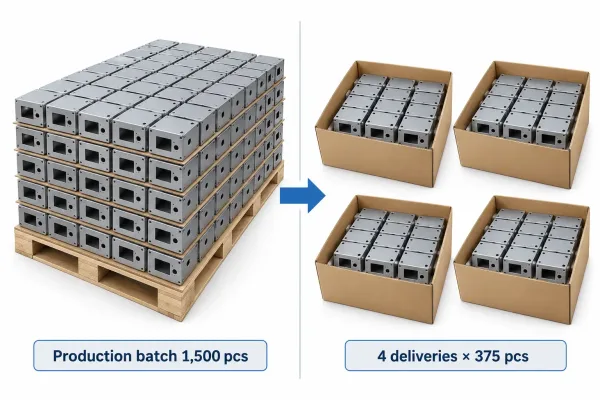
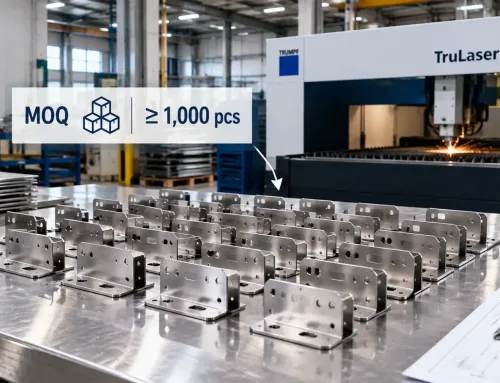
The same part count can be one production batch or several delivery batches.
Batch Quantity vs Order Quantity vs Annual Volume
These three numbers appear on different documents, measure different time scales, and drive different decisions. Treating them as synonyms is a common source of RFQ noise.
| Term | What it counts | Typical time scale | Where it usually appears | Effect on unit price |
|---|---|---|---|---|
| Batch quantity | Parts in one production or delivery batch | One run or one shipment | Routing notes, packing instructions, partial-shipment lines | Setup and changeover are spread over this batch size |
| Order quantity | Total parts on one PO line (or one order) | One purchase order | PO line, quote quantity field | Price breaks are usually quoted against this total |
| Annual volume | Expected usage over 12 months (or a contract year) | Year / program life | RFQ header, capacity discussion, LTA | Used for capacity planning and tiered pricing strategy |
Order quantity: total pieces on the purchase order
Order quantity is the full buy for that order line—for example, 6,000 pcs of a mounting bracket. Suppliers quote unit price and price breaks against this figure because material nesting, labor, and amortization are planned for the order as a whole.
Order quantity answers “how many are we buying this time?” Batch quantity answers “how many move through production or shipping as one block?”
Annual volume: yearly usage or forecast
Annual volume is a planning number—for example, 24,000 pcs per year of the same part. It may never appear as a single PO. Buyers use it to test whether a supplier can hold capacity, whether tooling makes sense, and whether a multi-year price is realistic.
Annual volume answers “how much do we need over a year?” It does not tell the shop how to cut, form, weld, inspect, or ship any single batch.
How the three numbers appear together on a quote
A clear RFQ or quote line often looks like this:
Order quantity: 6,000 pcs
Batch quantity: 1,500 pcs per production/shipment batch
Delivery: 4 batches / shipments
Here, 6,000 is what you are buying. 1,500 is how each run or shipment is grouped. 24,000 (if stated) is only the annual forecast.
A practical example: annual volume 24,000 pcs → four orders of 6,000 → each order produced and shipped in batches of 1,500. Every number is necessary; none of them replace the others.
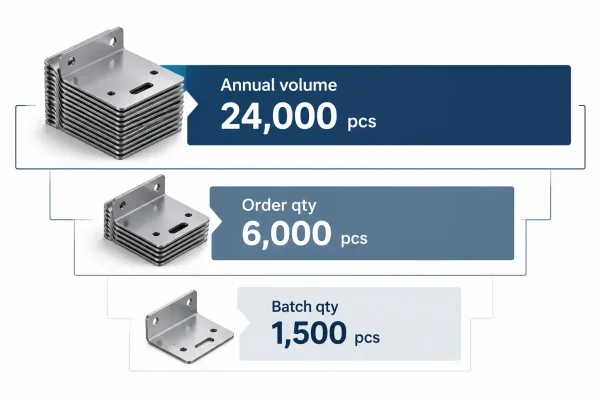
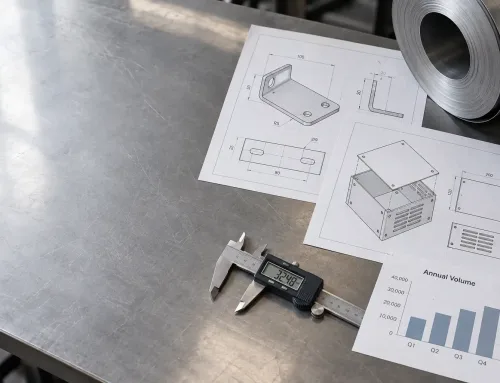
Annual volume, order quantity, and batch quantity count different scopes on the same program.
Whatever the document, the same discipline applies: name the quantity, the unit, and the field it belongs to—batch, order, or annual.
Batch Quantity vs Batch Size, Batch Number, and Lot
Shop-floor language is loose. Three neighbors of “batch quantity” show up on travelers, certificates, and emails.
Batch quantity and batch size
Batch size is the more common planning term for “how many pieces are produced together without interruption.” In many plants, batch size and batch quantity mean the same number. When they diverge, batch size often describes the process choice (what the machine runs before changeover), while batch quantity is the committed count on the order or shipment.
Use one term in the PO and define the number once. Do not assume the supplier’s “standard batch” equals your required batch quantity.
Batch quantity is not a batch number
A batch number (or lot code printed on the label) is an identifier—e.g., BQ-2026-03-15-01. It traces a group of parts back to a run, material heat, or inspection record. It does not tell you how many parts are in the group.
You can have batch quantity 500 pcs under batch number BQ-…-01. The number is the count; the code is the handle for traceability.
Where lot fits in
A lot is a quantity grouped for traceability: acceptance sampling, certificates of conformity, inventory moves, and—if needed—recall scope. One production batch may become one lot, or several batches may be pooled into one lot for a customer shipment. One batch may also be split into several lots for different destinations.
For buyers, the practical rule is: batch quantity controls how work is run and shipped; lot marking controls how product is identified and pulled if there is a quality issue. Define both when traceability matters.
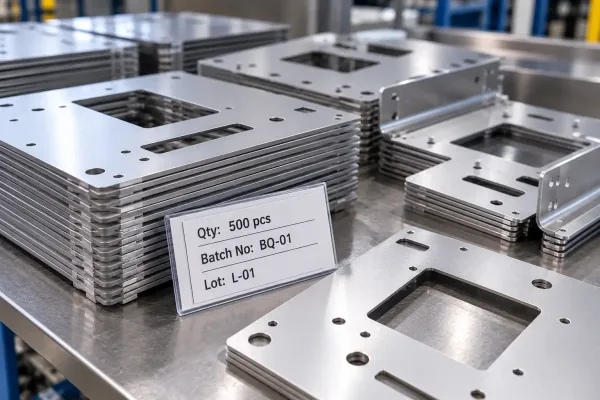
Batch quantity is the count; batch number and lot are identifiers for tracing that count.
Why Undefined Batch Quantity Costs You on Quotes and Deliveries
Quotes you cannot compare
If Supplier A prices 6,000 pcs as a single batch and Supplier B prices four batches of 1,500, the unit prices are not measuring the same setup load. Without an explicit batch quantity, “the cheaper quote” may simply assume fewer changeovers, tighter packing, or a different inspection frequency.
State batch quantity in the RFQ if you care about setup amortization, price breaks, or partial shipments. Then compare like with like.
Delivery disputes
Unclear batch language shows up late:
- The plant finishes one run of 6,000 and expects a single delivery; your line schedule needed four releases of 1,500.
- Packaging and labels are prepared per shipment, but the PO only listed order quantity.
- Incoming inspection plans a lot-based sample, but the shipment mixed two production runs without marking which is which.
Most of these are preventable in the RFQ or PO text, not on the loading dock.
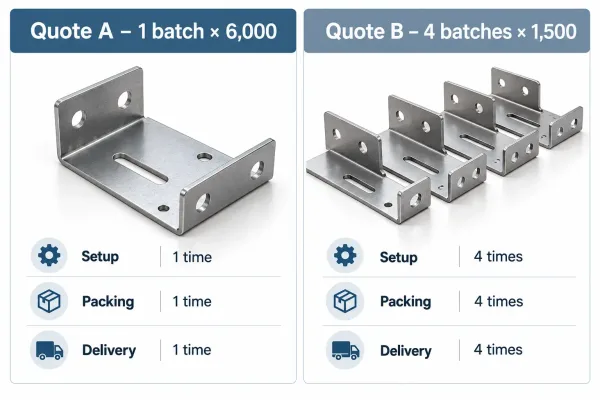
Two quotes for the same order total can assume different batch counts—and different costs.
Sample Batch and Production Batch Are Not the Same Number
What a sample batch is for
A sample batch (first article, pilot, or FAI quantity) is small—often 1–20 pieces for sheet metal. Its job is to prove material, forming, welding, finish, and critical dimensions before volume release. Sample quantity is not a production batch quantity and should not be quoted as if it were.
What a production batch controls
A production batch is the repeated unit for manufacturing consistency, in-process checks, and shipping. Larger batches spread setup cost; smaller batches reduce WIP and speed response to design changes. Neither is “correct” in the abstract—the right batch quantity is the one that matches your delivery schedule, inspection plan, and cost structure.
Keep the two fields separate on the PO: sample quantity for FAI; batch quantity for series production and shipments.
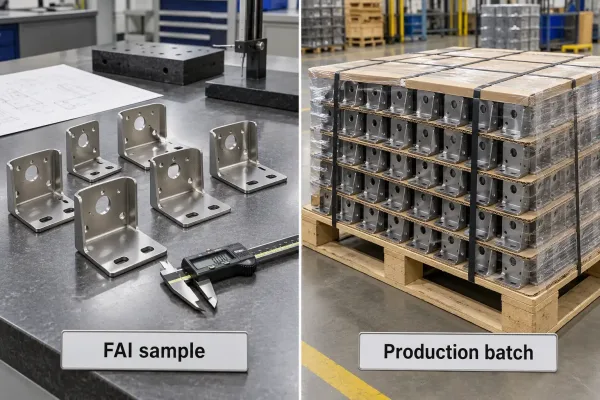
A sample batch proves the process; a production batch supplies the order.
How to Specify Batch Quantity on an RFQ or PO
Three fields to state clearly
- Order quantity – total pcs on the order line.
- Batch quantity – pcs per production and/or delivery batch.
- Shipment pattern – number of batches and whether sizes may vary (e.g., “4 × 1,500 pcs” or “ship in batches of ~1,500; final batch may balance the remainder”).
A simple example line for the PO
Order quantity: 6,000 pcs
Batch quantity: 1,500 pcs per shipment (4 shipments)
Each shipment: separate packing list and batch/lot marking
Sample: 10 pcs FAI prior to batch 1
Before you release the RFQ, check that quantity, unit, batch size, and shipment timing all appear in the same document block. If the manufacturer proposes a different batch size for process reasons, confirm it in writing before the quote is locked—batch quantity affects setup, inspection load, and how partial deliveries are scheduled.
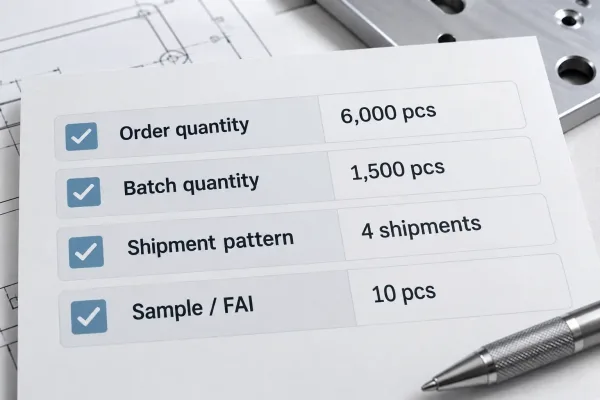
Four quantity fields buyers should state together on an RFQ or PO.
Key Takeaways
- Batch quantity is the number of parts in one production or delivery batch—not the order total and not the yearly forecast.
- Order quantity is what the PO buys; annual volume is what the program needs per year; batch quantity is how work and shipments are grouped.
- Batch size is often the same number in planning language; batch number and lot are identifiers and traceability units, not counts.
- Undefined batch quantity makes quotes hard to compare and deliveries easy to dispute.
- State sample quantity and production batch quantity as separate fields.
FAQs