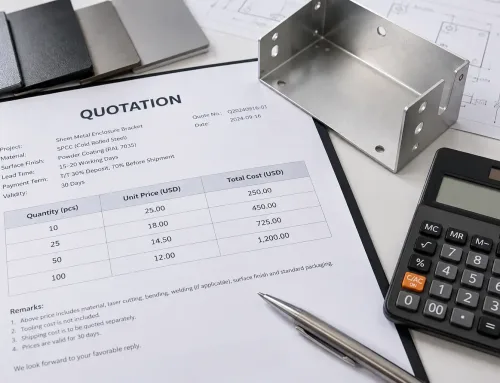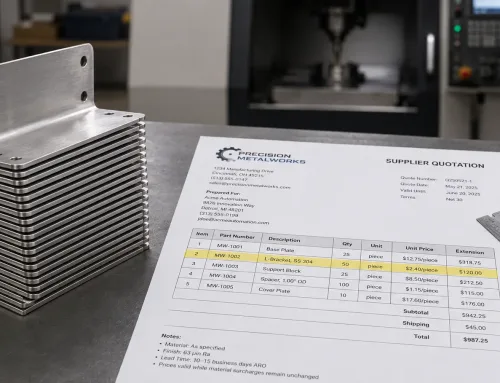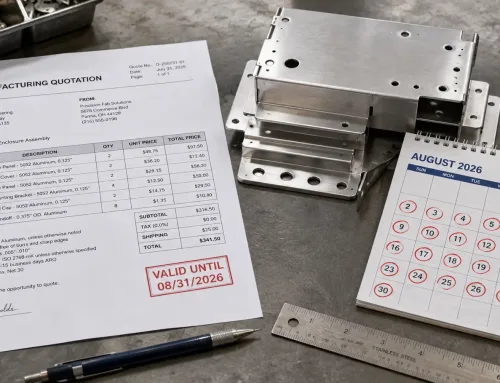

A quotation in manufacturing is a formal document from a supplier that states the price, lead time, and terms for producing a specific part or assembly. It is the supplier’s response to a buyer’s manufacturing request for quotation (RFQ) and typically includes a detailed breakdown of material costs, processing steps, and commercial conditions.
Unlike a casual price estimate, a manufacturing quotation is intended to be specific enough for the buyer to make a purchasing decision.
Definition — What a Quotation Means in Manufacturing
In everyday language, a “quote” can mean anything from a ballpark number thrown out in conversation to a formal price proposal.
In manufacturing procurement, the term has a more precise meaning. A quotation is a structured, itemized document that commits a supplier to a specific price, scope of work, and delivery schedule — usually for a defined validity period.
Manufacturing quotations are generated after the supplier reviews the buyer’s:
- manufacturing technical drawings
- sheet metal material specifications
- order quantities
The supplier evaluates each factor — material type, thickness, required processes, tolerances, finishing, and volume — and uses manufacturing process planning to determine the equipment, labor, and production assumptions behind the quoted price.
This is why two suppliers can quote the same part at very different prices: their equipment capabilities, material sourcing, and production assumptions may not be the same.
What a Manufacturing Quotation Includes
A well-structured manufacturing quotation gives the buyer enough information to:
- compare suppliers
- plan procurement
- place an order with confidence
The exact format varies by supplier, but most manufacturing quotations cover three areas.
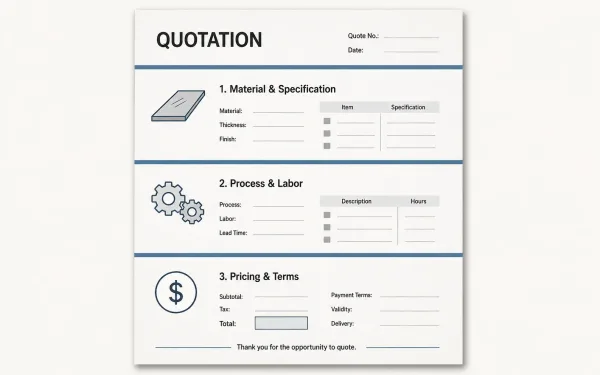
This diagram illustrates the three core sections that a well-structured manufacturing quotation should contain: material and specification details, process and labor breakdown, and pricing with commercial terms.
Material and Specification Details
The quotation should specify the material grade, thickness, and any applicable standards.
For sheet metal parts, this means items like “304 stainless steel, 1.5 mm thickness, per ASTM A240” rather than just “stainless steel.”
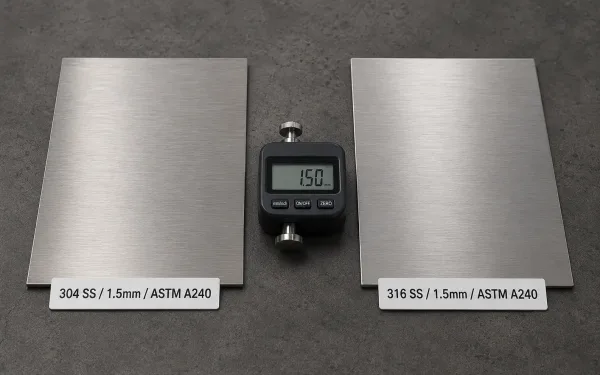
This image displays labeled sheet metal material samples — including 304 stainless steel and aluminum — with specification tags indicating grade, thickness, and applicable standards, illustrating why precise material callouts matter in a quotation.
Precise material callouts matter because material cost can account for 40–60% of the total part price, and swapping from one grade to another — say, from 304 to 316 stainless steel — can change the cost by 15–25%.
If the quotation leaves material details vague, the buyer has no way to verify what they are actually paying for.
Process and Labor Breakdown
This section lists the manufacturing process flow required to produce the part, including laser cutting, bending, welding, deburring, surface finishing, and other necessary operations.
Each step carries its own cost based on:
- cycle time
- labor involvement
- equipment usage
For a sheet metal enclosure, a quotation might show separate line items for laser cutting (based on cutting length and material thickness), bending (based on the number of bends and setup time), and powder coating (based on surface area and color).
A clear process breakdown helps the buyer understand which operations are driving cost and where DFM changes can reduce manufacturing cost without changing the part’s required function.
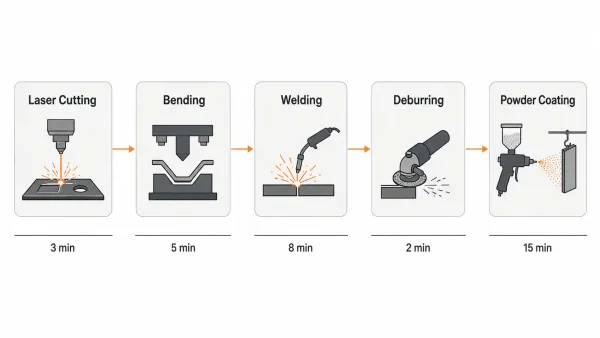
This flow diagram traces the sequential manufacturing steps involved in producing a sheet metal part, from laser cutting through powder coating, helping buyers understand what each line item on a quotation represents.
Pricing, Lead Time, and Commercial Terms
The quotation should state:
- the unit price
- total price
- tooling or setup fees (if any)
- lead time from the order confirmation date to shipment
- payment terms
- delivery terms (such as FOB or DDP)
Lead time is often the second most important factor after price, especially for production schedules with fixed deadlines.
A quotation that only shows a lump-sum price without breaking out tooling fees or lead time leaves the buyer exposed to surprises later.
Quotation vs. Estimate vs. Proposal — Key Differences
Buyers sometimes use these terms interchangeably, but they carry different levels of commitment and precision.
| Term | Price Precision | Binding? | Typical Use |
|---|---|---|---|
| Estimate | Approximate — a rough calculation based on limited information | No | Early-stage budgeting, before detailed drawings are available |
| Quotation | Specific — based on reviewed drawings and confirmed specifications | Usually becomes binding once accepted and signed | Formal procurement, when the buyer is ready to order |
| Proposal | Broad — may include pricing, scope, design recommendations, and timeline | Depends on terms | Complex projects, turnkey solutions, or when the supplier contributes design input |
An estimate is a starting point. A quotation is a commitment. A proposal is a package.
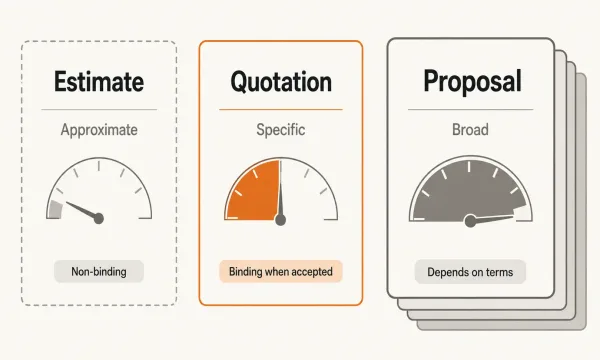
This comparison visual distinguishes three commonly confused terms — estimate, quotation, and proposal — by showing their relative price precision, commitment level, and typical use cases in manufacturing procurement.
For standard sheet metal parts with confirmed drawings, a quotation is the appropriate document.
For early-stage projects where the design is still evolving, an estimate may be more practical — and most suppliers will provide one if asked.
How Long a Manufacturing Quotation Stays Valid
For most custom manufacturing orders, the quote validity period is 14 to 30 days from the date of issue.
The validity period exists because:
- material prices
- labor costs
- production capacity
can shift.
Steel and aluminum prices, for example, can swing 5–10% in a single quarter. A supplier who quotes a part today at a specific material cost may not be able to hold that price two months later.
Some suppliers offer longer validity for repeat orders or standard parts with stable material costs.
Others shorten the window to 7–10 days for materials with volatile pricing or for quotes involving limited-availability stock.
If a buyer needs more time to decide, it is worth asking the supplier to extend the validity — most will accommodate a reasonable request, sometimes with a small price adjustment.
Is a Quotation Legally Binding?
A quotation by itself is generally not a legally binding contract. It is an offer, not an agreement.
The binding moment typically occurs when:
- the buyer issues a purchase order (PO) that references the quotation
- both parties sign a formal agreement that incorporates the quoted terms
That said, once a buyer accepts a quotation and the supplier begins work — ordering material, cutting tooling, starting production — the quotation’s terms often become enforceable even without a signed contract.
This is why it is important for both parties to review the quotation carefully before acting on it.
If there are discrepancies between the quotation and the buyer’s expectations on tolerances, finishing, or delivery, they should be resolved through technical clarification before a PO is issued.
How to Prepare an RFQ That Gets Accurate Quotes
The quality of a quotation depends directly on the quality of the information the buyer provides.
Vague or incomplete RFQs are the most common reason for:
- inaccurate quotes
- unexpected price changes
- production delays
What to Include in Your Drawing Package
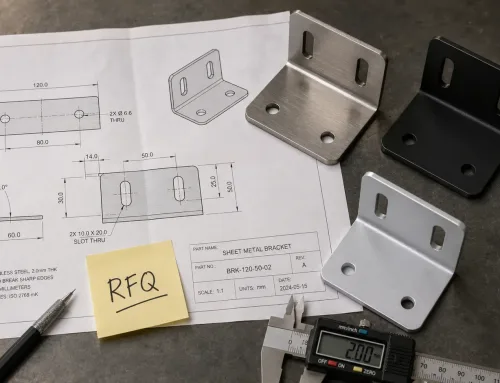
A complete sheet metal RFQ package should include:
- dimensioned 2D drawings for sheet metal fabrication with tolerances
- 3D CAD files (STEP or IGES format)
- material specification (grade, temper, and thickness)
- surface finish requirements
- quantity or annual volume estimate
- any critical functional requirements that are not obvious from the drawing
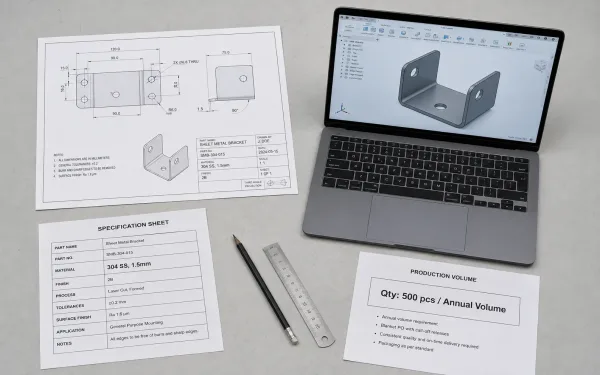
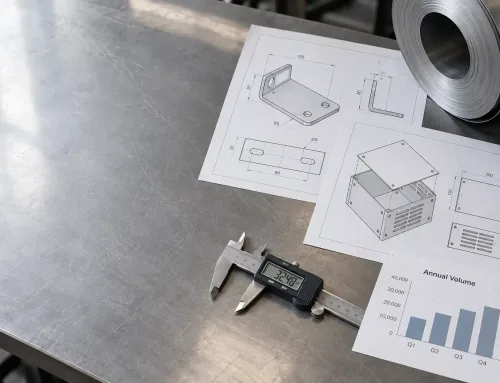
This image shows the key documents that should be included in a complete RFQ package: a dimensioned 2D drawing, a 3D CAD file preview, material specifications, and a volume estimate — all arranged on a flat surface.
If the part will be welded or assembled with other components, include assembly drawings or reference photos so the supplier can assess fit and access.
Why Vague Specifications Lead to Price Surprises
When a drawing does not specify a tolerance, the supplier defaults to their standard — which may be ±0.5 mm for laser-cut features and ±1.0 mm for bent dimensions.
If the buyer later requires tighter tolerances, the price will increase because additional fixturing or secondary operations are needed.
Similarly, if the drawing says “finish: smooth” without specifying a coating or roughness value, the supplier may quote a basic deburr — and the buyer who expected powder coating will face a change order.
Clear specifications up front prevent this kind of mismatch.
What Happens After You Accept a Quotation
Once the buyer accepts a quotation — typically by issuing a purchase order — the supplier:
- confirms the order
- enters it into their production schedule
- orders or pulls material from stock
- prepares tooling (if needed)
- establishes a production timeline
For custom sheet metal fabrication projects, the supplier usually begins with a first-article run or prototype batch.
This allows the buyer to verify:
- dimensions
- fit
- finish
before full production proceeds.
If the first articles meet specification, production continues at the quoted volume and lead time.
If changes are needed, the supplier issues a revised quotation reflecting any cost or schedule impact.
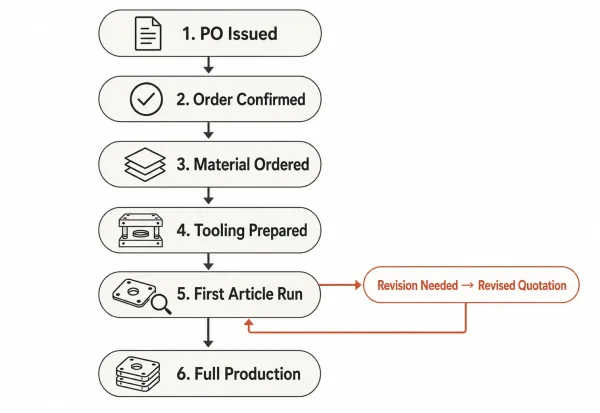
This workflow diagram outlines the post-quotation production sequence, starting from purchase order issuance through first-article inspection and into full-scale production.
FAQs
Need a quote for your next sheet metal project? Submit your RFQ and our team will provide a detailed quotation within 24–48 hours.