
When you request a quote for custom sheet metal parts, CNC machined components, or fabricated assemblies, the price you receive does not stay on the table forever. Every manufacturer attaches a time limit to their offer — a window during which the quoted price, lead time, and terms remain guaranteed. That window is the quote validity period.
Understanding what quote validity means, how long it typically lasts, and what happens when it expires can help you plan procurement timelines more effectively and avoid unexpected cost changes.
What Is Quote Validity?
Quote validity is the period during which a manufacturer commits to honor the pricing, lead time, and terms stated in a manufacturing quotation. Once that period passes, the manufacturer is no longer obligated to hold the original price — material costs, production capacity, and processing fees may have shifted.
In custom manufacturing, a quote is not a fixed catalog price. It is calculated from part geometry, the sheet metal material specification, tolerances, order quantity, and required manufacturing processes.
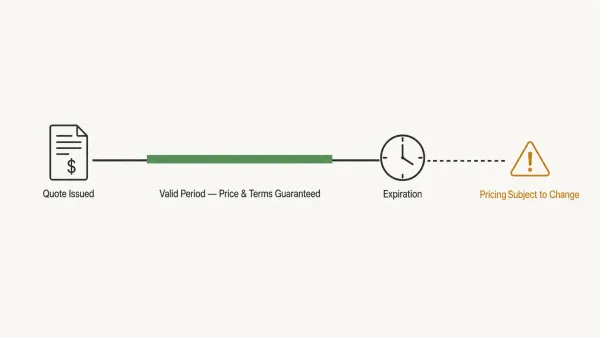
A simple timeline illustrating the lifecycle of a manufacturing quote — from issuance through the validity period to expiration — showing when pricing and terms are guaranteed.
Because these variables interact with market conditions and shop-floor scheduling, manufacturers cannot lock in pricing indefinitely. The validity period defines how long they are willing to absorb those variables at the quoted rate.
Why Manufacturers Set Expiration Dates on Quotes
A quote expiration is not a sales tactic. It reflects real operational constraints on the manufacturing side. Three factors drive most validity decisions.
Raw material price volatility. Metals like aluminum, stainless steel, and cold-rolled steel are priced against commodity indexes — LME for aluminum, COMEX for steel. Prices can swing 5–15% within a few weeks, especially during supply chain disruptions.
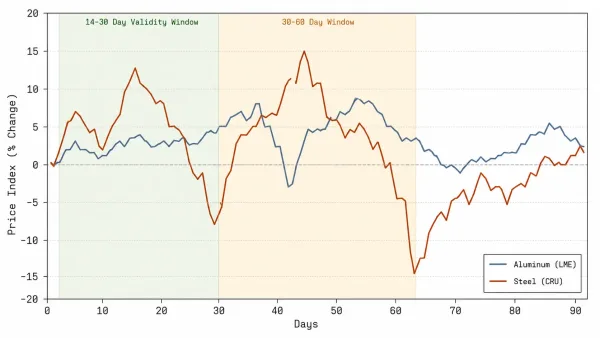
A line chart showing how aluminum and steel commodity prices fluctuate over a 90-day period, demonstrating why manufacturers limit quote validity to short windows.
A manufacturer quoting today at a certain material cost cannot guarantee that cost will hold 60 or 90 days out. Shorter validity periods protect both the buyer and the supplier from pricing misalignment.
Production capacity and scheduling. A fabrication shop runs on finite machine hours and labor availability. When a manufacturer quotes a job, they are reserving a rough slot in their production schedule.
If a quote sits unapproved for months, that capacity may no longer be available at the originally estimated lead time. The validity period helps manufacturers plan their shop floor realistically.
Process and finishing cost changes. Secondary operations — powder coating, anodizing, plating, hardware insertion — involve third-party vendors or consumables whose pricing can change.
Surface treatment costs, in particular, are sensitive to chemical prices and energy costs. A manufacturer who subcontracts finishing work cannot guarantee those costs beyond a limited window.
Typical Quote Validity Periods in Custom Manufacturing
Most custom manufacturing quotes fall within a 14- to 30-day validity window, though the exact period depends on the type of work and market conditions.
The table below shows typical ranges for common scenarios:
| Validity Period | Typical Use Case |
|---|---|
| 7–14 days | Volatile material costs (raw steel, copper), high-mix low-volume orders, construction or hardware components |
| 14–30 days | Standard sheet metal fabrication, moderate complexity, stable material markets |
| 30–60 days | Capital equipment, large assemblies, projects with long approval cycles |
| 60+ days | Long-term contracts with price-adjustment clauses, blanket purchase orders |
For custom sheet metal fabrication, a quote validity period of 14 to 30 days is the most common range under relatively stable material and production conditions.
If you need a longer window, many manufacturers will negotiate an extension — but it may come with conditions such as a material cost adjustment clause or a minimum order commitment.
What Affects the Length of a Quote Validity Period?
Not all quotes expire on the same schedule. Several variables influence how long a manufacturer is willing to hold a price.
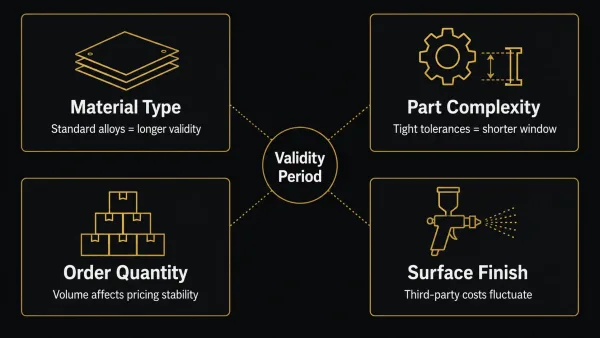
Four key variables — material type, part complexity, order quantity, and surface finish — shown as interconnected factors that determine how long a quote remains valid.
Material type and market conditions. Standard-grade aluminum (5052, 6061) and common stainless steel (304, 316) typically carry longer validity periods because supply is relatively stable.
Specialty alloys, copper, or materials subject to tariffs may carry shorter windows due to higher price volatility.
Part complexity and tolerances. Parts requiring tight tolerances (±0.005″ or tighter), complex forming, or multi-step fabrication involve more process planning.
If the manufacturer needs to reserve specific tooling or schedule dedicated machine time, they may offer a shorter validity to keep their planning flexible.
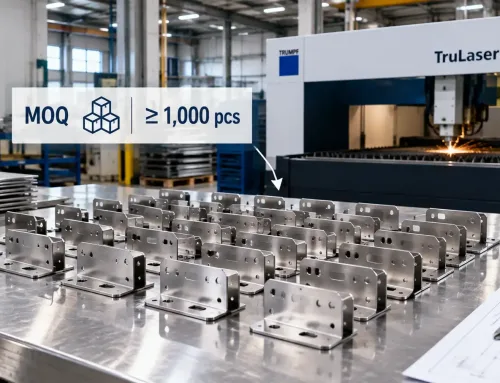
Order quantity and tooling requirements. Low-volume orders (under 100 pieces) typically have simpler pricing structures and may carry standard validity periods.
High-volume orders involving custom tooling, stamping dies, or dedicated fixtures often have longer validity periods because tooling costs are amortized over the production run — but the tooling itself may need to be ordered within a specific window.
Surface finish and secondary operations. Parts requiring powder coating, anodizing, silkscreening, or assembly involve coordination with finishing vendors.
If those vendors adjust their pricing, the original quote may no longer cover the full cost. Quotes with extensive secondary operations sometimes carry shorter validity or include a separate finishing cost review clause.
What Happens When a Quote Expires?
An expired quote does not mean the order is canceled or the manufacturer has declined the work. It simply means the original pricing and lead time are no longer guaranteed.
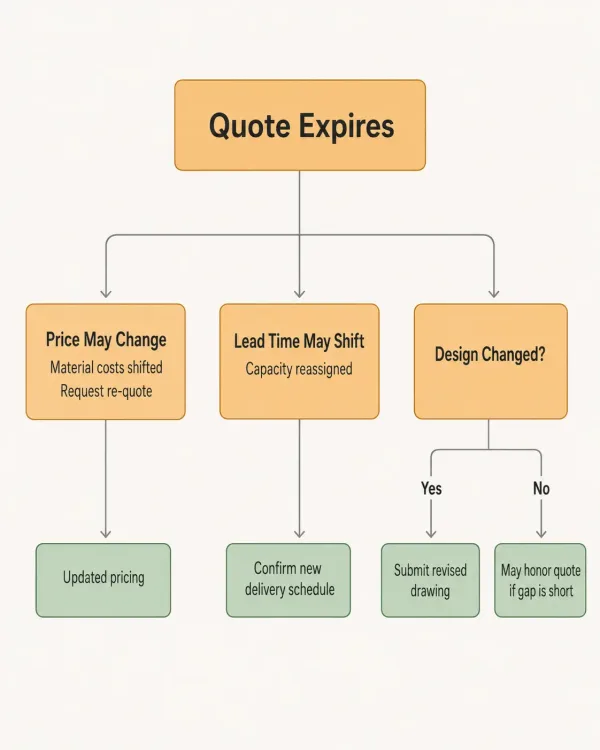
A flowchart outlining what happens when a quote expires — covering price changes, lead time shifts, and the re-quoting process.
Here is what typically happens:
The price may change. If material costs have risen since the original quote, the manufacturer will likely adjust the unit price. In some cases, the price may decrease — but buyers should not assume this.
Requesting a re-quote is the safest approach.
Lead time may shift. Production capacity that was available when the quote was issued may no longer be open.
A job that originally quoted a 2-week lead time might now require 3–4 weeks if the shop has since booked other orders.
A re-quote may require updated information. If your design has changed — even minor revisions to hole positions, bend radii, or surface callouts — the manufacturer may need to re-evaluate the part.
Sending the original drawing with a clear revision history speeds up the re-quoting process.
Can you still accept an expired quote? In some cases, manufacturers will honor an expired quote if the time gap is short (a few days) and material costs have not moved significantly.
However, this is a courtesy, not a guarantee. The safest approach is to confirm pricing before placing an order on an expired quote.
How to Make the Most of a Quote’s Validity Period
A few practical steps can help you move through the approval process before a quote expires:
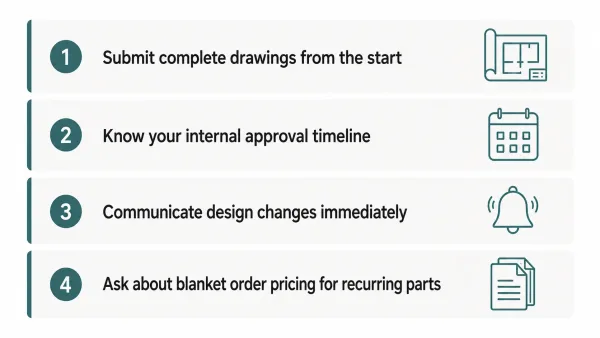
Four actionable procurement tips — submit complete drawings, know your approval timeline, communicate changes early, and consider blanket orders — presented as a quick-reference checklist.
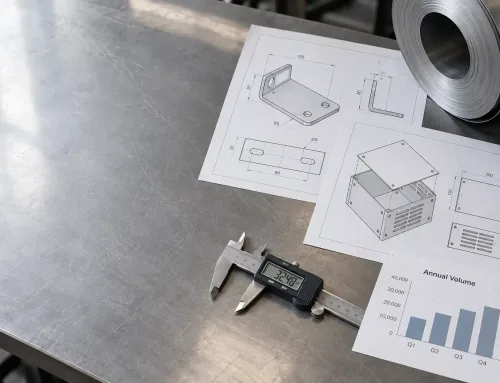
- Submit a complete sheet metal RFQ package from the start. Incomplete or ambiguous drawings often trigger technical clarification, and that back-and-forth can consume a significant portion of the quote validity window. Include material callouts, tolerances, surface finish requirements, and quantities on the first submission.
- Know your internal approval timeline. If your procurement process typically takes 3 weeks, request a validity period that covers that cycle — or ask the manufacturer about extension options upfront.
- Communicate design changes immediately. If you anticipate a drawing revision, let the manufacturer know before the validity period ends. A minor change to a bend angle or hole diameter can affect pricing and manufacturability.
- Ask about blanket order pricing. For recurring parts, a blanket purchase order with agreed-upon pricing over a longer period (e.g., 6–12 months) can eliminate the need to re-quote each batch.
FAQs
If you have a project in the quoting stage and want to understand how pricing, lead time, and validity apply to your specific parts, contact our engineering team for a detailed review.