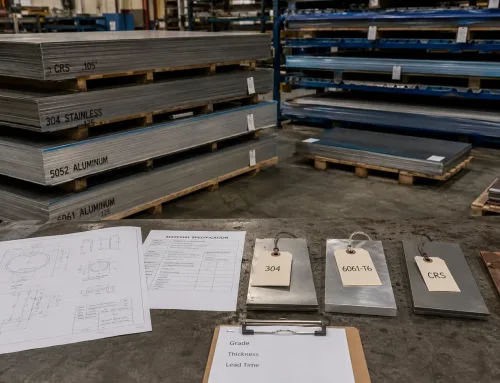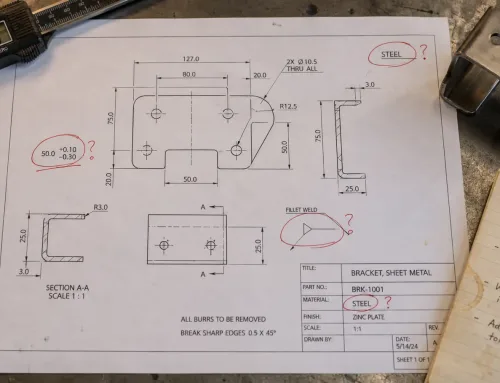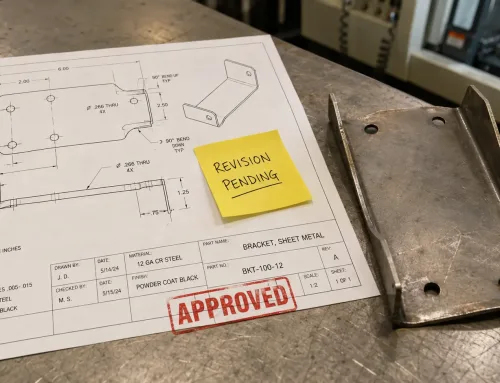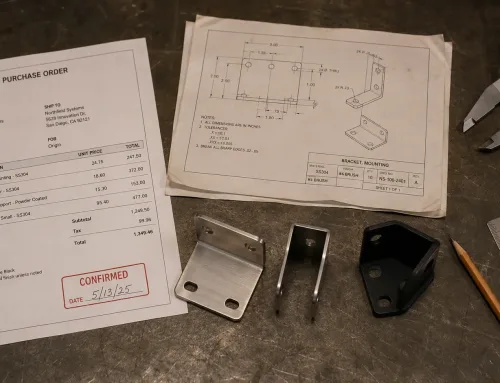

The first parts are off the machine. Dimensions look good on the shop floor, and the production team is ready to release the rest of the order. Then the project stops—not because something failed inspection, but because nobody has signed off yet.
That pause is not a paperwork formality. In custom manufacturing, first article approval is the gate between a completed first article and authorized volume production. Until the customer accepts the first-article evidence in writing, the schedule has not actually started the production run.
Why the Shop Floor Stops After the First Article
A finished first article answers one question: can this process make this part? It does not, by itself, answer a second question: does the customer accept that the process is ready for the order quantity?
Those two questions are handled by different activities. Measurement and inspection generate evidence. Approval is a decision about that evidence. Teams that treat “first article complete” as “production released” routinely discover a gap of days or weeks—review cycles, missing fields in the report, or a conditional approval that still blocks part of the run.
For buyers and project managers, the practical consequence is simple: sample lead time and production start date are not the same milestone.
What First Article Approval Means
First article approval is the customer’s written acceptance of first-article test or inspection results, which authorizes the supplier to proceed with production under the agreed requirements.
Two parts of that definition matter in practice.
First, approval is written. A verbal “looks fine” on a call is not a production release. Purchase orders and quality agreements usually require a documented decision—email from an authorized contact, a signed form, or a status in a supplier portal—precisely so both sides can prove when the gate opened.
Second, approval is tied to specific evidence and a specific part revision. Accepting a first article against drawing revision B does not authorize production against revision C. If the design, process route, material source, or key special process changes after the first article, a new review—or a focused partial review—is typically required before production continues.
In government contracting language (FAR Subpart 9.3), approval is the contracting officer’s written notification accepting first-article test results. Commercial sheet metal and machined-parts orders use the same logic with a different actor: the customer’s quality, engineering, or procurement contact.
How Approval Differs from First Article Inspection
First article inspection (FAI) and first article approval are often used as if they were interchangeable. They are not. Confusing them hides where the schedule actually stalls.
Inspection produces the evidence
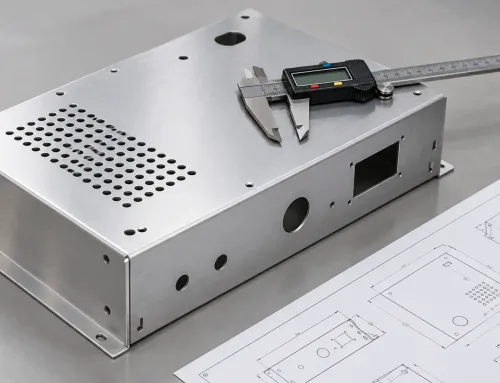
First article inspection is the technical verification that a part—usually the first part from a production-intent process—conforms to the drawing and specification. It covers dimensional results, material certificates, surface finish or coating records, and any required functional checks. The output is a report: measured values, pass/fail status, gage or method references, and open nonconformances.
This article does not re-teach how to measure those characteristics. What matters for scheduling and purchasing is that inspection creates the package the customer will judge.
Approval releases the production schedule
First article approval is the customer’s judgment on that package. The inspector can complete every dimension and still leave production waiting if the report is incomplete, the revision is wrong, or an open deviation has no agreed disposition.
In short: inspection asks “does the evidence show conformance?” Approval asks “do we accept this evidence and release the run?” Only the second action authorizes volume work under a typical first-article clause.
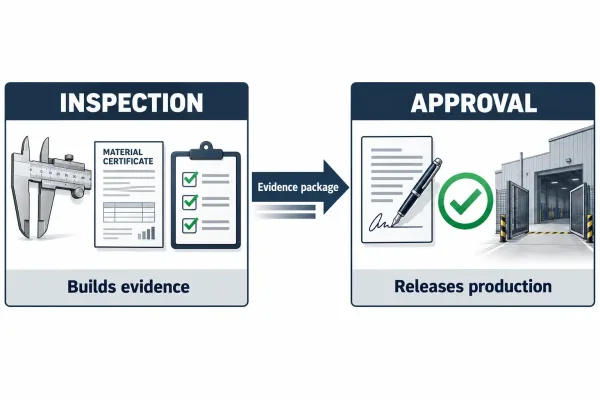
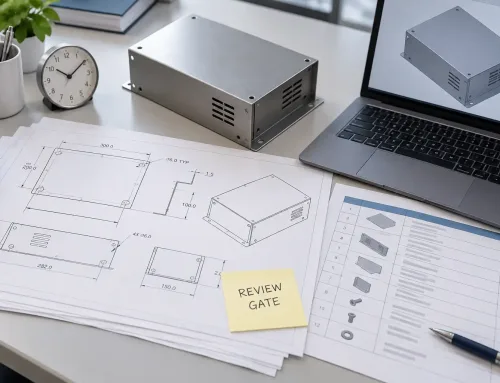
Left: inspection produces the evidence package. Right: written approval releases the production schedule.
What Goes into an Approval Package
Customers approve a document set, not a loose pile of measurements. Incomplete packages are the most common cause of avoidable review loops.
A practical approval package for sheet metal and fabricated parts usually includes:
- Drawing number and revision used to produce and inspect the first article
- Dimensional report with actual measured values (not only pass/fail boxes)
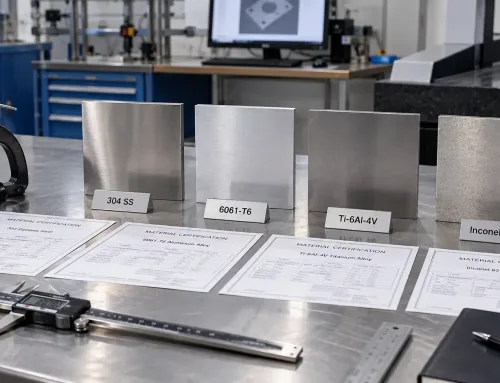
- Material certificate or lot traceability for the specified grade
- Records for special processes called out on the drawing—powder coat, anodizing, plating, heat treatment, weld inspections—with vendor or spec references
- A clear list of nonconformances or deviations, if any, with proposed disposition
- Part identification: part number, quantity of first articles, and date or work order reference
If a field is missing, the customer cannot close the review. The supplier may believe the parts are good while the buyer still cannot authorize production. Building the package to an agreed checklist before submission is one of the fastest ways to protect the delivery date.
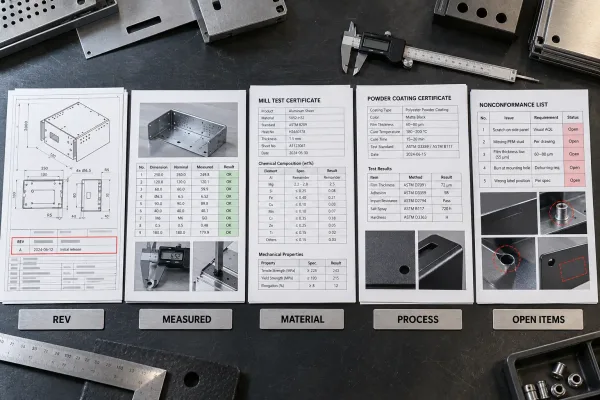
A complete approval package: controlled drawing, dimensional report, material cert, special-process records, and open nonconformance list.
Approval, Conditional Approval, and Disapproval
Written outcomes at this gate are usually one of three types. Each has a different effect on the production plan.
| Outcome | What it means | Effect on production |
|---|---|---|
| Approval | First-article results are accepted as submitted | Volume production may start for the agreed scope |
| Conditional approval | Results are accepted with remaining actions (document fixes, minor rework, limited open items) | Only the agreed portion may proceed; open items still block affected work |
| Disapproval | Results are not accepted | Production does not start; root cause, correction, and often a new first article are required |
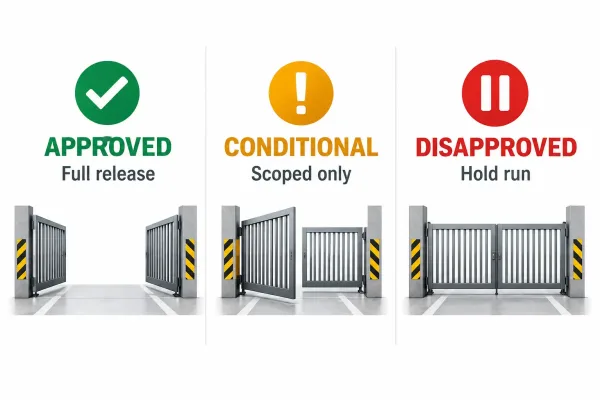
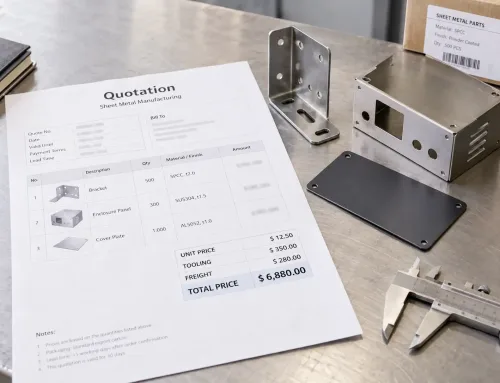
Three written outcomes and what each allows on the production floor.
Conditional approval is the status teams misunderstand most often. It is not a soft yes. It is a scoped release: perhaps long-lead material can be ordered, or a non-critical operation can run, while a dimensional issue or a missing certificate remains open. Unless the customer states in writing what may proceed, treat conditional approval as a hold on the full run.
After disapproval, rework or a replacement first article is usually re-tested and re-submitted. Cost and time for that loop sit with the party responsible for the nonconformance—another reason to define acceptance criteria before the first article is made.
Lead Time Before and After Written Approval
Treat first article approval as a schedule milestone, not as a quality afterthought.
A typical timeline looks like this:
- Production-intent first article is manufactured
- Inspection and documentation are completed
- Approval package is submitted to the customer
- Customer reviews, asks questions, or requests corrections
- Written approval (or conditional / disapproval) is issued
- Volume production is released
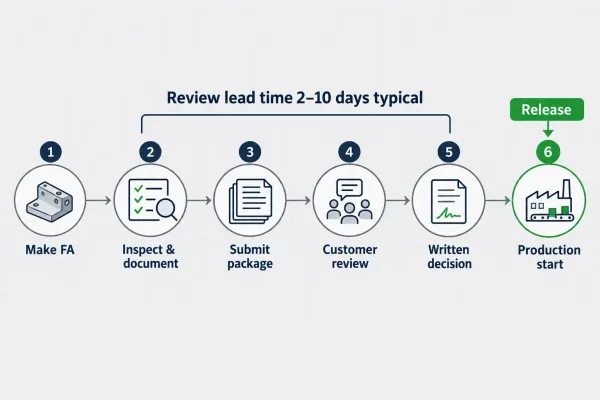
Production start follows written approval, not the day the first article is machined.
Steps 2 through 5 are real lead time. For many custom sheet metal orders, review and response take 2–10 business days when the package is complete; incomplete packages or multi-level customer approvals can stretch that further.
What “first article complete” really means on a schedule
On a Gantt chart or promise date, “first article complete” should mean package submitted, not merely “parts off the machine.” If measurement, certificates, or reports are still being assembled, the approval clock has not started.
Risk of starting production before sign-off
Buying long-lead raw material against a forecast is sometimes necessary. Starting finished production before written approval is a different decision: if the first article is later disapproved, parts already made may need rework, scrap, or re-inspection. Suppliers who proceed at risk should do so with explicit written authorization and a clear statement of who bears cost if the approval fails.
How Buyers and Suppliers Should Write the Gate into the PO
Both sides reduce delay when the approval gate is defined before the first chip is cut. The purchase order, quality appendix, or drawing notes should state:
- What must appear in the first-article submission package
- Who on the customer side issues written approval, and by what channel
- Target review turnaround (for example, five business days after complete submission)
- What conditional approval allows—and what it still blocks
- That volume production does not start until written approval, unless an explicit at-risk authorization is issued
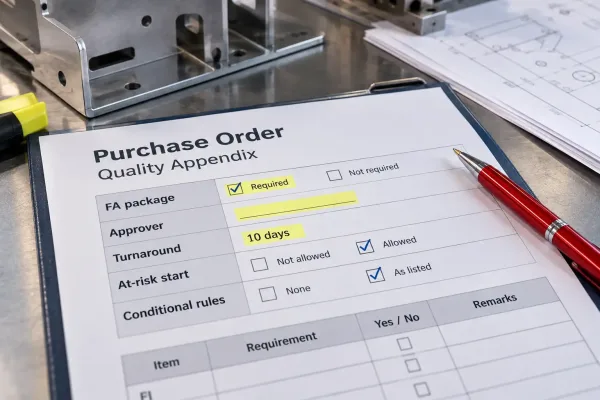
PO fields that define the approval gate before the first article is made.
Buyers who need faster ramps can also agree on a delta or partial first article for later revisions when only limited characteristics change. That avoids a full stop for a narrow change while keeping the approval discipline intact.
At RFQ stage, a short DFM and documentation review—confirming revision control, special-process certificates, and inspection scope—often prevents the multi-day loops that appear only after the first article ships.
Key Takeaways
First article approval is the written production-release gate after first-article evidence is accepted. Inspection builds the evidence; approval opens the schedule. Package completeness, named approvers, and clear conditional rules determine whether that gate takes days or weeks. For accurate delivery commitments, plan production start from written approval, not from the day the first article is finished.
FAQs