
Material availability sounds like a straightforward question: is the material in stock or not? In custom manufacturing, it is rarely that simple. A supplier may have plenty of steel on hand but still cannot source the exact material grade, thickness, or finish your drawing calls for. Availability is not a binary condition — it is a variable shaped by material choice, specification precision, order quantity, and how deep the supply chain runs for a given product.
Understanding these variables matters because material availability directly affects lead time, cost, and whether a project stays on schedule. A part that is simple to fabricate can still be delayed by weeks if the specified material is hard to source.
What Is Material Availability?
Material availability refers to whether a specific material — in the grade, form, size, and condition required — can be obtained from a supplier within a reasonable time frame and at a predictable cost. In custom part procurement, this means the raw material needed to produce your components is accessible when production is ready to begin.
The term is sometimes confused with related concepts:
- Inventory availability refers to what a specific supplier currently has in stock. Material availability is broader — it includes what can be ordered from distributors, mills, or secondary sources.
- Product availability typically describes finished goods ready for purchase. Material availability concerns raw or semi-finished inputs used in manufacturing.
For procurement teams, the distinction matters. A supplier with no steel on hand may still be able to source it within days if it is a common grade. Conversely, a supplier with steel in stock may not have the exact specification your drawing requires. Material availability is ultimately a question of supply chain depth for a given specification, not just warehouse stock.
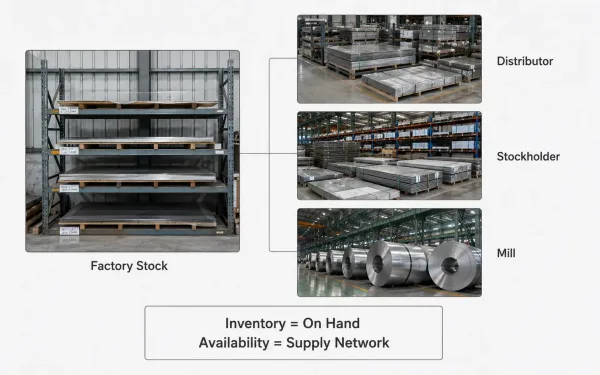
A simple sourcing diagram showing the difference between factory inventory and wider material supply chain availability.
What Affects Material Availability in Custom Manufacturing
Several variables determine how easily a supplier can obtain the material your parts require. None of them operate in isolation — they interact in ways that can compound delays or, when managed well, keep projects on track.
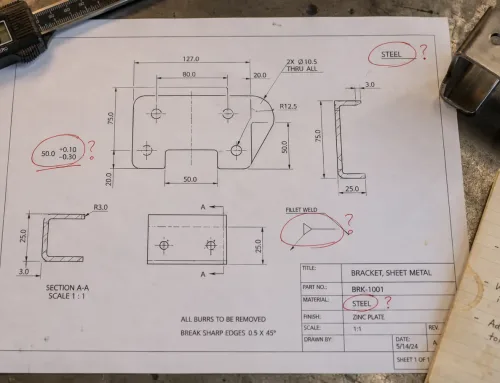
Specification precision on the drawing is often the most immediate factor. A drawing that calls for “stainless steel sheet” gives the supplier flexibility to source the most readily available grade and thickness. A drawing that specifies “ASTM A240 Type 304, 2B finish, 16 gauge (0.0598 in.), per AMS 2700 passivation” narrows the search to a very specific product. Both approaches are valid — the right level of precision depends on the part’s function — but the narrower the specification, the fewer sources can supply it.
Order quantity creates a different kind of constraint. Material suppliers and distributors set minimum order quantities (MOQs), often measured in full sheets or standard cut sizes. A project requiring 10 parts from a single sheet of aluminum may only need one sheet, well within typical purchase quantities. A project requiring 500 parts from a specialized alloy may demand a mill order with lead times measured in months rather than days.
Supply chain depth varies significantly by material type. Common grades of cold-rolled steel, galvanized steel, and 6061 aluminum have deep supply chains with multiple distributors stocking standard sizes in most industrial regions. Specialty alloys — certain copper grades, titanium, or high-nickel alloys — may have only a handful of domestic sources, with lead times that fluctuate based on demand from aerospace, medical, or energy sectors.
Surface treatment and secondary processing add another layer. A raw sheet of CRS (cold-rolled steel) may be available within days. The same sheet with a specific powder coat color, anodized finish, or electroless nickel plating introduces additional sourcing requirements — the coating material, the finishing vendor’s capacity, and the compatibility of the finish with the base material all become variables in the availability equation.
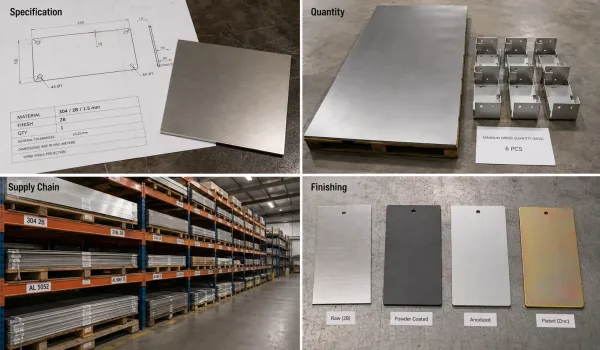
Four key factors affecting material sourcing: specification, quantity, supply chain depth, and finishing requirements.
How Material Choice Affects Availability
The material you select at the design stage has a direct and measurable impact on how quickly a supplier can begin production. This impact is not always obvious, because material selection is usually driven by mechanical requirements — strength, corrosion resistance, weight — rather than supply chain considerations.
Common structural steels such as ASTM A36, AISI 1018, and AISI 1045 are among the most readily available materials in sheet and plate form. Distributors stock standard sizes in most industrial markets, and secondary suppliers maintain inventories of common thicknesses from 0.030 in. to 1.000 in. Lead times for these materials are typically measured in days.
Stainless steels — particularly 304 and 316 grades — are widely available in standard sheet sizes, though the range of surface finishes (2B, No. 4, mirror, BA) varies by supplier. Specialty stainless grades such as 17-4 PH or duplex alloys are available from fewer sources and may require minimum orders or extended lead times.
Aluminum alloys follow a similar pattern. 6061-T6 aluminum and 5052-H32 are stocked by most aluminum distributors in standard sheet and plate sizes. Less common alloys — 2024, 7075, or cast plate — may require longer lead times or minimum purchase commitments.
Copper and brass present a more constrained picture. While C110 copper sheet is available from major distributors, the range of stocked thicknesses and widths is narrower than steel or aluminum. Certain copper alloys used in electrical applications may require mill orders.
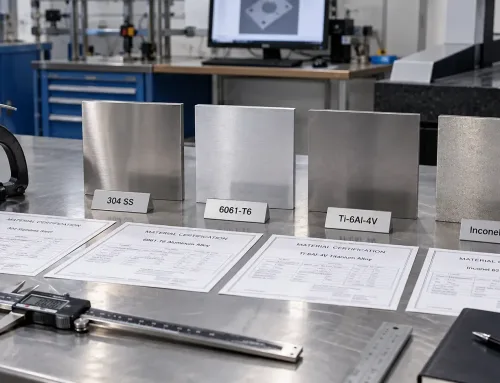
Titanium and high-performance alloys sit at the far end of the availability spectrum. Sheet titanium in Grade 2 or Grade 5 may be available from specialty distributors, but standard sizes are limited, and prices fluctuate more than common metals.
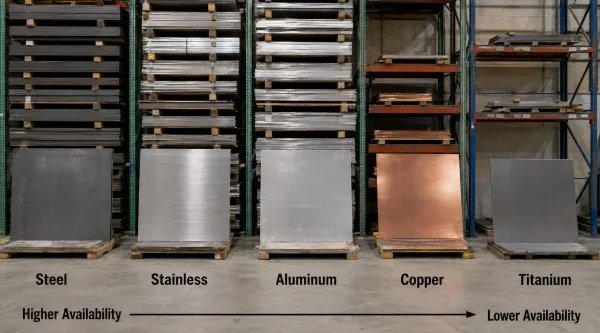
Common steel, stainless steel, aluminum, copper, and titanium shown with different levels of typical material availability.
When a specified material proves difficult to source, suppliers may be able to suggest an equivalent or near-equivalent substitute. A design that calls for 303 stainless steel — a free-machining grade — could potentially use 304 stainless if machinability is not the critical requirement. The key is for the drawing to either lock down the specific grade or explicitly allow alternatives.
How Drawing Specifications Influence Material Sourcing
The way a material is called out on a drawing does more than define a requirement — it determines how many potential sources can supply it. Engineers and designers who understand this relationship can write specifications that are both precise enough for quality control and flexible enough for sourcing.
A specification like “aluminum sheet, 0.063 in., 6061-T6” is clear, functional, and easy for a supplier to source from multiple distributors. It does not tie the material to a particular standard body or mill source. For many applications — brackets, enclosures, covers — this level of specification is entirely adequate.
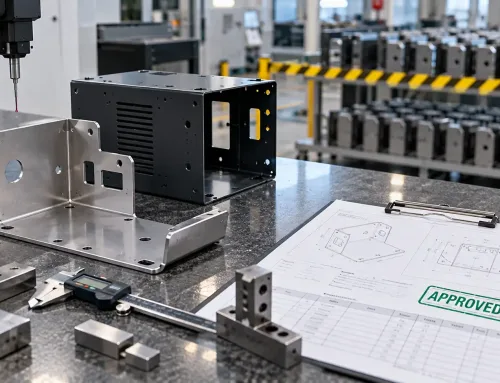
A specification like “aluminum sheet per AMS-QQ-A-250/11, 0.063 in. nominal, 6061-T6, bare, per MIL-DTL-5541 Type I Class 3 chromate conversion coating” is significantly more precise. It locks the material to an aerospace specification, defines the temper, and specifies the surface treatment. This is appropriate when the part must meet regulatory or customer-driven standards, but it limits sourcing to suppliers who can certify material to that specification and provide the required material certificate and documentation.
The trade-off is practical: higher specification precision generally means fewer qualified sources, longer lead times, and higher material costs. This does not mean specifications should be vague — it means they should be calibrated to the part’s actual requirements. A structural bracket in an industrial enclosure does not need the same material traceability as a flight-critical aerospace component.
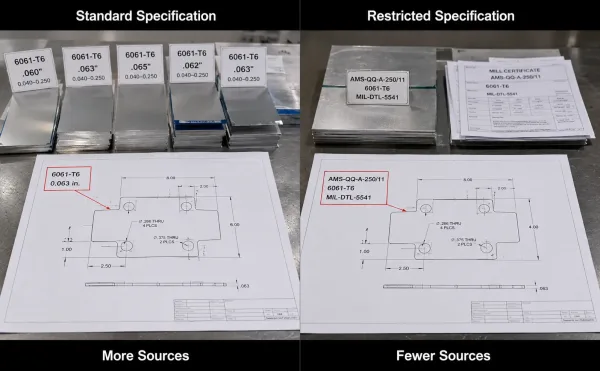
Two engineering material specifications showing how tighter requirements can reduce sourcing flexibility.
For procurement teams, one of the most effective steps is to review material callouts during the design phase, before drawings are released for quoting. Asking “is this specification as narrow as it needs to be, but no narrower?” can prevent sourcing delays downstream.
Material Availability for Small-Batch Projects
Low-volume sheet metal fabrication projects — prototype runs and short production quantities of 5 to 50 pieces — face a distinct set of material availability challenges that differ from volume production.
Minimum order quantities are the most common constraint. A material distributor may sell aluminum sheet in full-sheet increments of 48 × 96 in. A project requiring only a few small parts from that sheet means the buyer is purchasing far more material than the parts require. For common materials, this may be acceptable — the excess can be used on future orders or the per-unit material cost remains manageable. For expensive alloys, the MOQ mismatch can make small-batch projects disproportionately costly.
Supplier remnant stock can be a practical solution. Many fabrication shops and material distributors maintain inventories of offcuts and remnants — pieces remaining from larger orders that are too small for volume work but more than sufficient for a handful of parts. Not all suppliers advertise remnant availability, so asking directly can uncover material that is both faster to obtain and less expensive than a full-sheet purchase.
Lead time sensitivity is amplified at small quantities. In volume production, a two-week material lead time is absorbed into a longer production schedule. In a small-batch project where the entire order may be completed in a few days, that same two-week lead time becomes the dominant factor in the delivery schedule. Confirming material availability before committing to a delivery date is particularly important for small-batch orders.
For procurement teams, the most practical step is to communicate batch size early in the quoting process. Suppliers who understand the quantity context can offer material options — including remnants, alternative grades, or stocked sizes — that may not appear in a standard material specification.
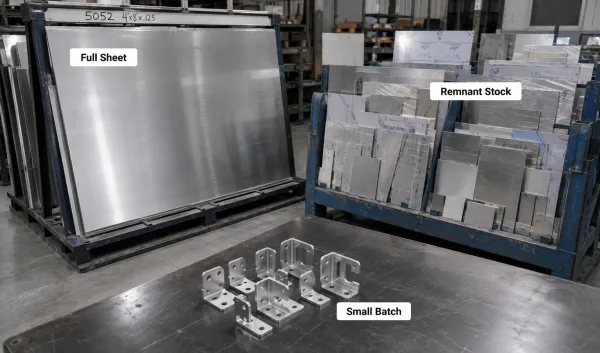
Full sheets, remnant stock, and small fabricated parts illustrating material sourcing options for low-volume orders.
How to Improve Material Availability for Your Orders
Improving material availability is less about finding better suppliers and more about making informed decisions earlier in the procurement cycle. The choices made at the design and specification stage have a disproportionate impact on whether materials can be sourced efficiently.
Start with common grades and standard sheet metal thicknesses when possible. A design that specifies 10-gauge CRS (0.1345 in.) will source more easily than one calling for 3.5 mm (0.1378 in.) — a thickness that exists in the metric system but does not correspond to a standard gauge or fractional inch size. Standard sizes are stocked by more distributors and are available with shorter lead times.
Allow flexibility where the design permits. If a part does not require a specific alloy for certification or performance reasons, the drawing can specify a material category rather than a single grade. “Stainless steel, austenitic, 300 series” gives the supplier room to source what is most available, while still defining the material family.
Confirm availability before finalizing the design. A brief check with the manufacturer or material supplier during the design phase — “is this material readily available in the quantity I need?” — can prevent delays that would otherwise surface weeks later during quoting or production.
Consider the total material pipeline. Material availability is not just about the raw sheet or bar — it includes any coatings, treatments, or secondary materials needed to complete the part. A design that specifies both a specialty alloy and a hard-to-source surface finish multiplies the sourcing challenge.
For most custom parts, the goal is not to minimize specification — it is to match specification to requirement. The right level of detail makes a part easier to source without compromising its fitness for use.
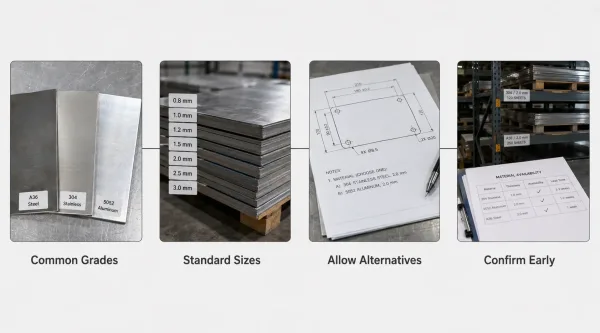
A practical material sourcing workflow using common grades, standard sizes, approved alternatives, and early availability checks.