
Your supplier says they check every Material Test Report that comes in.
The paperwork is filed, the folder is thick, and the audit looks clean.
But here is a question worth asking: when that MTR arrived with the last steel shipment, did anyone at the factory actually read it — or did it go straight into a drawer?
Most buyers treat the presence of MTRs as evidence of material quality. It is not.
An MTR sitting in a file proves one thing: that someone at the mill printed a document.
Whether your supplier verified the contents, caught a discrepancy, or acted on a red flag is a completely different matter.
And that gap — between collecting reports and reviewing them — is where real quality problems begin.
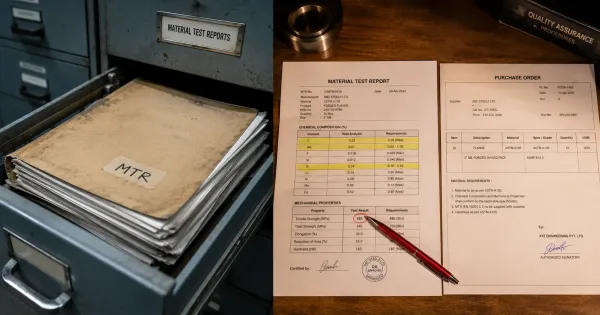
Left: MTR documents stored in a filing cabinet without review. Right: An MTR actively verified against the purchase order, with discrepancies flagged by hand.
This matters more in sheet metal fabrication than in many other manufacturing processes.
The mechanical properties listed on an MTR directly affect how sheet metal materials will bend, cut, and form.
A supplier that does not review these details is not just cutting corners on paperwork.
They are running production on unverified assumptions about the material on their shop floor.
Why “We Have the MTR” Is Not the Same as “We Reviewed the MTR”
In theory, every metal fabrication supplier reviews incoming material test reports.
In practice, the process often looks like this: a shipment arrives, the warehouse team checks the heat number against the packing list, the MTR gets stapled to the delivery note, and the bundle moves to the rack.
No one compares the chemical composition against the sheet metal material specifications defined in the purchase order.
No one checks whether the reported tensile strength falls within the acceptable range.
No one flags that the certificate type is 2.1 when the contract requires 3.1.
This is not negligence in the dramatic sense.
It is a systemic gap that develops when a supplier treats MTR review as a documentation task rather than a technical verification step.
The result is that the MTR exists in the system — it is “on file” — but the information it contains has never been validated against the actual requirements of the order.
The distinction matters because MTRs occasionally contain errors.
Mills sometimes ship material with a certificate that does not match the actual heat.
Chemical composition values may fall outside the specified range.
Mechanical test results may indicate properties that are marginal for the intended application.
These issues are catchable — but only if someone reads the report with the technical knowledge to spot them.
What a Competent MTR Review Process Actually Looks Like
A supplier with genuine MTR review capability does not treat incoming reports as a filing exercise.
The review is a structured technical checkpoint with defined steps, clear responsibilities, and documented outcomes.
At a minimum, a competent sheet metal inspection plan for incoming materials includes the following:
- Heat number verification. The heat number on the MTR must match the physical markings on the material. This is the foundation of traceability — if the numbers do not match, nothing else on the report can be trusted.
- Specification cross-reference. The material grade, product form, and applicable standard listed on the MTR are checked against the purchase order. A report for ASTM A36 steel is not acceptable if the order specifies ASTM A572 Grade 50.
- Chemical composition review. The reported carbon, manganese, sulfur, phosphorus, and other alloying elements are compared against the allowed ranges in the referenced standard. Values at or near the boundary limits should trigger a flag.
- Mechanical property verification. Tensile strength, yield strength, and elongation are checked against both the applicable manufacturing quality requirements and the specific needs of the application. For sheet metal destined for bending operations, elongation values are particularly important.
- Certificate type confirmation. The EN 10204 certificate type (2.1, 2.2, 3.1, or 3.2) is verified against what the customer or contract requires. This is a common failure point — many suppliers accept whatever certificate arrives without checking whether it meets the agreed type.
- Disposition decision. The review must have a clear outcome: accepted, accepted with deviation, or rejected. A review that never produces a rejection is a review that is not actually evaluating anything.
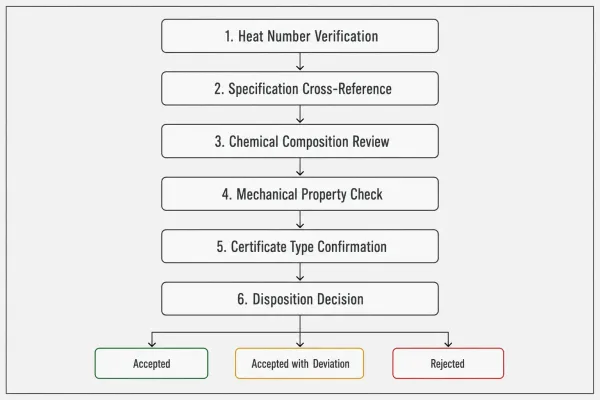
A structured six-step MTR review process used by competent sheet metal suppliers, ending with an accept, deviate, or reject decision.
The key difference between a real review and a paperwork exercise is whether the process can say “no.”
If a supplier has never rejected an incoming MTR, that is not a sign of perfect quality.
It is a sign that the review is not functioning.
The Fields That Matter Most — and What to Watch For
You do not need to read every field on an MTR to assess whether your supplier is doing a competent review.
Focus on the fields where errors have the most direct impact on sheet metal fabrication outcomes.
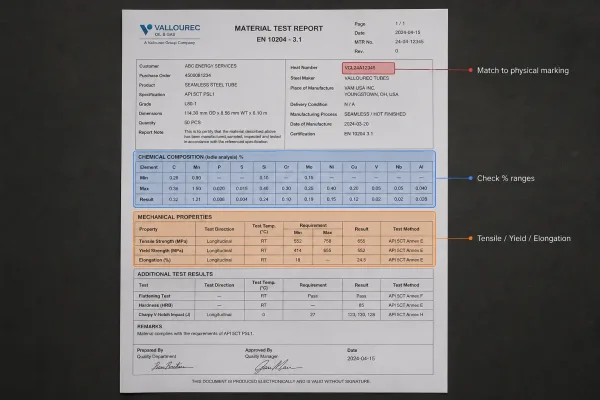
Three critical areas of an MTR that require technical review: chemical composition ranges, mechanical property values, and heat number for traceability.
Chemical Composition
Chemical composition determines weldability, corrosion resistance, and how the material responds to forming operations.
For mild steel, carbon content is the most critical variable — high carbon increases hardness but reduces ductility, making the sheet more prone to cracking during bending.
For stainless steel, the chromium and nickel balance affects both corrosion resistance and formability.
If your supplier is reviewing MTRs for sheet stock, they should be checking these values against the standard limits and flagging anything near the boundary.
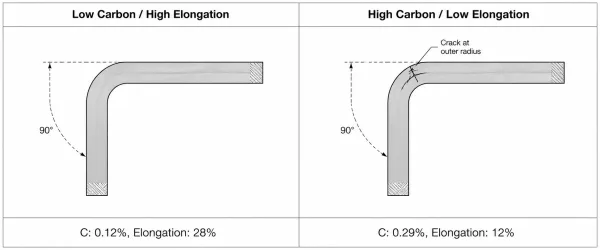
How material composition affects bend quality: low carbon and high elongation produce clean bends, while high carbon and low elongation lead to cracking at the bend radius.
Mechanical Properties
Mechanical properties — specifically tensile strength, yield strength, and elongation — tell you how the material will behave under load and during forming.
In sheet metal bending, elongation is often the most telling number.
A sheet with high tensile strength but low elongation may resist deformation initially but crack at the bend line.
Your supplier should understand this relationship, not just compare numbers against a table.
Heat Number and Traceability
Heat number and traceability connect the physical material on the shop floor to the data on the report.
If the heat number stamped on the sheet does not match the heat number on the MTR, the entire chain of quality assurance breaks.
This seems obvious, but it is one of the most common failures in incoming material inspection — especially when materials are stored in bulk and heat numbers are difficult to read after cutting.
A supplier that routinely checks these three areas through a documented quality control and inspection process is demonstrating real review capability.
A supplier that files the MTR without scrutiny is demonstrating the opposite.
EN 10204 Certificate Types — What Your Supplier Should Be Accepting
The EN 10204 standard defines four types of inspection documents, and the differences between them are not academic.
They determine who performed the testing, whether the results are independent, and what level of assurance the certificate actually provides.
| Certificate Type | Issued By | Test Basis | Independent Verification |
|---|---|---|---|
| Type 2.1 | Manufacturer | No test results reported | None |
| Type 2.2 | Manufacturer | Non-specific test results | None |
| Type 3.1 | Manufacturer | Specific test results per order | None (manufacturer only) |
| Type 3.2 | Manufacturer + Independent Inspector | Specific test results per order | Yes — by authorized or independent inspector |
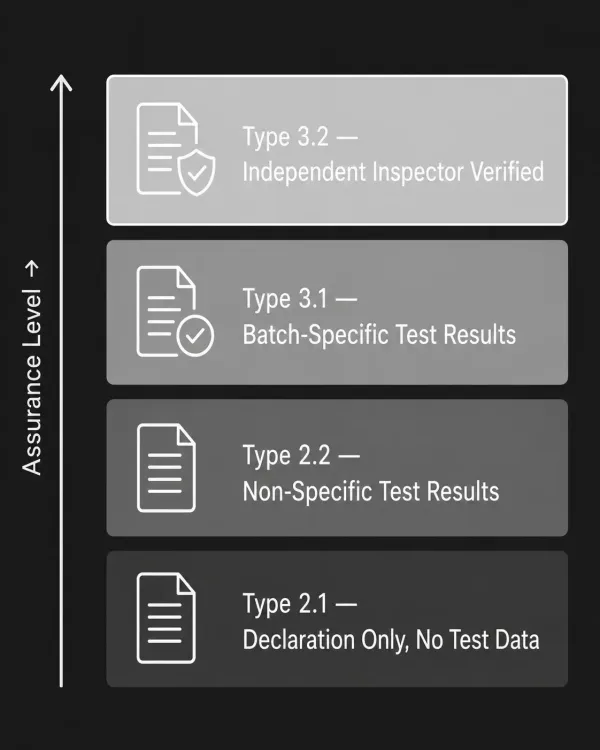
EN 10204 defines four certificate types with increasing levels of assurance, from manufacturer declarations (2.1) to independently verified inspection documents (3.2).
For B2B sheet metal fabrication, Type 3.1 should be the minimum expectation.
It confirms that the mill tested the specific material batch against the order requirements and reported the actual results.
Type 2.1 and 2.2 certificates do not provide this level of assurance — they are essentially declarations without supporting data.
The critical question for your supplier is not just “do you accept 3.1 certificates?” but “do you know when to require 3.2?”
Type 3.2 certificates, verified by an independent inspector, are appropriate for safety-critical applications, regulated industries, or orders where the buyer has no established trust relationship with the mill.
A supplier that blindly accepts whatever certificate arrives — or does not know the difference — is exposing you to risk.
How MTR Review Failures Lead to Real Manufacturing Problems
When a supplier does not review MTRs properly, the consequences do not stay on paper.
They show up on the shop floor as real manufacturing problems that are expensive to diagnose and correct.
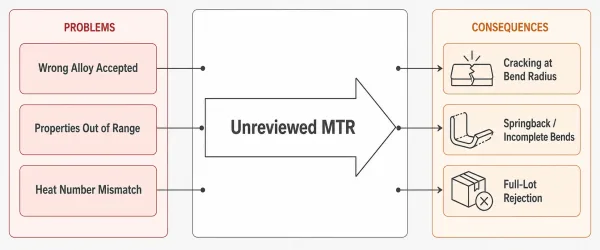
Three common consequences of MTR review failures: material grade mismatches cause cracking, out-of-range properties cause springback, and traceability gaps lead to full-lot rejection.
Material Grade Mismatch
If the wrong material grade is accepted and enters production, every part made from that material is suspect.
In sheet metal bending, using a material with lower ductility than specified can cause cracking at bend radii that should be safe.
The defect may not appear until forming — by which point the material has already been cut, and the scrap cost is locked in.
Mechanical Properties Outside Acceptable Range
A sheet with yield strength at the low end of the specification may not hold its formed shape, leading to springback issues in bent parts.
A sheet with tensile strength at the high end may require more bending force than the press brake setup allows, leading to incomplete bends or tooling damage.
Both scenarios are preventable when MTR review is built into the sheet metal production workflow before the material reaches the brake.
Traceability Failure
If heat numbers are not verified at incoming inspection, and a nonconforming material batch reaches production, the supplier cannot identify which finished parts are affected.
This turns a localized quality issue into a full-lot problem — the buyer must either inspect every part or assume the worst and reject the entire shipment.
Either outcome is far more costly than catching the discrepancy at the receiving dock.
The pattern is consistent: MTR review failures are silent until they become expensive.
A supplier that treats review as a formality is not saving time.
They are deferring risk to you.
How to Audit a Supplier’s MTR Review Capability — A Checklist
During a supplier factory tour or remote audit, the following checklist can help you assess whether their MTR review process is real or cosmetic.
These are not abstract quality management questions.
They are specific, observable indicators of whether material verification actually happens.
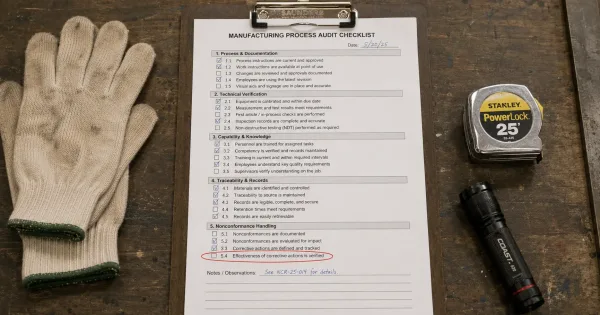
An audit checklist covering five key areas for evaluating a supplier’s MTR review capability: process documentation, technical verification, personnel knowledge, traceability, and nonconformance handling.
Process and Documentation
- Is there a written procedure defining incoming inspection standards for material checks and MTR review?
- Does the procedure define who is responsible for the review and what happens when a discrepancy is found?
- Are review results recorded with accept/reject decisions and the reviewer’s identification?
Technical Verification
- Does the reviewer cross-reference the MTR against the purchase order specification (grade, standard, certificate type)?
- Are chemical composition and mechanical properties checked against the applicable standard’s allowed ranges?
- Is the heat number on the MTR verified against the physical marking on the material?
Capability and Knowledge
- Can the person performing the review explain what they check and why?
- Do they understand how material properties affect downstream fabrication — particularly bending and welding?
- Have they ever rejected an incoming material shipment based on MTR findings? (If the answer is “never,” ask why.)
Traceability and Record Management
- Can the supplier trace a finished part back to the original material heat number?
- Are MTRs retained for the duration required by the customer or applicable standard?
- Is the filing system organized so that MTRs can be located quickly — not just filed, but retrievable?
Nonconformance Handling
- Is there a documented process for what happens when an MTR reveals a nonconformance?
- Does the supplier raise a technical clarification with the buyer before using material with a borderline or flagged result?
- Are rejected materials physically segregated to prevent accidental use?
A supplier that can answer these questions with evidence — not just verbal assurances — has a functioning MTR review process.
A supplier that struggles to show documentation, names, or examples is likely collecting reports without reviewing them.
FAQs
If you are evaluating sheet metal fabrication suppliers and want to understand how a manufacturer with structured incoming material inspection works, contact SR-MFG to discuss your project requirements.
Our engineering team can walk you through our material verification process and help you define the documentation standards your parts require.