
When a shipment of sheet metal parts arrives at your facility, how confident are you that the count matches the purchase order? For most buyers and quality engineers, the honest answer is: not very. Counting seems like the simplest part of receiving inspection, yet quantity discrepancies—shortages, overages, and mixed-lot shipments—remain one of the most common sources of delivery disputes in sheet metal fabrication.
The root cause is not carelessness. It is that part count verification is treated as a single checkpoint rather than a systematic process. This guide explains how to build quantity verification into every stage of production and delivery, from raw material intake through final shipment.
Why Part Count Verification Matters in Sheet Metal Fabrication
Part count verification is the practice of confirming that the actual number of parts at each production stage matches the expected quantity. In custom sheet metal fabrication, where a single production order may include hundreds or thousands of identical brackets, panels, or enclosures, even a small counting error can cascade into significant downstream problems.
What Happens When Counts Go Wrong
A missing part is not just a missing part. When a fabrication shop ships 980 pieces against an order for 1,000, the buyer faces a downstream assembly line running at 98% capacity—or stopping entirely if those 20 parts are on a critical path. The consequences extend beyond the immediate shortage:
- Production delays. Assembly lines halt when a component is missing, even by a small margin. The cost of downtime often exceeds the value of the missing parts by orders of magnitude.
- Emergency reorders. Rushing a small batch of parts through a second production run incurs setup costs, expedited shipping, and scheduling disruptions that affect other orders.
- Inventory confusion. Overages create their own problems: extra parts consume warehouse space, may not match future revision changes, and complicate inventory counts.
- Trust erosion. Repeated quantity discrepancies push buyers toward dual-sourcing or switching suppliers entirely, regardless of dimensional quality.
The financial impact is real. A 2023 survey by the Fabricators & Manufacturers Association found that quantity-related delivery issues account for roughly 15% of all customer complaints in custom sheet metal work—not far behind dimensional defects.
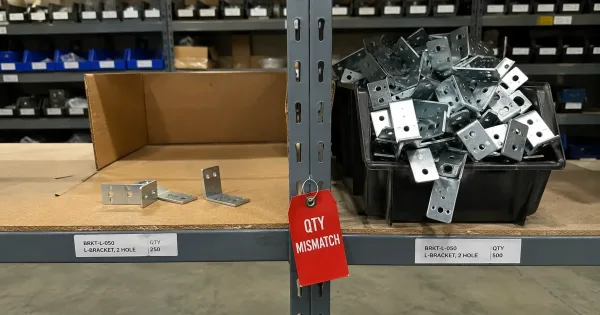
A storage shelf illustrating both outcomes of quantity errors: an empty gap representing a shortage and an overfilled bin of surplus parts consuming extra space.
Where Count Verification Fits in the Production Workflow
Effective quantity verification should be integrated into the sheet metal production workflow, rather than treated as a single checkpoint at the shipping dock.
- Raw material intake. Verify that incoming sheet stock, bar stock, and purchased components match the quantities on the supplier’s packing slip and your purchase order. Assign traceability codes to each batch.
- Production run. Track parts as they come off the cutting, forming, and welding stations. Count at the end of each operation, not just at final inspection.
- A sheet metal inspection plan should account for parts removed during in-process sampling so that inspection activity does not reduce the final deliverable quantity below the order requirement.
- Pre-packaging. Before parts are boxed or palletized, include a dedicated quantity check in the pre-shipment inspection. This is the last opportunity to catch discrepancies before the shipment leaves the factory.
- Final shipment. Match the packed quantity against the packing slip, the purchase order, and any approved overage or shortage tolerance.
Each stage serves a different purpose. Raw material intake catches supplier errors. Production tracking catches scrap and process losses. Pre-packaging catches miscounts from multi-station handling. Final shipment catches packing errors.
Skipping any stage shifts the burden of discovery to the next—and the cost of correction increases with each step.
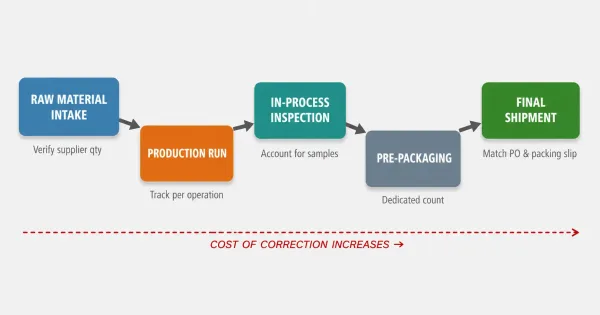
A step-by-step production workflow diagram showing the five key stages where part count verification should occur, from raw material intake to final shipment.
Practical Methods for Counting Sheet Metal Parts
The right counting method depends on batch size, part geometry, and the required accuracy. Below are the three most common approaches used in sheet metal fabrication.
Manual Counting for Small Batches
For prototype runs, small production lots (under 100 pieces), or parts with complex geometry, manual counting remains the most reliable method. The process is straightforward: an operator counts parts into groups of 10 or 25, then multiplies.
Manual counting works best when parts are uniform in size and easy to handle. For very small parts (under 50 mm), operators often count into trays with fixed cell counts—similar to how electronic components are counted into tape reels.
The key discipline is separating counted from uncounted parts with a physical barrier, not just a mental note.
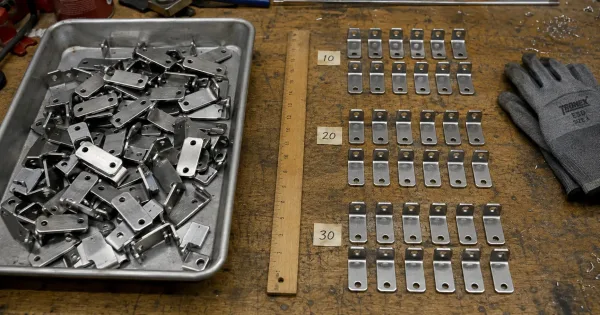
Sheet metal brackets manually sorted into groups of ten, with a physical divider separating counted parts from the uncounted batch.
Accuracy: Near 100% when performed correctly, but error rates climb with operator fatigue. For batches over 200 pieces, consider pairing two operators for independent counts.
Weight-Based Counting for Larger Runs
When batch sizes exceed a few hundred pieces and parts have consistent weight, weighing is faster and often more accurate than manual counting. The method is simple: weigh a sample of 10–20 parts to establish a per-piece weight, then weigh the full batch and divide.
The accuracy of weight-based counting depends on two factors: part weight consistency and scale resolution. Stamped or laser-cut parts from the same sheet typically have weight variations under 1%, making this method highly reliable. However, parts that have been bent or formed may show slightly more weight variation due to material thinning at bend radii.
Practical tip: Always weigh a fresh sample from the current production run. Material thickness tolerances (typically ±0.05 mm for cold-rolled steel per ASTM A568) mean that per-piece weight can vary between batches, even for identical part numbers.
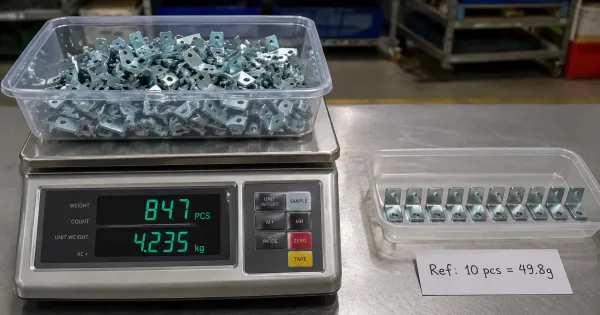
An industrial counting scale weighing a batch of sheet metal parts, with the display showing the calculated piece count based on reference sample weight.
Automated Counting Technologies
For high-volume production (1,000+ pieces), several automated methods are available:
- Vision-based counting. Camera systems mounted above conveyor lines or bin openings count parts as they pass through the field of view. Modern systems handle overlapping parts and variable orientations, though accuracy drops with highly reflective surfaces or tightly nested parts.
- Laser-based stack counting. For sheet stock or stacked flat parts, laser distance sensors measure stack height and divide by the known per-piece thickness. This method is commonly used for incoming raw material verification.
- Counting scales with piece-counting mode. Industrial scales designed for piece counting combine high-precision weighing with statistical sampling routines. The operator weighs a reference sample, and the scale calculates total count from the batch weight.
Automated systems reduce human error but require initial calibration and periodic validation.
A common mistake is trusting automated counts without cross-checking: even a 0.5% error rate on a 5,000-piece order means 25 parts unaccounted for.
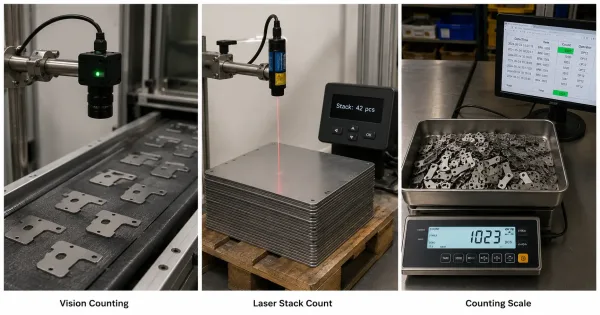
Three automated counting technologies used in sheet metal fabrication: a vision-based camera system, a laser stack height sensor, and a piece-counting industrial scale.
Specifying Quantity Requirements on Drawings and Purchase Orders
The most effective way to prevent quantity disputes is to define measurable manufacturing quality requirements before production begins, including quantity expectations on the purchase order and any related production documentation.
Key elements to specify:
- Order quantity and unit of measure. State the exact number of parts required, and specify whether the count applies to finished, inspected parts or includes test pieces and setup scrap.
- Allowable shortage tolerance. Define an acceptable shortfall—for example, “1,000 pieces ±2%”—to account for normal production losses. Without this, any shortage becomes a dispute.
- Packaging count per container. Specify how many parts go in each box, tray, or pallet. This prevents the supplier from packing “approximately” 50 per box when you need exactly 50 for kitting.
- Count verification method. Define the applicable inspection standards or approved counting method—such as weight-based, manual, or automated verification—on the purchase order when required. Do not assume the supplier will use your preferred method.
- Overage policy. Clarify whether overages are acceptable and, if so, within what percentage. Some buyers welcome a small buffer; others have strict inventory controls that reject any overage.
These specifications do not need to be lengthy.
A single line on a purchase order—“Quantity: 1,000 pcs ±2%, 50 pcs per box, weight-verified”—eliminates the most common sources of disagreement.
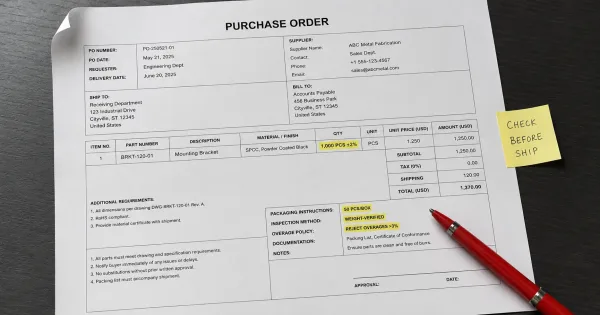
A sample purchase order document with highlighted quantity specifications including tolerance, packaging count, and verification method
Common Count Verification Mistakes and How to Avoid Them
Even experienced fabrication shops make counting errors. Here are the most frequent mistakes and how to prevent them:
Counting only at final shipment. If the first count happens when parts are already boxed, there is no opportunity to correct discrepancies from earlier stages. Build count checkpoints into each production stage, as described above.
Relying on packaging estimates. “About 50 per box” is not a count. If parts are packed by volume rather than by number, the actual count per box can vary by 10% or more, depending on part geometry and how tightly they are stacked.
Ignoring scrap and rework adjustments. Parts rejected during inspection or sent back for rework should be subtracted from the total count. A common oversight is counting all parts that came off the production line without accounting for those that failed quality checks.
Mismatch between BOM and actual count. In assemblies that include multiple sheet metal components, the bill of materials (BOM) specifies the quantity of each part. If the BOM says 4 brackets per assembly but the shop ships 3, the buyer discovers the error only during assembly. Cross-check shipped quantities against the BOM before packaging.
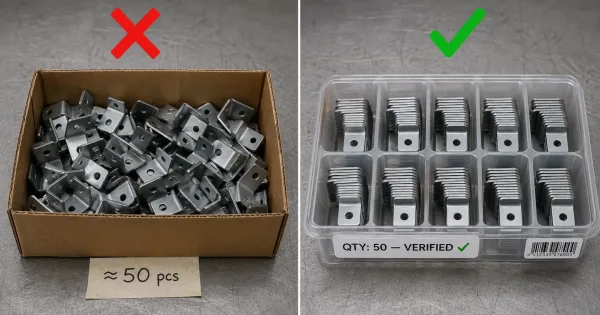
A side-by-side comparison of common counting mistakes: loose parts packed by volume (left) versus properly counted and labeled parts in divided trays (right).
Not counting returned or reworked parts. When parts are returned for rework (e.g., a weld repair or re-bending), they should be counted separately and reconciled against the original shipment. Mixing reworked parts with new production can lead to double-counting or missing parts.
Key Takeaways
- Part count verification is a production-wide process, not a single step at shipping. Build count checkpoints into intake, production, inspection, packaging, and shipment.
- Choose counting methods based on batch size and part characteristics: manual for small lots, weight-based for medium runs, automated for high-volume production.
- Document quantity requirements explicitly on purchase orders, including tolerances, packaging counts, and verification methods.
- The most expensive counting error is the one discovered by your customer. Catching discrepancies early—before parts leave your facility—costs far less than corrective shipments and lost trust.