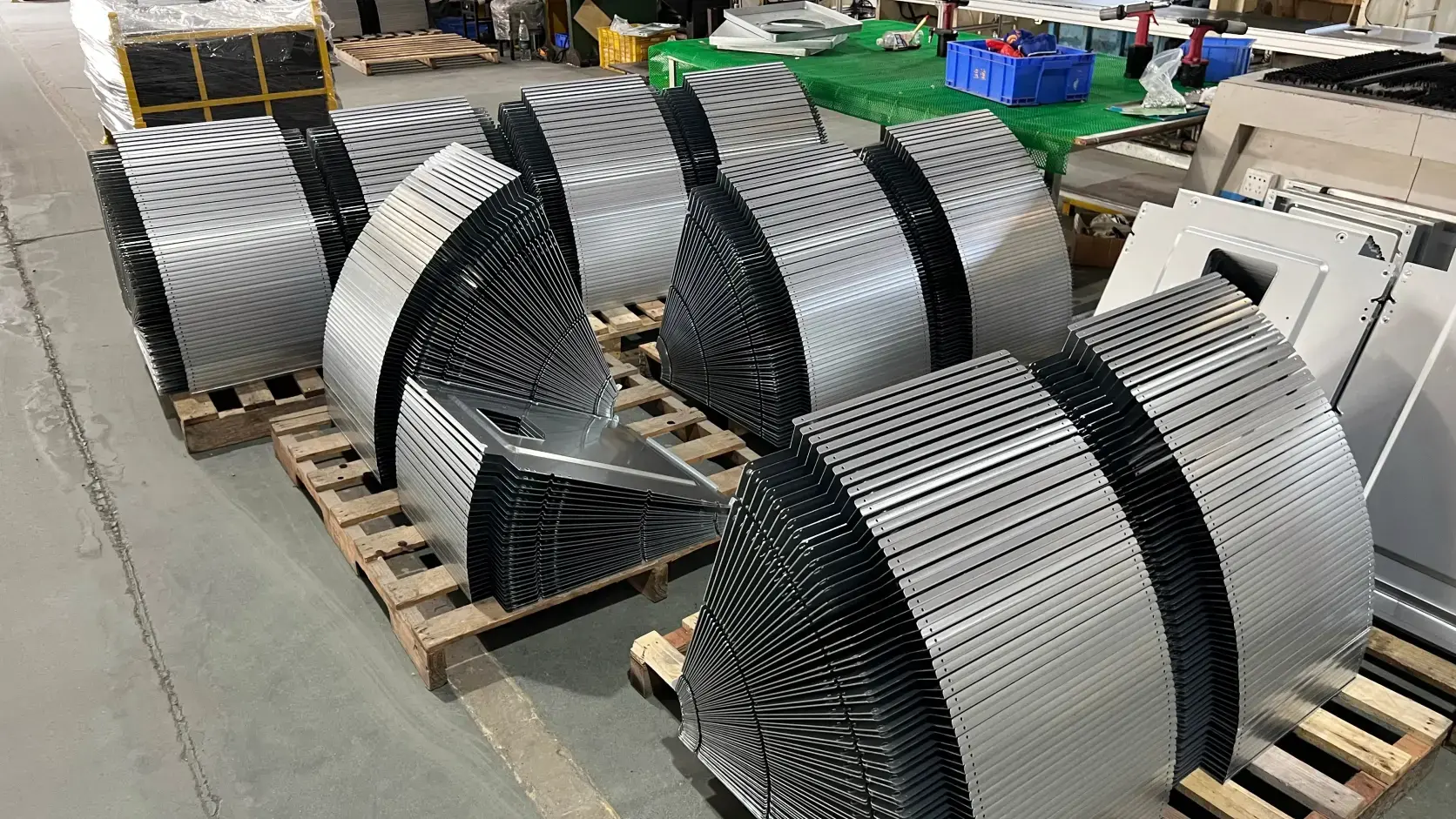

A dimensional check just failed. The inspector marks the lot nonconforming, and the next question is whether the parts can be reworked, must be repaired under a concession, or should be scrapped. In practice those three words get used as if they were interchangeable. They are not — and choosing the wrong one changes cost, lead time, and what your quality records actually claim.
Rework is the disposition that returns a nonconforming part to the original specification. Repair leaves the part usable but not necessarily to print. Scrap ends the part. This glossary entry defines rework, separates it from repair and scrap, and shows how the choice usually plays out on sheet metal parts.
What Rework Means in Manufacturing
In manufacturing quality language, rework is corrective work on a nonconforming item that brings it back into full conformity with the original requirement — the drawing, the specification, or the purchase order callouts. A re-machined bore, a weld ground and re-finished to the stated profile, a re-cleaned surface that now meets the cleanliness requirement: each is rework if the endpoint is the same acceptance criteria that should have been met the first time.
The defining feature is the endpoint, not the amount of labor. After rework, the part is as specified. In compliance terms it is indistinguishable from one that was made correctly on the first pass, which is why rework is usually preferred when it is technically feasible.
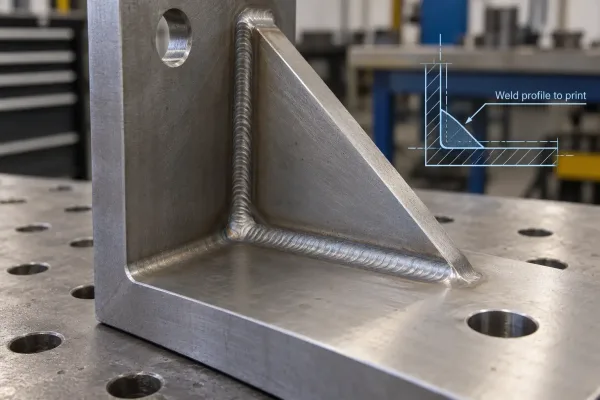
Rework restores a nonconforming feature — here a weld profile — to the original drawing requirement.
Rework is still not free. It consumes machine time, labor, and sometimes material to redo work already paid for, and it occupies capacity that new jobs expected. The part re-enters normal flow; the schedule and the cost sheet absorb the hit.
How Rework Differs from Repair
Repair is work on a nonconforming item that makes it acceptable for its intended use without necessarily restoring full conformity to the original specification. The part becomes fit for purpose — but it may not match the print.
That difference is the whole distinction. Rework ends at full specification. Repair ends at fit for use, often with a documented deviation or concession: a record that the part does not fully meet the drawing and that the buyer (or an authorized authority) accepts it anyway.
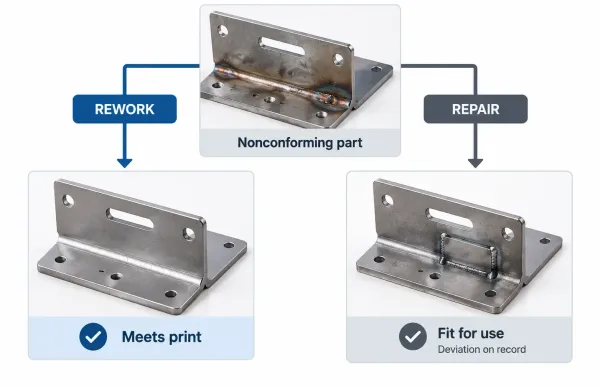
Rework ends at full specification; repair ends at fit for use and may carry a documented deviation.
A simple sheet metal example: a formed bracket has a weld undercut outside the visual class. Grinding and re-finishing the seam until it meets the specified weld profile is rework. Blending the area, applying an approved patch strategy, and shipping it under a written acceptance that the seam is cosmetically relaxed is repair. The bracket may work in both cases. Only the first case claims the original requirement was met.
Mixing the two corrupts quality data. A repaired lot recorded as rework claims conformance it does not have; a reworked lot recorded as repair carries unnecessary concession baggage. Keep the words separate at inspection and on the report.
How Rework Differs from Scrap
Scrap is the disposition that removes the item from the order permanently. The part is discarded or diverted to scrap stock; replacement material and full processing start again on a new blank.
Rework keeps the existing part in the order and spends additional operations to restore it. Scrap abandons the part because recovery is impossible, unsafe, or uneconomic.
The boundary is practical, not emotional. If the base geometry, material condition, or critical surface cannot be brought back to the drawing without creating a new defect, scrap is usually the honest outcome — even when the scrap cost looks high in the moment. Re-working into a worse condition is more expensive than a clean scrap decision taken early.
Three Dispositions at a Glance
The table below summarizes the three dispositions by endpoint and meaning. Use it as a shared vocabulary with suppliers and inspectors, not as a substitute for case-by-case judgment.
| Disposition | Endpoint | What the records claim | Typical trigger |
|---|---|---|---|
| Rework | Part meets the original specification | Fully conforming after additional work | Defect is correctable to print without new risk |
| Repair | Part is acceptable for use; may deviate from print | Fit for purpose under concession or approved deviation | Full rework is impossible or uneconomic, but use is still safe and agreed |
| Scrap | Part leaves the order | No delivery of this unit | Recovery is not feasible, or risk/cost of recovery exceeds remake |
Which Sheet Metal Defects Are Usually Reworkable
Sheet metal work favors rework when the nonconformance is local, surface-level, or dimensional in a feature that still has stock or access to tooling. Common cases that often remain reworkable include:
- Weld appearance or profile that can be dressed and re-inspected to the stated class
- Local surface marks on non-cosmetic faces that can be blended or re-finished within drawing limits
- Hole position or size errors that can be plugged and re-machined or re-punched where design allows
- Slight bend-angle correction where springback left the part short of angle and material condition still allows re-hit
- Coating touch-up or localized re-coat where film build and color match stay inside the specification
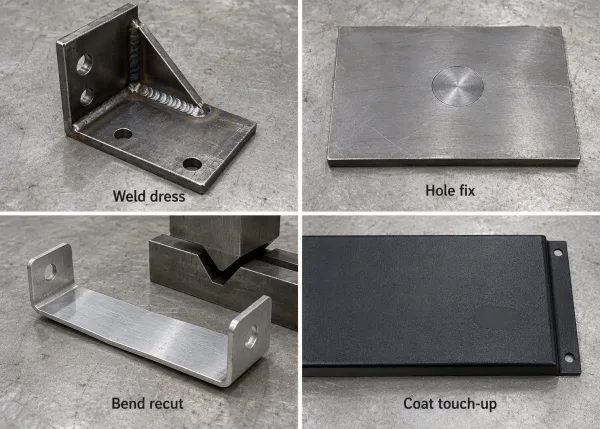
Local weld, hole, bend-angle, and coating defects are common rework candidates when the part can still return to print.
Many defects are poor rework candidates. Thin sheet that has already cracked at a bend, critical hole patterns where a plug would violate strength or appearance zones, coating thickness that has already consumed the tolerance band, or base material damage under protective film on a cosmetic face all tend to push the decision toward repair or scrap. The question is never “can someone try to fix it?” — it is “can this part still meet the print after the fix?”
Material and thickness matter. Aluminum alloys in the T6 condition tolerate limited re-bending before cracking; stainless work-hardens and may need intermediate annealing that the print may not allow. A 0.8 mm cover panel will not behave like a 2 mm structural bracket when you attempt a second hit on the press brake.
When Rework Becomes Repair or Scrap
Use a short decision order after the nonconformance is understood.
- Feasibility first. Can the feature return to the original specification without damaging another requirement (thickness, flatness, finish, corrosion protection)? If yes, rework is the clean path.
- Then economics and risk. If full rework is possible but costs more than remake, scrap may still win. If rework risks warping, burning through, or staining an appearance surface, stop and reassess.
- Only then consider repair. If the part is functionally acceptable and the deviation can be described and agreed, repair under concession is valid — but it is a different claim than rework, and it needs the right paperwork.
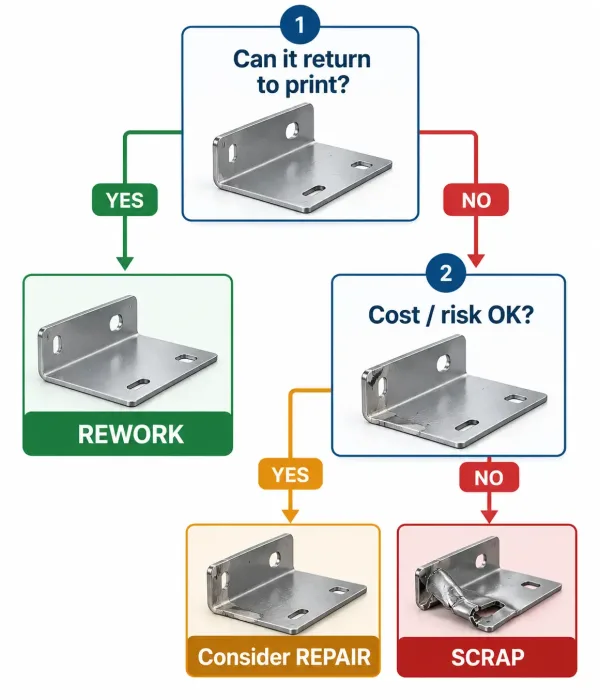
Disposition order: confirm feasibility to print first, then weigh cost and risk, then consider repair under concession.
Prefer rework when it is feasible and sensible, because the result is a genuinely conforming part. Reach for repair when rework would do more harm than the original deviation, and when fitness for use can be documented. Scrap when neither path is safe or economic. That order keeps small quality problems from becoming larger commercial ones.
What Buyers Should Clarify Before Rework Happens
Most rework disputes start as communication gaps, not as manufacturing gaps. A few points settled at RFQ or PO stage remove most of the back-and-forth later.
On drawings and in the RFQ, state which nonconformances may be reworked without prior written approval, and which always require buyer agreement (cosmetic Class A faces, structural welds, sealing surfaces). Separate appearance zones from structural zones where the part has both. If repair is ever acceptable, say so explicitly and name the approval path.
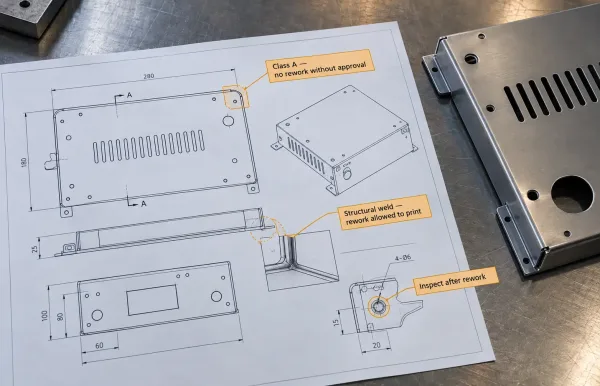
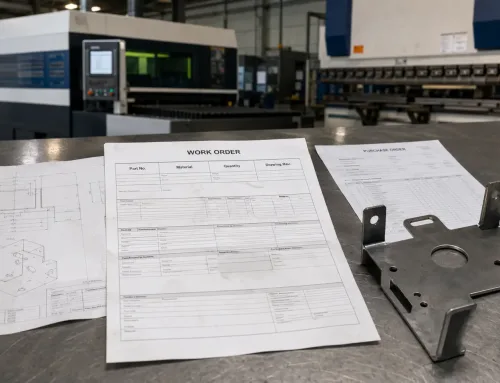
Drawings and RFQs should state which nonconformances may be reworked without prior approval and which require buyer agreement.
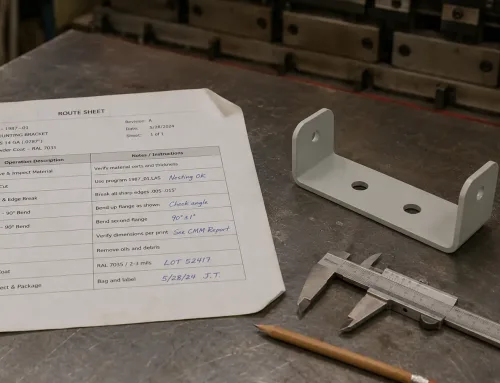
At inspection and delivery, agree who initiates rework, how cost responsibility is assigned when the supplier caused the defect, and whether reworked parts need supplemental inspection or a clear notation on the inspection report. You do not need a full nonconformance report (NCR) system to do this — a short paragraph in the quality requirements is often enough for production parts.
Clear wording converts “we’ll fix it” into an executable instruction. Ambiguous wording turns every lot into a negotiation.
Key Takeaways
Rework restores a nonconforming part to the original specification; repair makes it usable without necessarily meeting the print; scrap ends the part. On sheet metal, rework works best when the defect is local and the feature can return to drawing without new risk to thickness, finish, or geometry. Choose in that order — feasibility, then cost and risk, then concession — and write the allowed paths into the RFQ so the shop floor is not guessing what “good” means after the fact.
FAQs