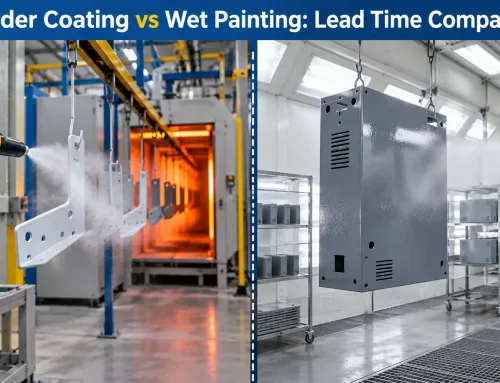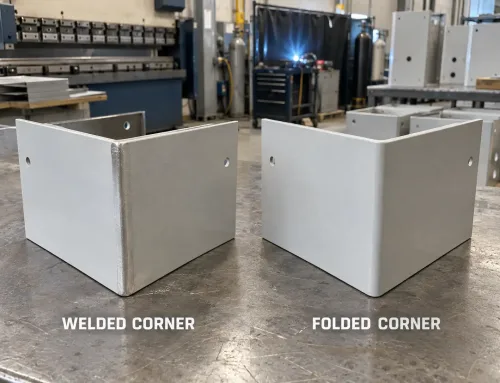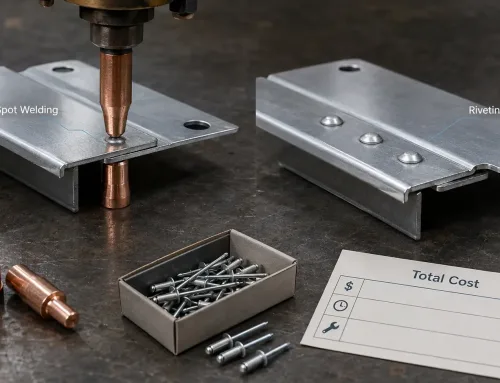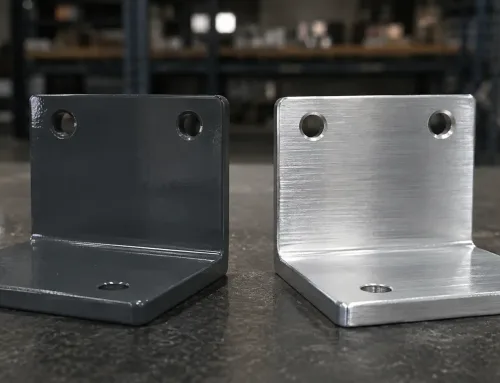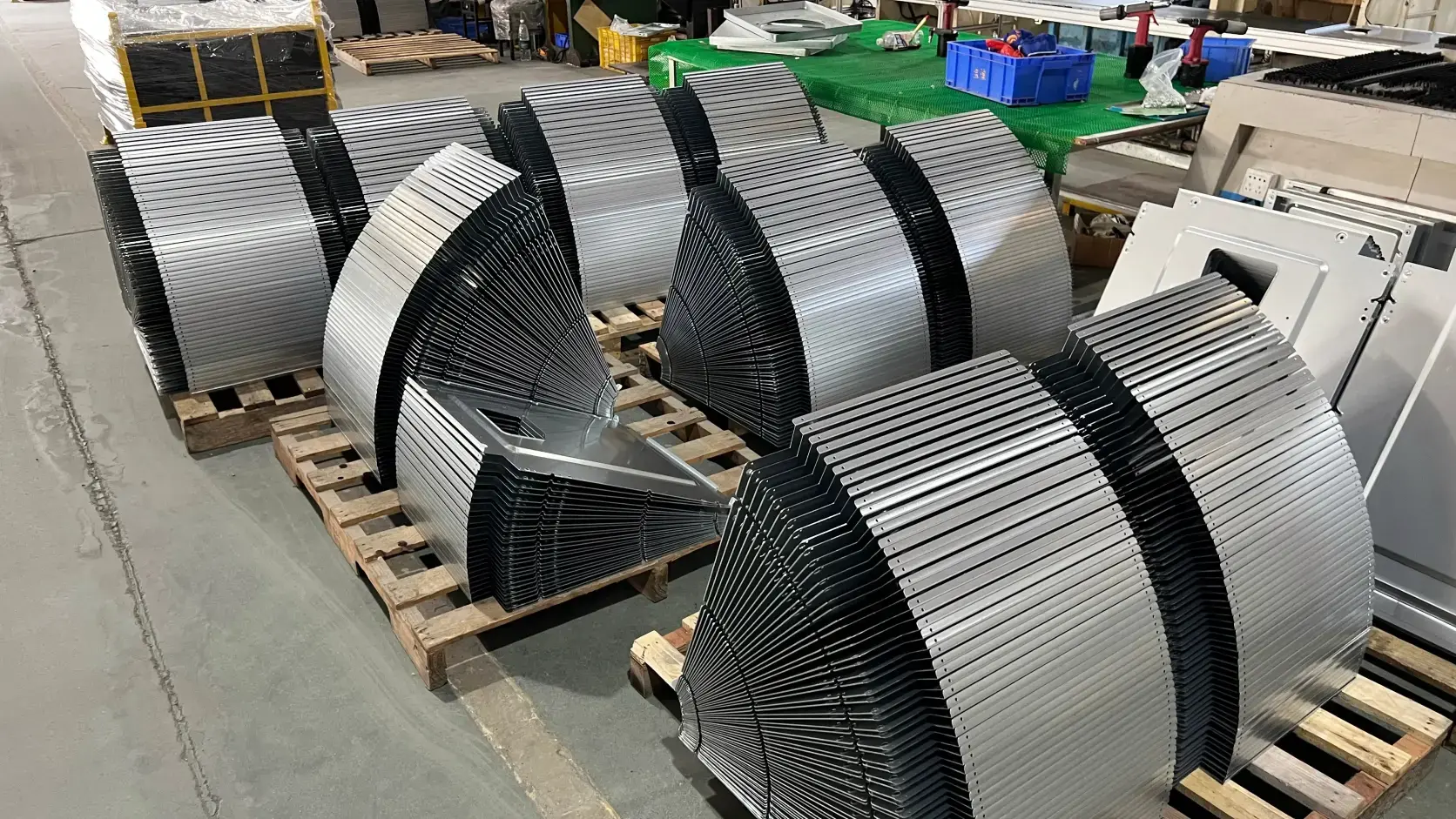

In custom sheet metal fabrication projects involving aluminum or stainless steel, these two materials are among the most commonly used options. Aluminum is lightweight, offers better thermal and electrical conductivity, and has good formability. Stainless steel, on the other hand, provides higher strength, better corrosion resistance, and stronger heat resistance.
The right choice depends on the application, working environment, structural requirements, and budget.
Aluminum vs. Stainless Steel Comparison
| Comparison Factor | Aluminum 5052-H32 | Stainless Steel 304 |
|---|---|---|
| Density | ~2.7 g/cm³ | ~8.0 g/cm³ |
| Weight at the Same Size | Baseline | About 3 times heavier |
| Strength | Medium | Higher |
| Strength-to-Weight Ratio | Excellent | Lower |
| Corrosion Resistance | Good, with a natural oxide layer | Excellent, with a chromium oxide layer |
| Chloride / Marine Resistance | Requires anodizing or protective coating | Good for 304; excellent for 316 |
| Thermal / Electrical Conductivity | High | Low |
| Welding Difficulty | More difficult; usually requires AC TIG or pulsed MIG | Easier; DC TIG or MIG is commonly used |
| Bending Formability | Good for 5052; poor for 6061 | Good, but requires higher tonnage and has more springback |
| Surface Finishing | Anodizing, powder coating | Passivation, electropolishing, brushing |
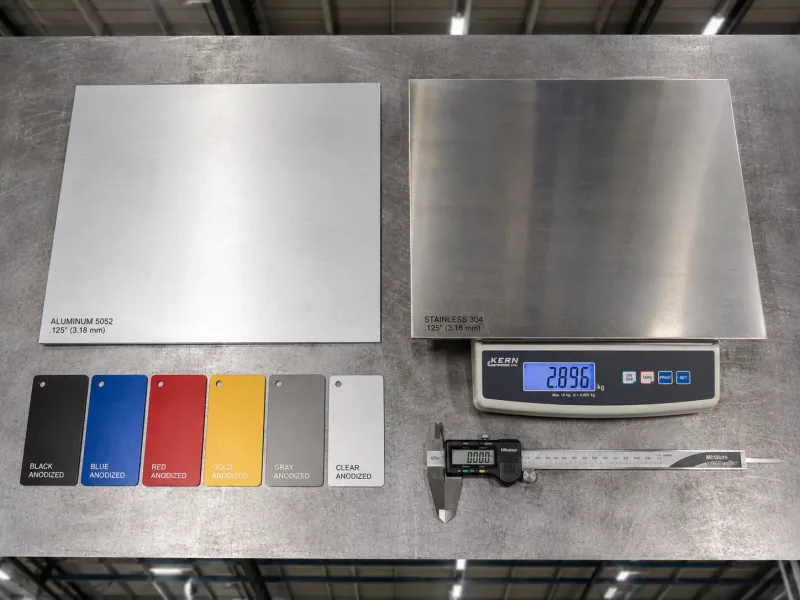
Two identical-size sheet metal panels — aluminum 5052 and stainless steel 304 — placed on a bench scale to illustrate the approximately three-to-one weight difference between the two materials.
When Should You Choose Aluminum?
Aluminum is often used for covers, housings, panels, and lightweight structural parts. Because it is much lighter than stainless steel, it is easier to handle, machine, and assemble. For wall-mounted or portable products, aluminum can reduce the load on the overall structure.
5052 aluminum for sheet metal parts is one of the most common choices when the design requires good formability and stable bending performance. 6061 aluminum in sheet metal bending is more often seen in parts that also require machining, but it needs to be handled carefully during forming. When the bend radius is small or the structure is complex, 6061 is more likely to crack.
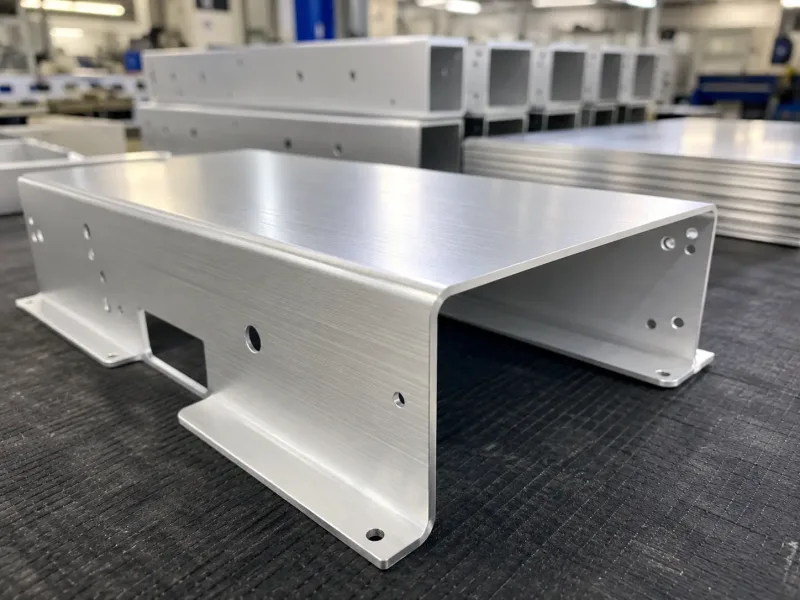
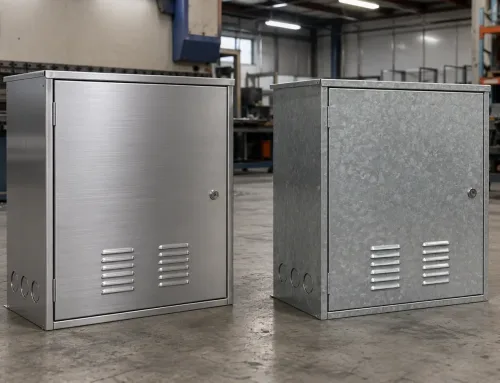
A precision-bent 5052 aluminum sheet metal enclosure demonstrating good formability, clean edge quality, and a durable anodized surface finish.
Aluminum is also a good option for products that require aluminum anodizing or powder coating. Anodizing preserves the metallic appearance of the material, while powder coating is suitable for parts that require color, protection, or a more finished exterior surface. However, aluminum surfaces are more prone to scratches, so extra care is needed during handling, packaging, and transportation.
For large sheet metal panels, stiffness should be reviewed carefully. Large aluminum parts may show slight deformation, especially if the structure is too flat. This can usually be improved through flanges, bends, ribs, or reinforcement features. At SR MFG, we evaluate these risks before prototyping to help avoid rework later in the project.
When Should You Choose Stainless Steel?
Stainless steel sheet metal parts are suitable for humid, corrosive, high-temperature, or more demanding environments. It is widely used in food processing equipment, medical devices, laboratory equipment, marine applications, and industrial protection systems.
304 stainless steel for general industrial environments is one of the most commonly used grades for standard industrial sheet metal parts. 316 stainless steel is more suitable for coastal areas, chemical cleaning environments, and applications exposed to higher chloride levels.
Many buyers assume that “stainless steel will never rust,” but that is not completely accurate. Salt, acids, alkalis, temperature, welding quality, and surface contamination can all affect the corrosion resistance of stainless steel.
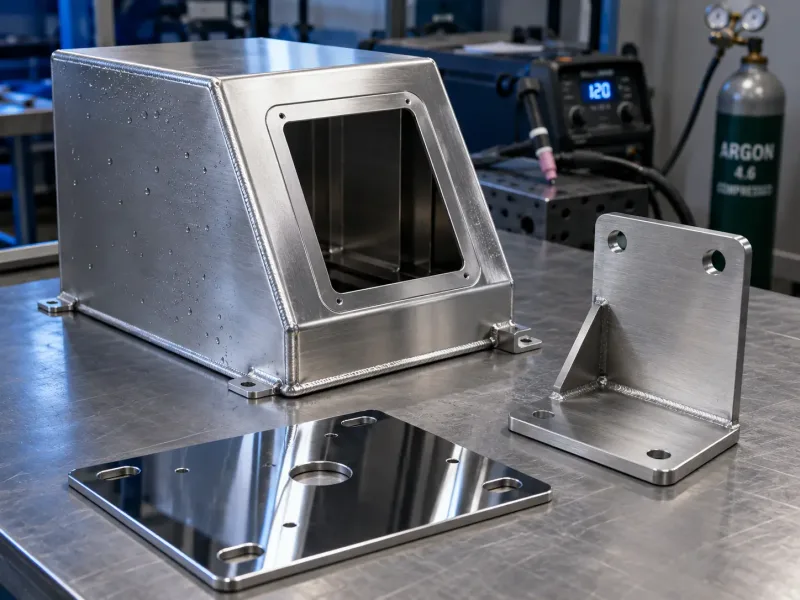
Various 304 stainless steel sheet metal parts with different surface finishes, suitable for food processing, marine, and industrial structural applications.
Stainless steel offers better strength and surface durability, making it a strong choice for brackets, structural plates, and load-bearing parts. The trade-off is that it is more difficult to process. Bending requires higher forming force, springback is more obvious, and process compensation must be considered in advance.
How Material Choice Affects Sheet Metal Manufacturing
Laser cutting:
Both aluminum and stainless steel can be laser cutting aluminum and stainless steel. Aluminum requires more careful parameter adjustment because of its high reflectivity and thermal conductivity. Stainless steel may have a larger heat-affected area and may require additional post-processing depending on the part requirements.
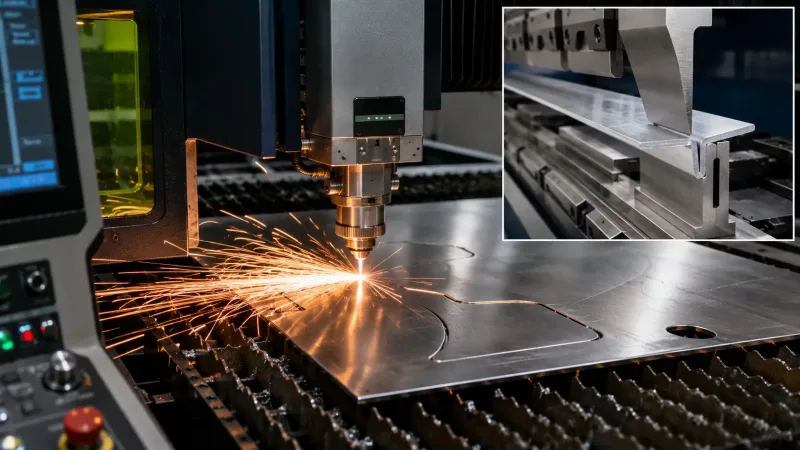
A fiber laser cutter actively cutting a stainless steel sheet, illustrating the precision cutting process used in sheet metal fabrication for both aluminum and stainless steel.
Bending:
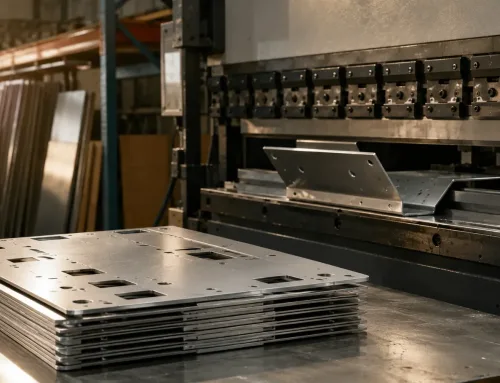
5052 aluminum has lower bending tonnage requirements and better process tolerance. 6061 aluminum is more likely to crack during bending. Stainless steel requires higher tonnage, has greater springback, and often needs sheet metal bending compensation to keep the final angle and dimensions under control. Stainless steel also work-hardens more easily, so repeated bending in the same area can increase the risk of cracking.
Welding:
Aluminum and stainless steel welding process control requires different levels of skill and preparation. The oxide layer must be fully cleaned before aluminum welding, and filler wire selection has a direct impact on weld quality. Stainless steel welding is generally more stable, but thin stainless sheets can deform under heat. Aluminum and stainless steel cannot be directly welded together in standard sheet metal fabrication. Mechanical fastening with insulation or separation is usually required.
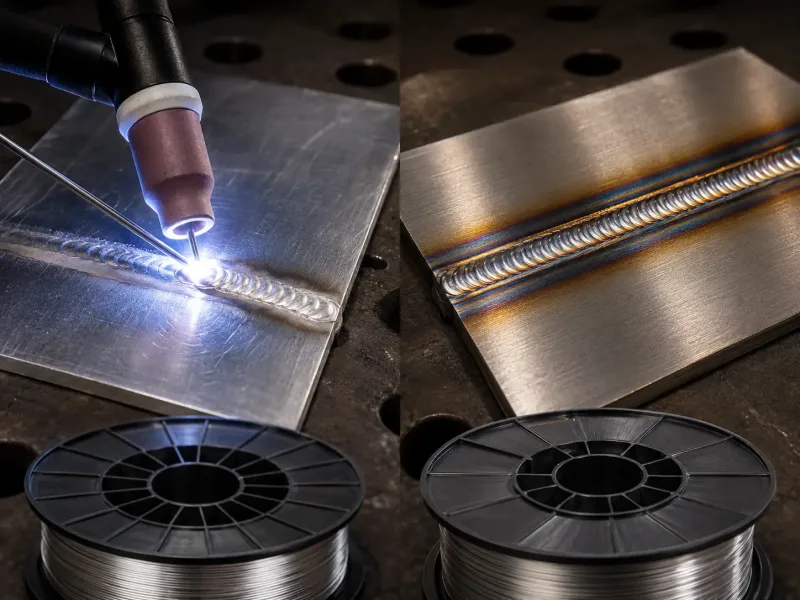
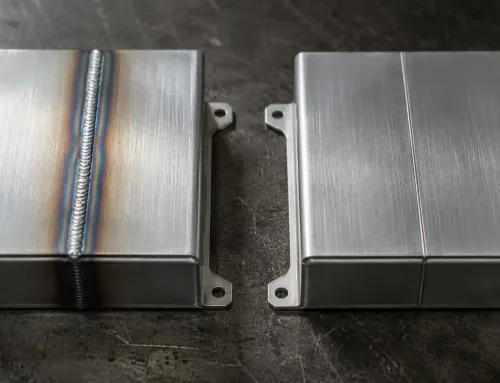
A visual comparison of TIG weld beads on aluminum and stainless steel sheet metal, highlighting the differences in weld appearance, heat-affected zone, and filler wire selection.
Assembly:
Aluminum is easier to tap, but the thread strength is lower. Press-fit nuts and threaded inserts for sheet metal are often recommended. Stainless steel requires higher tapping torque and causes faster tool wear, but the finished threads are stronger.
Common Surface Finishes for Aluminum and Stainless Steel
| Material | Common Surface Finishes |
|---|---|
| Aluminum Alloy | Anodizing, powder coating, brushing, sandblasting, conductive oxidation |
| Stainless Steel | Passivation, electropolishing, brushing, sandblasting |
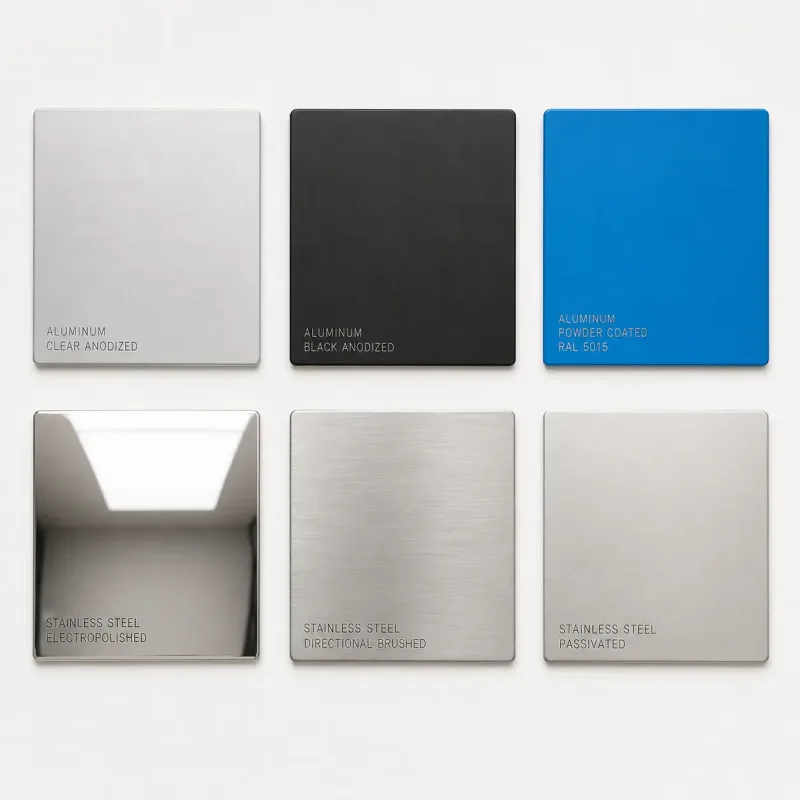
A display of common surface finish options for aluminum and stainless steel sheet metal parts, including anodizing, powder coating, electropolishing, brushing, and passivation.
For aluminum, aluminum anodizing can provide color options and improve surface hardness. Powder coating for sheet metal parts offers rich color choices and good corrosion protection.
For stainless steel, stainless steel passivation helps restore and strengthen the passive layer after fabrication. Electropolishing creates a bright, clean, high-grade surface, which is often used in food and medical applications. Brushing gives stainless steel a decorative satin finish.
Surface finishing is often one of the key factors in material selection. If the product requires colored anodizing, aluminum is usually the right choice. If the product requires a mirror finish or electropolishing, stainless steel is usually more suitable. Both materials can be powder coated, but the pretreatment process is different.
Material Selection by Application
| Application | Recommended Material | Key Advantages |
|---|---|---|
| Indoor electrical enclosure | 5052 aluminum | Lightweight, suitable for anodizing |
| Outdoor communication cabinet | 5052 aluminum or 304 stainless steel | Depends on weight, budget, and corrosion level |
| Food processing equipment | 304 or 316 stainless steel | Hygienic, easy to clean, food-grade applications |
| Marine / coastal parts | 316L stainless steel | Strong chloride corrosion resistance |
| Heat dissipation / thermal management panel | 6061 aluminum | Excellent thermal conductivity |
| Lightweight brackets / internal structural parts | 5052 aluminum | Good strength-to-weight ratio |
| Chemical equipment | 316 stainless steel | Better resistance to acids and alkalis |
| High-temperature equipment housing | 304 / 316 stainless steel | Maintains strength at higher temperatures |
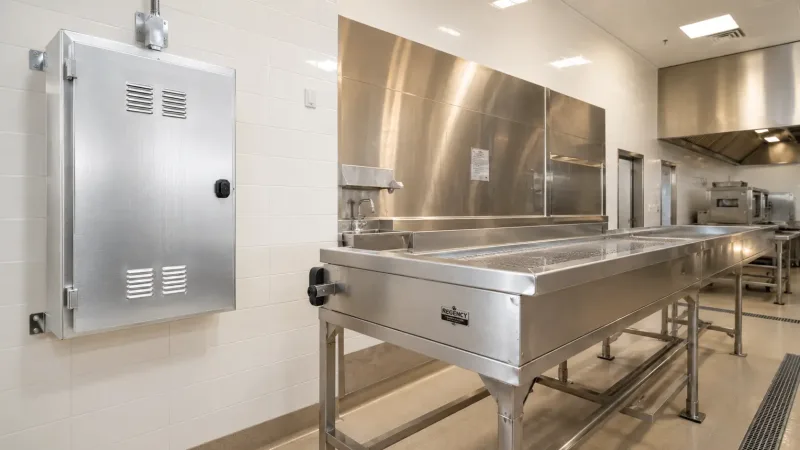
Real-world application of stainless steel and aluminum sheet metal in a food processing environment — stainless steel for hygienic work surfaces and aluminum for lightweight electrical enclosures.
Aluminum vs. Stainless Steel Material Selection Guide
In sheet metal material selection, aluminum and stainless steel do not have absolute advantages or disadvantages. The most important question is what problem the part needs to solve. Choosing a material based only on raw material price can create more problems during manufacturing, assembly, or long-term use. In material grade selection in sheet metal fabrication, the grade, temper, surface finish, working environment, and forming method all need to be reviewed together.
The table below summarizes some of our practical material selection experience at SR MFG.
| Requirement | Recommended Material | Notes |
|---|---|---|
| Lightweight design | 5052 aluminum, 6061 aluminum | 5052 is better for bending; 6061 is better for machining. Complex bends need crack-risk evaluation. |
| Higher strength | 304 stainless steel, 316 stainless steel | Requires higher bending tonnage and has greater springback. Process compensation should be planned early. |
| Heat dissipation / thermal conductivity | 5052 aluminum, 6061 aluminum, 1060 aluminum, 3003 aluminum | Grade selection depends on bending, machining, and anodizing requirements. |
| Food equipment | 304 stainless steel, 316 stainless steel | Weld treatment, passivation, surface roughness, and cleanability should be considered. |
| Outdoor use | Powder-coated 5052 aluminum, 304 stainless steel, 316 stainless steel | 304 or powder-coated aluminum may work for standard outdoor use. For coastal or salt-spray environments, 316 / 316L should be evaluated. |
| Colored appearance | Anodized aluminum, powder-coated aluminum, powder-coated steel | Colored anodizing is usually done on aluminum. Powder coating requires proper pretreatment. |
| Mirror finish or high-cleanliness surface | 304 / 316 stainless steel | Brushing, electropolishing, or mirror polishing can be selected. |
| Low-cost housing | 5052 aluminum, powder-coated cold-rolled steel, powder-coated galvanized steel | When choosing only between aluminum and stainless steel, aluminum often has advantages in weight and processing efficiency. |
| Heavy-duty bracket | 304 stainless steel, 316 stainless steel, powder-coated carbon steel | Aluminum can be used for light-duty structures, but strength and stiffness must be recalculated for heavy loads. |
| Chloride corrosion resistance | 316 / 316L stainless steel | 304 is not recommended for long-term use in high-chloride, marine, or harsh cleaning environments. |
| Frequent disassembly | Stainless steel, or aluminum with press-fit hardware | Aluminum base threads are weaker, so press-fit nuts or rivet nuts are recommended. |
| Large appearance panels | 5052 aluminum, 304 stainless steel | Aluminum panels need flatness and deformation control. Stainless steel panels need weight and scratch-control evaluation. |
In simple terms, choose aluminum when the product needs to be lightweight. Choose stainless steel when the product needs higher strength, better durability, or stronger corrosion resistance.
Why Material Cost Is Not the Same as Part Cost
Many customers ask us the same question: “Is this part cheaper in aluminum or stainless steel?”
For a simple answer, we could say which raw material is cheaper. But as a manufacturer, we need to look at the complete cost of the finished part, not just the material price.
We need to consider questions such as:
- Is aluminum or stainless steel actually suitable for this part?
- Will the cost difference make a major impact on the final product?
- Is the required surface finish suitable for the chosen material?
- Will the defect rate or scrap rate be high?
- Will the part require extra packaging, hardware, or post-processing?
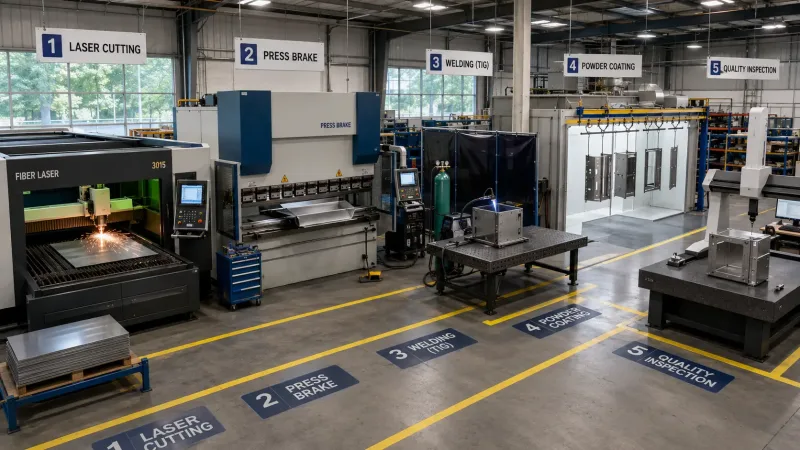
A panoramic view of a sheet metal fabrication facility showing the full manufacturing workflow, illustrating why the total cost of a finished part involves far more than just raw material price.
| Cost Factor | Impact on Quotation |
|---|---|
| Material Cost | Grade, thickness, sheet size, purchase quantity, and market price all affect material cost. |
| Cutting Efficiency | Material thickness, cutting length, hole quantity, and profile complexity affect processing time. |
| Bending Difficulty | Number of bends, bend length, angle tolerance, and springback compensation affect labor time. |
| Welding Time | Weld length, welding method, grinding requirements, and deformation control affect cost. |
| Surface Finishing | Anodizing, powder coating, brushing, passivation, and electropolishing vary greatly in cost. |
| Yield Loss | Appearance parts, thin sheet parts, and complex bent parts are more likely to require rework or scrapping. |
| Assembly Hardware | Press-fit nuts, rivet nuts, studs, screws, and washers all add cost. |
| Packaging Cost | Aluminum parts, brushed parts, and mirror-finished parts require stronger scratch-protection packaging. |
| Shipping Cost | Aluminum is lighter and has advantages in bulk shipping. Stainless steel is heavier and increases handling and transportation cost. |
For example, the unit price of an aluminum enclosure is not always lower than that of stainless steel. However, aluminum may still provide better overall cost efficiency because of its lighter weight, faster processing, and lower shipping cost.
Stainless steel usually costs more to process, but in corrosion-resistant applications, it may be the more cost-effective choice over the full product life cycle.
That is why material selection should always be evaluated as part of the full manufacturing process.
Can Aluminum and Stainless Steel Parts Be Assembled Together?
Yes. Aluminum and stainless steel parts can be assembled together, and this is common in many projects.
Typical examples include:
- Aluminum housings with stainless steel screws
- Stainless steel brackets with aluminum panels
- Aluminum frames combined with stainless steel connection plates
However, in humid, outdoor, coastal, or electrolyte-rich environments, direct long-term contact between aluminum and stainless steel may cause galvanic corrosion.
This can be solved through proper isolation and design.
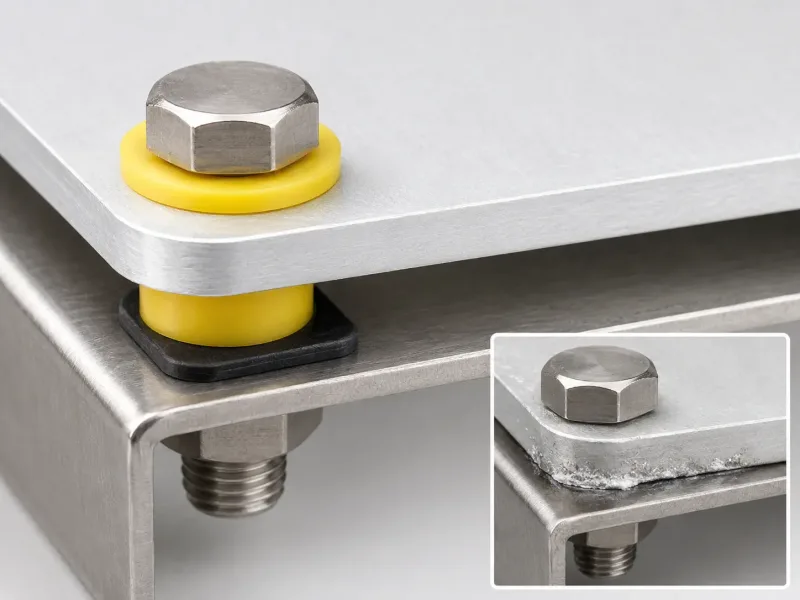
A detailed view of dissimilar metal assembly using nylon washers and rubber gaskets to isolate aluminum from stainless steel, preventing galvanic corrosion in sheet metal fabrication.
| Assembly Condition | Recommended Practice |
|---|---|
| Aluminum part with stainless steel screws | Use nylon washers, plastic sleeves, insulating washers, or coating isolation. |
| Direct contact between aluminum and stainless steel plates | Add rubber pads, coatings, sealant, or plastic isolation sheets. |
| Outdoor equipment assembly | Design for drainage and avoid long-term water accumulation. |
| Coastal or salt-spray environment | Reduce exposed direct contact between aluminum and stainless steel. Use more corrosion-resistant materials and isolation structures when needed. |
| Food equipment assembly | Control corrosion risk while also avoiding cleaning dead corners. |
| Long-term vibration environment | Insulating washers and fasteners must be checked for loosening risk. Anti-loosening structures may be needed. |
Practical Example: Weight Difference at the Same Size
To better understand the difference between aluminum and stainless steel, we can make a simple weight estimate.
Assume a sheet metal enclosure has a flat pattern size of 1000 mm × 500 mm and a thickness of 2.0 mm.
Volume:
1000 mm × 500 mm × 2.0 mm = 1,000,000 mm³
Converted to cubic centimeters:
1,000,000 mm³ = 1000 cm³
Using common density values:
| Material | Density Reference | Estimated Weight |
|---|---|---|
| Aluminum | ~2.7 g/cm³ | ~2.7 kg |
| Stainless Steel | ~8.0 g/cm³ | ~8.0 kg |
From this example, stainless steel is about three times heavier than aluminum at the same size and thickness. For projects where shipping cost, handling, or installation weight matters, aluminum can offer a clear advantage.
However, weight should not be the only selection factor. If the part will be used in a humid, corrosive, or high-strength application, stainless steel may still be the better choice.
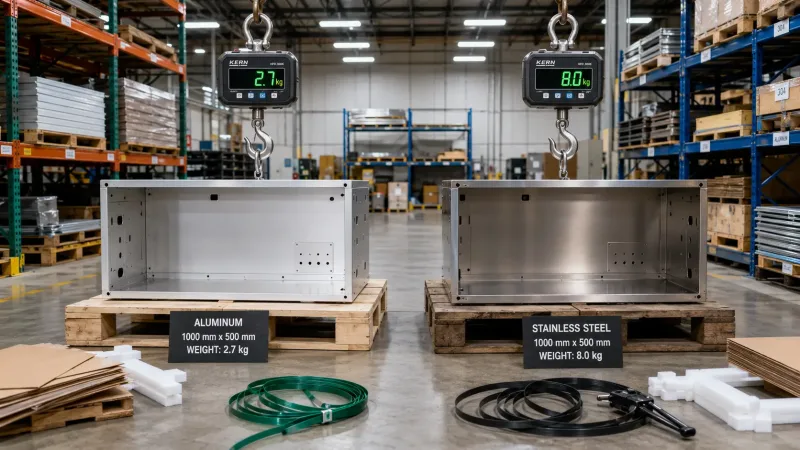
A practical demonstration of the weight difference between aluminum and stainless steel sheet metal enclosures of the same dimensions — aluminum at approximately 2.7 kg versus stainless steel at approximately 8.0 kg.
Case 1: Standard Outdoor Equipment Housing
For outdoor control box enclosures used in a normal outdoor environment, if the customer cares more about weight, appearance, and cost, 5052 aluminum with powder coating can be considered first. This option can usually balance lightweight design, exterior appearance, and corrosion protection.
If the equipment will be exposed to salt spray or a coastal environment for a long time, 316 or 316L stainless steel for salt-spray environments is usually the safer choice.
Case 2: Food Processing Equipment Parts
For food processing equipment that requires frequent cleaning, 304 stainless steel is suitable for most standard structural parts.
If the equipment is exposed to stronger cleaning chemicals, salt, acidic ingredients, or harsher sanitation conditions, 316 stainless steel should be evaluated.
Case 3: Changing from 304 Stainless Steel to Aluminum
Some customers want to replace 304 stainless steel custom sheet metal enclosures with aluminum to reduce weight. This direction can work, but the structure must be reviewed carefully.
Large aluminum panels may show slight deformation. This can be improved through flanges, ribs, reinforcement features, or increased thickness. However, even after these design changes, aluminum may still not provide the same strength and rigidity as stainless steel.
If the part needs high strength, strong impact resistance, or long-term structural stability, changing to aluminum may not be recommended.