
Ordering checker plate looks like one of the easier procurement tasks in a fabrication project: pick a material, choose a thickness, and the supplier quotes a delivery date. In practice, the lead time for checker plate — also called tread plate or diamond plate — is far less predictable than for standard flat sheet, and the gap between a stock delivery and a custom fabrication run can be several weeks.
This guide explains why availability varies so much, where the time goes once the plate reaches a fabrication shop, and what buyers can do to keep delivery dates realistic.
Why Checker Plate Availability Is Harder to Predict Than Flat Sheet
Checker plate is not manufactured like ordinary sheet metal. Instead of being rolled as plain flat stock and processed later, the raised pattern — typically diamonds, teardrops, or lentil shapes — is pressed into the surface during hot rolling by a dedicated patterned roll. That single difference shapes the entire supply picture.
Flat sheet is a commodity: any distributor can source it in days. Checker plate, by contrast, is produced by steel mills in specific pattern configurations, and those mills decide which patterns, thicknesses, and grades they roll in a given period. Availability at the distributor level therefore depends on what the mills have recently produced, not on what your project needs.
Stocked Sheets vs. Mill Orders: Two Different Supply Paths
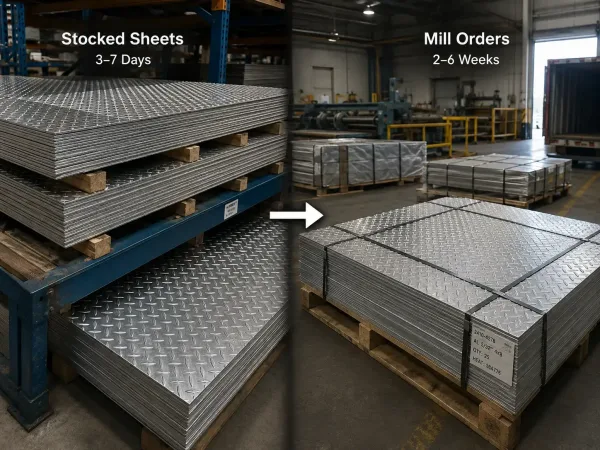
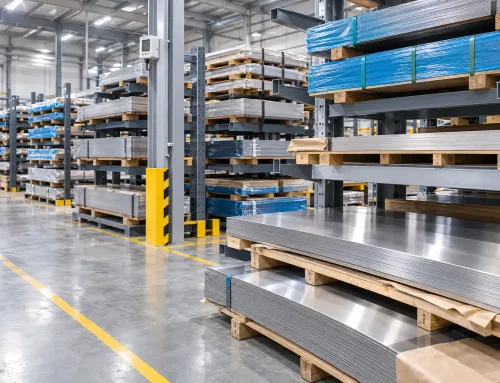
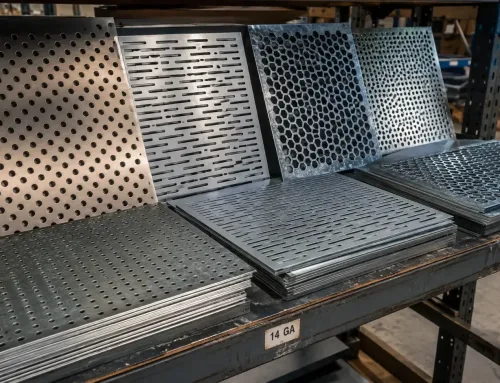
This image compares stocked checker plate sheets with mill-order material to show the difference in sourcing paths and lead times.
The first question to ask any supplier is about material availability — whether the material you need is sitting in a warehouse or has to be ordered from the mill.
Stocked sheets are the common sizes and grades that distributors keep on hand — typically carbon steel (A36 or S235JR) and aluminum 5754 in standard sheet dimensions such as 4 ft × 8 ft (1219 mm × 2438 mm) or 2500 mm × 1250 mm. When your requirements match stocked material, delivery can be as fast as 3 to 7 business days, because the fabricator can cut and process immediately.
Mill orders are required for non-stocked grades, thicknesses, or pattern styles. Mills run checker plate in production campaigns, so a mill order waits for the next campaign slot. Depending on the mill and the destination, this adds 2 to 6 weeks before the material even arrives at the fabricator. Some aluminum alloys, for example 5083 or 5086 tread plate, are rolled to order and commonly quoted at 5 to 8 weeks ex-mill.
Pattern and Roll Availability: Why Some Styles Are Harder to Source
The pattern itself is also a supply variable. A rolling mill configures its roll stands for a specific pattern — one-bar, two-bar, five-bar, teardrop — and switching patterns means changing rolls, which is expensive and time-consuming. Mills therefore concentrate production on a small set of standard patterns.
In practice, this means the five-bar diamond pattern in carbon steel and aluminum 5754 is almost always available, because it accounts for the bulk of global demand. Less common patterns, or the same pattern in an unusual width, may only be rolled a few times a year. If your design does not depend on a specific pattern style, confirming which patterns your fabricator can source from stock can save weeks.
Material Availability: Carbon Steel, Stainless, and Aluminum Compared
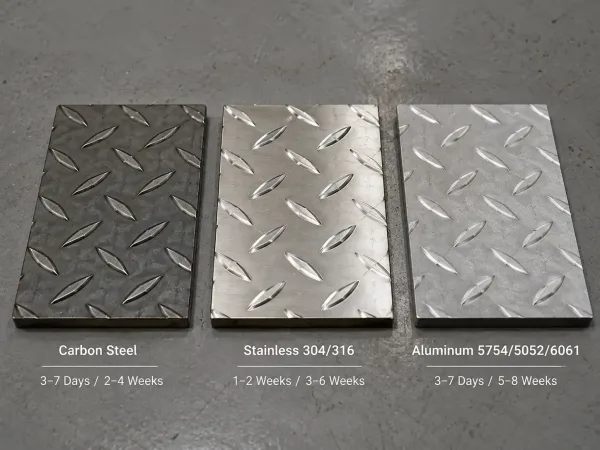
Carbon steel, stainless steel, and aluminum checker plate samples are compared to show typical availability and lead-time differences.
Material choice is usually driven by strength, corrosion resistance, or weight — but it also determines how quickly the plate can be sourced. The table below summarizes typical availability across the three main checker plate materials.
| Material | Typical Grades | Stock Availability | Typical Lead Time |
|---|---|---|---|
| Carbon steel | A36, S235JR, SS400 | High — the most widely stocked checker plate material | 3–7 days (stock); 2–4 weeks (mill) |
| Stainless steel | 304, 316 | Moderate — 304 common; 316 and No.4/mirror finishes less so | 1–2 weeks (stock); 3–6 weeks (mill) |
| Aluminum | 5754, 6061, 5052 | Moderate — 5754 five-bar common; 5083/5086 rolled to order | 3–7 days (stock); 5–8 weeks (mill) |
Carbon steel is the default choice for flooring, ramps, and platforms, and it is the material distributors stock most aggressively. If the project can tolerate a protective coating for corrosion resistance, carbon steel usually offers the shortest sourcing path.
Stainless steel is common in food, pharmaceutical, and marine environments. Grade 304 is widely available in standard thicknesses; grade 316 is less frequently stocked and may add a week or more to procurement. Finished surfaces such as No.4 or mirror also narrow the pool of available stock.
Aluminum checker plate is popular where weight matters — vehicle flooring, trailers, and lightweight platforms. The 5754 five-bar pattern is a stock item at many distributors, while harder alloys and thicker plates (above 6 mm base) are often made to order.
Where the Time Goes: Fabrication Steps That Add to Your Lead Time
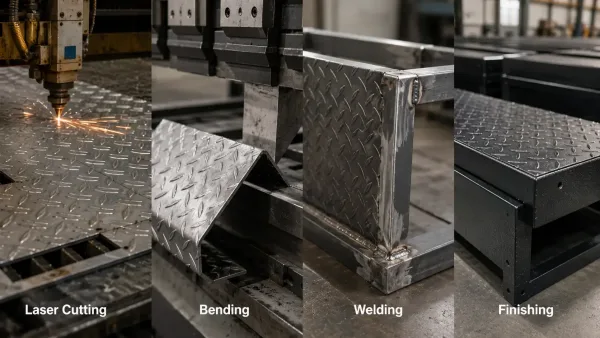
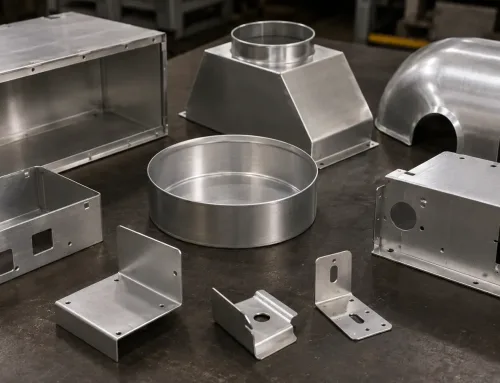
The main fabrication steps for checker plate parts are shown to explain where production lead time is added.
Sourcing the plate is only half the story. For fabricated parts — cut, bent, welded, and finished — the sheet metal production workflow itself adds time, and checker plate behaves differently from flat sheet at almost every step.
Laser Cutting Textured Plate
The raised pattern complicates the laser cutting of textured plate in ways that flat sheet does not. The pattern creates an uneven surface on the machine bed, and the focal distance of the laser shifts as the beam crosses the raised lugs.Operators compensate by adjusting focus settings and, in some cases, reducing cutting speed to maintain edge quality.
This matters most for intricate profiles or tight tolerances. Rectangular blanks cut quickly; complex contours through 8 mm or 10 mm patterned plate take noticeably longer. A fabricator experienced with textured plate will quote this realistically; an inexperienced shop may underestimate the time and miss the delivery date.
Bending and Forming Around the Pattern
Checker plate is often bent into ramps, steps, and trays, and the pattern side must face outward for these applications. Bending over the raised lugs concentrates stress at the pattern, so the minimum bend radius is larger than for flat sheet of the same thickness, and the final bend quality depends on the lugs staying intact through the radius.
The orientation of the pattern — which side faces out — also affects the bend allowance and the final dimensions. Specify it on the drawing before quoting; the fabricator may need a different tooling setup or a sample test.
Welding and Grinding on Checker Plate
Welded assemblies, such as frames with checker plate decks, add preparation time. If a weld lands on the patterned side, the lugs in the weld zone must be ground flat first so the joint can be fitted properly — a step that does not exist with flat sheet. Grinding also removes material less predictably on a patterned surface, so operators work more slowly and inspect more carefully.
Where the pattern side must remain unmarked, extra protection and handling during welding add further time.
Finishing: Coatings and the Raised Pattern
Surface finishing is often the longest single step after fabrication. Carbon steel checker plate typically requires hot-dip galvanizing or powder coating for corrosion protection; aluminum may be anodized or left bare; stainless steel usually needs no coating at all.
The raised pattern affects coating application. Powder coating and painting deposit a thinner film on the tops of the lugs and a thicker film in the valleys, which can cause uneven coverage or premature wear on the high points. Hot-dip galvanizing coats the full surface evenly but adds 3 to 5 business days and requires a scheduled dipping slot; powder coating typically adds 5 to 7 business days, including masking and curing.
Two Timelines: Standard Sheet vs. Custom Fabricated Parts
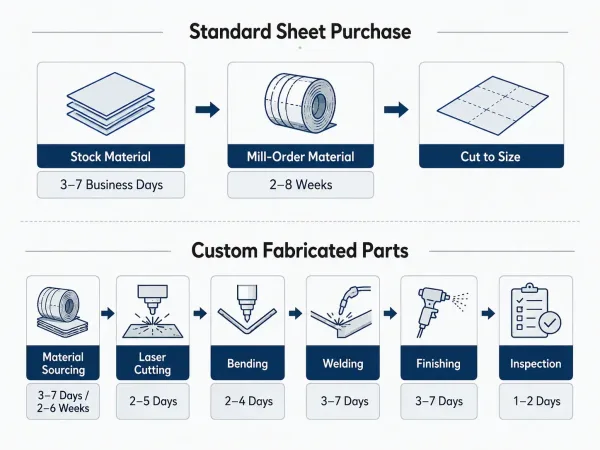
A two-row timeline compares lead times for standard sheet purchases and custom fabricated checker plate parts.
A common source of confusion is mixing up two different purchases: buying a standard sheet versus commissioning a fabricated part. They are different projects with different timelines.
Standard sheet purchase:
- Stock material: 3–7 business days
- Mill-order material: 2–8 weeks
- No fabrication beyond cutting to size
Custom fabricated parts:
- Material sourcing: 3–7 days (stock) to 2–6 weeks (mill)
- Laser cutting: 2–5 business days
- Bending and forming: 2–4 business days
- Welding and assembly: 3–7 business days
- Surface finishing: 3–7 business days
- Inspection and packaging: 1–2 business days
A typical low-volume custom part in a stocked material lands at 2 to 3 weeks from order confirmation. The same part in a mill-order material with galvanizing can reach 6 to 8 weeks. Asking your fabricator to separate sourcing time from production time at the quoting stage makes the total easier to plan around.
Quantity, Tooling, and Seasonality: The Hidden Variables
Beyond material and process, three variables quietly move delivery dates.
Low Volume vs. Production Runs
For low volumes — a few parts or a single prototype — the fabricator can often fit the job between larger production runs, so lead time is driven mainly by material availability. For production runs of hundreds of parts, the job must compete for machine capacity, and the fabricator will quote a slot based on current workload. Ordering early for production quantities is the only reliable way to hold the schedule.
Tooling and Fixtures
Most checker plate parts can be cut and bent with standard tooling. If your design requires a special bend form, a dedicated welding fixture, or a forming die, the tooling itself adds 1 to 2 weeks. Ask at the RFQ stage whether your part uses standard tooling or requires new tooling.
Seasonal Capacity
Fabrication shops and coating subcontractors run at higher utilization during peak construction and industrial seasons — galvanizing lines in particular develop backlogs in spring and summer. If your project has a hard deadline in a peak period, add a week of buffer or confirm finishing capacity before you commit.
Planning Your Checker Plate Order: What Buyers Can Do
The variables above are mostly controllable — if you plan for them. Six practices consistently shorten lead times:
- Confirm material availability before finalizing the drawing. Ask which grades, thicknesses, and patterns are in stock. If your design can accept a stocked alternative, say so early.
- Specify pattern type, pattern side, and total thickness. Remember that checker plate is quoted by base thickness plus pattern height. An unstated pattern side forces a later clarification, which costs time.
- Lock in the surface finish at the quoting stage. Adding galvanizing or powder coating after the order is placed extends the schedule by a week or more.
- Give firm quantities and a target date. Fabricators schedule production slots from confirmed information; vague requirements get quoted with extra safety margin.
- Separate material procurement time from production time. Ask your supplier to break the lead time into sourcing and fabrication components, so you know which part of the schedule is at risk.
- Build in a buffer for peak season. If the delivery date falls in a busy period, assume the quoted date is optimistic and plan accordingly.
If you are unsure how these factors apply to your part, share the drawing at the quoting stage and ask the fabricator to confirm material availability and standard tooling before production begins. That single question usually exposes the longest lead-time risk in the schedule.
FAQs
Before You Place the Order: A Six-Point Checklist
- Material grade and thickness confirmed against what the fabricator can source from stock
- Pattern type, pattern side, and base vs. total thickness stated on the drawing
- Surface finish specified and included in the quoted lead time
- Quantity and target delivery date confirmed in writing
- Lead time broken into material sourcing and production components
- Peak-season buffer included if the delivery date falls in a busy period
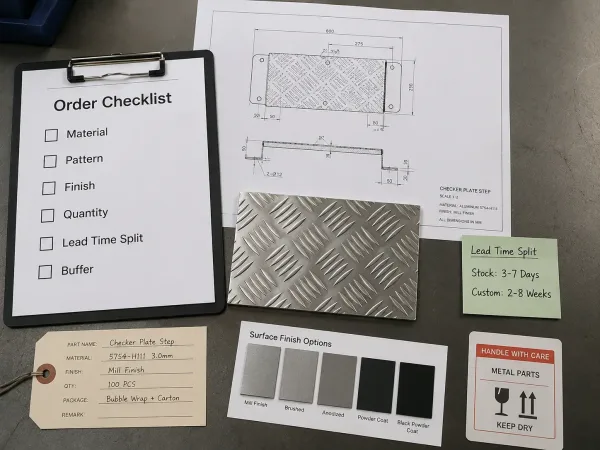
A six-point checklist highlights the key details buyers should confirm before placing a checker plate order.
A checker plate part can arrive in days or in weeks, and the difference is rarely luck — it is the sum of material availability, process decisions, and how early the details were locked down. Working through this list before sending the RFQ is the most reliable way to ensure the quoted delivery date is the one you get.