
When a shipment of sheet metal parts arrives at your receiving dock, someone has to confirm that the documentation is complete before the parts move to assembly or inventory. One of the most important documents in that package is the material certificate — yet many buyers are not sure what it actually contains, which type they should require, or who is responsible for providing it.
A material certificate, also called a material test certificate (MTC) or mill test certificate (MTR), is a quality document issued by the material producer — the mill — that certifies the chemical composition and mechanical properties of a specific batch of metal. It is not a generic quality statement. It is a traceable record that links a physical batch of material, identified by a heat number, to verified test data. In sheet metal fabrication, this document applies to the raw sheet stock — cold-rolled steel, stainless steel, aluminum plate, and similar flat products — rather than to the finished fabricated part. The terms material certificate, mill test certificate, and MTC are used interchangeably across the industry. The global framework governing these documents is EN 10204:2004, a European standard that defines the types of inspection documents supplied with metallic products.
A material certificate is not the same as a certificate of conformance (CoC). The material certificate proves that the raw material meets a specified material grade and standard. The certificate of conformance proves that the finished part meets your engineering drawing. These are separate documents with different purposes — a distinction covered in more detail later in this article.
EN 10204 Certificate Types: 2.1, 2.2, 3.1, and 3.2
Not all material certificates carry the same weight. EN 10204 defines four document types, each offering a different level of testing evidence and verification independence. Understanding these types is the first step to specifying the right one on your purchase order.
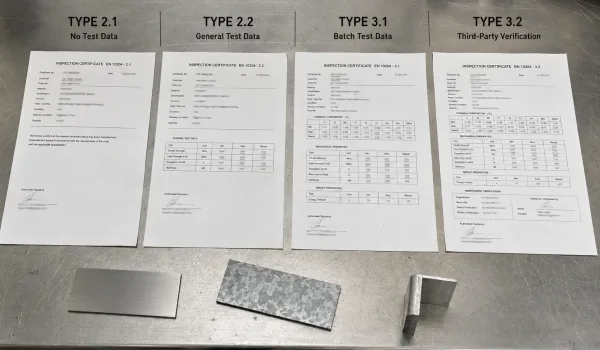
A visual comparison of EN 10204 certificate Types 2.1, 2.2, 3.1, and 3.2 showing increasing levels of testing and verification.
| Checkpoint | FOB (Free on Board) | DDP (Delivered Duty Paid) |
|---|---|---|
| Freight arrangement | Buyer | Supplier |
| Freight cost | Buyer | Supplier |
| Risk transfers | When goods are loaded on the vessel | When goods are delivered to the buyer |
| Export customs (China) | Supplier | Supplier |
| Import customs and duties | Buyer | Supplier |
| Visibility for buyer | Higher — buyer controls the shipment | Lower — supplier controls the shipment |
Type 2.1 is a signed statement that the supplied material conforms to the order requirements. It does not include any test data. This type is common for low-risk, non-critical applications where traceable test results are not required.
Type 2.2 includes general test results based on routine production testing, but these results are not tied to the specific batch delivered. The data is representative of the product type, not the exact shipment.
Type 3.1 is the most widely used certificate type in industrial procurement. It includes actual test results — chemical composition, mechanical properties, and any additional tests specified in the order — for the specific batch or heat delivered. The certificate must be validated by the manufacturer’s inspection representative who is independent of the production department. For most sheet metal fabrication projects, Type 3.1 is the standard requirement.
Type 3.2 provides the highest level of assurance. It includes the same specific test data as Type 3.1, but the certificate must be countersigned by an independent third-party inspector — organizations such as TÜV, DNV, Lloyd’s Register, or SGS. Type 3.2 is mandatory for high-risk sectors such as offshore platforms, nuclear systems, and certain pressure equipment. For typical sheet metal fabrication, it is rarely necessary and adds both cost and lead time.
Specifying “EN 10204 Type 3.1” on your purchase order eliminates ambiguity. If you write only “material certificate required,” the supplier may provide a Type 2.1 declaration — which technically satisfies the request but contains no actual test data.
What Does a Material Test Certificate Contain?
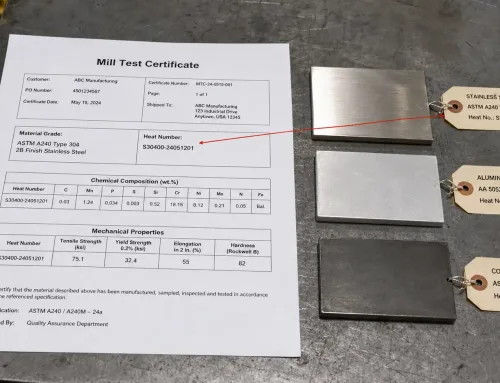
A standard MTC (EN 10204 Type 3.1) contains the following information. When reviewing a certificate, check each section against your purchase order and the applicable material standard.
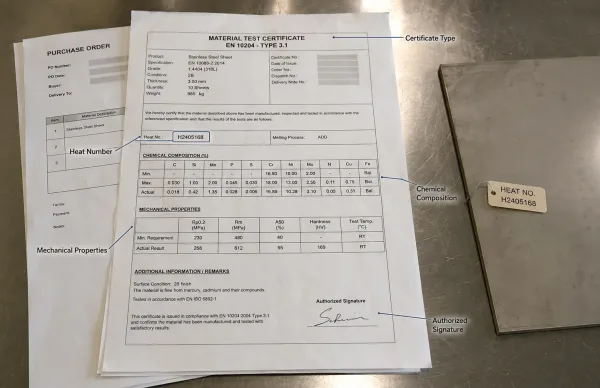
An EN 10204 Type 3.1 material certificate highlighting the certificate type, heat number, chemical composition, mechanical properties, and signature.
- Manufacturer identification — Name, address, and accreditation marks of the mill that produced the material.
- Certificate type declaration — The EN 10204 type (e.g., “EN 10204 Type 3.1”), certificate number, and issue date.
- Order and product details — Customer name, purchase order reference, product form (e.g., sheet, plate), dimensions, grade (e.g., 304L, 6061-T6), and quantity.
- Chemical composition — Element-by-element analysis (C, Mn, P, S, Si, Cr, Ni, Mo, and others as applicable) compared against the specification limits of the relevant standard.
- Mechanical properties — Tensile strength, yield strength, elongation, and hardness values. For some applications, impact test results (Charpy V-notch) are also included.
- Heat treatment condition — The condition of the material as supplied: annealed, solution annealed, cold-rolled, or as-rolled.
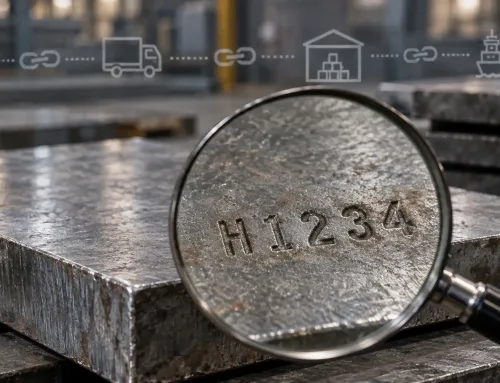
- Heat number — A unique alphanumeric identifier for the melt batch. This number must match the physical marking on the material and serves as the traceability link between the certificate and the product.
- Authorized signature — The signature of the manufacturer’s inspection representative (for Type 3.1) or both the manufacturer’s and the independent inspector’s signatures (for Type 3.2).
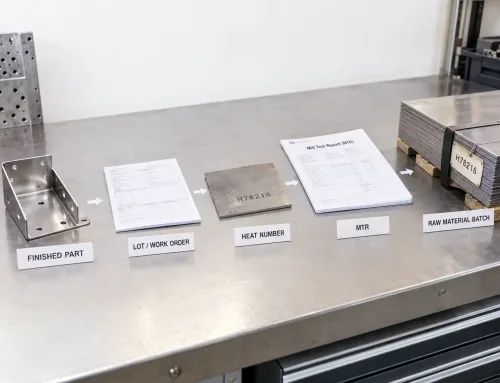
As part of material traceability and quality control, verify that the heat number on the document matches the marking on the physical material, that all chemical and mechanical values fall within the specification limits, and that the certificate type matches what was required in your purchase order.
Material Certificate vs. Certificate of Conformance: What Is the Difference?
Buyers frequently confuse these two documents. They serve different purposes and are issued at different stages of the supply chain.
| Aspect | Material Certificate | Certificate of Conformance (CoC) |
|---|---|---|
| Issued by | Material producer (the mill) | Fabricator or supplier |
| Proves | Raw material meets a specified grade and standard | Finished part meets the engineering drawing |
| Contains | Chemical composition, mechanical properties, heat number | Part number, drawing revision, dimensions, quantity |
| Traceability | Links to the melt batch (heat number) | Links to the production order |
| When needed | At material receiving | At part delivery |
A material certificate tells you what the material is. A certificate of conformance tells you that the part matches your drawing. For critical applications, you may need both. For non-critical commercial parts, a certificate of conformance alone may suffice — but that decision should be made at the engineering or procurement stage, not at receiving.
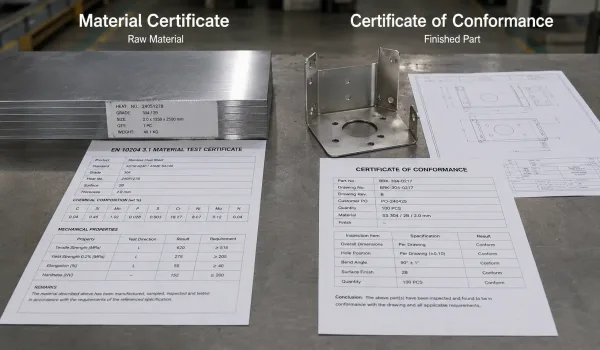
A side-by-side comparison showing that a material certificate verifies raw material while a certificate of conformance verifies the finished fabricated part.
Some suppliers combine both documents into a single package. Others provide them separately. The key is to know which document you are looking at and what it does and does not prove.
Who Issues the Material Certificate for Sheet Metal Parts?
This is where many buyers encounter confusion — and where the distinction between the material producer and the fabricator matters most.
The material certificate is issued by the mill that produces the raw material, not by the sheet metal fabricator. In the sheet metal supply chain, the certificate follows the material:
- The rolling mill produces sheet stock (cold-rolled steel, stainless steel, aluminum) and issues the material certificate with each heat or batch.
- The stockist or distributor receives the material and passes the certificate through to the buyer.
- The sheet metal fabrication supplier receives the material and the certificate, then passes both through to the customer as part of the delivery documentation.
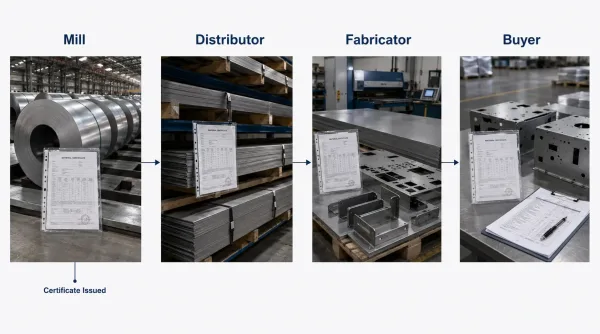
The material certificate supply chain showing how the original mill certificate follows the material from the mill through the distributor and fabricator to the buyer.
A sheet metal fabricator cannot issue a mill test certificate. The fabricator did not produce the material and therefore cannot certify its chemical composition or mechanical properties. What the fabricator can do is:
- Pass through the original mill certificate received from their material supplier.
- Issue a certificate of conformance for the finished fabricated part, confirming it meets the engineering drawing.
- Provide a material declaration (EN 10204 Type 2.1) stating that the material supplied conforms to the specified grade.
- Arrange independent testing (such as XRF alloy verification) if additional assurance is required.
For buyers, this means the quality of the material certificate depends on the fabricator’s supply chain. If the fabricator purchased material directly from a mill and can trace the certificate to the original heat, the documentation is strong. If the material passed through multiple distributors, traceability may be harder to verify. This is a question worth asking at the sheet metal RFQ stage — not after parts have been delivered.
How to Specify Material Certificate Requirements on Your Purchase Order
The most effective way to ensure you receive the correct certificate is to specify the requirements explicitly on your purchase order. Vague language creates ambiguity. Specific language prevents it.
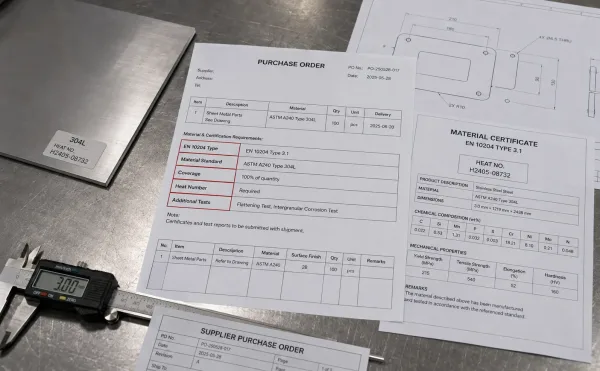
A purchase order showing the key material certificate requirements buyers should specify before ordering sheet metal parts.
Your purchase order should include:
- The EN 10204 type required — e.g., “EN 10204 Type 3.1” rather than “material certificate.”
- The applicable sheet metal material specification — e.g., “ASTM A240 Type 304L” or “EN 10088-2 1.4307.”
- The scope of coverage — whether the certificate should cover the raw sheet stock, the finished parts, or both.
- Heat number marking requirements — whether the heat number must be physically marked on each part or on the packaging.
- Any additional tests — if your application requires impact testing, hardness testing, or other specific tests beyond the standard requirements.
Specifying these details at the ordering stage costs nothing. Correcting a missing or incorrect certificate after delivery can delay production, trigger re-inspection, or — in regulated industries — require the entire shipment to be rejected and re-sourced.