
The High-Volume Dilemma: When Laser Cutting Capacity Becomes the Constraint
You need 10,000 sheet metal parts per month. You search for laser cutting services and find dozens of suppliers—but how do you know which ones can actually deliver at that volume? This is the high-volume dilemma: laser cutting is excellent for precision and flexibility, but capacity constraints can turn a straightforward procurement task into a complex evaluation challenge.
The problem isn’t just finding a supplier with enough machines. It’s understanding whether their entire operation—equipment configuration, automation level, workflow optimization, material supply chain, and quality control systems—can sustain consistent output at your required volume without compromising quality or delivery schedules.
This guide provides a systematic framework for evaluating laser cutting capacity for high-volume sheet metal orders. You’ll learn how to define what “high volume” actually means for your specific parts, assess supplier capabilities beyond marketing claims, understand when alternative processes might be necessary, and implement cost optimization strategies that work at scale.
What Defines a High-Volume Sheet Metal Laser Cutting Order?
“High volume” is relative. For a simple bracket made from 1mm stainless steel, 5,000 pieces per month might be considered high volume. For a complex enclosure with multiple bends, weldments, and surface treatments, 1,000 pieces per month could represent significant production scale.
Material-Specific Volume Thresholds
Different materials affect cutting speed and capacity:
- Mild steel (CRS): Fastest cutting speeds; high-volume thresholds typically start at 5,000-10,000 pieces per month depending on thickness and complexity
- Stainless steel: Slower cutting speeds due to material hardness; high-volume thresholds may be 30-50% lower than mild steel
- Aluminum: Good cutting speeds but requires attention to reflectivity and heat dissipation; thresholds similar to mild steel for thin gauges
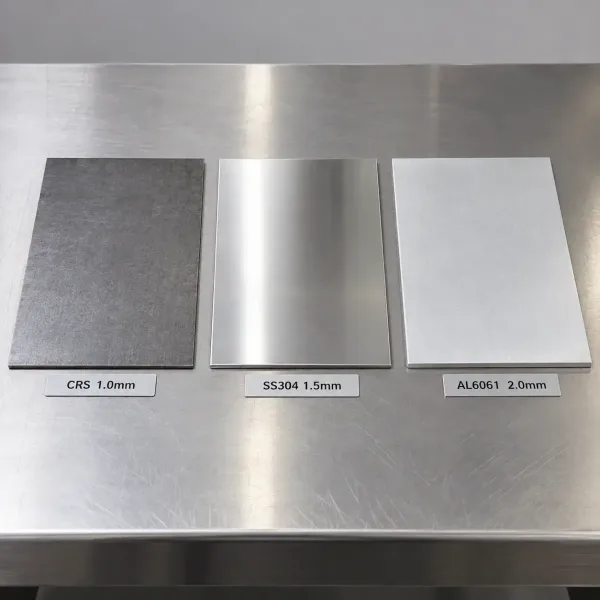
This image displays three different sheet metal material samples side by side – mild steel, stainless steel, and aluminum – each labeled with material type and typical thickness, showing material diversity in laser cutting.
Complexity-Based Volume Definitions
Part complexity dramatically affects capacity:
- Simple flat patterns: High volume can mean 10,000+ pieces per month per machine
- Complex geometries with multiple features: High volume might be 1,000-3,000 pieces per month due to longer cycle times
- Parts requiring secondary operations: Bending, welding, or finishing reduce effective laser cutting capacity
Industry Standards for High-Volume Production
While no universal standard exists, industry practice suggests:
- Low volume: 1-500 pieces per order
- Medium volume: 500-5,000 pieces per order
- High volume: 5,000+ pieces per order or consistent monthly orders of 1,000+ pieces
The key insight: high volume isn’t just about quantity—it’s about consistent, repeatable production that requires systematic capacity planning.
Key Factors That Determine Laser Cutting Capacity
Understanding capacity requires looking beyond the number of laser machines. Four interconnected factors determine actual production capability.
Equipment Configuration and Automation Level
Machine count and type: A supplier with 10 fiber laser machines has more theoretical capacity than one with 3 CO2 lasers, but machine age, power (1kW to 12kW+), and maintenance status matter equally.
Automation systems:
- Automatic loading/unloading: Reduces manual handling time by 60-80%
- Multi-pallet systems: Allow continuous cutting while loading/unloading occurs
- Automated sorting: Separates parts from scrap without manual intervention
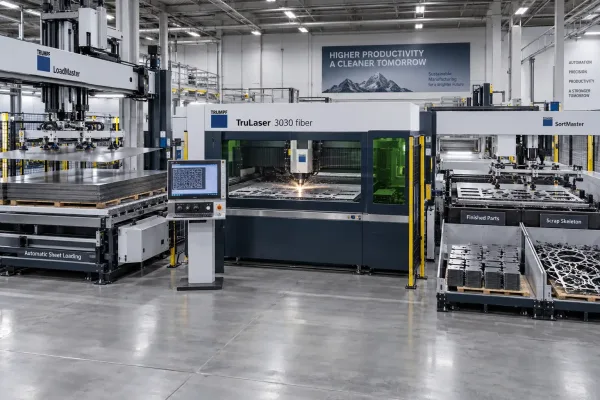
This image shows a complete automated laser cutting system with automatic sheet loading from a stack, laser cutting in progress, and an automated sorting system separating finished parts from scrap material.
Example: A 4kW fiber laser with automated sheet loading can process 1.5-2x more parts per shift than the same machine with manual loading.
Process Optimization and Workflow
Nesting efficiency: How much of each sheet becomes parts versus scrap? Optimized nesting can improve material utilization from 70% to 85%+, directly affecting effective capacity.
Cut path optimization: Software that minimizes head travel distance reduces cycle time by 10-20%.
Setup time reduction: Quick-change nozzle systems and offline programming reduce machine downtime between jobs.
Material Management and Supply Chain
Raw material availability: Can the supplier maintain consistent material supply for your volume requirements? This includes:
- Standard material grades and thicknesses
- Certified materials with proper documentation (MTR, CoC)
- Buffer stock for demand fluctuations
Supply chain resilience: Multiple material sources, domestic and import options, and relationships with steel service centers.
Workforce and Shift Structure
Skilled operators: Laser cutting requires trained personnel for setup, monitoring, and quality checks.
Shift patterns:
- Single shift: 8 hours/day capacity
- Double shift: 16 hours/day capacity
- 24/7 operations: Maximum capacity but requires robust maintenance scheduling
How to Assess a Supplier’s True Production Capacity
Marketing materials claim “high-volume capability,” but verification requires systematic evaluation.
Equipment Audit Checklist
Request and verify:
- Machine inventory list: Make, model, age, power rating, and maintenance records
- Automation systems: Loading, unacking, sorting capabilities
- Support equipment: Bending, welding, finishing equipment for complete parts
- Software systems: CAD/CAM, nesting, production scheduling
Capacity Calculation Methods
Theoretical capacity:
- Cutting speed (mm/min) × available hours × efficiency factor = daily output
- Example: 4kW laser cutting 1mm CRS at 20,000 mm/min × 16 hours × 70% efficiency = ~134,000 linear meters per day
Practical capacity:
- Adjust theoretical capacity for setup time, material handling, quality checks, and maintenance
- Typically 60-75% of theoretical capacity for sustained production
Validation approach:
- Ask for production data from similar jobs (with customer permission)
- Request a trial run of 100-500 pieces to verify actual cycle times
- Check references from customers with similar volume requirements
Case Study Validation Techniques
When reviewing supplier case studies:
- Ask for specific numbers: “We cut 15,000 parts/month for Customer X” is more valuable than “We handle high-volume orders”
- Request customer references: Speak directly with customers about consistency and delivery performance
- Visit the facility: See production in action, talk with operators, observe workflow
When Laser Cutting Reaches Its Limits: Alternative Processes
Laser cutting excels at medium-volume production with complex geometries, but certain scenarios favor alternative processes.
Stamping
Best for: Very high volumes (50,000+ pieces), simple geometries, consistent designs
Advantages:
- Extremely fast cycle times (seconds per part)
- Low per-part cost at volume
- Excellent repeatability
Disadvantages:
- High tooling costs (
10,000−100,000+) - Long lead times for tooling (4-12 weeks)
- Design changes require new tooling
Plasma Cutting
Best for: Thick materials (>10mm), large parts, lower precision requirements
Advantages:
- Fast cutting on thick materials
- Lower equipment costs than laser
- Can cut conductive materials regardless of reflectivity
Disadvantages:
- Lower precision (±0.5mm vs ±0.1mm for laser)
- Larger heat-affected zone
- Rougher edge quality
Waterjet Cutting
Best for: Heat-sensitive materials, thick composites, materials that cannot tolerate HAZ
Advantages:
- No heat-affected zone
- Can cut virtually any material
- Good for thick materials (up to 200mm+)
Disadvantages:
- Slower than laser cutting
- Higher operating costs (abrasive consumption)
- Not suitable for high-volume production of thin sheet metal
CNC Machining
Best for: 3D features, very tight tolerances, complex internal geometries
Advantages:
- Can create features impossible with 2D cutting
- Excellent surface finish
- Very tight tolerances possible
Disadvantages:
- Much slower than laser cutting for 2D profiles
- Higher per-part cost
- Material waste from subtractive process
Laser Cutting vs. Stamping: A Detailed Comparison for High-Volume Production
The most common decision point for high-volume sheet metal parts: laser cutting or stamping?
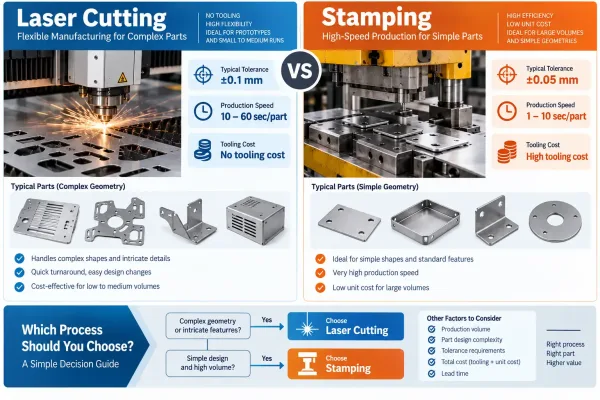
This diagram compares laser cutting and stamping processes side by side, showing laser cutting’s flexibility for complex shapes versus stamping’s speed for high-volume simple parts, with key specifications labeled.
Production Capacity Comparison
| Factor | Laser Cutting | Stamping |
|---|---|---|
| Typical daily output | 500-5,000 parts per machine | 10,000-100,000+ parts per machine |
| Cycle time per part | 10-60 seconds | 1-10 seconds |
| Setup time | 5-15 minutes (program change) | 2-8 hours (die change) |
| Multi-part efficiency | Good (nesting optimization) | Excellent (progressive dies) |
Precision and Quality Comparison
| Factor | Laser Cutting | Stamping |
|---|---|---|
| Dimensional tolerance | ±0.1-0.2mm | ±0.05-0.1mm |
| Edge quality | Smooth, minimal burrs | May require deburring |
| Heat-affected zone | Small (0.1-0.5mm) | None |
| Repeatability | Excellent | Excellent |
Cost Structure Comparison
| Volume Range | Laser Cutting | Stamping |
|---|---|---|
| Prototype (1-100) | $2-20/part | $100-1,000/part (tooling amortized) |
| Low volume (100-1,000) | $1-10/part | $10-100/part |
| Medium volume (1,000-10,000) | $0.5-5/part | $1-10/part |
| High volume (10,000+) | $0.2-3/part | $0.1-1/part |
Flexibility and Lead Time Comparison
Design changes:
- Laser cutting: Update program, immediate implementation
- Stamping: New tooling required, 4-12 weeks lead time
Lead time for first parts:
- Laser cutting: 1-3 days
- Stamping: 6-14 weeks (including tooling)
Mix flexibility:
- Laser cutting: Easy to switch between different parts
- Stamping: Difficult and costly to changeover
Decision Framework
Choose laser cutting when:
- Volume < 10,000 parts per month
- Design may change
- Multiple part numbers needed
- Fast time-to-market required
- Complex geometries required
Choose stamping when:
- Volume > 50,000 parts per month
- Design is stable and proven
- Simple geometries
- Lowest per-part cost critical
- Long product lifecycle expected
Quality Control for High-Volume Laser Cutting Orders
High-volume production amplifies quality challenges. What passes inspection in a 100-piece batch can become systematic failure in a 10,000-piece run.
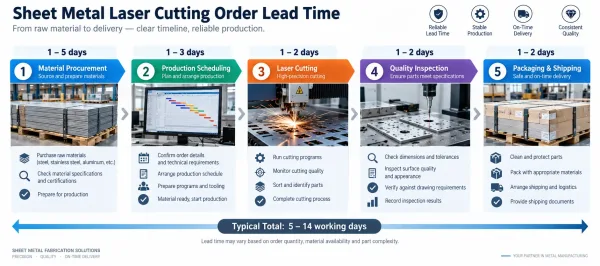
This timeline diagram breaks down the lead time components for high-volume laser cutting orders, showing material procurement, production scheduling, cutting time, quality inspection, and packaging/shipping phases with typical durations.
Process Control Measures
Statistical Process Control (SPC):
- Monitor critical dimensions with control charts
- Identify trends before they become defects
- Adjust process parameters proactively
First Article Inspection (FAI):
- Comprehensive inspection of first parts from each setup
- Document all critical dimensions and characteristics
- Customer approval before full production run
In-Process Inspection:
- Regular checks during production (every 100-500 parts)
- Automated measurement systems for critical features
- Visual inspection for surface defects
Quality Inspection System
Incoming material inspection:
- Verify material certificates match specifications
- Check material thickness, surface condition, and flatness
- Reject non-conforming material before production
Final inspection:
- 100% inspection for critical characteristics
- Sample inspection for non-critical features
- Document results for traceability
Measurement equipment:
- Calibrated measuring tools (calipers, micrometers, CMM)
- Regular calibration schedules
- Measurement uncertainty analysis
Non-Conformance Handling
Containment: Isolate suspect material immediately
Root cause analysis: 5-Why, fishbone diagrams, 8D reports
Corrective action: Fix the cause, not just the symptom
Prevention: Update controls to prevent recurrence
Lead Time Planning and Guarantee
High-volume orders require precise lead time planning to maintain production schedules.
Lead Time Calculation Methods
Standard lead time components:
- Material procurement: 1-5 days for standard materials, 2-8 weeks for special alloys
- Production scheduling: 1-3 days for queue time
- Cutting time: Actual machine time based on part complexity and quantity
- Secondary operations: Bending, welding, finishing (if applicable)
- Quality inspection: 1-2 days for inspection and documentation
- Packaging and shipping: 1-2 days
Example calculation for 5,000 simple brackets:
- Material: 1 day (stock material)
- Scheduling: 1 day
- Cutting: 2 days (10 hours machine time)
- Inspection: 1 day
- Packaging: 1 day
- Total: 6 working days
Factors Affecting Lead Time
Demand fluctuations: Seasonal variations, promotional spikes
Material availability: Common vs. specialty materials
Production complexity: Simple cuts vs. complex assemblies
Quality requirements: Standard vs. enhanced inspection protocols
Supplier capacity utilization: How busy is the supplier?
Lead Time Guarantee Measures
Contractual terms:
- Penalty clauses for late delivery
- Bonus for early delivery (if critical)
- Force majeure definitions
Communication protocols:
- Weekly progress updates
- Early warning for potential delays
- Alternative options discussion
Buffer strategies:
- Safety stock for critical components
- Multiple qualified suppliers
- Flexible scheduling arrangements
Cost Optimization Strategies for Large Orders
High-volume orders create opportunities for significant cost reduction through systematic optimization.
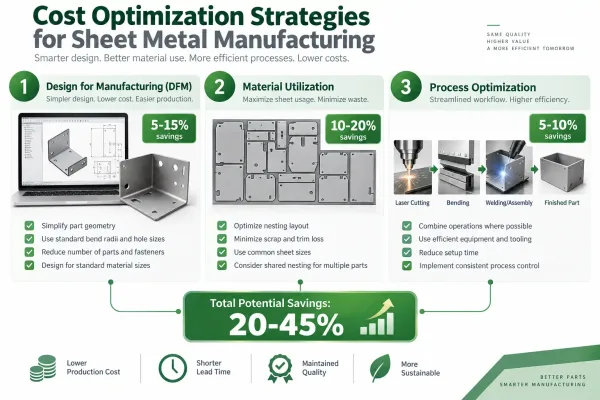
This infographic illustrates three main cost optimization strategies for high-volume laser cutting: Design for Manufacturing (DFM), Material Utilization, and Process Optimization, with specific savings percentages for each category.
Volume Discount Strategies
Tiered pricing: Negotiate price breaks at 1,000, 5,000, 10,000 pieces
Long-term agreements: Annual contracts with volume commitments
Payment terms: Net 30 vs. net 60 pricing differences
Consignment arrangements: Supplier holds inventory, you pay on usage
Design Optimization for Cost Reduction
Design for Manufacturing (DFM):
- Standard bend radii (avoid tight radii requiring special tooling)
- Consistent material thickness throughout part
- Minimize number of bends and secondary operations
Material utilization:
- Optimize part geometry for better nesting
- Consider standard sheet sizes to reduce scrap
- Evaluate material grade downgrades where possible
Tolerance optimization:
- Specify only necessary tolerances
- Use standard tolerances where possible
- Avoid unnecessarily tight specifications
Material and Process Optimization
Material selection:
- Evaluate alternative materials with similar properties
- Consider coated vs. raw materials
- Balance material cost with processing efficiency
Process simplification:
- Combine operations where possible
- Eliminate unnecessary finishing steps
- Standardize surface treatment requirements
Supplier Evaluation Checklist for High-Volume Orders
Systematic evaluation reduces risk and ensures supplier capability matches requirements.
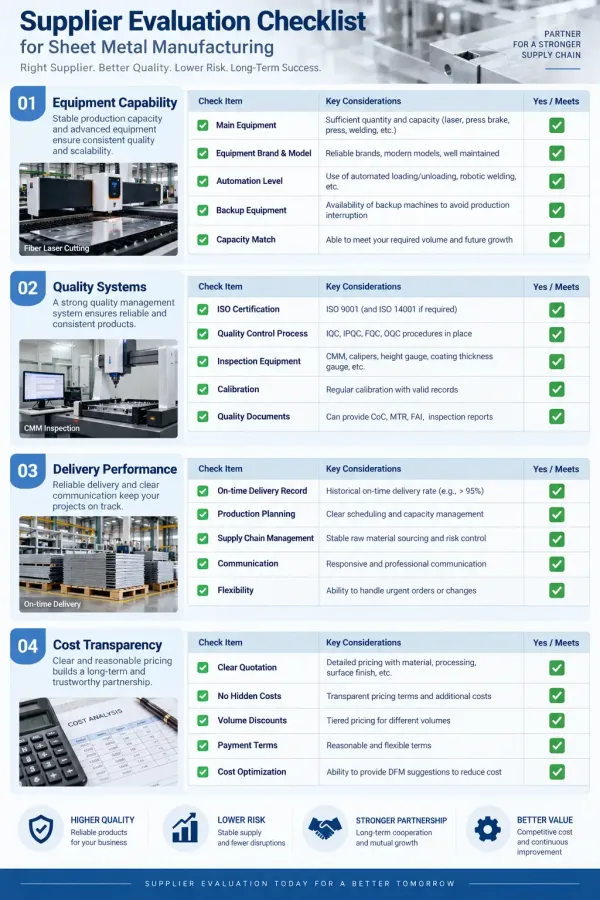
This visual checklist shows the key evaluation categories for selecting a high-volume laser cutting supplier, including equipment capability, quality systems, delivery performance, and cost transparency.
Capacity Assessment Checklist
Equipment capability:
- Sufficient machine quantity for required volume
- Appropriate machine power for material thickness
- Automation systems for efficiency
- Backup equipment for maintenance periods
Production planning:
- Capacity planning system in place
- Experience with similar volumes
- Shift structure matches requirements
- Overtime capability when needed
Quality System Assessment
Certifications and systems:
- ISO 9001 or equivalent certification
- Documented quality procedures
- Calibration program for measuring equipment
- Training program for operators
Inspection capabilities:
- Appropriate measuring equipment
- Inspection procedures documented
- Non-conformance handling process
- Customer complaint resolution system
Delivery and Cost Assessment
Delivery performance:
- On-time delivery track record
- Communication protocols for delays
- Contingency planning for disruptions
- Shipping and logistics capabilities
Cost transparency:
- Clear pricing structure
- No hidden charges
- Volume discount structure
- Payment terms flexibility
Your High-Volume Laser Cutting Supplier Evaluation Checklist
Use this checklist when evaluating suppliers for your high-volume sheet metal laser cutting requirements:
Phase 1: Initial Assessment
- Define your requirements clearly
- Annual volume and monthly distribution
- Material specifications and certifications
- Quality requirements and inspection levels
- Delivery schedule and flexibility needs
- Gather supplier information
- Equipment list and capabilities
- Quality certifications and systems
- Customer references with similar volumes
- Financial stability assessment
Phase 2: Detailed Evaluation
- Technical capability verification
- Facility visit and equipment inspection
- Trial production run with your parts
- Quality system audit
- Capacity calculation validation
- Commercial terms negotiation
- Pricing structure and volume discounts
- Payment terms and conditions
- Lead time guarantees and penalties
- Intellectual property protection
Phase 3: Ongoing Management
- Performance monitoring
- Regular quality and delivery reviews
- Continuous improvement initiatives
- Capacity planning for growth
- Relationship management
- Risk management
- Secondary supplier qualification
- Inventory buffer strategies
- Contingency planning
- Regular re-evaluation schedule
Remember: The cheapest supplier is rarely the best for high-volume production. Focus on total cost of ownership, including quality costs, delivery reliability, and management overhead. A supplier that consistently delivers quality parts on time at a fair price is far more valuable than one that offers the lowest price but creates constant firefighting.
FAQ