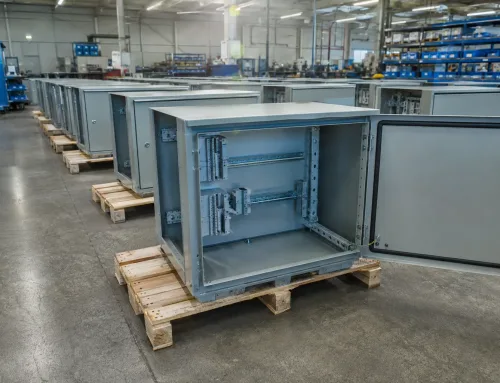

A batch of powder-coated sheet metal enclosures arrives at your assembly facility. The outer cartons look fine.
But when the line opens them, brown spots have formed along bent edges and around mounting holes — areas where the coating was thinnest or where handling scratched through it.
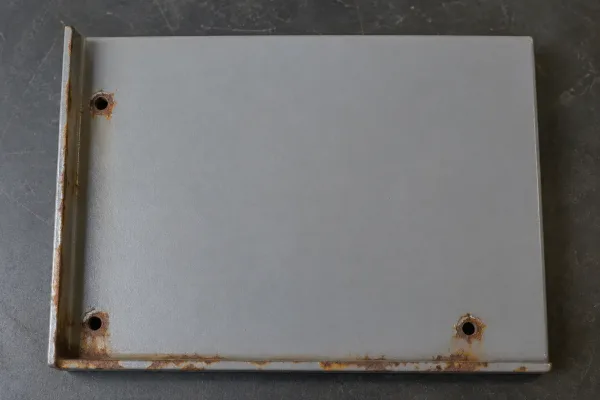
This image shows a powder-coated enclosure panel where brown corrosion has formed along bent edges and around mounting holes — the areas most vulnerable to coating damage and moisture penetration.
The parts are not scrap yet, but they need rework before they can reach your customer. You have just lost two weeks and a margin you cannot recover.
This scenario is not rare.
Moisture-related corrosion during storage and transit is one of the most common — and most preventable — causes of sheet metal part rejection.
The fix is not a better box or a more expensive coating. It is a systematic approach that starts before the part is even packed.
Why Sheet Metal Parts Corrode in Storage and Transit
Corrosion on steel and aluminum parts requires three things:
- oxygen
- moisture
- a temperature differential that causes condensation
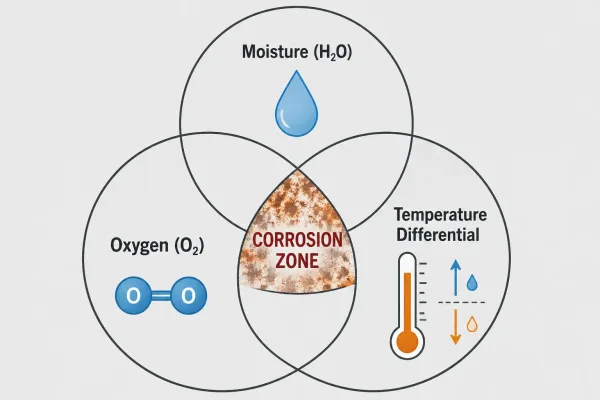
This diagram illustrates the three conditions that must be present for corrosion to occur on sheet metal parts — oxygen, moisture, and a temperature differential causing condensation.
In a sealed shipping container crossing an ocean, all three are present.
Relative humidity inside a standard container can reach 98% during temperature swings, and salt-laden air accelerates the electrochemical reaction on exposed metal surfaces.
Even parts that look dry at the factory gate can corrode in transit.
Residual machining coolant trapped in a bend radius, fingerprints from bare hands, or a microscopic scratch in the powder coating — each of these creates a starting point where moisture collects and oxidation begins.
The lesson is straightforward:
Corrosion does not wait for obvious water exposure. It starts wherever a vulnerable surface meets humid air.
Pre-Shipment Surface Inspection — What to Check Before Packing
The most important moisture protection step happens before any packaging material is selected.
A part that enters the packing stage with surface contamination or coating damage will corrode regardless of how well it is wrapped.
This is the stage most guides skip, and it is the stage where manufacturers have the most control.
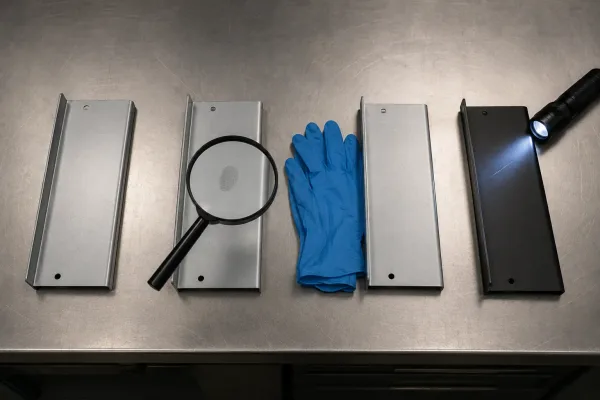
This image shows the four key pre-shipment inspection steps for sheet metal parts: verifying dryness, checking for surface residue, ensuring clean glove handling, and inspecting coating integrity along edges.
Before packing, confirm the following on every batch:
- Dryness. Parts must be completely dry after final cleaning or surface treatment. Water trapped in hems, seams, or blind holes will cause localized corrosion inside the package.
- Residue-free surfaces. Machining fluids, degreasing agents, and welding spatter residue are hygroscopic — they attract and hold moisture. Verify that cleaning processes have fully removed these contaminants.
- Coating integrity. Inspect sheet metal finishing such as powder coat, plating, or anodizing for scratches, chips, or thin spots — especially along bends, edges, and around fastener holes. These are the first areas to corrode.
- No bare-hand contact. Skin oils are mildly acidic and create corrosion initiation sites. Parts should be handled with clean gloves from the final finishing step onward.
This pre-shipment inspection takes minutes per batch and prevents the most expensive failure mode:
A part that was properly coated, properly packed, and still corroded because it was not clean when it went into the box.
Moisture Protection Levels by Surface Finish
Not every part needs the same level of protection.
The risk depends primarily on the sheet metal surface finish — bare carbon steel is far more vulnerable than stainless steel or anodized aluminum, and the packaging approach should reflect that difference.
Treating all parts the same wastes material on low-risk items and under-protects high-risk ones.
The following framework categorizes sheet metal parts by corrosion risk based on their surface condition:
| Risk Level | Surface Condition | Corrosion Onset | Recommended Protection |
|---|---|---|---|
| High | Bare cold-rolled steel, unfinished carbon steel | Hours to days in humid air | VCI film or paper + desiccant + sealed barrier bag |
| Medium | Powder-coated, galvanized, zinc-plated | Days to weeks; starts at scratches or exposed edges | VCI paper or film + desiccant; sealed outer wrap |
| Low | Stainless steel, anodized aluminum, copper with patina | Weeks to months; slow surface oxidation | Desiccant in sealed poly bag; VCI optional for long storage |
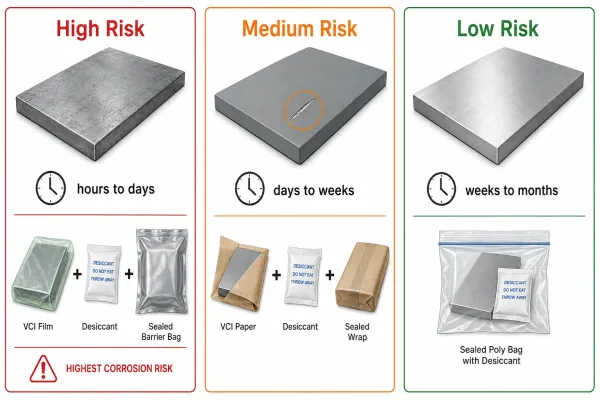
This infographic compares three corrosion risk levels based on surface finish type, showing the expected corrosion onset time and the recommended packaging protection for each level.
A common mistake is assuming that the corrosion resistance of metal finishes such as powder coating or galvanizing eliminates the need for moisture protection.
It does not.
A corrosion protection coating can delay corrosion, but it does not prevent attack at damaged or exposed areas.
For export shipments with transit times exceeding four weeks, even medium-risk parts benefit from VCI protection.
Packaging Methods — Choosing the Right Protection
Once surface inspection is complete and the risk level is determined, the next step is selecting a packaging method that matches:
- the part’s vulnerability
- the expected storage duration
- the expected transit duration
Three core approaches cover most sheet metal applications.
VCI (Vapor Corrosion Inhibitor) Film or Paper
VCI materials release a thin molecular layer that settles on metal surfaces and blocks the electrochemical reaction causing rust.
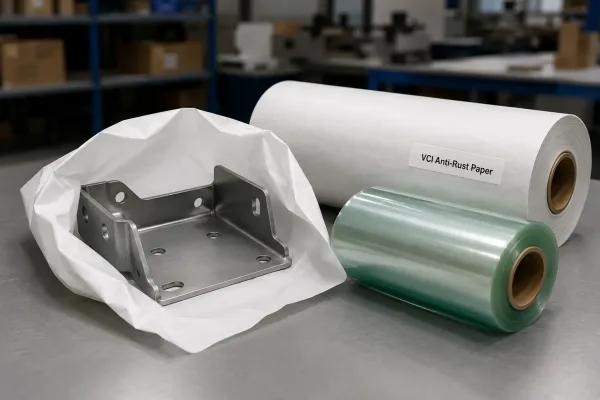
This image shows VCI paper and VCI poly film used for wrapping sheet metal parts. A bracket is partially unwrapped to demonstrate how VCI materials enclose and protect metal surfaces from corrosion.
They work without direct contact — the vapor fills the enclosed space and protects all exposed surfaces, including recessed areas and internal cavities.
VCI is the standard choice for:
- medium- to long-term storage
- parts that will not be immediately unpacked and used
Desiccant Packs in Sealed Bags or Containers
Desiccants — typically silica gel or montmorillonite clay — absorb moisture trapped inside the package at packing time.
They do not actively protect against moisture that enters after sealing, so they depend on a good moisture barrier, such as a sealed poly bag or shrink wrap, to be effective.
Desiccants are a practical choice for:
- short-term storage
- low-risk parts where VCI is unnecessary
Aluminum Barrier Foil with Desiccant
For high-risk parts on long ocean transits or extended warehouse storage, aluminum foil laminate provides the lowest water vapor transmission rate of any common packaging material.
Combined with desiccant and vacuum sealing, this approach creates a dry, isolated environment that can protect bare steel for a year or more.
It is the most expensive option, but for high-value parts or harsh transit routes, the cost is justified.
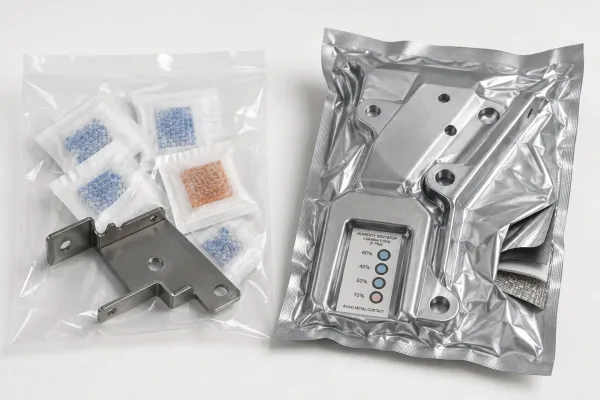
This image shows two moisture protection methods side by side: silica gel desiccant packs inside a sealed poly bag (left) and a vacuum-sealed aluminum barrier foil bag (right) with a humidity indicator card visible inside.
In practice, many shipments use a combination — for example:
- VCI paper wrapped around individual parts
- desiccant packs between layers
- a sealed outer bag as the moisture barrier
The key is matching the protection level to the risk, not defaulting to the cheapest or the most expensive option.
Storage and Shipping Environment Controls
Packaging protects parts during the time they are sealed.
But between the moment a box leaves the factory and the moment it reaches the assembly line, it passes through environments that can undermine even good packaging.
Warehouse Storage

This image shows best practices for warehouse storage of sheet metal parts: cartons on wooden pallets elevated off the concrete floor, dehumidifier unit, good ventilation, and clean dry conditions.
Parts should be stored in a dry, ventilated warehouse — ideally below 60% relative humidity.
Place pallets or skids on the floor rather than setting cartons directly on concrete, which wicks ground moisture upward.
Avoid storing near:
- open dock doors
- steam pipes
- areas with frequent temperature swings that cause condensation inside packaging
Shipping Containers
Ocean freight containers are not airtight.
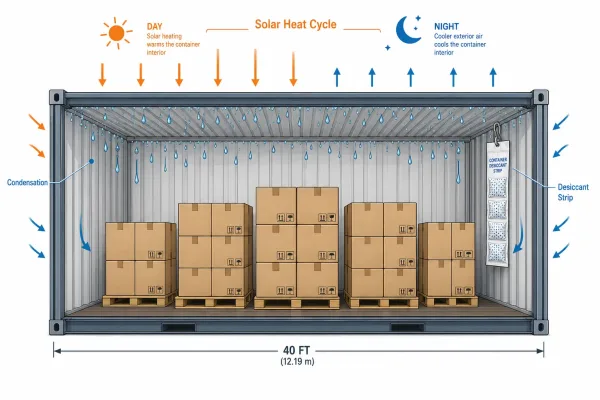
This diagram shows the “container rain” effect inside an ocean freight container, where temperature swings cause moisture to condense on the ceiling and drip onto cargo below. A container desiccant strip is shown as one mitigation method.
During a typical voyage, the container walls heat and cool with the sun, creating a “container rain” effect — moisture condenses on the ceiling and drips onto cargo.
To mitigate this:
- use container desiccant strips hung from the container walls
- ensure cargo is wrapped rather than loose
- avoid mixing sheet metal parts with moisture-generating cargo such as wet lumber or freshly painted goods
Transit Handling
Cartons should not be left on the tarmac or dock in rain or direct sun.
Waterproof outer wrapping or shrink wrap adds a layer of protection for the loading and unloading phases.
For less-than-container-load (LCL) shipments that pass through multiple warehouses, the risk of exposure increases — and so does the need for robust inner packaging.
Verifying Moisture Protection — Inspection and Monitoring
Installing moisture protection is not the same as confirming it works.
Without verification, you are relying on assumptions — and assumptions do not hold up in a container crossing the equator in July.
Humidity Indicator Cards
Humidity indicator cards are the simplest verification tool.
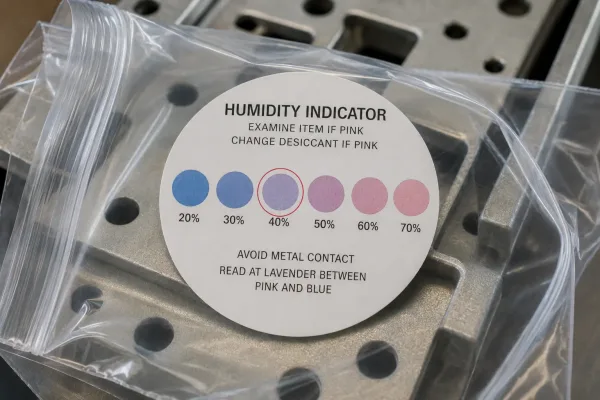
This image shows a humidity indicator card placed inside a sealed package. The color-change dots indicate whether humidity levels remained within safe thresholds during storage and transit, with the 40% dot showing the threshold was exceeded.
Placed inside the sealed package, they change color if moisture levels exceed a threshold, typically:
- 30% relative humidity
- 40% relative humidity
- 50% relative humidity
When the receiving team opens a shipment, the card provides an immediate, visible record of whether the package stayed dry.
If the card shows elevated humidity, the parts need inspection even if they look acceptable.
Data Loggers
For longer storage periods or higher-value shipments, consider adding a data logger inside the package or container.
These devices record temperature and humidity at set intervals, creating a time-stamped history that can pinpoint where and when conditions deteriorated.
This is especially useful for diagnosing recurring corrosion problems — the data often reveals that damage occurs not during ocean transit but during a two-week sit in an unventilated port warehouse.
Incoming Surface Inspection
At the receiving end, make surface inspection part of your incoming inspection standards.
Check high-risk areas on a sampling basis:
- edges
- bend radii
- fastener holes
- scratched coating spots
- thin coating spots
Catching corrosion early means you can address it before parts reach the assembly line, where the cost of delay multiplies.
How to Use This Checklist in Your Supplier Evaluation
The checklist above is most effective when it is not just a reference document but a requirement embedded in your procurement process.
If you source sheet metal parts from an overseas manufacturer, the time to define moisture protection standards is before the first order — not after the first corroded shipment.
Include Requirements in RFQ Documents
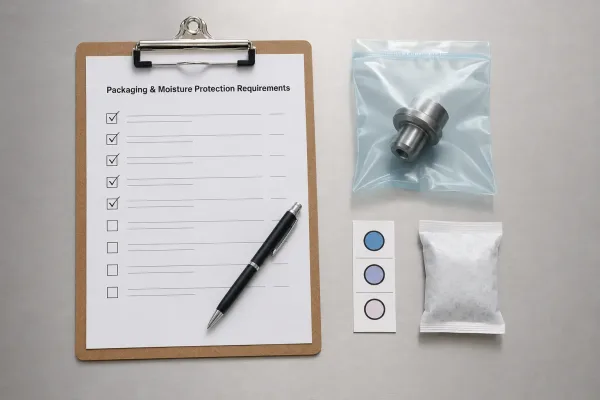
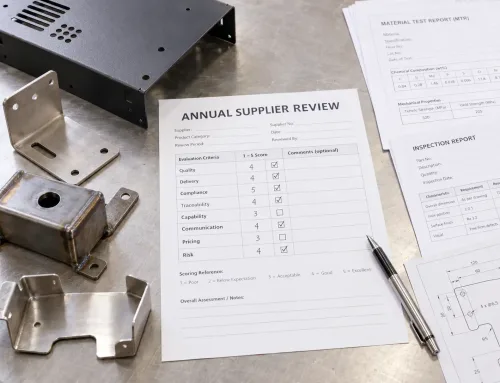
This image shows a packaging and moisture protection requirements checklist for supplier evaluation, accompanied by the key protection items: a VCI-sealed part, a humidity indicator card, and a desiccant pack.
Include packaging, moisture protection, and applicable surface finish requirements in your RFQ documents.
Specify:
- the surface finish
- the expected storage duration
- the transit conditions
- whether VCI protection is required
- what type of desiccant should be used
- whether humidity indicator cards must be included
If your parts will pass through tropical climates or extended port holds, say so explicitly — your supplier cannot protect against conditions they do not know about.
Check the Process During Supplier Audits
During supplier audits, ask to see the supplier’s quality control and inspection process, including how pre-shipment checks are actually performed.
Confirm that:
- parts are handled with gloves after finishing
- surface pretreatment and cleaning remove residue
- packaging is done in a dry environment
These are small operational details, but they are the difference between parts that arrive ready to assemble and parts that arrive needing rework.
A supplier who treats moisture protection as a standard operating procedure — not an afterthought — is a supplier who understands what it costs you when things go wrong.