
A bracket passes every inspection before it ships — dimensional check, coating thickness, visual review, all green.
Three weeks later, it snaps on the assembly line under loads well within its rated capacity.
No stretching, no bending, no warning. Just a clean, brittle fracture surface that looks nothing like an overload failure.
This is hydrogen embrittlement.
It is one of the most dangerous failure modes in plated steel components because it produces no visible signs before fracture, and it can appear days or even weeks after a part has been accepted and installed.
For engineers and procurement teams working with high-strength steel parts — brackets, clips, structural hardware, not just fasteners — understanding this risk is not optional.
It affects sheet metal material selection, surface finish specification, drawing annotations, and supplier process requirements.
What Hydrogen Embrittlement Actually Does to Steel
Hydrogen embrittlement (HE) occurs when atomic hydrogen enters the steel’s crystal structure during processes like acid cleaning or electroplating.
Once inside, hydrogen atoms migrate to areas of high stress — grain boundaries, inclusions, thread roots, or the tensile side of a bent flange.
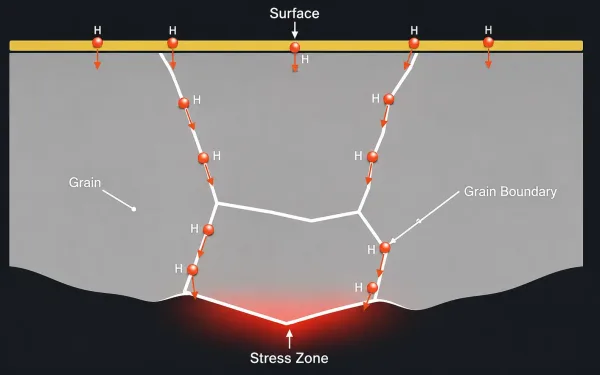
Cross-section view of steel at the grain boundary level, illustrating how atomic hydrogen enters during plating and migrates toward areas of high stress, where it accumulates and weakens the metal’s ability to deform plastically.
Under sustained load, the accumulated hydrogen reduces the metal’s ability to deform plastically, and the part fractures at stress levels well below its normal yield strength.
The defining characteristic of hydrogen embrittlement is delayed failure.
A part may appear structurally sound for hours, days, or even weeks after plating before cracking without warning.
This is what makes it particularly dangerous: conventional receiving inspections catch dimensional defects, coating issues, and surface damage, but they do not detect hydrogen already sitting inside the steel.
Which Parts Are at Risk — It Is Not Just Fasteners
Most published guidance on hydrogen embrittlement focuses on fasteners — Grade 10.9 and 12.9 bolts, hardened screws, and spring clips.
Those parts are indeed high-risk, but the same physics applies to any high-strength steel component that goes through electroplating.
The Strength Threshold
For high-strength plated steel, material test report verification becomes especially important because hydrogen embrittlement concern begins at approximately 150 ksi (1,034 MPa) tensile strength, or about HRC 36.
Above this level, the steel’s reduced ductility makes it increasingly vulnerable to hydrogen-induced cracking under sustained tensile stress.
The table below shows how risk scales with material strength:
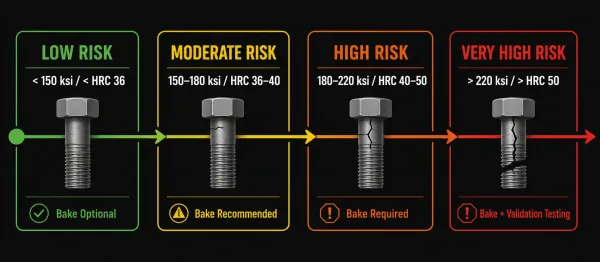
Visual guide showing how hydrogen embrittlement risk escalates with increasing steel strength, from low risk below 150 ksi to very high risk above 220 ksi, with corresponding baking requirements at each level.
| Tensile Strength | Hardness | HE Risk Level | Bake Relief Required |
|---|---|---|---|
| Below 150 ksi | Below HRC 36 | Low | Optional |
| 150–180 ksi | HRC 36–40 | Moderate | Recommended |
| 180–220 ksi | HRC 40–50 | High | Required |
| Above 220 ksi | Above HRC 50 | Very High | Required + validation testing |
For reference, ASTM B633 explicitly requires hydrogen embrittlement relief baking for steel parts exceeding HRC 40.
Aerospace standards such as AMS 2417 set the threshold lower, at HRC 36, reflecting the more conservative approach appropriate for safety-critical applications.
Sheet Metal Parts That Deserve Attention
In sheet metal fabrication, hydrogen embrittlement risk is easy to overlook because the conversation usually starts and ends with fasteners.
But several categories of plated sheet metal parts can cross the risk threshold:
- Hardened brackets and clips made from heat-treated alloy steel (e.g., 4130, 4340) used in aerospace or defense assemblies
- Cold-formed spring clips where the forming operation introduces residual stress into already-high-strength material
- Bent flanges on high-strength steel enclosures — the outer surface of a bend is in tension, and that residual stress creates the same kind of hydrogen accumulation site as a fastener thread root
- Stamped parts from AHSS (advanced high-strength steel) increasingly common in automotive and industrial applications
The critical point is that bending and forming operations add residual tensile stress to areas that were already susceptible.
A flat sheet of 150 ksi steel has moderate risk. The same sheet with a sharp bend flange has higher risk at the bend line, because the combination of material strength, residual stress, and absorbed hydrogen creates all three conditions needed for delayed fracture.
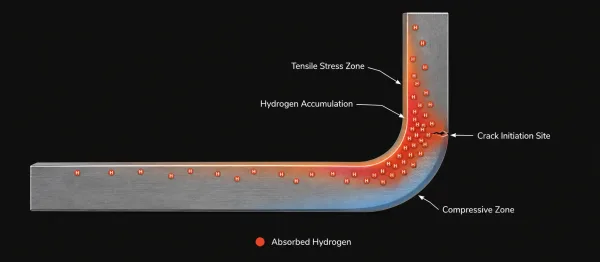
Cross-section of a bent high-strength steel flange showing how residual tensile stress on the outer bend surface creates an accumulation site for absorbed hydrogen, increasing the risk of delayed cracking at the bend line.
How Hydrogen Gets In — The Plating Process Chain
Hydrogen enters steel during two distinct stages of the metal electroplating process, both of which generate atomic hydrogen at the part surface.
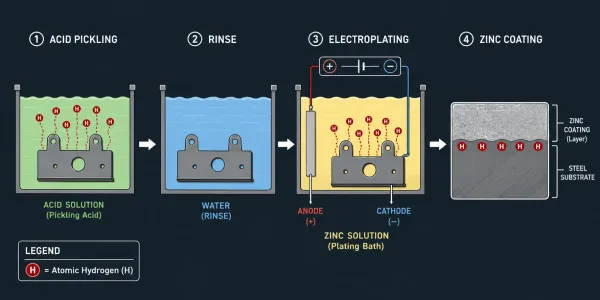
Simplified process flow showing acid pickling and electroplating as the two stages where atomic hydrogen is generated at the steel surface and absorbed into the substrate.
Acid pickling and cleaning is the first stage.
Before plating, the steel surface must be stripped of oxides, scale, and contaminants — typically using hydrochloric or sulfuric acid.
These acids dissolve surface layers but also attack the base metal, generating atomic hydrogen at the metal surface.
For high-strength steels, this pre-treatment step alone can introduce enough hydrogen to cause embrittlement.
The electroplating reaction is the second stage.
As zinc (or another metal) deposits onto the cathode — the steel part — hydrogen ions in the electrolyte are simultaneously reduced to atomic hydrogen at the same surface.
Acid zinc bath systems, the most common commercial zinc plating chemistry, generate more hydrogen absorption than alkaline zinc systems, though both require attention for high-strength substrates.
The zinc coating itself makes the problem worse.
Once deposited, it acts as a barrier that slows the outward diffusion of trapped hydrogen from the steel.
This is why prompt baking after plating is essential — it must happen before the coating fully seals the diffusion pathways.
Baking — The Standard Defense, With Limits
Post-plating baking — sometimes called hydrogen embrittlement relief or de-embrittlement — is the most widely used method for driving absorbed hydrogen out of the steel before it can cause damage.
Baking Parameters
The standard baking cycle for most zinc-plated steel parts falls within these ranges:
| Parameter | Typical Range | Key Standards |
|---|---|---|
| Temperature | 190–230°C (375–450°F) | ASTM B850, ISO 9587 |
| Duration | 4–24 hours (depends on part strength, coating type, and thickness) | ASTM B633, ISO 4042 |
| Timing | Begin within 1–4 hours of plating completion | ASTM B633, SAE AMS 2759 |
Higher-strength parts and thicker coatings generally require longer bake times.
For extremely critical applications — aerospace fasteners, safety hardware — baking may extend to 24 or even 48 hours, with validation testing per ASTM F519.
Timing Is Everything
The window between plating completion and oven entry is the most critical variable in the entire de-embrittlement process.
If a plated part sits at room temperature for too long, hydrogen atoms continue migrating deeper into the steel, concentrating at grain boundaries and stress concentrators.
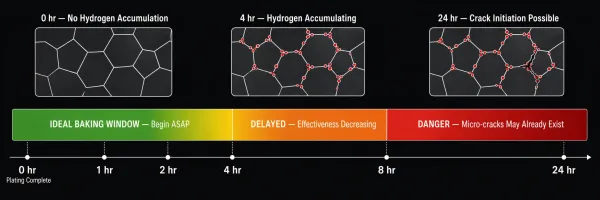
A timeline illustrating why baking must begin within 1–4 hours of plating completion. Hydrogen continues migrating deeper into the steel over time, and once micro-cracks initiate, the damage becomes permanent.
Once micro-cracks initiate at these sites, baking cannot reverse them — the damage is permanent.
ASTM B633 requires baking to begin “as soon as practicable” after plating.
Most industry standards specify 1 to 4 hours as the maximum acceptable delay.
For high-strength parts above HRC 40, the tighter end of this window — within 1–2 hours — is the safer practice.
What Baking Cannot Fix
Baking is effective at reducing risk, but it is not a guarantee.
Several conditions limit its effectiveness:
- Delayed oven entry — if the part has already been at room temperature for hours, hydrogen may have already caused irreversible microstructural damage
- Very high strength levels — parts above 220 ksi may retain residual risk even after standard baking cycles
- Dense coatings — thick or low-porosity coatings can block hydrogen egress, requiring longer bake times or alternative approaches
- Geometric stress concentrators — sharp bend radii, deep notches, and thread roots can trap hydrogen in localized zones that baking cannot fully reach
For these reasons, baking is best understood as risk reduction, not risk elimination.
The most reliable approach combines baking with material selection, process control, and — where possible — non-electrolytic coating alternatives.
Non-Electrolytic Alternatives That Eliminate the Risk at the Source
The most effective way to prevent hydrogen embrittlement is to avoid introducing hydrogen in the first place.
Several non-electrolytic coating technologies provide corrosion protection without the electrochemical reactions that generate atomic hydrogen.
Zinc flake coatings (marketed as Dacromet, Geomet, Delta-Protekt, and similar systems) are applied mechanically — zinc and aluminum flakes are bonded to the part surface using an inorganic binder, then cured at moderate temperatures.
Because there is no electrolysis, no hydrogen is generated during application.
These coatings also deliver excellent corrosion resistance, often exceeding 720–1,000 hours in neutral salt spray testing per ASTM B117.
Mechanical zinc plating uses a tumbling process in which zinc powder is cold-welded onto the part surface using glass beads as a peening medium.
Like zinc flake coatings, it is a non-electrolytic process that eliminates hydrogen introduction entirely.
Both alternatives have constraints — zinc flake coatings are thicker than electroplated zinc (typically 6–10 μm vs. 5–8 μm), which can affect thread fit on fasteners, and mechanical plating may not achieve the same surface brightness.
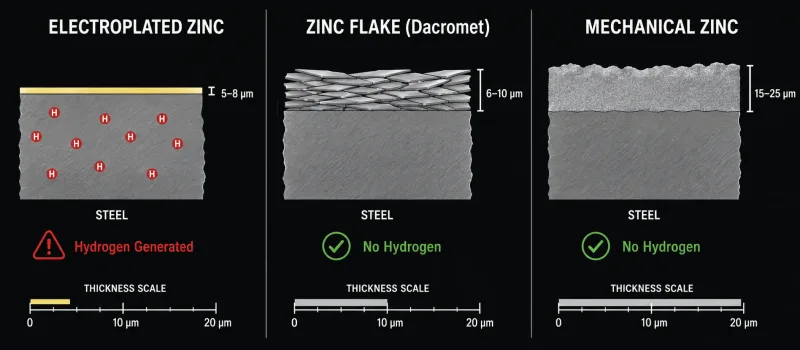
Side-by-side cross-section comparison of three coating types — electroplated zinc, zinc flake (Dacromet), and mechanical zinc — showing structural differences, typical thickness, and whether hydrogen is introduced during application.
But for high-strength parts where hydrogen embrittlement risk outweighs cosmetic requirements, these processes are the industry’s preferred solution.
What to Specify on Your Drawings
The gap between knowing hydrogen embrittlement exists and actually preventing it in production is bridged by what appears — or does not appear — on the engineering drawing.
Many hydrogen embrittlement failures trace back not to a plater’s negligence, but to a drawing that specified a coating standard without mentioning baking, material condition, or validation requirements.
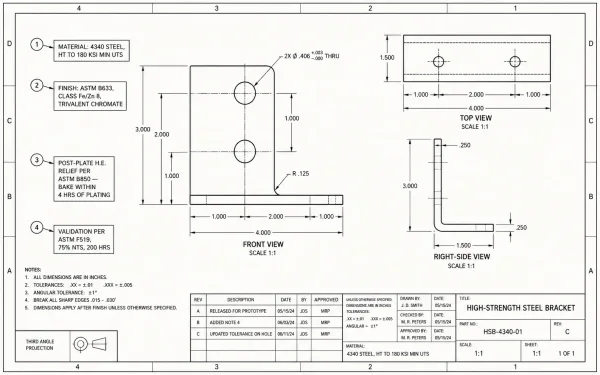
An example engineering drawing of a steel bracket with proper annotations for material callout, plating specification, hydrogen embrittlement relief baking requirement, and validation testing reference.
Complete sheet metal surface requirements for a plated high-strength steel part should include:
- Material callout — alloy, temper, and heat treatment condition (e.g., “4340 steel, heat treated to 180 ksi min. UTS”)
- Surface finish standard — with class, thickness, and passivation type (e.g., “ASTM B633, Class Fe/Zn 8, trivalent chromate”)
- Hydrogen embrittlement relief requirement — the baking standard and timing (e.g., “Post-plate hydrogen embrittlement relief per ASTM B850. Baking to begin within 4 hours of plating.”)
- Validation method — where risk warrants it (e.g., “Per ASTM F519, sustained load test at 75% notched tensile strength for 200 hours”)
Without these annotations, a plating supplier may follow their standard process, which — for many shops — does not include baking unless explicitly requested.
The cost of specifying baking on the drawing is a single line of text.
The cost of not specifying it can be a field failure with no warning.
Where Hydrogen Embrittlement Prevention Is Heading
The electroplating industry is moving toward lower-hydrogen process chemistries — alkaline zinc-nickel alloys, for example, generate significantly less hydrogen absorption than traditional acid zinc baths while delivering superior corrosion resistance.
These processes are gaining adoption in automotive and industrial applications where high-strength substrates are increasingly common.
At the same time, non-electrolytic coatings like zinc flake and mechanical plating are expanding beyond their traditional fastener stronghold into brackets, structural hardware, and other formed sheet metal parts.
As AHSS adoption grows across industries, the demand for hydrogen-safe finishing options will only increase.
For engineers and buyers, the practical takeaway is straightforward:
Hydrogen embrittlement prevention starts at the drawing stage, not at the plating bath.
Specifying the right material, the right sheet metal finishing process, and the right post-treatment requirements — in clear, unambiguous language — is the single most effective step you can take to prevent a failure that no inspection will catch before it happens.