
A technical clarification is a formal request from a manufacturer to a customer, asking for confirmation or additional detail on specifications in a drawing or quote package that are incomplete, ambiguous, or open to more than one reasonable interpretation.
It is not a sign that the manufacturer lacks capability — it is a safeguard against misinterpretation that could lead to wrong parts, cost overruns, or production delays.
Technical clarifications also occur before production, when the engineering team begins manufacturing process planning and needs confirmed requirements before selecting the operation sequence.
In both cases, the goal is the same — resolve ambiguity before it becomes a physical defect.
Technical Clarification vs. Related Terms
Several terms overlap with technical clarification in procurement and engineering communication. Understanding the distinctions helps you route questions to the right process and avoid delays.
| Term | What It Means | How It Differs from Technical Clarification |
|---|---|---|
| RFI (Request for Information) | A broad request covering any missing information — commercial, logistical, or technical | Broader in scope; a technical clarification is a subset focused specifically on engineering specifications |
| TQ (Technical Query) | Essentially the same concept, more common in construction and infrastructure projects | Interchangeable in practice; “technical clarification” is the prevailing term in custom manufacturing |
| ECO (Engineering Change Order) | A formal revision to a released design — changes geometry, material, or function | An ECO modifies the design intent; a technical clarification confirms the original intent |
| RFQ Follow-Up | General communication during the quoting process | A technical clarification is a specific type of RFQ follow-up that addresses a defined technical question |
In short: if the manufacturer is asking “what did you mean by this?” rather than “do you want to change this?” — it is a technical clarification.
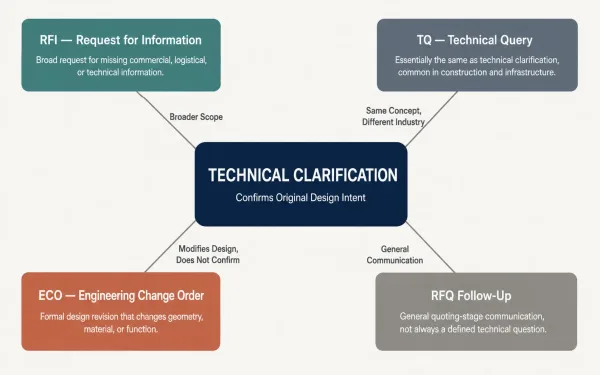
A visual comparison showing how technical clarification relates to and differs from RFI, Technical Query, Engineering Change Order, and RFQ follow-up in the manufacturing workflow.
When Does a Manufacturer Issue a Technical Clarification?
Manufacturers do not issue clarifications on every drawing.
A clarification is triggered when a specification has more than one reasonable reading, and choosing the wrong one would result in a non-conforming part.
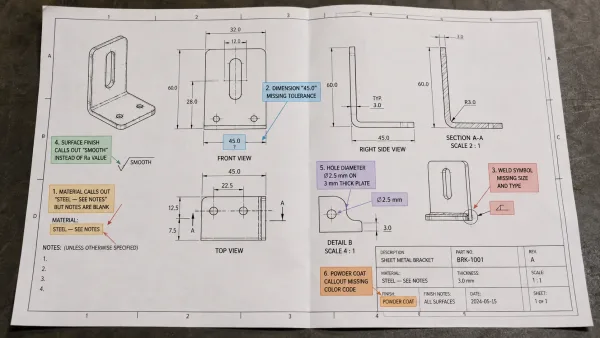
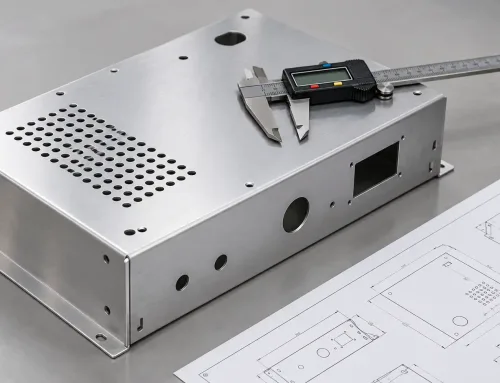
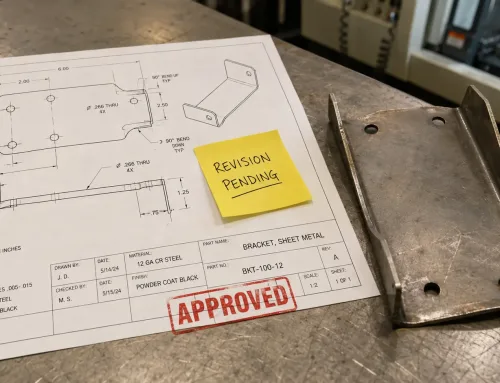
A detailed close-up of a sheet metal fabrication drawing with six annotated callout areas, each illustrating a common scenario that triggers a technical clarification — ambiguous material, unclear tolerances, missing weld specs, vague finish requirements, geometric conflicts, and incomplete secondary process details.
Here are the most common scenarios in sheet metal fabrication:
Ambiguous or missing material specification.
A drawing says “steel” without specifying a grade. Cold-rolled steel (AISI 1018), stainless steel (304), and galvanized steel all behave differently in forming, welding, and finishing. The manufacturer must confirm which grade the designer intended.
Inconsistent tolerance callouts.
The general tolerance block specifies ±0.5 mm, but a critical dimension has no individual tolerance. The manufacturer needs to know whether the general tolerance applies or whether the dimension requires tighter control.
Unclear welding requirements.
A drawing calls for welding but does not specify weld type (fillet, groove, spot), weld location, quality standard (AWS D1.1, ISO 5817), or whether cosmetic appearance matters. Each combination leads to a different process and cost.
Vague surface finish descriptions.
Terms like “smooth finish” or “clean surface” are not measurable. A manufacturer needs a quantified specification — Ra 0.8 μm, for example, or a reference to a standard like SSPC-SP6 — to select the right finishing process and verify the result.
Geometric conflicts.
A hole diameter is smaller than the material thickness, a bend radius is tighter than the material’s minimum allowable, or a feature is dimensioned from a datum that is not physically accessible during forming. These are not design errors per se, but they require confirmation before tooling is selected.
Missing secondary process details.
For a drawing-based product such as a custom WiFi router metal housing, specifying powder coating without the required color, thickness range, or masking details leaves important manufacturing requirements unresolved. The manufacturer needs these details to quote accurately and plan the production sequence.
In each case, the manufacturer could make an assumption and proceed — but if the assumption is wrong, the result is scrap, rework, or a delayed shipment.
A technical clarification adds a small amount of time upfront to avoid a much larger disruption later.
How Technical Clarification Affects Quoting and Lead Time
A technical clarification is not a bureaucratic step. It has direct, measurable effects on project timelines and cost.
Quoting cannot be finalized until clarifications are resolved.
If a drawing specifies “aluminum” without a temper (6061-T6 vs. 5052-H32), the material cost, forming behavior, and weldability are all different. The manufacturer may provide a preliminary quote based on an assumption, but the final price will depend on the confirmed specification.
Clarification results can change the manufacturing process.
Suppose a customer specifies 304 stainless steel but the actual application requires 316 for corrosion resistance. The clarification changes the material, which may change the laser cutting parameters, the bending tooling, and the finishing process. If this change happens after production starts, it means scrapped parts and restarted production.
Each clarification round adds lead time.
A straightforward question — “Does this dimension apply to the formed or flat state?” — may be resolved in one business day. A complex clarification involving material substitution or tolerance renegotiation can take three to five business days. If multiple rounds are needed, the cumulative delay compounds.
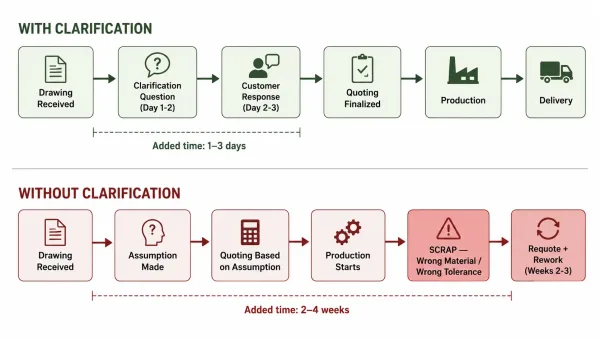
A process timeline comparing two scenarios — one where a technical clarification is resolved before production, and one where ambiguity is ignored, leading to scrap and rework — demonstrating the time and cost impact of each approach.
The practical implication: when you receive a technical clarification from your manufacturer, responding promptly and precisely is one of the most effective ways to keep your project on schedule.
A two-day delay in answering a clarification question often translates to a two-day delay in receiving your parts.
How to Reduce Technical Clarifications
You cannot eliminate technical clarifications entirely — complex parts will always have edge cases.
You can significantly reduce clarification rounds by submitting a complete sheet metal RFQ package with unambiguous material, tolerance, welding, finish, and quantity requirements upfront.
The following checklist covers the information that most commonly triggers clarifications when missing:
- Material grade and temper. Write “AISI 304 stainless steel, annealed” rather than “stainless steel.” If you are flexible on grade, say so explicitly.
- Tolerances on critical dimensions. If a dimension must be held to ±0.1 mm, call it out individually. Do not rely on a general tolerance block for features that matter.
- Weld type, location, and quality standard. Specify fillet or groove, indicate weld seams on the drawing, and reference a standard (e.g., AWS D1.1, ISO 5817 Class C).
- Surface finish with a measurable value. Use Ra values (e.g., Ra 1.6 μm) or reference a standard (e.g., SSPC-SP6). Avoid subjective terms like “smooth” or “mirror finish” without a definition.
- Secondary processes with full detail. For powder coating, specify color (RAL or Pantone code), thickness (60–80 μm is typical), and masking requirements. For anodizing, specify type (II or III), color, and thickness.
- Assembly context. If a part mates with another component, include a simple assembly drawing or note the mating part number. This helps the manufacturer flag fit issues before they become problems.
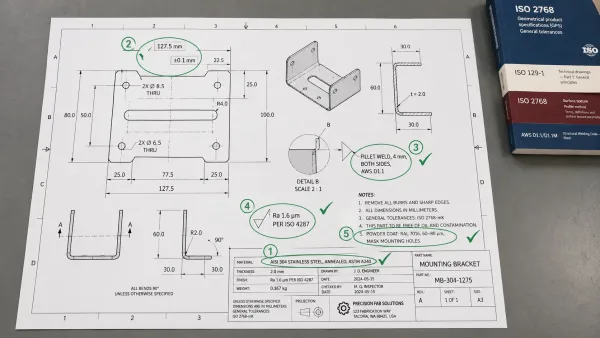
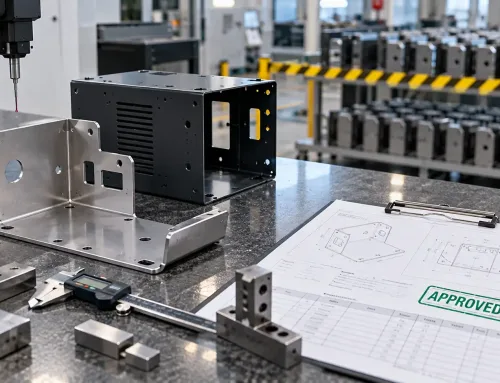
A well-annotated sheet metal drawing demonstrating best practices for reducing technical clarifications — every specification field is fully defined with measurable values, standards references, and clear callouts, serving as a visual checklist for engineers preparing quote packages.
Providing this information does not make your drawing more complicated — it makes it more actionable.
A manufacturer receiving a complete specification package can quote faster, plan production more accurately, and deliver with fewer interruptions.