
When engineers and procurement teams ask which coating process has the shorter lead time, they often expect a simple answer: powder coating or wet painting. The reality is more nuanced. Lead time is not a fixed attribute of a coating method—it is a variable outcome determined by part geometry, coating system complexity, batch size, supplier capability, and logistical factors. Choosing the faster option requires understanding these variables, not just comparing generic process speeds.
The Real Question Isn’t “Which Is Faster” — It’s “Faster Under What Conditions?”
The question “which is faster” assumes a direct comparison between two static processes. In practice, a single-coat powder coating on a simple bracket may ship in three days, while a multi-coat wet paint system on a complex enclosure could take three weeks. Conversely, a small batch of prototypes requiring custom color matching might move faster through a wet painting shop with flexible scheduling than through a powder coating line optimized for high-volume production. The answer depends entirely on the specific project parameters.
This article provides a framework for evaluating lead time based on your project’s actual requirements, not industry generalizations. We will break down the time components of each process, identify the key variables that drive turnaround, and offer practical guidance for specifying lead time expectations in your requests for quotation.
How Powder Coating and Wet Painting Work: Process Overview
Understanding the fundamental workflow of each coating method is essential before analyzing lead time. While both processes aim to protect and finish metal surfaces, their application methods, curing mechanisms, and production sequences differ significantly.
Powder Coating: Electrostatic Application and Curing
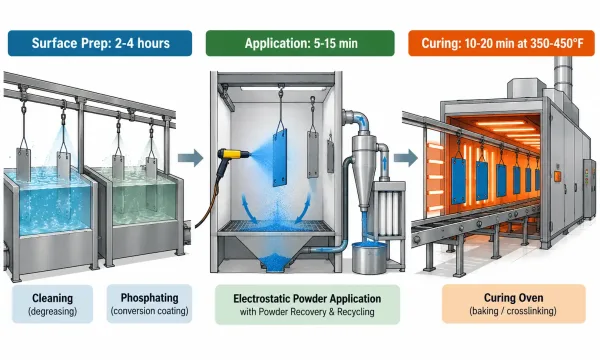
Three-stage powder coating process: surface preparation, electrostatic powder application, and thermal curing in oven.
Powder coating applies a dry, free-flowing powder to a grounded workpiece using an electrostatic spray gun. The charged powder particles adhere to the part surface until heat fuses them into a continuous film. The process typically involves three main stages: surface preparation, powder application, and thermal curing. Surface preparation usually includes cleaning, phosphating, or chromate conversion to ensure adhesion. The powder is applied in a spray booth, often with reclaim systems to recycle overspray. Finally, the coated part enters a curing oven where the powder melts, flows, and cross-links into a durable finish at temperatures between 350°F and 450°F (175°C–230°C) for 10 to 20 minutes.
Wet Painting: Spray Application and Drying
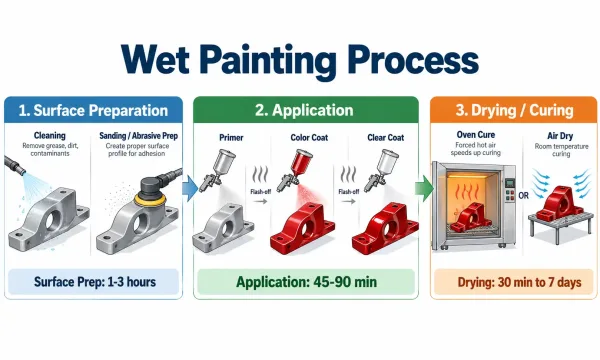
Wet painting process showing surface preparation, multiple coat application with flash-off periods, and final drying/curing.
Wet painting, also called liquid painting or spray painting, applies a liquid coating material—typically solvent-based or water-based paint—using conventional, airless, or electrostatic spray equipment. The process also begins with surface preparation, which may include cleaning, sanding, and priming. The liquid coating is applied in multiple thin layers, with flash-off periods between coats to allow solvent evaporation. After the final coat, the part enters a drying phase that may involve air drying, force drying at elevated temperatures, or baking in an oven. Drying times vary widely based on paint chemistry: water-based acrylics may dry to touch in 30 minutes but require 24 hours for full cure, while two-component epoxies may need 7 days at room temperature.
Breaking Down Lead Time: From Surface Prep to Final Inspection
Lead time for coating processes extends beyond the actual application and curing steps. It encompasses all activities from when the part arrives at the coating facility to when it is inspected, packaged, and ready for shipment. Understanding these components helps identify where time is spent and where efficiencies can be gained.
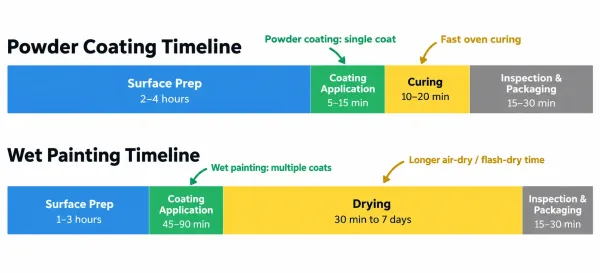
Horizontal timeline comparing time components for powder coating and wet painting, from surface preparation to final inspection.
Surface Preparation Time: Cleaning, Phosphating, and Masking
Surface preparation is often the most time-consuming variable in coating lead time. For powder coating, preparation typically includes alkaline cleaning, rinsing, and conversion coating (iron phosphate or zinc phosphate), which may take 2–4 hours in automated lines or longer for manual processes. Wet painting may require similar cleaning plus additional steps like sanding, scuffing, or primer application, adding 1–3 hours. Masking—covering areas that must remain uncoated—adds time proportional to part complexity. Simple parts may need 15 minutes of masking; complex assemblies with multiple masked zones may require 2–3 hours.
Application and Curing/Drying Time
Application time depends on the number of coats and the method’s transfer efficiency. Powder coating typically requires a single coat applied in 5–15 minutes per part, followed by 15–25 minutes of oven curing. Wet painting often requires multiple coats—primer, base coat, clear coat—with flash-off periods between each. A three-coat wet system may take 45–90 minutes of application time, plus 30–60 minutes of oven baking or 24 hours of air drying. For large batches, conveyorized powder coating lines can process hundreds of parts per hour, while wet painting booths may handle 20–50 parts per hour depending on size and complexity.
Quality Inspection and Rework Allowance
Inspection and potential rework add contingency time to lead estimates. Both processes require adhesion testing, thickness measurement, and visual inspection. Powder coating typically has lower reject rates due to its single-coat application and uniform thickness, but repairs are more difficult—damaged areas often require complete stripping and recoating. Wet painting allows easier touch-up and blending, reducing rework time for minor defects. However, wet paint systems are more sensitive to application errors like runs, sags, or orange peel, which may require sanding and recoating. A realistic lead time estimate should include 5–10% buffer for inspection and minor rework.
Five Factors That Actually Determine Your Coating Lead Time
Generic comparisons between powder coating and wet painting miss the point. Your project’s lead time is determined by specific factors that interact in ways unique to your parts and requirements.
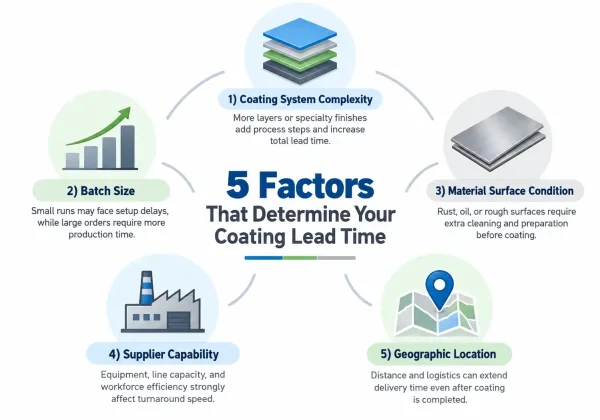
Infographic showing five factors that determine coating lead time with icons and brief explanations.
Factor 1: Coating System Complexity (Single vs Multi-Coat)
The number of coating layers has the greatest impact on lead time. A single-coat powder system—primer and color combined—may require only 2–3 hours of total process time. A multi-coat wet system with primer, base coat, and clear coat can easily double or triple that time due to additional application steps, flash-off periods, and curing cycles. Specifying a simpler coating system is the most effective way to reduce lead time, regardless of the process chosen.
Factor 2: Batch Size and Production Scheduling
Batch size affects lead time through setup efficiency and scheduling priority. Small batches (under 50 parts) often move faster through wet painting shops because setup time is minimal and color changes are quick. Powder coating lines have longer setup times for color changes and oven temperature adjustments, making them less efficient for small, mixed-color batches. For large batches (over 500 parts), powder coating’s conveyorized processing and fast cure times typically yield shorter overall lead times. Medium batches (50–500 parts) may show little difference between processes, depending on the supplier’s current workload and scheduling.
Factor 3: Material and Surface Condition
The substrate material and its condition influence preparation time. Aluminum parts may require chromate conversion or anodizing before coating, adding a day to the process. Hot-rolled steel with mill scale needs more aggressive cleaning than cold-rolled steel. Parts arriving with oil, grease, or rust require additional degreasing or blasting, extending preparation time by 1–2 hours. Specifying the surface condition on your drawing—such as “HRPO dry” or “cold-rolled, degreased”—helps the coater estimate preparation time accurately.
Factor 4: Supplier Capability and Capacity
Supplier capability is often the hidden variable in lead time. A powder coating shop with automated lines, multiple ovens, and dedicated masking crews can process parts faster than a manual operation. Similarly, a wet painting shop with experienced spray operators and well-maintained equipment will have fewer rejects and rework. Current capacity matters equally: a shop running at 80% capacity may quote 5-day lead time, while the same shop at 95% capacity may quote 10 days. Asking suppliers about their current workload and typical lead times for similar parts provides more accurate estimates than comparing process types.
Factor 5: Geographic Location and Logistics
Shipping time between your facility and the coating shop adds to total lead time. If your fabricator subcontracts coating to a remote specialist, you may add 2–5 days of transportation time each way. Choosing a fabricator with in-house coating capabilities—or a coating shop nearby—can reduce total lead time by eliminating this logistics gap. For international sourcing, customs clearance and freight forwarding can add 1–2 weeks, making local coating options more attractive despite potentially higher unit costs.
Sheet Metal Specifics: Why Your Part Geometry Changes the Timeline
Sheet metal parts present unique challenges that affect coating lead time differently than cast, machined, or molded parts. These geometric and manufacturing constraints must be considered when estimating turnaround.
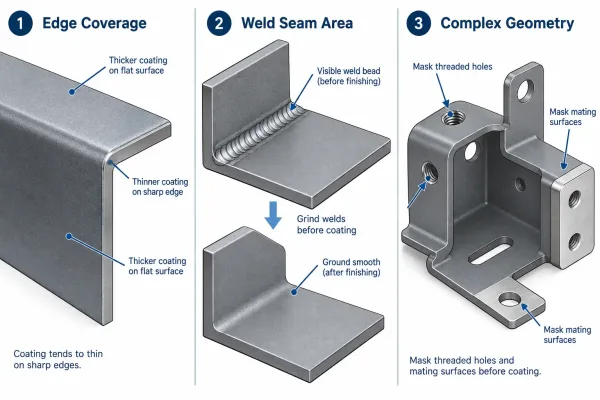
Technical illustration showing common sheet metal coating challenges: edge pull-back, weld buildup, and masking requirements.
Edge Coverage and Weld Seam Considerations
Sharp edges and weld seams are problem areas for both coating processes. Powder coating tends to pull away from sharp edges (“edge coverage effect”), requiring either pre-rounding of edges or acceptance of thinner coverage at these points. Wet painting provides better edge coverage but may build up excessively on weld seams, requiring grinding or sanding before coating. Both processes may need additional preparation time for parts with continuous welds, weld spatter, or rough edges. Specifying edge break requirements on your drawing—such as “break all sharp edges 0.5mm”—helps the coater estimate preparation time.
Complex Shapes and Masking Requirements
Parts with deep draws, tight corners, or recessed areas require more masking and may have longer application times. Powder coating’s electrostatic attraction helps it reach recessed areas better than spray painting, but Faraday cage effects can limit penetration into deep cavities. Wet painting allows more precise control for complex geometries but requires skilled operators and multiple spray angles. Parts requiring masking of threaded holes, mating surfaces, or grounding points add 30–60 minutes of masking time per part, depending on complexity.
Post-Bend and Post-Weld Coating Sequences
The sequence of forming, welding, and coating affects both lead time and quality. Coating before bending may cause cracking at bend radii; coating after welding may trap weld splatter or heat discoloration under the finish. Most fabricators prefer to coat after all forming and welding operations are complete, but this may require additional cleaning steps to remove welding residues. If your design allows coating before assembly, discuss the sequence with your fabricator early in the design phase to avoid rework and delays.
Choosing the Faster Option: A Decision Framework
Rather than declaring one process universally faster, use this decision framework to evaluate which option is likely to have shorter lead time for your specific project.
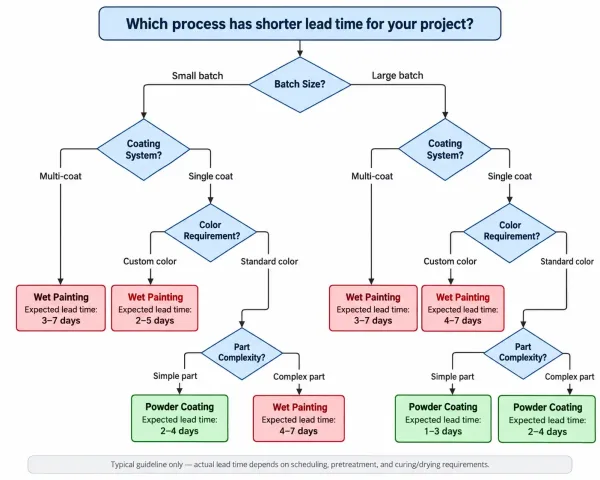
Flowchart helping users decide which coating process offers shorter lead time based on project requirements.
When Powder Coating Typically Wins on Lead Time
Powder coating tends to have shorter lead time when:
- The part requires a single-coat system (color and protection combined)
- Batch size is large (over 500 parts) and can justify line setup
- The part geometry is simple with minimal masking requirements
- The coating shop has automated lines and available capacity
- The part material is steel or aluminum with standard surface condition
- No custom color matching is required (standard RAL or Pantone colors)
When Wet Painting May Be the Faster Choice
Wet painting may offer shorter lead time when:
- The part requires multiple coats (primer + color + clear coat)
- Batch size is small (under 50 parts) with frequent color changes
- Custom color matching is required (specialty colors, metallic finishes)
- The part has complex geometry requiring precise application control
- Touch-up and repair capability is important for the application
- The coating supplier has flexible scheduling and quick changeover
The Hidden Cost of Rushing: Quality vs Speed Trade-offs
Expedited lead times often come with quality trade-offs. Rushing surface preparation may compromise adhesion; skipping flash-off periods may cause solvent entrapment; reducing cure time may result in under-cured coatings with poor chemical resistance. Before requesting expedited processing, consider whether the application truly requires the fastest possible turnaround or whether a slightly longer lead time with proper process control is more cost-effective in the long run.
How to Specify Lead Time Requirements in Your RFQ
Clear communication of lead time expectations in your request for quotation helps suppliers provide accurate estimates and avoids misunderstandings later in the process.
Essential Lead Time Information to Include
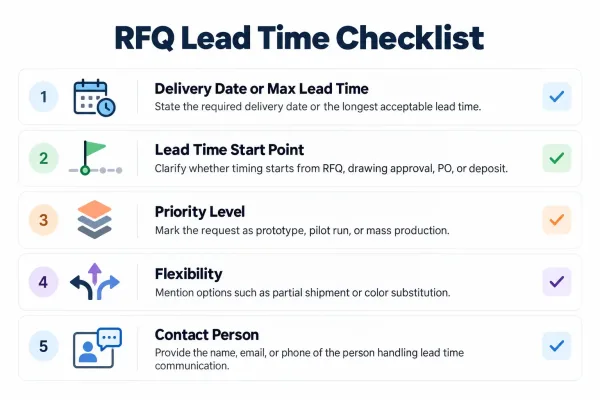
Visual checklist showing essential information to include in RFQ for accurate lead time quotes.
Your RFQ should specify:
- Required delivery date or maximum acceptable lead time (e.g., “parts needed by October 15” or “maximum 10 business days from PO”)
- Whether lead time is measured from drawing approval, material receipt, or production start
- Priority level: is this a prototype rush, production order, or standard delivery?
- Any flexibility: can you accept partial shipments or alternative coating colors?
Sample vs Production Lead Time Considerations
Sample orders typically require longer lead time per part due to setup time and first-article inspection requirements. Production orders benefit from established processes and optimized scheduling. When requesting quotes, ask suppliers to provide separate lead time estimates for samples and production quantities. This helps you plan project timelines accurately and avoids surprises when transitioning from prototype to production.
Communication Strategies to Avoid Delays
Several communication practices help maintain lead time commitments:
- Provide complete and accurate drawings with all coating specifications clearly noted
- Respond promptly to technical clarification requests from the coating shop
- Approve samples and first articles quickly to avoid production delays
- Confirm shipping instructions and packaging requirements early in the process
- Establish a single point of contact for technical and scheduling questions
Key Takeaways: Matching Your Project to the Right Process
The lead time comparison between powder coating and wet painting is not a simple binary choice. Instead, it requires evaluating your project’s specific requirements against the factors that actually drive turnaround time. For large batches of simple parts with standard colors, powder coating often provides shorter lead times due to efficient processing and fast curing. For small batches, complex geometries, or custom colors, wet painting may move through the shop faster with less setup overhead.
The most effective strategy for minimizing lead time is to specify your coating requirements clearly and completely on your drawings, discuss sequencing and preparation requirements with your fabricator early in the design process, and choose a coating supplier with demonstrated capability and available capacity for your part type and batch size. By focusing on these practical considerations rather than generic process comparisons, you can make informed decisions that keep your projects on schedule.
Need help optimizing your sheet metal coating specifications? Our engineering team can review your drawings and provide DFM feedback to reduce lead time and improve coating performance. Upload your design for a free review within 24 hours.