
A lightweight sheet metal enclosure that looks correct on paper can still fail in production. Walls buckle during forming. Bend radii crack at the edges. Weight targets are met only by sacrificing structural integrity. The root cause is usually not the manufacturer’s equipment — it is a design that did not account for how thin-gauge metal behaves under real-world forces.
Evaluating a supplier’s lightweight design capability means checking whether their engineering team can catch these problems before they reach the shop floor.
Why Lightweight Design Capability Differs from General Sheet Metal Design
Lightweight Design Is Not Just Thinner Material
Many buyers assume lightweight sheet metal design simply means specifying thinner stock. In practice, reducing wall thickness from 1.5 mm to 0.8 mm changes every downstream decision — bend allowance calculations, punch tooling selection, welding parameters, and even packaging methods. A supplier experienced only with standard-gauge parts may not anticipate the cascading effects of these choices.
General sheet metal design focuses on manufacturability at a given thickness. Lightweight design adds a second constraint: achieving a target weight while maintaining stiffness, strength, and dimensional stability. This dual objective requires a different engineering mindset — one that treats weight as a design parameter, not an afterthought.
The Hidden Cost of Getting It Wrong
When a supplier lacks lightweight design expertise, the consequences appear downstream. Parts arrive warped from internal stress relief. Assembly tolerances stack up because thin panels flex under bolt load. Prototype cycles stretch from two weeks to six because each iteration requires redesign rather than minor adjustment.
The cost is not always visible in the initial quote. A supplier that quotes low but cannot optimize for lightweighting may produce parts that require secondary straightening, additional stiffening brackets, or thicker material than necessary — all of which erode the original weight and cost targets.
What Makes Lightweight Sheet Metal Parts Harder to Design
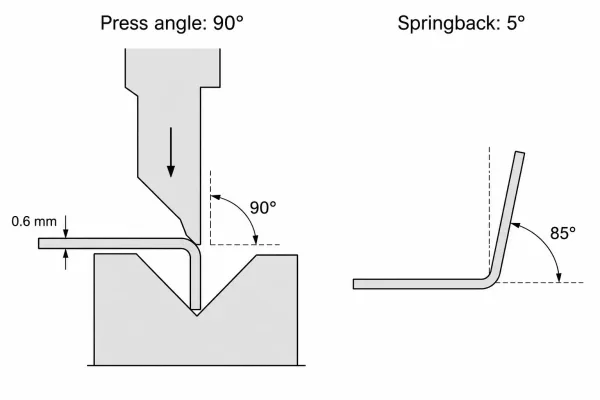
A side-view comparison showing a thin sheet metal part before and after bending, with springback angle labeled to illustrate why lightweight parts require tighter forming control.
Thin Wall Deformation and Springback
Sheet metal below 1.0 mm thickness behaves differently during bending. The material springback angle increases, meaning the final bend angle deviates more from the programmed press brake angle.
For a 0.6 mm aluminum bracket, springback can exceed 5 degrees — enough to push a part out of tolerance if the designer did not compensate in the flat pattern.
Thin walls also deform under handling and fixturing pressure. A vacuum chuck or welding clamp that works reliably on 2.0 mm steel can dent or buckle 0.5 mm aluminum. Suppliers with lightweight experience design fixturing contact points into the part geometry; those without it discover the problem only after the first batch arrives with surface marks.
Weight-Reduction Features That Weaken the Structure
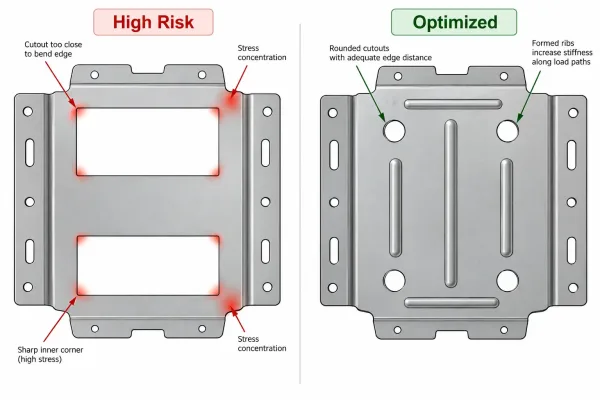
A top-down view of two sheet metal panels — one with improperly placed cutouts causing stress concentration, and one with proper rib reinforcement maintaining structural integrity.
Lightening holes, relief cutouts, and stepped profiles reduce mass — but they also introduce stress concentrations. A circular cutout near a bend line can cause cracking during forming. A rectangular slot in a load-bearing panel shifts the neutral axis and changes how the part deflects under load.
Experienced suppliers evaluate these features during design review. They flag cutouts placed too close to edges, suggest radius corners on slots to reduce stress risers, and recommend rib patterns instead of large open cutouts when stiffness matters more than absolute weight.
Material Selection Trade-offs for Lightweighting
Not all lightweight materials suit all applications.
Aluminum 5052-H32 bends well but has lower yield strength than 6061-T6; choosing 6061 for its strength means accepting tighter bend radii and higher springback. High-strength low-alloy (HSLA) steel offers weight savings over mild steel at the same thickness, but its higher yield strength demands more press brake tonnage and sharper tooling.
A supplier’s ability to recommend the right alloy-temper combination for a given weight target — rather than defaulting to whatever they stock — is a direct indicator of lightweight design competence.
How to Read Design Files for Lightweight Intent
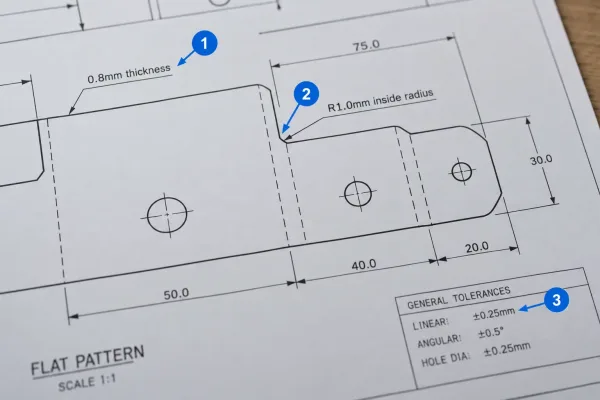
A section of a sheet metal flat pattern drawing with callout arrows pointing to key annotations: wall thickness (0.8mm), inside bend radius (1.0mm), and tolerance specifications.
Wall Thickness and Bend Radius Choices
The first signal in a lightweight design file is the wall thickness relative to the part’s overall size. A 300 mm × 200 mm enclosure at 0.8 mm thickness suggests the designer is targeting significant weight reduction.
The second signal is bend radius: a tight inside radius (0.5× material thickness or less) on thin stock indicates either aggressive lightweighting or insufficient forming knowledge — the supplier’s DFM feedback should clarify which.
Look for consistency. If the designer specifies 0.8 mm walls but 2.0 mm mounting flanges, the part may be a hybrid design where certain zones need reinforcement. A capable supplier recognizes this and does not flag it as an error.
Reinforcement Ribs and Gusset Placement
Thin panels that span large areas require stiffening. The design file should show either formed ribs (created by partial-depth press brake bends or stamping dies) or welded gusset plates.
The placement of these features reveals the designer’s structural intent — ribs along load paths, gussets at corners, and cross-bracing on open panels.
If the design has no stiffening features on a thin, wide panel, the supplier should raise this during DFM review. Silence on this point suggests the supplier either did not notice or does not consider it their responsibility — both are warning signs.
Tolerance Annotations That Signal Design Maturity
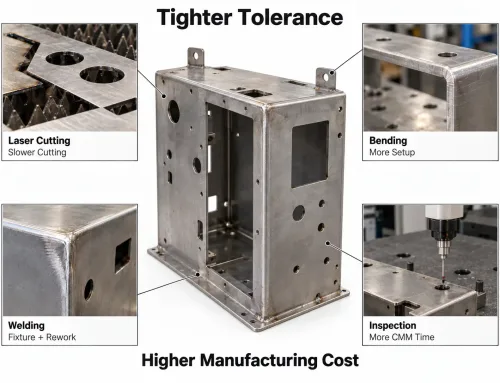
Tight tolerances on non-critical features are common in designs created by engineers unfamiliar with sheet metal manufacturing.
A ±0.1 mm flatness callout on a 0.6 mm aluminum cover panel, for example, is achievable only with secondary straightening — an operation that adds cost and lead time without improving function.
A supplier with lightweight design experience will question such tolerances during RFQ review. They will suggest relaxing non-critical dimensions to ±0.25 mm or ±0.5 mm where possible, reducing the number of secondary operations and keeping the part within the weight-cost target.
Five Dimensions to Evaluate a Supplier’s Lightweight Design Capability
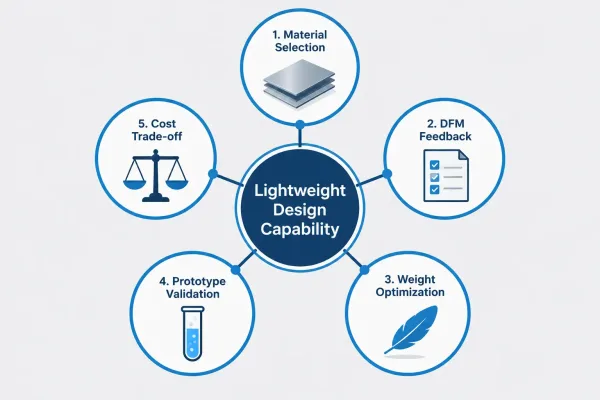
A radial diagram displaying five evaluation dimensions: Material Recommendation, DFM Feedback Quality, Lightweight Optimization, Prototype Validation, and Cost-Weight Trade-off.
Material Recommendation and Selection Guidance
Ask the supplier which alloys they recommend for your weight target and application.
A capable supplier will discuss trade-offs — for example, suggesting 5052-H32 for a bent enclosure that needs good formability, or 6061-T6 for a structural bracket that needs higher yield strength despite tighter bend constraints.
If the answer is limited to “what do you want to use?”, the supplier is executing your design rather than contributing to it.
DFM Feedback Quality and Specificity
Request a sample DFM report from a previous lightweight project.
Generic feedback (“this part should be manufacturable”) tells you nothing.
Specific feedback — “the 0.5 mm wall at feature X will likely buckle during bending; consider adding a stiffening bead or increasing to 0.8 mm” — demonstrates real engineering judgment.
The best DFM feedback includes alternatives:
“Option A meets your weight target but requires a custom forming die ($X NRE). Option B is 12% heavier but forms on standard tooling with no NRE.”
This level of detail indicates the supplier understands lightweight design is a series of trade-offs, not a single optimization.
Lightweight Optimization Suggestions
Beyond DFM corrections, evaluate whether the supplier proactively suggests weight-reduction opportunities.
Examples include: replacing welded stiffeners with formed ribs, thinning non-critical flanges, or reorienting a cutout to avoid a bend line.
These suggestions should appear in the DFM report, not require repeated follow-up.
Prototype Validation Capability
For lightweight parts, prototype validation is not optional — it is essential.
Ask the supplier whether they produce functional prototypes (not just visual models) and whether they measure weight, dimensional accuracy, and forming quality against the design intent.
A supplier that skips prototype validation for lightweight parts is accepting higher risk in production.
Cost-Weight Trade-off Guidance
A capable supplier can articulate the cost impact of weight-reduction decisions.
For example:
“Reducing wall thickness from 1.0 mm to 0.8 mm saves 20% weight but increases forming complexity and adds $X per part for tighter tooling tolerances.”
This guidance helps you make informed decisions rather than discovering cost surprises after committing to a design.
How to Verify Whether a Supplier’s DFM Advice Actually Works
Request Before-and-After Design Comparisons
Ask the supplier to show the original design alongside their suggested revision, with annotations explaining each change.
This exercise reveals whether the DFM feedback is substantive or cosmetic. If the supplier can only say “we changed the bend radius” without explaining why, the advice may not be grounded in manufacturing reality.
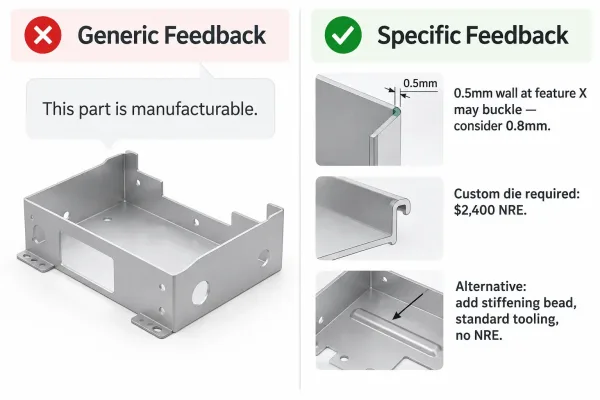
A split-screen comparison showing a generic DFM response on the left (“manufacturable”) versus a detailed DFM response on the right with specific forming risk, cost impact, and alternative suggestions.
Evaluate the Specificity of Feedback
Vague feedback — “this feature may be difficult to form” — is less useful than precise guidance:
“this feature will require a wiping die with a 0.3 mm minimum radius, which adds $X NRE and 3 days to lead time.”
Specific feedback allows you to evaluate the trade-off and decide whether to accept the cost, modify the design, or seek an alternative supplier.
Check if Suggestions Are Manufacturable
Counter-intuitively, some DFM suggestions are not actually manufacturable. A supplier may suggest a stiffening rib pattern that looks good in CAD but requires a custom stamping die they do not own.
Always ask:
“Can you produce this with your current equipment, and if so, what is the cost and lead time impact?”
The answer separates suppliers who understand their own capabilities from those who forward engineering suggestions without verification.
Lightweight Design vs. Cost and Lead Time: What to Expect
When Lightweighting Adds Cost
Lightweight designs often require tighter tolerances, custom tooling, or secondary operations — all of which increase per-part cost.
A thin-wall enclosure that needs a forming die to prevent wrinkling, or a panel that requires post-form straightening to meet flatness specs, will cost more per unit than a standard-gauge equivalent.
The cost premium is not a supplier markup; it is the real manufacturing cost of achieving a weight target.
When Lightweighting Reduces Cost
In some cases, lightweighting reduces cost.
Thinner material costs less per sheet. Smaller parts require less cutting time. Reduced weight lowers shipping costs — a factor that matters significantly for high-volume or international orders.
A supplier with lightweight experience can identify these savings and factor them into the quote.
How to Balance Weight Targets with Budget
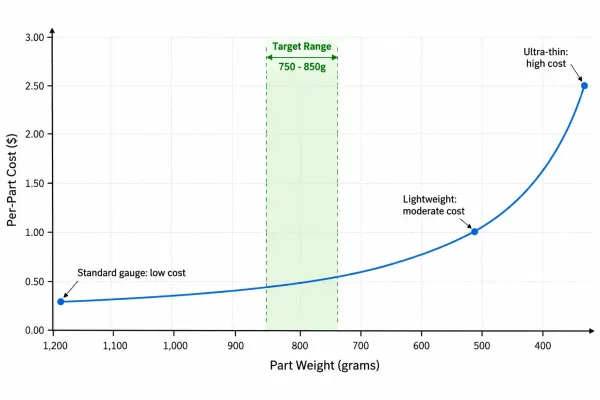
A line chart illustrating how per-part cost increases as weight decreases, with a highlighted “optimal range” zone where cost and weight balance.
The most effective approach is to define a weight range rather than a single number.
For example:
“Target weight 800 g ± 50 g; maximum acceptable weight 900 g.”
This range gives the supplier room to optimize for cost within the weight constraint. A rigid single-number target forces the supplier into the most expensive manufacturing path — and they may not tell you there was a cheaper alternative 30 g heavier.
FAQ
How to Start Evaluating Suppliers for Lightweight Capability
Begin with a simple test: send a lightweight design file to two or three candidate suppliers and request DFM feedback.
Compare the specificity, depth, and cost-weight trade-off guidance in each response.
The supplier that identifies forming risks, suggests material alternatives, and provides cost implications — rather than simply confirming the design is “manufacturable” — is the one with genuine lightweight design capability.
If you are working on a lightweight sheet metal project and want an engineering review of your design, contact our team for a DFM assessment. We can evaluate your design for forming feasibility, weight optimization opportunities, and cost-effective manufacturing paths.