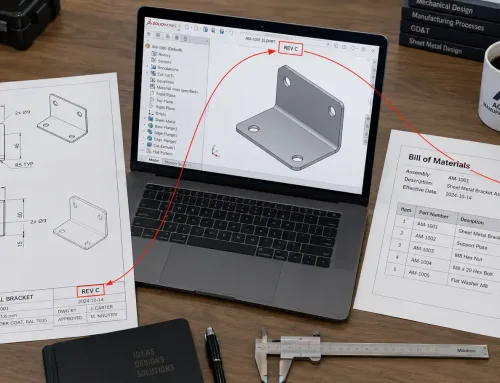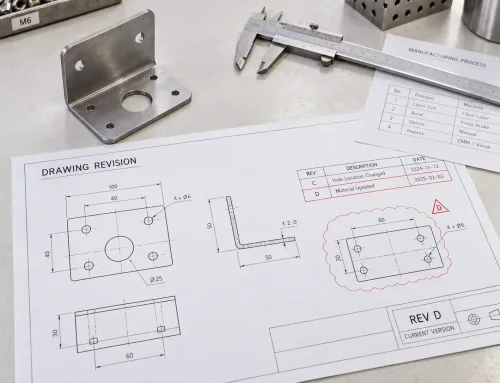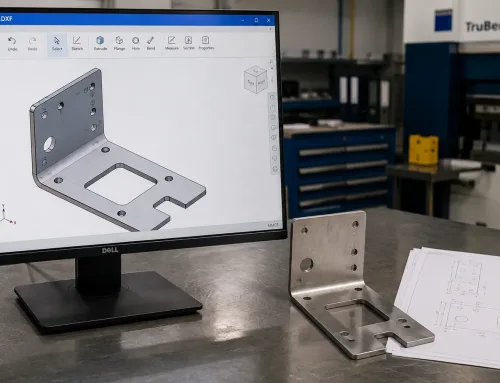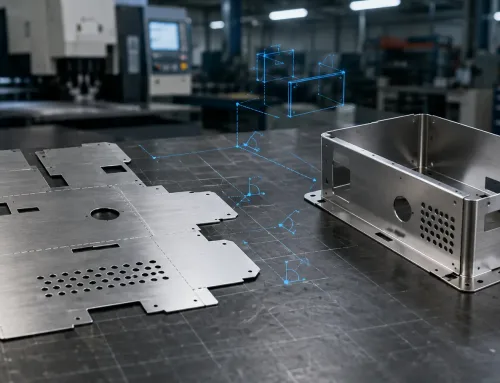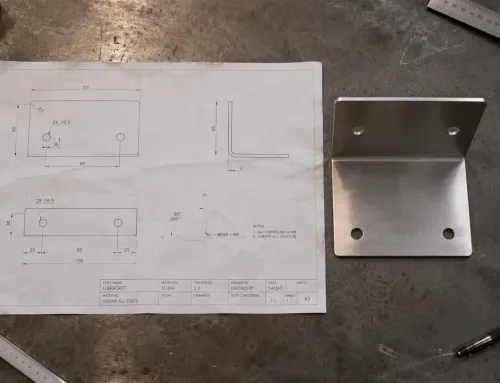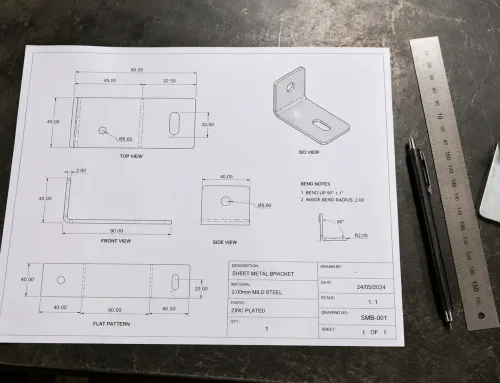

You send a drawing package to a sheet metal supplier and expect a quote in two days. Instead you get a list of questions: which revision is current, which material grade applies, whether the 3D model matches the flat pattern, and what the surface finish callout actually requires. Days pass while files are re-sent and answers are checked. That delay is rarely a capacity problem. It is usually the missing step of an engineering review — checking that the package is complete, clear, and consistent before anyone prices or cuts metal.
What “Engineering Review” Means in a Manufacturing Order
In a manufacturing context, an engineering review is the systematic check of an engineering data package before it is released for quotation or production. The question it answers is simple: can a fabricator read these files, quote them without guesswork, and build the part you intend?
The review focuses on the documents that carry design intent — drawings, CAD models, material callouts, revision status, and written requirements — and on whether those documents agree with one another. It is not a branding exercise and not a ceremonial meeting. It is a pass/fail style assessment of whether the information is ready to act on.
This meaning matters because “engineering review” is overloaded in search results. Some pages describe academic journals. Others describe company-wide quality system audits or multi-stage design gates in hardware programs. Those uses are real, but they answer a different question. For custom parts, the practical definition is narrower: a pre-release check of the files a supplier will use to quote and make the part.
What Engineering Review Is Not
Confusing engineering review with adjacent processes is how packages get released too early. Three distinctions keep the boundary clear.
Engineering review vs. design review
A design review (for example, a preliminary or critical design review in a development program) asks whether the product concept and detailed design meet requirements. It often involves cross-functional teams, trade studies, and formal gates before tools are cut. An engineering review for a manufacturing order sits later and closer to the floor: the design is largely settled, and the focus is whether the released package is usable by a supplier.
Engineering review vs. quality audit
A quality audit evaluates an organization’s systems — procedures, records, and compliance over time. An engineering review evaluates a specific data package for a specific order. One is about how you work; the other is about whether these files are ready today.
Where DFM review fits
DFM review (design for manufacturability) checks whether features can be produced economically and reliably — bend radii, hole spacing, weld access, tolerance callouts, and similar constraints. It is important, but it is only one layer inside a full engineering review.
Sequence matters. If material, revision, or requirements are missing or contradictory, a DFM review cannot give a reliable conclusion: the reviewer is optimizing against an incomplete picture. Complete the document check first; then run manufacturability. Treating DFM as the whole review is how teams discover, after quoting, that the model and the drawing described different parts.
The Five Document Sets Under Review
A practical package check covers five sets of information. Each must stand on its own and line up with the others.
| Document set | What the supplier needs from it |
|---|---|
| Drawings | Dimensions, tolerances, hole callouts, bend notes, weld symbols, and finish requirements with units and datum scheme |
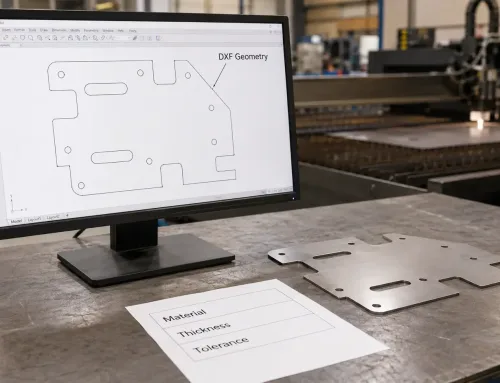
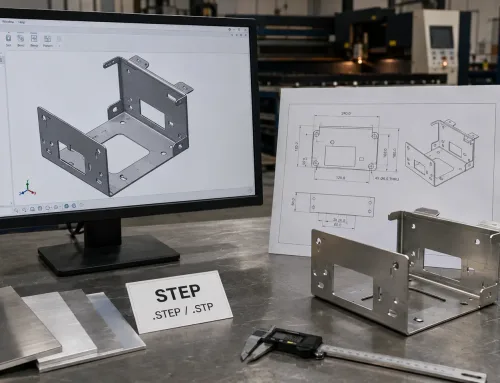
| CAD models | Geometry that matches the drawing — preferably a neutral format such as STEP for 3D and DXF where flat patterns are needed |
| Material | Grade, thickness, and any standard (for example, ASTM or EN) that defines chemistry or mechanical properties |
| Revision | A single current revision, shown the same way on every file and on the PO or RFQ |
| Requirements | Quantities, inspection level, surface finish, packaging, and delivery expectations stated in measurable terms |
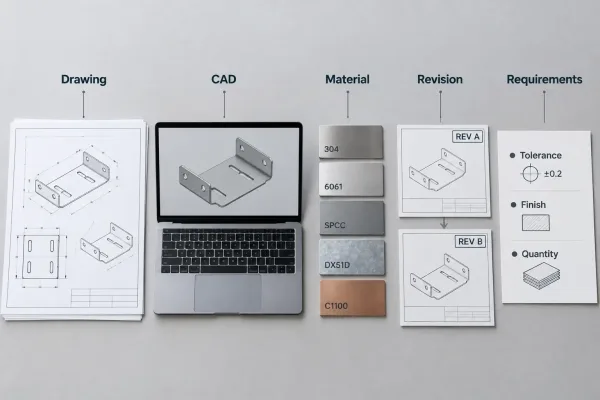
The five document sets a fabricator needs before quoting: drawing, CAD model, material, revision, and requirements.
Drawings remain the contractual backbone for many shops; models accelerate programming and DFM. Material callouts drive cost and lead time as much as geometry. Revision control prevents mixed batches. Written requirements close gaps the graphics cannot express — cosmetic zones, deburring expectations, or which dimensions are critical to function.
Complete, Clear, Consistent — How to Judge Each
Engineers and buyers can evaluate a package against three criteria before it leaves their desk.
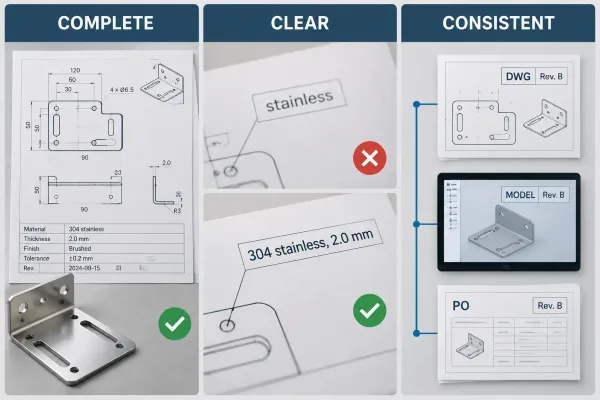
Three pass criteria for an engineering data package: Complete, Clear, and Consistent.
Complete
Nothing required to quote or build is missing. If a fabricator must invent a tolerance class, a surface texture, or a material substitute to continue, the package is incomplete. Completeness does not mean every possible note is present; it means every decision the shop must make is specified or explicitly left to a stated default.
Clear
There is only one reasonable reading. Ambiguity is the expensive kind of defect: “stainless steel” without a grade, “black anodize” without thickness or standard, or a dimension shown in inches on one sheet and millimeters on another. If two engineers could interpret the callout differently, rewrite it before release.
Consistent
The files agree with each other. Consistency is the check most often skipped and the one suppliers feel first.
- Drawing revision B with a model filename still marked A
- BOM or note specifying 304 stainless while the PO says 316
- Flat-pattern thickness 1.5 mm on the model and 2.0 mm on the drawing
- Finish called out as powder coat in the notes and as wet paint in the requirements email
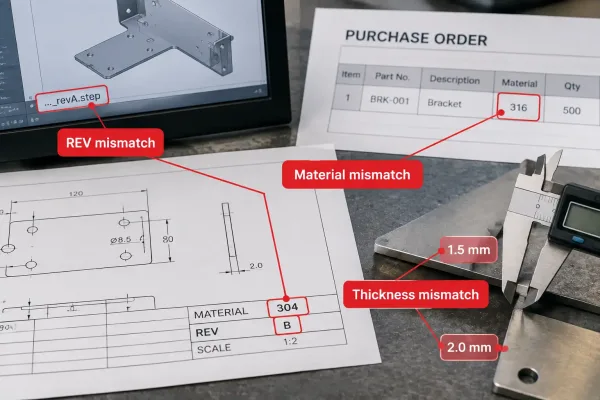
Common cross-file mismatches: drawing revision, model filename, material grade, and thickness must agree.
A short cross-file pass — drawing title block, model properties, material note, revision block, and RFQ text — catches most of these before they become technical queries (TQs).
What Happens If You Skip It
Skipping the review does not remove the work; it moves it downstream, where it costs more.
TQ loops and quote delays. Suppliers pause the quote until questions are answered. Each round adds calendar time and can reset the pricing window if material markets move.
Assumptions become defects. When files conflict, fabricators may quote on the most conservative reading or on a stated assumption. If that assumption is wrong, the error is found in inspection or assembly — scrap, rework, or a dispute about who owns the cost.
Revision mix-ups. Without a single current revision, cut parts can land in the wrong configuration. Recovering a mixed lot almost always costs more than confirming the revision at RFQ.
Schedule and accountability gaps. Late clarifications compress production and blur responsibility. A documented engineering review gives both sides a shared baseline: what was released, and against which requirements the part will be judged.
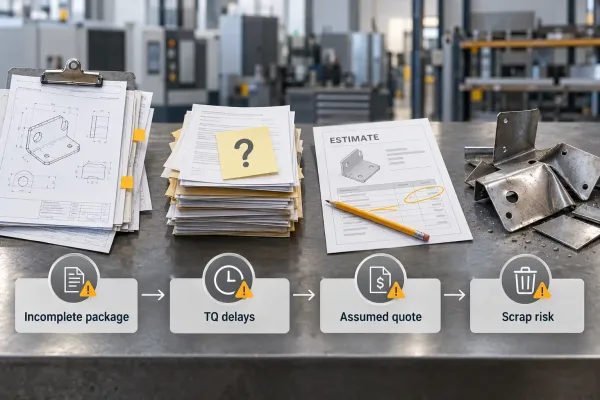
Skipping engineering review moves cost downstream: TQ loops, assumed quotes, and scrap risk.
A Practical Pre-RFQ Self-Check
Before you request a quote, a short internal review is enough for most sheet metal and machined parts.
- Attach the current drawing with title block, revision, units, and material clearly visible.
- Attach CAD that matches the drawing (STEP for 3D; DXF or the agreed flat-pattern format where needed).
- State material and thickness once, in one place, and use the same wording everywhere else.
- Confirm revision alignment across drawing, model, RFQ, and any BOM line.
- List requirements the files cannot show — quantities, critical dimensions, finish standard, cosmetic areas, inspection or certification needs.
- Declare defaults. If something is intentionally open, say so: “unless noted, ±0.5 mm applies,” or “deburr all edges per supplier standard.”
- Name what you do not want assumed — substitutions, surface condition, or protective packaging.
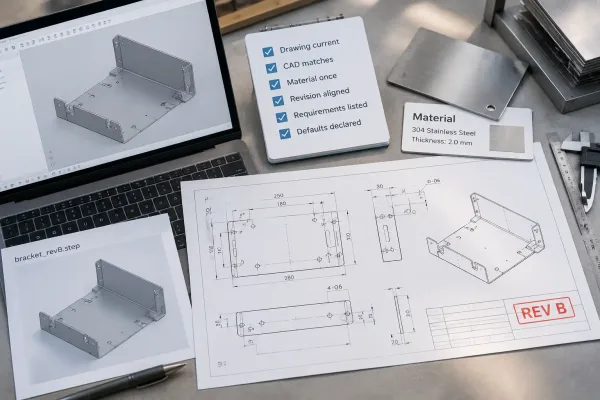
Pre-RFQ self-check: align files, state material once, confirm revision, and declare defaults.
That checklist is the practical content of an engineering review at the buyer’s desk. It does not replace a supplier’s own review or a DFM pass; it makes both of those faster and more accurate.
For best results, treat the package as something a stranger must be able to build from. If you would not send it to a colleague without a cover note, it is not ready for an RFQ. When geometry, material, or finish is still open, write that explicitly. A clear open point is safer than a silent gap. If you want a second pair of eyes before release, a manufacturing engineering review of the package can surface conflicts while they are still free to fix.
FAQ