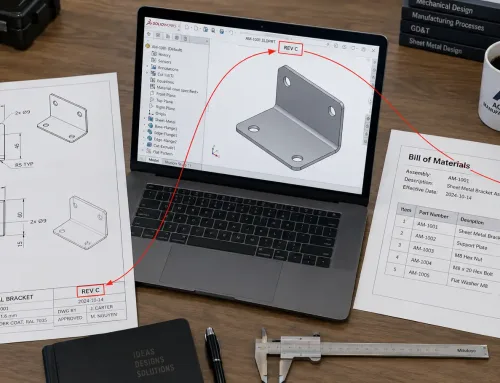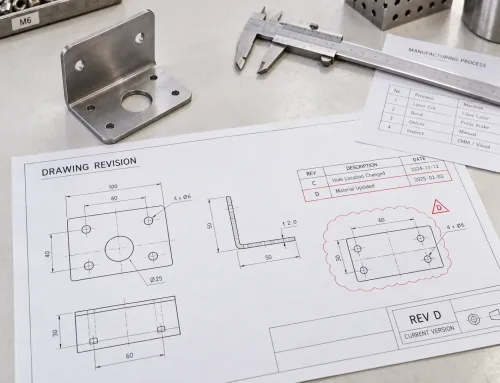

A hole moves by 2 mm, and someone emails the supplier: “Just shift it on the floor this batch.” Three weeks later, the assembly does not fit, and nobody can say which version of the drawing the parts were cut from. That instruction was not an engineering change. An engineering change is the formal alternative — a documented, evaluated, and approved modification to a requirement that has already been released for manufacturing. The difference between the two is not paperwork for its own sake. It is what protects your cost, your stock, and your delivery date once a project is already in motion.
What Is an Engineering Change?
An engineering change is a formal, documented, and approved modification to the design, material, dimensions, or process requirements of a part or assembly that has already been released — meaning the drawing or specification has been issued to production, purchasing, or a supplier as the baseline for making the part.
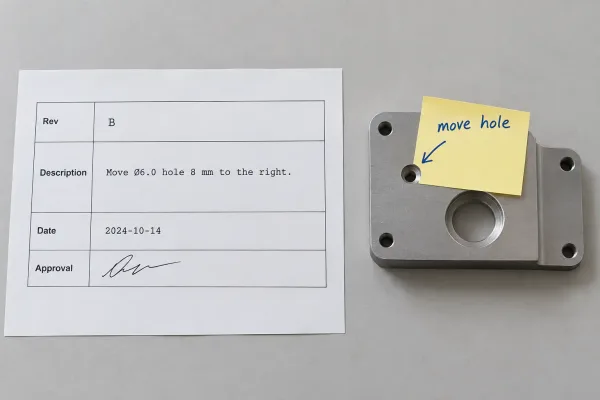
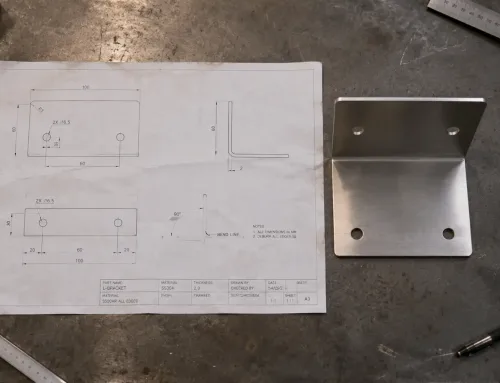
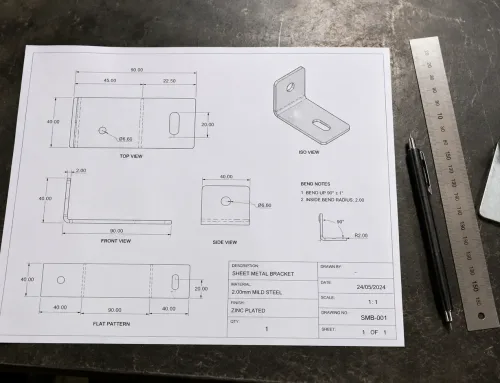
Left: a controlled change document with revision and approval fields. Right: an informal handwritten note — neither carries a documented impact review.
Two words in that definition carry the weight. Formal means the change is recorded in writing, reviewed for its consequences, and approved by someone with the authority to accept those consequences. Released means the requirement it modifies was already treated as final by the people acting on it.
An engineering change is not a suggestion, a verbal instruction, or an email that says “make it like this from now on.” If a supplier can act on your message without anyone reviewing its impact first, the process is not under control — regardless of what the message is called.
Why the formality? Because once material is ordered, tools are set up, or a batch is in process, a change ripples outward. The formal process forces the ripple to be assessed — cost, stock, and schedule — before the change is made, not after.
What an Engineering Change Can Change
In sheet metal work, an engineering change can touch any requirement that the part is judged against. Four categories cover most cases:
- Design changes — adding a stiffening rib, relocating a mounting bracket, or changing a corner joint from folded to welded.
- Material changes — switching grade (for example, mild steel to stainless), changing thickness, or substituting an equivalent material when the specified one is unavailable.
- Dimensional changes — moving a hole pattern, tightening a tolerance, or altering an overall dimension that affects fit.
- Process requirement changes — changing the surface finish from powder coat to paint, revising a weld sequence, or adding a heat treatment that was not previously specified.
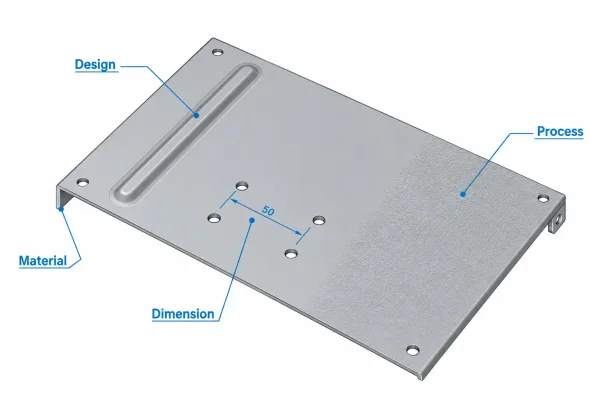
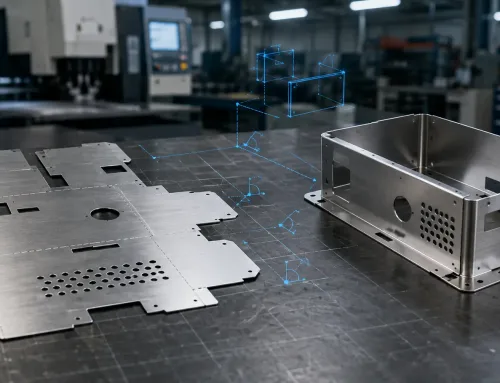
A sheet metal enclosure panel with four callouts marking design, material, dimensional, and process changes.
The category matters because each one reaches different downstream records. A material change affects purchasing and stock first; a process change affects the router and supplier quotations first. That is one reason the process reviews the change before it is implemented, rather than discovering the affected records afterward.
Engineering Change vs. ECR, ECO, and ECN
Search results for “engineering change” return several adjacent terms, and they are not interchangeable. An engineering change is the event — the modification itself. The other terms are the documents that carry it through an organization:
| Term | What it is | Who issues it | When it is used |
|---|---|---|---|
| Engineering change | The modification itself, to a released requirement | Defined by the organization | The general term for the event |
| ECR (Engineering Change Request) | A proposal to make a change, submitted for review | Requester (engineering, quality, or customer) | Before any decision — someone wants the change considered |
| ECO (Engineering Change Order) | The approved instruction to implement the change | Engineering or a change control board | After approval — the change is now authorized |
| ECN (Engineering Change Notice) | A formal notification that the change has occurred or is effective | The organization that made the change | After approval or implementation — to inform downstream parties |
In practice: the request proposes, the order authorizes, the notice informs. A supplier who receives an ECO knows to change the part; a supplier who receives only an ECN may be too late to prevent rework.
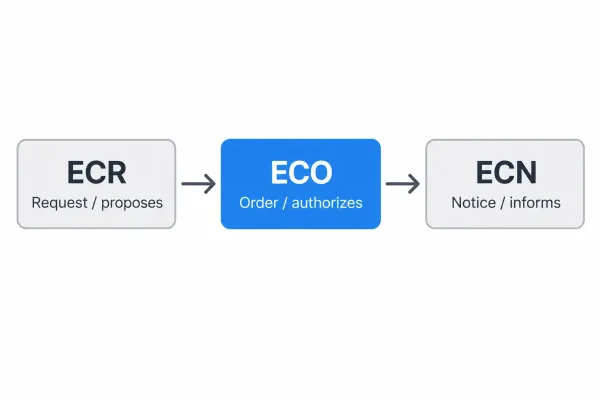
The request proposes the change, the order authorizes it, and the notice informs downstream parties.
The Formal Change Process, Step by Step
While implementations vary, most controlled processes follow the same chain:
- Request. The change is submitted in writing with a description of what should change and why.
- Impact review. The change is evaluated against the factors it will actually touch: tooling, purchased material, work in process, inspection criteria, open orders, and schedule. This is where cost and lead-time consequences surface — before anything is cut.
- Approval. A designated authority accepts or rejects the change based on the review. Rejecting or deferring a change is a legitimate outcome; approving everything on sight is not control.
- Implementation with effectivity. The change is made effective for a defined point — a specific lot, date, or revision. Effectivity is what prevents new and old parts from mixing.
- Documentation and archive. Drawings, specifications, and process records are updated to the new revision, and the change record is retained so the as-built part can be traced later.
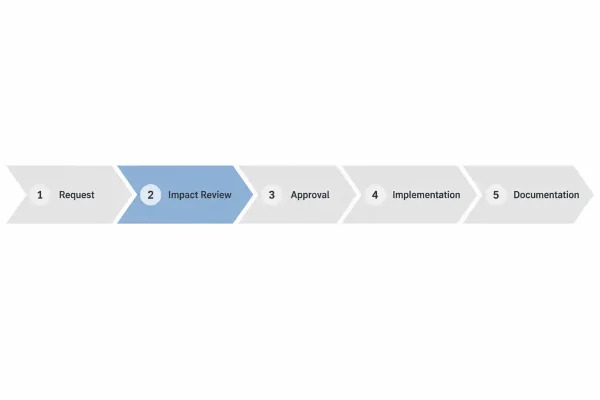
The formal change chain: request, impact review, approval, implementation with effectivity, and documentation.
The sequence is the point. Cost, inventory, and schedule consequences are identified in step 2; money is spent in step 4. Skipping the review does not remove the consequences — it only moves their discovery to the shop floor or the receiving dock.
How a Change Hits Cost, Inventory, and Lead Time
This is where a “small” change stops being small, and where most generic definitions of engineering change go quiet.
Cost
The change itself is rarely the expensive part. The expensive part is what has already been done in the old configuration: material purchased against the previous specification, laser programs and bend setups prepared for the previous geometry, fixtures built, and parts machined or formed that now must be scrapped or reworked. Each of those is a sunk commitment the change invalidates.
Timing drives the magnitude. A change raised during quoting usually just changes the quoted numbers. A change raised after material is ordered but before production typically costs a re-quote and possibly a cancellation fee on the order. A change raised mid-batch can mean scrapping finished or semi-finished parts, re-cutting programs, and paying for setup time twice. There is no universal percentage — but the cost curve always rises the later the change arrives.
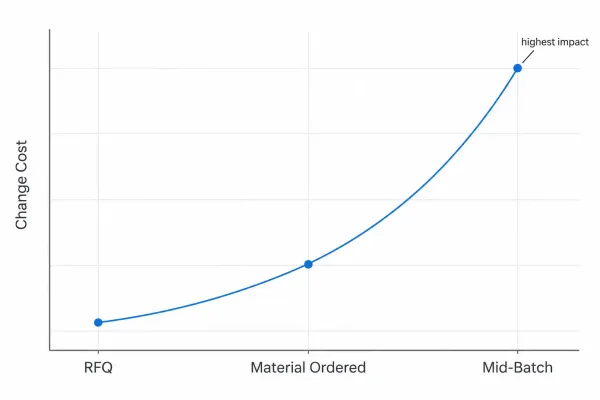
Change cost stays low during RFQ, rises after material is ordered, and peaks mid-batch when parts must be scrapped or reworked.
Inventory and Work in Process
A change splits existing stock into a question: which material and which parts are still valid?
- Raw material ordered to the old specification may be usable if the change does not touch grade or thickness, and unusable if it does.
- Work in process — parts already cut, formed, or welded — may finish under the old revision or be scrapped, depending on whether the change affects fit or function.
- Finished goods awaiting shipment need an explicit disposition: ship as-is with approval, rework, or hold.
Without a defined effectivity point, the most common failure is mixing: some units built to the old requirement and some to the new, shipped in the same lot. Recovering from a mixed lot costs far more than deciding its disposition in the impact review.
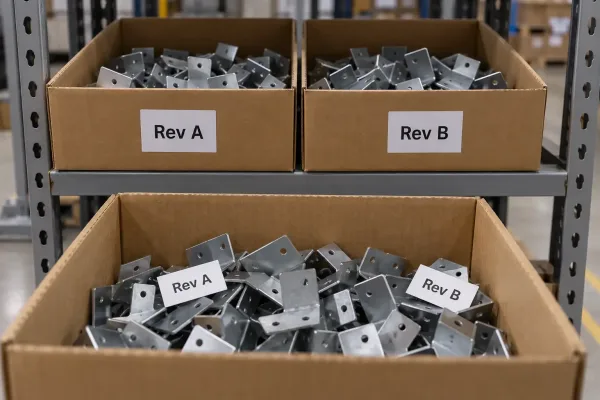
Two batches of identical parts labeled Rev A and Rev B ending up in the same shipment, the result of a change without a defined effectivity point.
Lead Time
Lead-time impact depends on where the project stands when the change lands:
- During RFQ: usually none. The revised requirement is simply priced and scheduled with the rest of the order.
- After sample approval: moderate. Samples may need to be rebuilt and re-inspected, adding a sample cycle to the schedule.
- After production starts: highest. The line stops or diverts, affected setups are re-run, and inspection criteria are rewritten — days to weeks of added time, depending on batch size and how far material has moved through the process.
This is the practical answer to whether a change can wait: it can wait only as long as no downstream commitment has been made against the old requirement.
Writing a Change Request That Does Not Cause Rework
Most back-and-forth around changes comes from incomplete requests, not from complex engineering. A request that gets evaluated correctly the first time includes five things:
- What changes — the specific requirement, stated as it should appear on the drawing (new dimension, new material, new callout), not “adjust the hole.”
- Why it changes — the functional or business reason, so the reviewer can judge scope and whether similar parts are affected.
- Affected documents — drawing numbers and current revisions, plus any related parts or assemblies.
- Effectivity — the lot, date, or build at which the new requirement takes effect, and whether in-process parts continue under the old revision.
- Old-part disposition — whether existing stock and WIP is used up, reworked, returned, or scrapped.
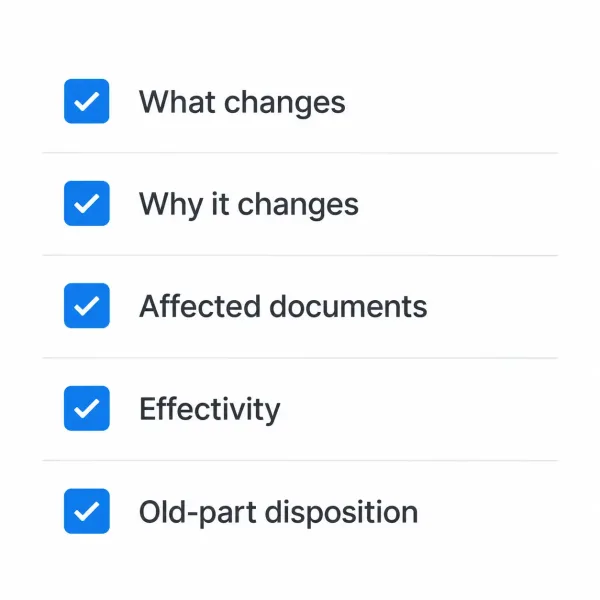
The five fields every change request should include: what changes, why, affected documents, effectivity, and old-part disposition.
Leave any of the five out and the supplier’s next question is guaranteed — and each round of questions is a cycle in which material may already be moving under the wrong assumption.
Key Takeaways
- An engineering change is a documented, evaluated, and approved modification to a released design, material, dimensional, or process requirement — not an informal instruction.
- ECR proposes, ECO authorizes, ECN informs; the engineering change itself is the underlying modification.
- Impact review happens before implementation because that is the last point at which cost, stock, and schedule consequences are cheap to manage.
- Timing drives everything: earlier changes adjust numbers, later changes scrap material and extend delivery.
- Effectivity and old-part disposition must be stated in writing, or mixed lots follow.
FAQ
A clear change request tells your supplier exactly what to evaluate: what changes, why, which documents, when it takes effect, and what happens to parts already made. If you are mid-project and a change is unavoidable, send those five points with the revised drawing — most engineering teams can re-quote a well-defined change faster than they can interpret an ambiguous one.