
When a purchase order for custom sheet metal parts asks for “batch control,” different suppliers may picture completely different systems. One shop thinks of a process-plant recipe controller. Another thinks of an accounting batch that must balance before posting. A third thinks of a lot number stamped on a carton. Only the last interpretation is close—and even that misses how batches are actually built, recorded, and quarantined in discrete fabrication.
For fabricated enclosures, brackets, and panels, batch control is a quality discipline: keep each production batch identifiable, reconstructable from records, and isolatable when something goes wrong. This glossary entry defines that meaning and explains the three jobs behind it—distinguishing batches, documenting them, and separating nonconforming product.
Why “Batch Control” Does Not Mean the Same Thing Everywhere
The term appears in at least three industries with different jobs to do. Clear boundaries prevent the wrong requirements from landing on a sheet metal RFQ.
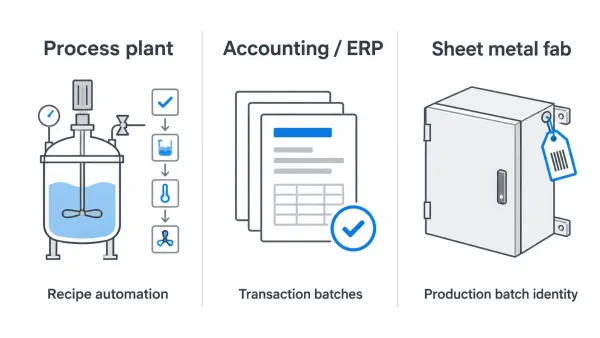
Three-column diagram showing how batch control means recipe automation in process plants, transaction balancing in accounting, and production-batch identity in sheet metal fabrication.
What process plants mean by batch control
In chemical, food, and pharmaceutical plants, batch control is process automation. Software sequences recipes through vessels and mixers, holds parameters in phase logic, and logs every unit operation. Systems such as ISA-88-style batch architectures belong here. They control how a continuous or semi-continuous batch is made.
That is not the problem a sheet metal shop solves. A press brake or laser cutter does not run a recipe the way a reactor does.
What accounting and ERP systems mean by batch control
In finance and some ERP modules, batch control means grouping transactions—invoices, receipts, journal entries—and checking document counts and totals before the batch is posted. It is a data-integrity control.
Useful for the books. It does not tell you which heat of steel went into which enclosure, or which parts must be held back after a weld defect.
What it means for discrete sheet metal fabrication
In fabrication, a production batch is a defined set of parts processed together under shared material, routing, and inspection conditions. Batch control is the set of rules that:
- keeps that set distinct from other sets,
- records what was used and done to it, and
- allows the set to be locked or released as a unit.
Related terms—lot control, lot traceability, batch tracking—overlap, but they often stop at inventory movement. Batch control here covers the shop-floor decisions that make traceability real.
What Batch Control Covers on a Fabricated Part
On a fabricated part, batch control is not a single label. It is three linked duties:
| Duty | Question it answers |
|---|---|
| Distinguish | Which parts belong to this batch, and how do we prove it? |
| Record | What material, process, and inspection data must stay with the batch? |
| Isolate | If something is wrong, how do we stop only this batch—and not mix it into good stock? |
If any duty is missing, the others fail. A batch number without records cannot be reconstructed. Records without isolation cannot protect good parts already on the floor.
How Production Batches Are Distinguished
Distinguishing a batch starts with a boundary: where the batch begins and ends on the traveler or work order.
Where a batch starts and ends in a sheet metal job
In practice, shops split batches at points that change risk or identity:
- a new heat or lot of sheet or coil
- a new setup on the laser, punch, or press brake after a tool or program change
- a planned production release (for example, first 200 of 1,000)
- a surface-treatment load (powder, plating, e-coat) that must not mix part types
- a ship lot or pack-out group
The rule should be written before production, not invented after a customer call. If the drawing or PO does not define a batch, the fabricator will default to the work-order quantity—sometimes too large to isolate economically.
Batch numbering, labeling, and what must stay unique
A workable batch ID is unique, readable, and stable through the process. Common practice is a combination of part number, job or work-order number, sequence, and date—for example PN-4820-WO-1184-B03-2026-10. What matters is not the exact format but three constraints:
- Unique: no reuse across jobs or years
- Present: on traveler, labels, and packing list
- Stable: rework or partial shipment must not silently overwrite the original ID
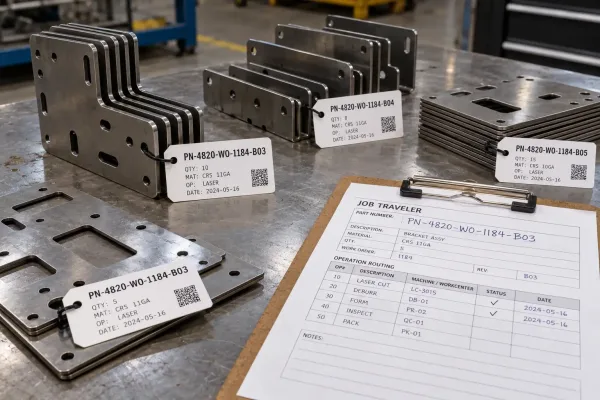
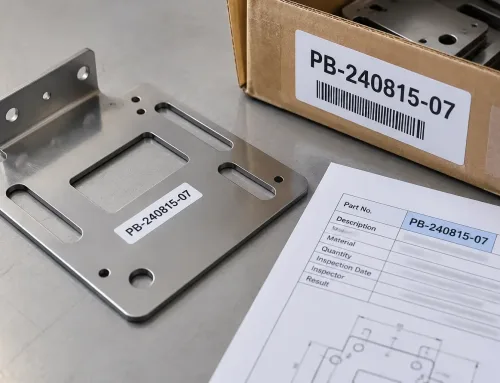
Batch ID labels on cut sheet metal parts with matching IDs on the job traveler used to keep each production batch distinct.
Barcodes help, but a legible printed ID is enough for most low- and mid-volume sheet metal programs.
Linking Material Lots to the Production Batch
Finished parts inherit risk from raw stock. The link between mill identity and production batch is what makes a recall or investigation bounded.
Reading heat and lot numbers from incoming stock and mill certificates
Steel and aluminum mill products carry a heat number (melting batch) and often a lot or coil number. The mill test report (MTR) lists chemistry and mechanical properties against that heat. Incoming inspection should record:
- heat / lot number from the tag or certificate
- grade and thickness
- date received and internal material ID
When parts are cut from that stock, the job traveler should reference the same material ID—not only the grade. “CRS, 1.5 mm” is not enough. “CRS, 1.5 mm, heat H48219 / internal lot L-240912” is.
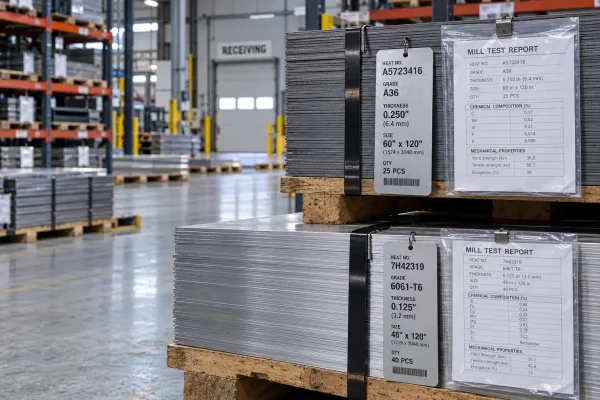
Incoming sheet stock with heat/lot tags beside a mill test report so material identity can be linked to the production batch.
Mixing rules, leftover stock, and partial-sheet consumption
Mixing heats inside one production batch is sometimes allowed, sometimes not. The PO should say which. Practical defaults many fabricators use:
- No mixing for structural, pressure, or regulated parts
- Controlled mixing with both heats recorded on the traveler when the customer allows it
- Leftover remnant labeled and returned to stock with the original heat ID still readable
Remnants that lose their identity become “mystery metal.” They are a common source of mixed batches later.
Production Records That Must Travel With the Batch
Labels distinguish a batch. Records explain it. For sheet metal, the minimum set is short and practical.
Minimum record set for a controlled batch
A controlled batch should be reconstructable from:
- batch ID and part number / revision
- material heat or lot (and MTR reference where required)
- routing steps actually run (cut, form, weld, grind, finish)
- key process data when specified (for example weld procedure, powder lot, cure)
- inspection results—dimensional and visual—against the drawing revision
- quantity produced, accepted, rejected, and scrapped
- operator or station and timestamps for critical steps
- shipping pack list linked to the same batch ID
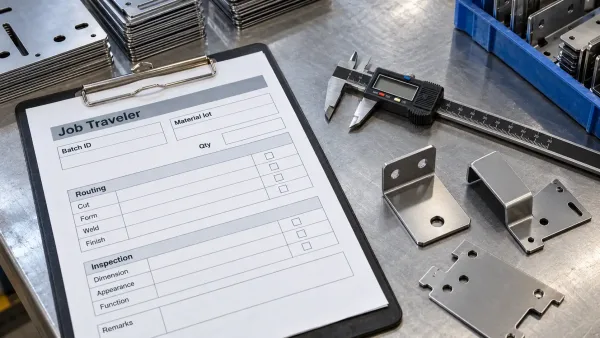
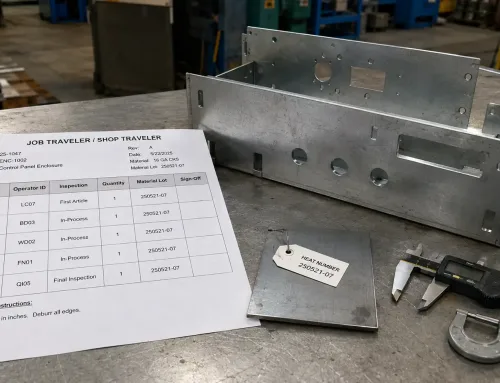
Completed job traveler showing batch ID, material lot, routing steps, and inspection results that travel with the parts.
Job travelers, route sheets, and inspection reports are the usual carriers. Electronic records work; the content requirement does not change.
How records attach at inspection, pack-out, and shipment
Records must follow the physical parts at each handoff:
- In-process or final inspection stamps or logs accept/reject against the batch ID
- Pack-out labels cartons with the same batch ID and quantity
- Shipment documents (packing list, CoC) quote that batch ID
If cartons from two batches share one packing list without line-level batch IDs, isolation after delivery is effectively lost.
Isolating Nonconforming Product Without Contaminating Good Batches
Distinguishing and recording only pay off when bad material can be stopped.
Physical quarantine vs system status
Isolation has two layers:
- Physical: red tags, marked bins, or a quarantine area so mixed parts cannot be picked for shipping
- System: hold status in the ERP or traveler so the batch cannot be released by mistake
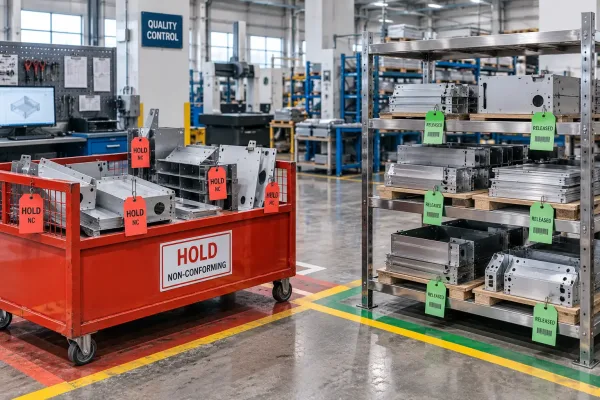
Rejected parts held in a quarantine bin with hold tags while accepted batches remain on a separate rack.
Physical-only isolation fails when someone moves stock. System-only isolation fails when the floor cannot see the hold. Sheet metal bins and cut-part stacks make both layers necessary.
Rework, scrap, and whether the batch identity changes
Nonconforming disposition follows the batch:
- Scrap: remove quantity from the batch; keep the record
- Rework: decide whether rework stays in the same batch ID or gets a linked child ID (for example
-R1) - Use-as-is / repair: needs customer concession and must appear in the batch record
The key rule: do not merge unverified rework back into a clean batch. If weld repair or re-bend touches parts from an isolated set, those parts keep a distinguishable identity until inspection closes the hold.
Sample Batches and Production Batches Control Different Things
Samples and production both need batch discipline, but they prove different risks.
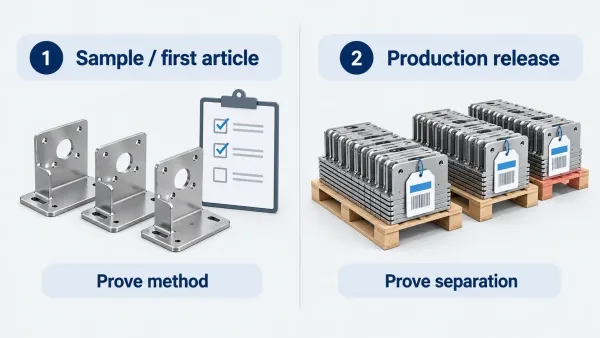
Side-by-side comparison: sample batches prove the method with a small documented lot; production batches enforce separation across full releases.
| Stage | What the batch is for | Control emphasis |
|---|---|---|
| Sample / first article | Prove the method is repeatable | Define batch rules, record format, and hold points while volume is small |
| Production | Prove batches stay separate under real volume | Enforce numbering, material linkage, and quarantine every release |
Do not wait for the first mass shipment to invent batch IDs. If the sample lot is undocumented, the production lot has no baseline to copy—and disputes usually appear after parts already ship.
What to Specify in Your RFQ and PO
Buyers reduce rework and finger-pointing by writing batch requirements before cutting starts. A compact checklist:
- Batch definition — where batches start and end (heat change, setup, release qty, finish load, ship lot)
- Batch ID format — who assigns it, what fields it contains, where it is printed
- Material lot linkage — heat/lot on traveler and, if required, on CoC
- Mixing rules — whether heats or surface-treatment loads may be combined in one batch
- Minimum records — traveler, inspection, and packing-list fields that must be complete
- Nonconformance handling — quarantine location/label, rework ID rules, customer notification triggers
- Ship lot packing — one batch per carton, or batch IDs on every carton line
- Sample vs production — first-article batch package requirements before volume release
You do not need a full MES to run this. You need rules the shop floor can follow and your receiving team can audit.