
Signing an NDA before you send drawings for a sheet metal quote sounds like complete protection. It is not. An NDA records legal intent. It does not decide what a fabricator must see to price a part, what you can safely withhold, or how missing data becomes an inflated number—or a wrong one.
Confidentiality and quote accuracy pull in opposite directions. Share too little and the supplier prices uncertainty. Share too much and proprietary geometry leaves your control before you have chosen a partner. Drawing confidentiality management is the set of decisions that keeps both risks in bounds.
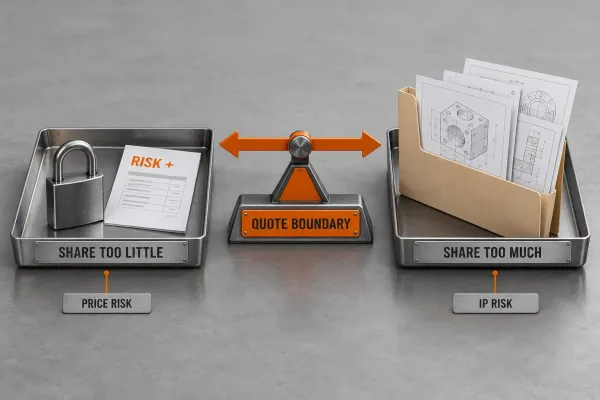
Over-sharing exposes IP; over-redaction forces fabricators to price uncertainty.
Why Confidentiality and Quote Accuracy Pull Against Each Other
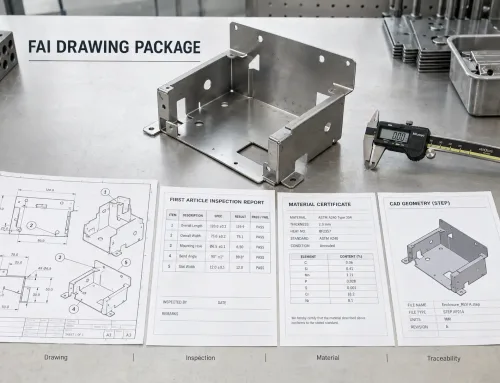
A sheet metal quote is not a guess about how hard a part looks. It is a cost build-up from laser or punch time, bend count, weld length, finish area, hardware, inspection level, and scrap risk. Each of those inputs comes from the drawing package.
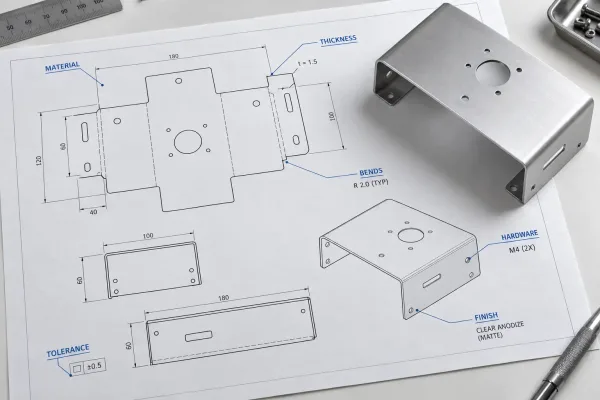
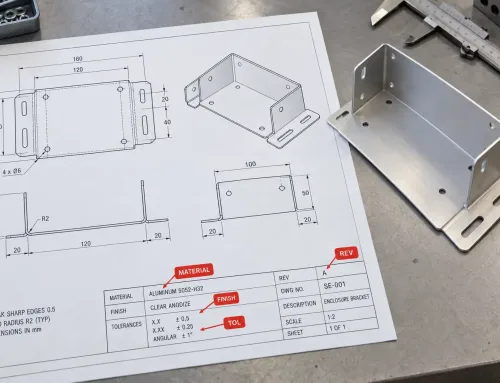
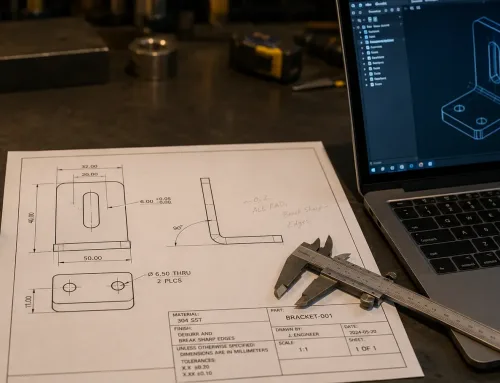
Price-critical drawing data: blank size, thickness, bends, tolerances, finish, and hardware.
When buyers redact dimensions, hide internal features, or send only a “concept” view to protect IP, fabricators fill the gaps with assumptions. Assumptions are priced as risk. That shows up as contingency in the unit price, a wider delivery window, or a quote that must be revised after award—sometimes by 15–30% when critical callouts were missing.
The reverse failure is quieter. Sending full production models, unrestricted STEP files, and every revision to five suppliers before an NDA is in place does not speed up quoting. It multiplies copies of your design without a documented control path.
The workable position is neither “lock everything” nor “send everything.” It is a deliberate boundary: enough information for a defensible price, under controls that match the sensitivity of the design.
What Fabricators Need From Drawings to Quote Accurately
Manufacturers read quote packages in a fixed order. Understanding that order tells you what must leave your side at RFQ and what can wait.
Price-critical information usually includes:
- Overall geometry and blank size — drives material utilization and nest efficiency.
- Material grade and thickness — one step in thickness can move cost more than most design tweaks.
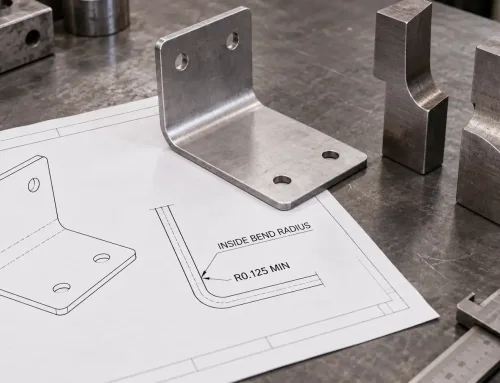
- Bend count, angles, and inside radii — form time and tooling assumptions.
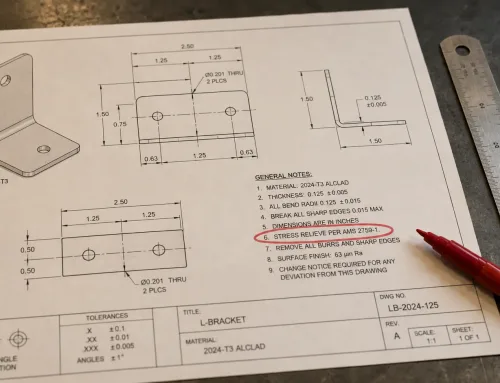
- Tolerance class on functional features — loose default tolerances quote cheaper than tight ones on non-critical edges.
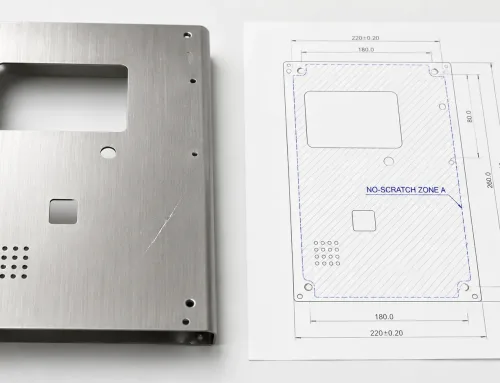
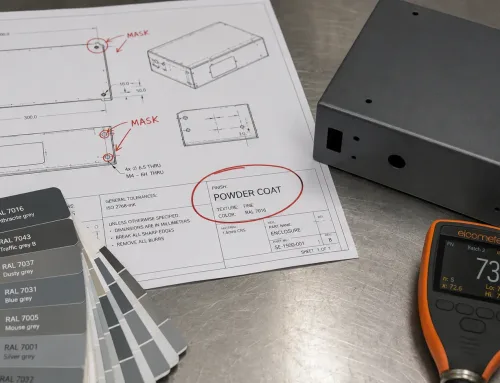
- Finish type and coverage area — powder, anodize, plating, and selective masking are priced differently.
- Hardware and inserts — PEM, weld nuts, rivets, and tapping change both process and inspection.
- Quantity, revision level, and delivery expectation — volume tiers and schedule risk live here.
Information that rarely changes the first quote, but often triggers a clarification round, includes cosmetic class beyond “visible A-surface,” internal color standards outside a stated range, packaging preferences, and long-term forecast language.
A useful test: if a fabricator cannot decide machine sequence, material buy, or inspection effort from what you sent, that item is price-critical. If it only changes how the job is administered after award, it can wait.
What to Share at RFQ and What to Hold Until Award
Staged disclosure is the practical answer to the confidentiality–accuracy tension. You release a quote-stage package first, then a full production package after supplier selection.
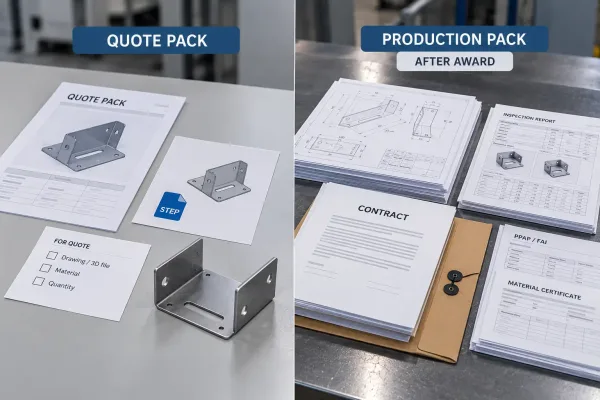
Quote-stage pack stays limited and marked; full production data is released only after award.
| Package stage | Typical contents | Confidentiality controls |
|---|---|---|
| Quote-stage (pre-award) | Controlled PDF drawing or marked 3D view, material and thickness, quantity breaks, tolerance class, finish summary, hardware list, critical CTQs only | Quote NDA, named recipients, no redistribution clause, watermarked files |
| Award-stage (post-selection) | Full STEP/native model as required, complete dimensioned drawings, inspection plans, process notes, packaging and labeling specs | Production NDA or quality agreement, access log, defined retention period |
| Never free-sent before award | Full unrestricted native CAD history, supplier cost models, unrelated product assemblies, customer BOM with third-party IP | Release only under contract, to named engineers |
2D vs 3D at quote stage. A dimensioned PDF plus a simplified STEP is often enough. Native parametric history is rarely required for a reliable sheet metal quote and expands leak surface without improving price accuracy.
Redaction boundaries. Withhold unrelated assembly context, customer logos on title blocks if they are not needed, and commercial data. Do not withhold blank size, thickness, bend logic, or finish scope if those drive cost. A redacted drawing that hides a bend family or a masked finish will still produce a number—it just will not be the number you can budget from.
Drawing Confidentiality Management Requirements
“Management requirements” means more than an NDA file in a folder. For RFQ of proprietary sheet metal parts, four controls do most of the work.
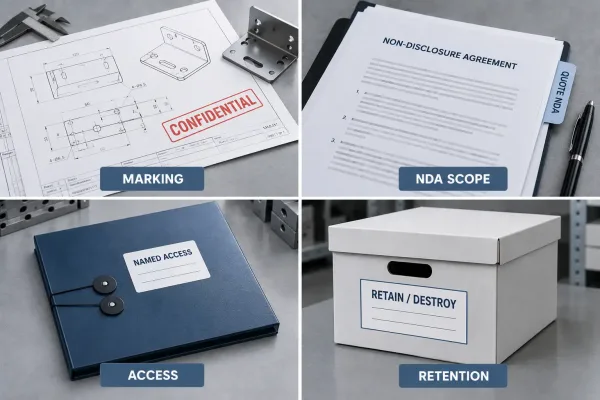
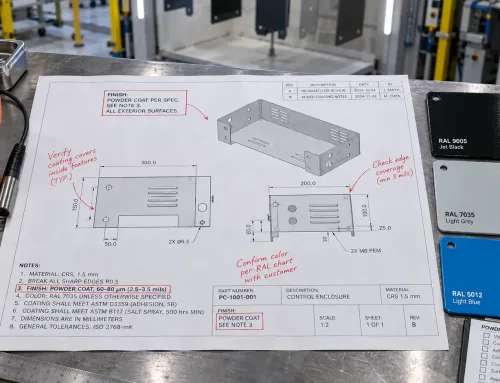
Four controls that keep quote-stage drawings under control: marking, NDA scope, access, and retention.
Classification and marking
Label drawings and models with a sensitivity class (for example, Confidential—Supplier Quote Use Only), revision, and date. Marking sets the baseline for every later conversation about who saw what.
NDA scope for quoting
A quote NDA should cover purpose limitation (pricing and DFM feedback only), named individuals, no subcontracting of the review without consent, return or destruction on request, and survival after the RFQ ends. A production NDA or quality agreement can wait until award—do not block accurate pricing on a six-page contract negotiation if a short mutual NDA already covers quote use.
Access and distribution control
Send packages to named contacts, not shared inboxes or open cloud links with edit rights. Prefer view-only or download-logged transfer. Ask suppliers who on their side may open the file (estimating, manufacturing engineering) and keep that list short.
Retention, return, and destruction
State what happens if you do not award the job: delete working copies within a defined window (often 30 days), confirm destruction in writing if required, and keep only the quote record. Reputable fabricators already do this; making it explicit removes ambiguity later.
These controls are cheap. Retrofitting them after drawings have been forwarded through three mailboxes is not.
How Redacted or Incomplete Drawings Change the Quote
Incomplete packages do not always produce a higher price. They produce an unreliable price, and unreliability is expensive in different ways.
- Missing tolerances on formed or welded features — suppliers assume their standard, which may be looser or tighter than yours. Tighter assumptions raise cost; looser ones create inspection disputes at delivery.
- Hidden finish or mask notes — a full powder coat vs. selective masking changes setup, labor, and scrap. If masking is omitted from the quote package, it reappears as a change order.
- Ambiguous assemblies — without fastener strategy and joint logic, estimating either under-counts secondary ops or adds a generic assembly premium.
- No quantity or revision freeze — pricing is tied to a specific revision and break quantities. Floating either forces re-quoting.
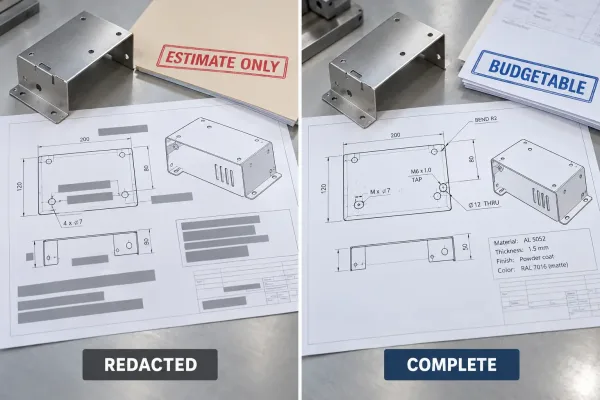
Hiding cost-driving callouts turns a budgetable quote into a risk-priced estimate.
From the fabricator’s side, missing CTQs (critical to quality) are the most expensive gap. They drive fixture design, inspection time, and reject risk. If a feature is truly confidential and cost-driving, state its functional requirement in words (“this edge seals against a gasket; flatness within X”) even if you withhold the surrounding geometry. That keeps the quote honest without releasing the full design.
How to Run an RFQ for Confidential Sheet Metal Parts
The following sequence protects IP without forcing fabricators to guess.
- Classify the package. Decide what is quote-critical, what is award-only, and what is unrelated.
- Prepare a quote-stage pack. Controlled drawing set, simplified 3D if helpful, material/qty/finish/tolerance summary, CTQ list in words.
- Execute a short mutual NDA first. Purpose-limited to quote and DFM review.
- Limit distribution. Named recipients only; record who received which revision.
- Invite DFM feedback on the quote pack. Ask specifically what they assumed because data was withheld. Those assumptions are your risk list.
- Compare quotes on basis alignment. Same revision, same quantity breaks, same finish scope. Do not compare a full-package quote against a redacted-package quote as if they were equal.
- Release the production package only after award. Then tighten access, retention, and change control.
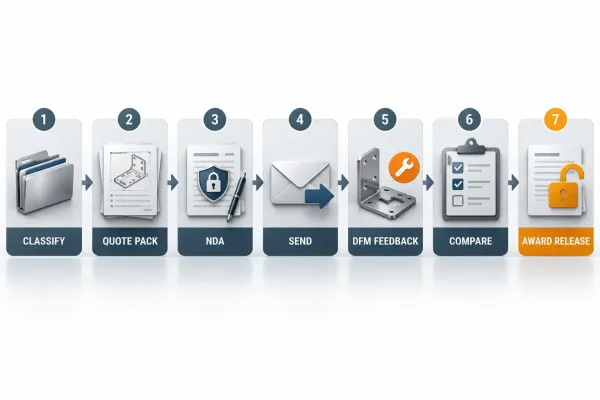
Run confidential RFQs in seven controlled steps from package classification to post-award release.
Pre-RFQ checklist for confidential drawings
- Revision frozen and marked on every file
- Sensitivity label on drawing and model
- Quote NDA signed before file transfer
- Named recipient list agreed
- CTQs described in words where geometry is withheld
- Finish, hardware, and quantity breaks stated explicitly
- Return/destruction expectation written into the RFQ email or attachment
Do this once, properly, and you cut the loop of “we cannot quote until you send more” that wastes weeks on sensitive projects.