
Machine time on a simple sheet metal bracket might be three days. The quoted lead time is three weeks. The gap is rarely a mystery of cutting or bending—it is usually the production queue: the stretch between releasing an order to the floor and the first real cycle on the equipment that matters.
This glossary entry defines production queue for custom manufacturing, shows where it sits inside total lead time, and explains the three factors that change the wait: shop busy level, critical equipment, and priority rules.
What Is a Production Queue in Custom Manufacturing?
Definition: waiting for a capacity window, not for paperwork
A production queue is the ordered set of released jobs waiting for machine time and capacity windows inside a fabrication facility. Your order has cleared the usual gates—purchase order, drawing revision, material, and process plan—but it has not started the operations that transform the part. Until that first cutting, forming, or joining cycle begins, the job is in queue.
The queue is not idle chaos. It is how a shared shop sequences work when more orders are ready than the bottleneck resources can absorb at once.
When an order enters the queue
Most plants will not queue an order that is not ready to run. Entry typically requires:
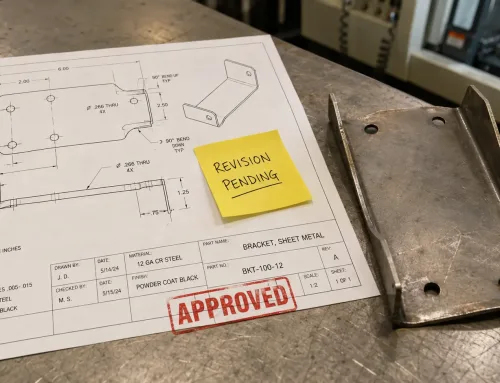
- Approved drawings and revision (including any engineering clarification closed)
- Material on hand or firmly allocated for the job
- Routing and work order released to the floor
- Tooling, fixtures, or nest programs identified when the job needs them
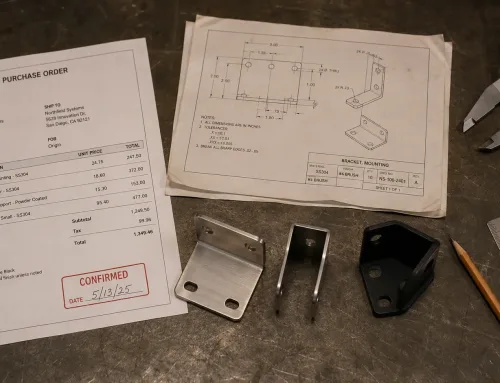
Quote acceptance alone does not put you on the machines. Sample approval, missing mill certificates, or an open dimensional question can hold the job outside the queue. Once those clear, the order joins the line and the production lead-time clock that matters to the shop actually starts.

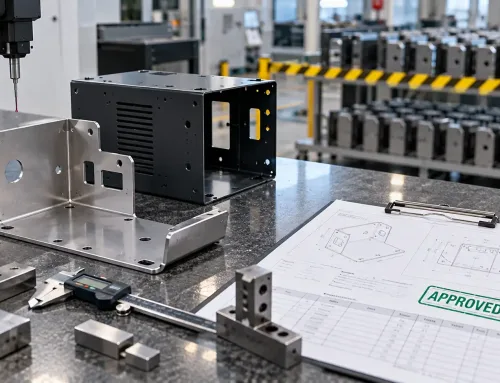
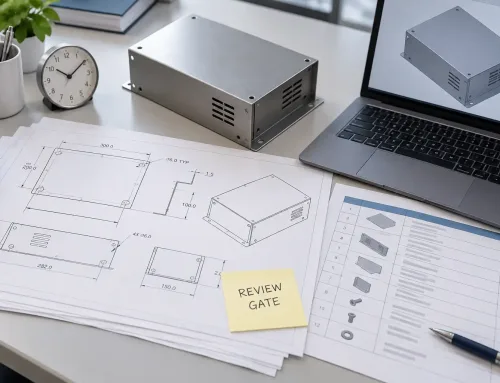
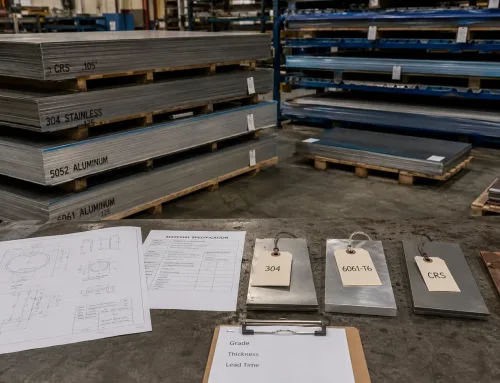
Release paperwork—drawings, job travelers, and material tags—ready before orders enter the production queue.
Where Production Queue Sits in Total Lead Time
Lead time is the full span from order acceptance to shipment. Inside the plant, that span breaks into setup, run time, move time, inspection—and waiting. Waiting is almost always the largest slice.
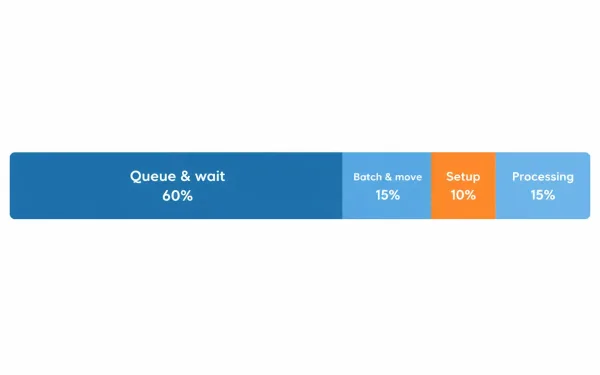
Lead time split: most calendar days are queue and wait; only a small share is active processing.
That is why production queue is easy to underestimate. Cutting and forming are visible. Queue days are not. If a part family spends two days of cycle time and eighteen days moving between work centers and waiting, improving the machines will not fix the delivery date. Reducing or planning for queue will.
Production queue vs related terms
| Term | What it measures | Scale | Typical question |
|---|---|---|---|
| Production queue | Released jobs waiting for equipment and capacity windows | Order or work-order level | When will this order start? |
| Queue time | Wait in front of one work center before that operation | Operation or work-center level | How long until this step runs? |
| Cycle time | Time to complete the planned operations for a job | Part or job level | How long does making it take? |
| Batch-and-queue | A push-style flow where large lots advance whether needed or not | Process model | How does material move through the plant? |
In practice, production queue is the order-level view of the same waiting problem shop-floor planners track as queue time at each work center. Batch-and-queue describes a production method; it is not a synonym for your position in line.
What Makes the Wait Longer: Busy Level and Capacity Windows
Queue length is not a fixed plant constant. It moves with load and with the slots the shop can actually open on key equipment.
How shop load changes queue depth
When a fabricator is quiet, released work often starts within a day or two. When the same shop is in peak load—seasonal demand, a large program soaking up capacity, or several finishing lines booked—the same part can sit for weeks without any change to the drawing.
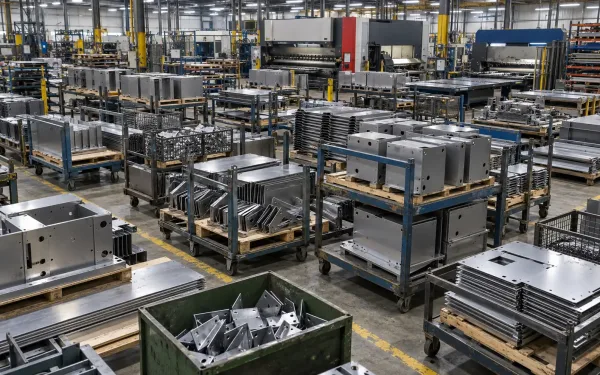
Peak-load shop floor: work-in-process accumulates in staging areas when capacity windows are full.
Utilization drives this effect. As bottleneck equipment approaches full load, average wait rises sharply rather than in a straight line. A cell that feels “busy but fine” at moderate load can develop deep queues once demand pushes it near saturation. That is a capacity and sequencing problem, not a sign that your drawing is wrong.
Capacity windows: shifts, changeovers, and planned stops
Even with open demand, start time depends on usable windows:
- Shift patterns — a job finished at the end of Friday may not start until Monday’s first shift on a single-shift cell.
- Setup and changeover — press brake tooling, laser nests, weld fixtures, and coating colors consume windows before any part is made.
- Planned maintenance and outside processing — furnace schedules, plating pickup days, or a press down for service push starts to the next free slot.
- Sample vs. production slots — many shops protect small setup-heavy sample runs differently from long production batches, so lead time on a prototype is not a scaled version of a production order.
Ask which resource is the constraint and when its next realistic window opens. That answer is more useful than a generic “we are busy.”
Which Critical Equipment Controls the Wait in Sheet Metal Fabrication
Not every machine on the routing creates equal queue risk. Jobs tend to pool at a few critical equipment types—shared, setup-sensitive, or capacity-limited resources that the rest of the shop depends on.
Laser cutting, turret punch, and nest-dependent cutting
Flat cutting is often the first shared gate. Nesting efficiency, sheet availability, and program readiness affect when a job can start. Complex profiles or tight cosmetic edges may need dedicated nests or slower parameters, which reduces how many jobs can share a window.
Press brake capacity and tooling setup
Forming queues concentrate where tonnage, bed length, or special tooling match the part. A bracket that needs a rare V-die or a long flange on a busy brake will wait behind other jobs that use the same setup. Tooling changes are non-productive time the shop tries to batch, so your job may wait to share a changeover with similar work.
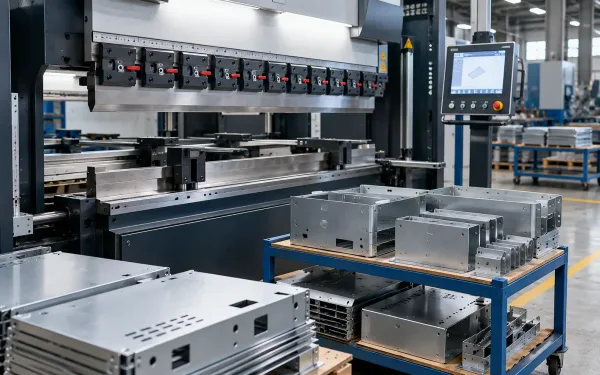
Press brake as a critical resource: parts wait for tooling setup and an open machine window.
Welding cells and finishing lines
Weld fixtures, operator skill mix, and heat input limits sequence welded assemblies. Finishing—powder coat, e-coat, plating, passivation—often has the deepest queues because lines run in campaigns by color, chemistry, or rack type. A part that is free at the laser can still sit days for the next compatible finishing window.
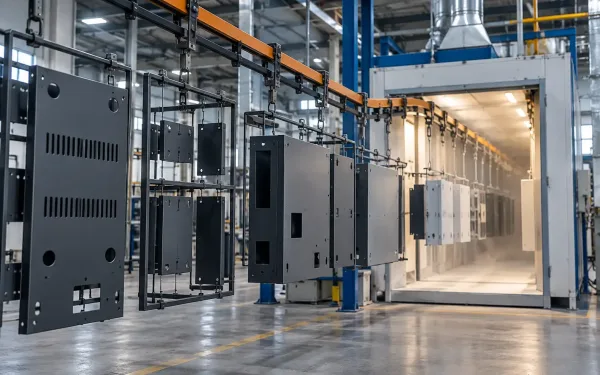
Finishing lines run in campaigns; parts wait for a compatible coating or plating window.
If your part’s bottleneck is finishing, faster cutting will not pull in the ship date. Plan and communicate against the resource that actually gates the order.
How Priority Rules Resequence the Queue
First-in, first-out is a default, not a law of physics. Real shops resequence for operational and contractual reasons.

Priority tags resequence the queue; standard and expedite jobs do not share the same start order.
Rush jobs, rework, and held lots
Expedited orders can be inserted when capacity is reserved or when commercial terms allow it. Rework and quality holds jump ahead when they block shipment of already-committed revenue—or they sit longer when they depend on a scarce technician or fixture. Jobs held for missing information fall out of the active sequence until the hold clears, which can mean re-entering behind newer work.
Sample vs. production runs and large-batch effects
Sample and FAI (first article inspection) work often needs setup-heavy attention on the same equipment as production. Large production batches occupy machines longer and delay everything behind them; they may also earn better scheduling treatment when the contract or account priority supports it.
None of this replaces fairness or written lead-time commitments. It does mean “position three” on a list is not a guarantee of start time unless priority, capacity reservation, and definition of “queue entry” are agreed in writing.
How to Plan Around Production Queue When You Order
You cannot remove queue from a shared shop, but you can plan it instead of discovering it late.
What to confirm before the PO
Before treating a lead time as firm, clarify:
- Queue assumption — Does the quoted lead time include current queue, or only process time after start?
- Entry criteria — What must be complete before the order enters the production queue (drawing rev, material cert, sample sign-off)?
- Priority — Is the job standard, planned, or expedited, and what does that change?
- Split lots — Can samples or partial shipments release earlier than the full batch?
- Constraint resource — Which operation is expected to gate the order, and is that equipment already allocated?
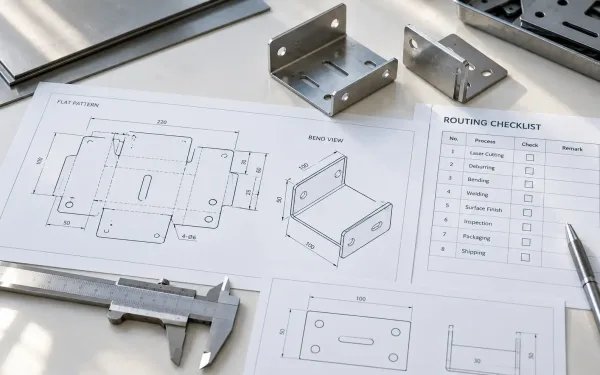
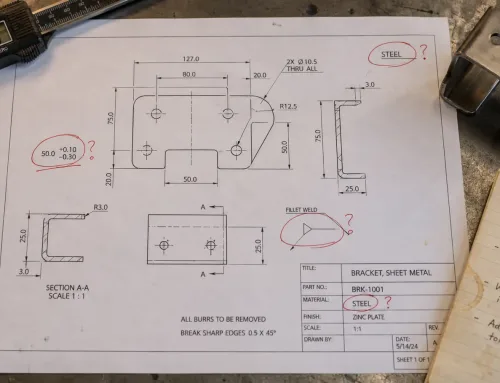
Before PO: confirm queue entry, constraint operation, and priority against drawings and routing.
How drawings and process choices change which queue you enter
Non-standard holes, rare tooling, tight cosmetic zones, or mixed surface treatments send work into narrower equipment windows and deeper queues. Standardizing thickness, fastener strategy, and finish type can move a job from a scarce cell to a shared one with more open capacity. Early DFM (design for manufacturability) review is often cheaper than later expedite fees.
Key Takeaways
Use these rules when you read a lead time or open a new sheet metal order:
- Treat production queue as a real phase between release and first machine cycle—not as slack the supplier invented.
- Judge wait against the bottleneck equipment (cutting, forming, welding, finishing), not against total machine count.
- Expect queue depth to move with shop busy level and capacity windows; peak load changes dates even when drawings do not.
- Do not assume strict FIFO—confirm priority, holds, and sample vs. production rules in writing.
- Align drawing complexity and finish choices with available equipment windows when schedule risk matters more than feature count.
- Ask when the order enters the queue, not only when it will ship.
FAQ
Looking for a fabrication partner who states queue assumptions clearly at quote stage? SR-MFG reviews routing risk, critical equipment constraints, and priority options with your drawings before you commit a date.