
If your part requires bending, drawing, stamping, or roll forming—and does not need to survive a marine environment or carry heavy structural loads—3003 aluminum is usually the right alloy.
It forms more easily than 5052 or 6061, costs less in most sheet markets, and is available from nearly every aluminum supplier worldwide.
However, 3003 is not a universal solution. It has real limits in strength, corrosion resistance, and surface appearance after forming. A successful production run often depends on two decisions:
- Choosing the correct temper
- Designing within the alloy’s actual forming limits, rather than idealized data-sheet values
This article explains when 3003 makes sense, how to select the right temper, its practical forming limits, and when to switch to 5052.
When 3003 Aluminum Makes Sense for Formed Parts
The 3003 aluminum-manganese alloy is non-heat-treatable. Its primary alloying element—1.0–1.5% manganese—gives it roughly 20% higher strength than commercially pure 1100 aluminum while preserving excellent ductility and corrosion resistance.
Because 3003 is not heat treatable, its strength is controlled by cold working and temper designation.
The alloy provides a practical balance for formed sheet metal components. It is:
- Stronger than 1xxx-series alloys
- Easier to form than 5xxx- or 6xxx-series alloys
- Weldable using MIG and TIG processes
- Resistant to atmospheric corrosion in indoor, outdoor, and mildly chemical environments
These properties make it a standard material for:
- HVAC housings and ductwork
- Electrical enclosures
- Decorative panels
- Food-processing equipment
- Chemical tanks
- Light-duty structural covers
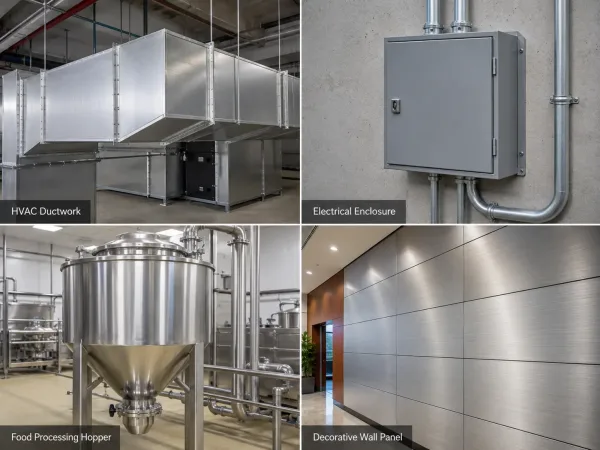
Four typical 3003 aluminum applications: HVAC rectangular ductwork, a powder-coated electrical enclosure, a food-processing aluminum hopper, and an anodized decorative wall panel.
3003 is less suitable for coastal, marine, or salt-spray environments and parts requiring significant structural load capacity. For these applications, 5052 is usually the better choice.
For formed parts used in general atmospheric conditions, however, 3003 offers an effective combination of formability, cost, and availability.
Choosing the Right Temper: O, H14, or H18
Temper selection is the most important decision when specifying 3003 for formed parts.
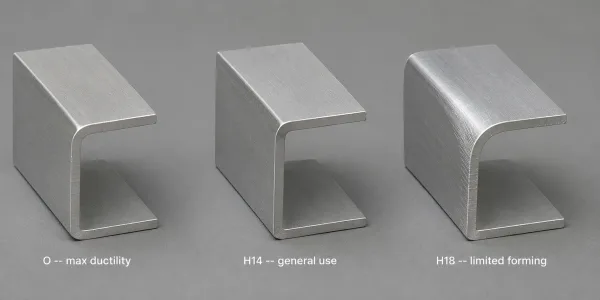
Three 3003 aluminum pieces bent to 90° side by side: O temper achieves the tightest radius with smooth deformation; H14 shows a moderate radius with a crisp bend line; H18 requires the largest radius and shows stress whitening at the bend.
The temper determines:
- How easily the material bends
- How much it springs back after forming
- How much load the finished part can carry
3003-O Temper
The O temper, or fully annealed condition, provides maximum ductility.
It is suitable for:
- Tight bends
- Deep draws
- Spinning operations
A bracket with a 0.5t bend radius or a drawn pan with a draw ratio above 1.8 needs O-temper material to reduce cracking risk.
The trade-off is a lower yield strength of 35–55 MPa and less dent resistance in the finished part.
3003-H14 Temper
The H14 temper is strain-hardened to a half-hard condition and is the commercial default for most formed sheet metal parts.
It balances moderate formability with enough yield strength—115–150 MPa—to resist denting and maintain dimensional stability.
If a part has bend radii of 1.5t or larger and does not require deep drawing, H14 is usually the most cost-effective and widely available option.
3003-H18 Temper
The H18 temper, or fully hard condition, is appropriate only for flat or shallow-formed components where strength and stiffness matter more than ductility.
H18 parts require:
- Generous bend radii of 2t–4t
- Minimal deformation
- No tight bends
Attempting tight bends in H18 sheet is a reliable way to produce scrap.
| Temper | Tensile Strength | Yield Strength | Elongation | Best For |
|---|---|---|---|---|
| O | 95–130 MPa | 35–55 MPa | 25–35% | Deep drawing, spinning, tight bends |
| H12 | 120–160 MPa | 85–125 MPa | 8–15% | Moderate forming with improved stiffness |
| H14 | 140–180 MPa | 115–150 MPa | 3–10% | General sheet metal, panels, tanks |
| H16 | 160–200 MPa | 140–170 MPa | 2–6% | Higher-strength sheet, limited forming |
| H18 | 185–220 MPa | ≥165 MPa | 1–4% | Flat components, stiff panels |
If a part cracks during forming and is already at the minimum acceptable bend radius, change the temper first—not the tooling or lubricant.
Downgrading from H14 to O temper eliminates most cracking problems in 3003 parts.
Forming Limits: Bend Radii and Draw Ratios
Alloy data sheets list typical mechanical properties and may include minimum bend radii. These values are useful for initial screening, but they are usually based on laboratory conditions:
- Slow bending speeds
- Polished tooling
- Optimal grain orientation
Real production introduces variables that data sheets do not cover.
The following practical minimum bend radii assume:
- A 90° bend
- Bending perpendicular to the rolling direction
- Standard V-die press-brake tooling
- Sheet thicknesses between 0.5 and 3.0 mm
- Approximately 0.020–0.125 in.
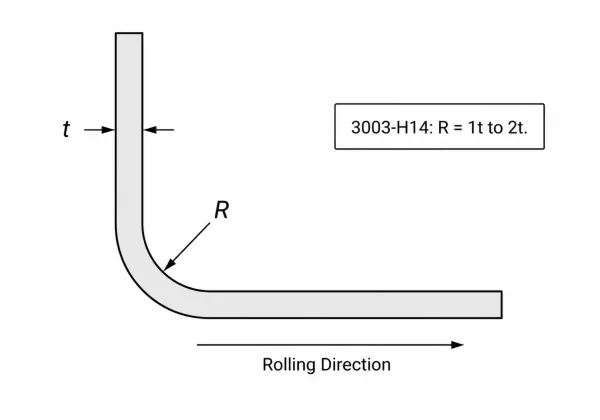
Cross-section of a 90° bend in aluminum sheet, labeling the relationship between sheet thickness (t) and inner bend radius (R), with H14 practical range R = 1t–2t and rolling direction indicated.
| Temper | Minimum Bend Radius for a 90° Bend |
|---|---|
| O | 0.5t–1t |
| H12 | 1t–1.5t |
| H14 | 1t–2t |
| H16 | 2t–3t |
| H18 | 3t–4t |
Bending Direction Matters
Bending parallel to the rolling direction increases cracking risk.
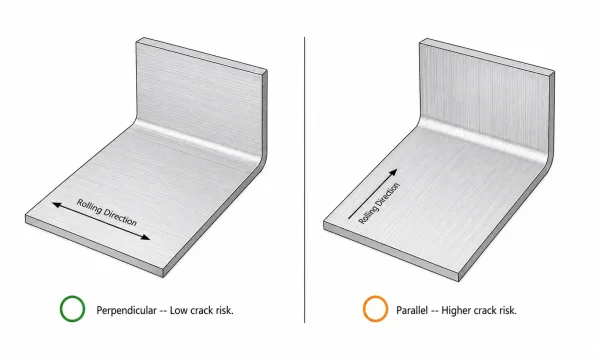
Two bending orientations compared: bending perpendicular to the rolling direction carries low crack risk; bending parallel to the rolling direction significantly increases the chance of cracking.
If a part has bends in several orientations, specify the critical bend direction on the 2D drawing. Otherwise, the minimum radius may need to increase for bends aligned with the grain.
Thin and Thick Sheets Behave Differently
Sheet below 0.8 mm, or roughly 22 gauge, springs back more aggressively and is harder to hold within tight angle tolerances.
Sheet above 3.0 mm requires significantly more press-brake tonnage, and the bend zone may show greater surface deformation.
Deep Drawing Has Separate Limits
The limiting draw ratio, or LDR, for 3003-O is approximately 2.0–2.2.
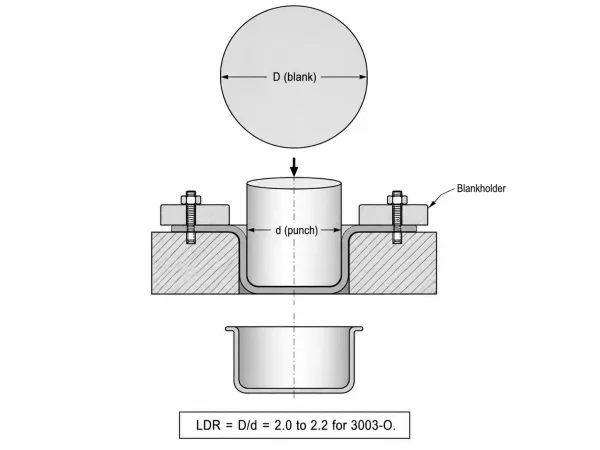
Cross-section of a deep drawing operation showing the relationship between blank diameter (D) and punch diameter (d). For 3003-O, the limiting draw ratio LDR ≈ 2.0–2.2, meaning the blank can be roughly twice the punch diameter before tearing.
This means the blank diameter can be roughly twice the punch diameter before the material tears.
Complex shapes may require:
- Multiple draw stages
- Intermediate annealing between stages
Data sheets provide a starting point. Production trials provide the real answer.
If a design is near the selected temper’s forming limit, plan a first-article run before committing to full production.
Common Forming Defects and Prevention
Three forming defects regularly appear in 3003 aluminum parts. Understanding their causes helps reduce scrap and rework.
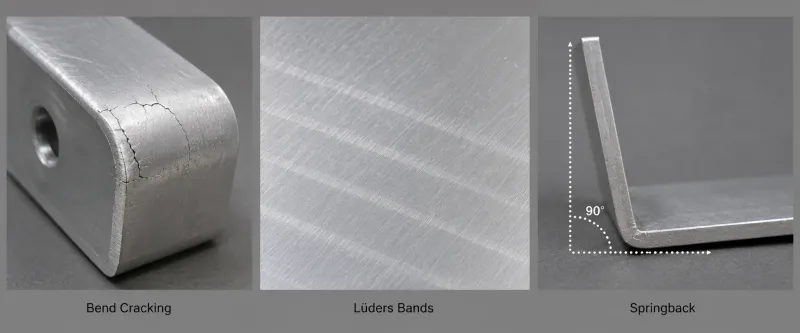
Three common 3003 aluminum forming defects: bend cracking (cracks along the outer bend surface), Lüders bands (faint parallel lines on annealed sheet), and springback (angular deviation from the intended 90° bend).
Bend Cracking
Bend cracking occurs when strain at the outer bend surface exceeds the material’s elongation capacity.
Common causes include:
- A temper that is too hard for the bend radius
- A bend radius that is too tight for the sheet thickness
- Bending parallel to the rolling direction
Prevention begins with temper selection.
For tight radii, use O temper. If H14 or a harder temper is required, increase the bend radius or add a relief notch at the bend line.
Lüders Bands
Lüders bands, also called stretcher strains, appear as visible parallel lines on annealed or lightly worked 3003 sheet.
They result from a yield-point phenomenon in low-magnesium aluminum alloys and are cosmetic rather than structural.
The standard prevention method is to specify material that has been temper-rolled by 1–2% before forming, which eliminates the yield point.
For visible parts, ordering an H2x-series temper, such as H22 or H24, instead of O temper can prevent the problem. H2x tempers are strain-hardened and partially annealed, removing the yield-point behavior.
Springback
Springback is not a defect. It is a physical property of aluminum.
After bending, 3003 sheet partially returns toward its original shape.
Springback depends on:
- Temper
- Thickness
- Bend radius
- Die opening
Harder tempers spring back more, and thinner sheets also show more springback.
The standard compensation method is to overbend by the expected springback angle—typically 1–3° for a 90° bend in H14 material, with more compensation for O temper or tight radii.
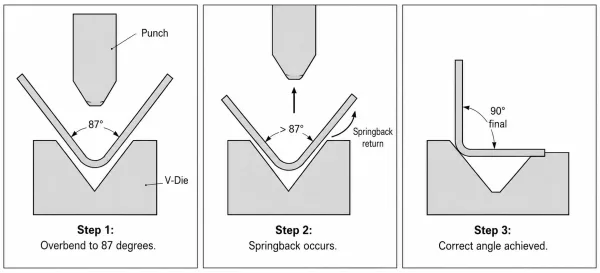
Three-step springback compensation: the punch overbends the sheet to 87°, the material springs back upon release, and the final resting angle settles at the target 90°.
For critical angle tolerances, air bending with CNC angle correction is more reliable than bottoming.
3003 vs 5052 for Formed Parts
3003 and 5052 are both non-heat-treatable aluminum alloys widely used in sheet metal fabrication.
The decision is not about which alloy is universally better. It depends on the property the part actually needs.
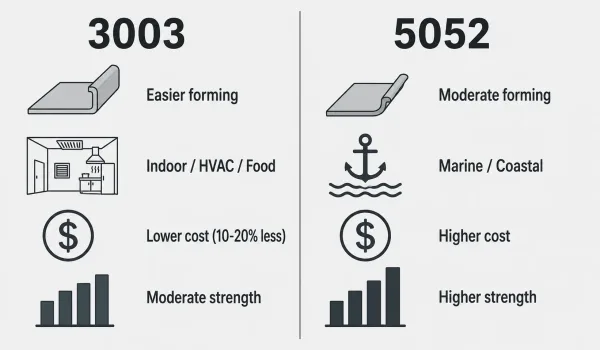
Key property comparison between 3003 and 5052: 3003 excels in formability, cost, and indoor suitability; 5052 offers higher strength, better marine corrosion resistance, and improved fatigue performance.
3003 offers:
- Easier forming
- Lower cost in most markets
- A wider range of gauges and tempers
5052 offers:
- Higher strength
- Better salt-spray and marine corrosion resistance
- Better fatigue performance
For parts used indoors, in HVAC systems, food equipment, or non-coastal outdoor environments, 3003 is usually the more practical choice.
For parts exposed to salt water, salt spray, or sustained cyclic loading, 5052 is usually worth the additional cost.
| Decision Factor | Choose 3003 | Choose 5052 |
|---|---|---|
| Forming complexity | Tight bends, deep draws, spinning | Moderate bends, simple forms |
| Environment | Indoor, HVAC, food, atmospheric | Marine, coastal, salt spray |
| Strength requirement | Low to moderate | Moderate to high |
| Cost sensitivity | High—3003 is typically 10–20% less | Budget allows an upgrade |
| Availability | Excellent and widely stocked | Good, but with fewer temper and gauge options |
One important detail is that 5052-H32 has forming characteristics comparable to 3003-H14 in many applications.
If a part is marginal in 3003-H14—with slightly excessive springback or cracking at the bend—upgrading to 5052-H32 provides greater strength and corrosion resistance without a major forming penalty.
The additional cost is usually justified only when required by the environment or structural demands.
Design and Specification Tips
The most common source of production problems in 3003 formed parts is not the material itself. It is how the material is specified on the drawing.
A drawing that calls out only “aluminum” or “3003” without a temper leaves the supplier guessing.
- An O-temper part incorrectly specified as H14 may crack during forming.
- An H14 part specified without a temper may arrive in O condition and dent during handling.
A complete sheet metal material specification for 3003 aluminum includes four elements:
- Alloy
- Temper
- Thickness
- Governing standard
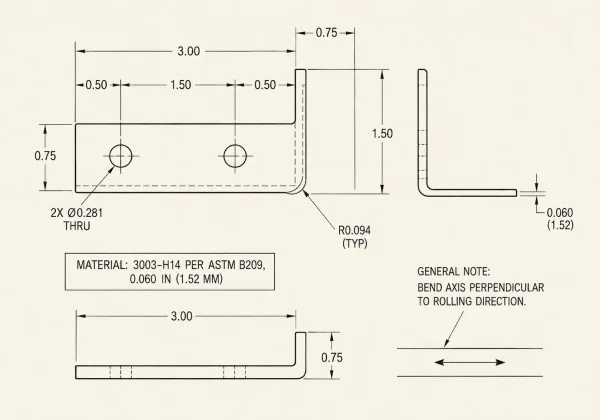
An engineering drawing excerpt demonstrating the correct material callout format: “MATERIAL: 3003-H14 PER ASTM B209, 0.060 IN (1.52 MM),” with a note specifying bend axis perpendicular to rolling direction.
For example:
3003-H14 per ASTM B209, 0.060 in. (1.52 mm)
This tells the supplier exactly what to purchase and gives the quality team a clear basis for incoming inspection.
Thickness Tolerance Matters
Standard commercial tolerance for most aluminum sheet gauges is ±0.005 in. (±0.13 mm).
If the part mates with a gasket, PCB, or another formed component, a tighter tolerance may be required.
Specify it on the drawing rather than assuming the supplier will use the expected tolerance.
Specify Bend Orientation
Bend orientation relative to the rolling direction matters for parts with:
- Critical cosmetic surfaces
- Tight bend radii
If the bending direction is not specified, the supplier may orient the sheet for material yield rather than grain-direction requirements.
A drawing note such as “bend axis perpendicular to rolling direction” eliminates this ambiguity.