
You receive your first batch of electropolished stainless steel parts. The finish looks bright and clean—at first glance. Then you notice slightly over-etched edges, uneven material removal in the inside corners, and weld seams with a different color tone from the rest of the surface. Your quality team raises concerns, and your customer asks questions you cannot answer.
The problem is not the process itself. Electropolishing is a well-established stainless steel surface treatment. The problem is that you selected a supplier based only on price and lead time, without a framework for distinguishing a capable provider from one that simply owns the equipment.
This article provides that framework. It explains which certifications matter, how to verify quality claims, what different industries require, where hidden costs arise, and which suppliers are worth shortlisting.
What to Look for in an Electropolishing Provider
Comparing electropolishing suppliers is not about finding the lowest quote. It is about finding a provider with repeatable process control, verifiable quality documentation, and experience that matches your industry requirements.
The evaluation can be divided into five areas:
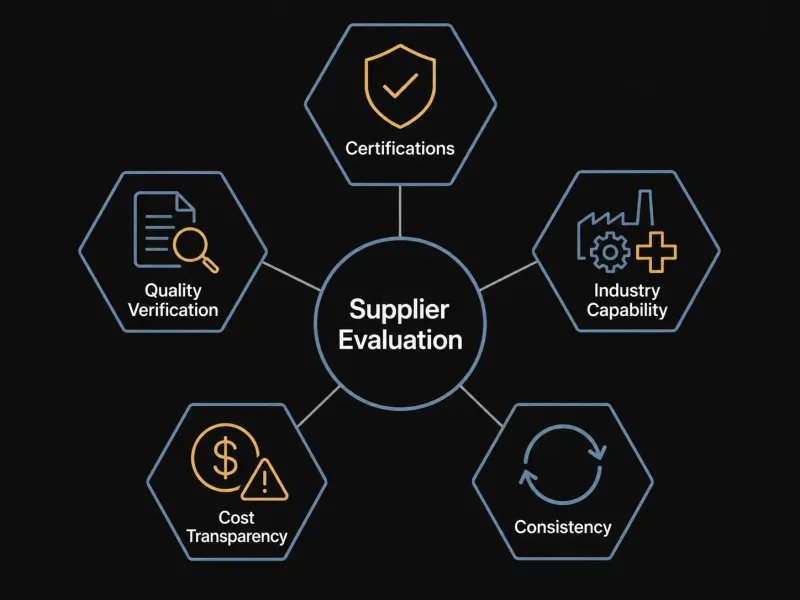
The five key areas to evaluate when comparing electropolishing providers — price and lead time alone are not sufficient criteria.
- Certifications and standards compliance
- Quality verification processes
- Industry-specific capabilities
- Cost structure transparency
- Production consistency
The importance of each area depends on your application. A food-grade enclosure has different priorities from an aerospace manifold. The following sections explain each area so you can build a supplier scorecard that fits your needs.
Certifications That Actually Matter
Not all certifications carry equal weight. Some genuinely demonstrate process discipline, while others are little more than marketing checkboxes. Prioritize the following:
ASTM B912
This is the primary standard for passivating stainless steel through electropolishing. It covers 200-, 300-, and 400-series stainless steels, as well as precipitation-hardened grades.
If a supplier cannot confirm compliance with ASTM B912, treat it as a warning sign. The standard defines electrolyte conditions, current-density parameters, and acceptance criteria for passivation quality.
Updated in 2026, it now provides clearer guidance on verification methods, including water-immersion and humidity-exposure testing.
ISO 9001
This is a baseline quality management certification. It confirms that the supplier has documented processes, but it does not prove any specific electropolishing capability.
Treat ISO 9001 as a minimum requirement, not a differentiator.
ISO 13485
This certification is required when parts are used in medical devices. In addition to ISO 9001 requirements, it introduces traceability, biocompatibility documentation, and validated process controls.
For medical-sector suppliers, ISO 13485 is non-negotiable.
AS9100
This is the aerospace equivalent of a quality management certification. If your parts are used in aircraft or defense systems, the electropolishing provider should hold this certification.
It requires stricter controls for documentation, risk management, and first-article inspection.
NADCAP
NADCAP stands for the National Aerospace and Defense Contractors Accreditation Program. It is a process-specific accreditation covering special processes such as chemical processing and surface treatment.
NADCAP accreditation means the supplier has been independently audited against aerospace-industry standards. It is expensive and difficult to obtain, which is precisely why it is meaningful.
| Certification | What It Proves | When You Need It |
|---|---|---|
| ASTM B912 | The electropolishing process meets passivation standards | Always |
| ISO 9001 | A general quality management system is in place | Always, as a baseline |
| ISO 13485 | Medical-device quality management requirements are met | Medical-device components |
| AS9100 | Aerospace quality management requirements are met | Aerospace and defense components |
| NADCAP | Aerospace special-process requirements are met | Critical aerospace applications |
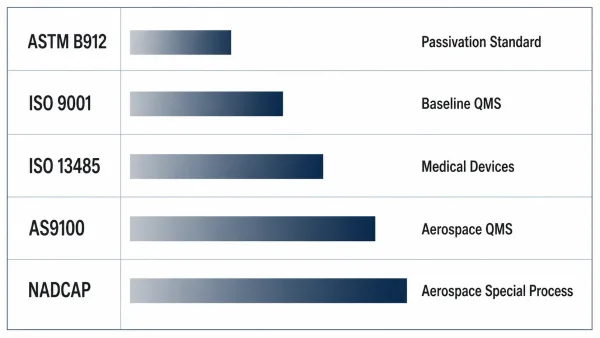
Not all certifications are equal. From general passivation standards to aerospace special-process accreditation, each certification serves a different level of criticality.
Ask to see current, valid certificates, not copies from three years ago. Certifications expire. A supplier whose ISO 13485 certification expired six months ago is not equivalent to one holding a valid certificate.
How to Verify a Supplier’s Quality Claims
Certifications show that a supplier passed an audit. They do not show how the supplier will perform on your specific parts.
Verifying capability requires going beyond paperwork.
Request Sample Parts With Documentation
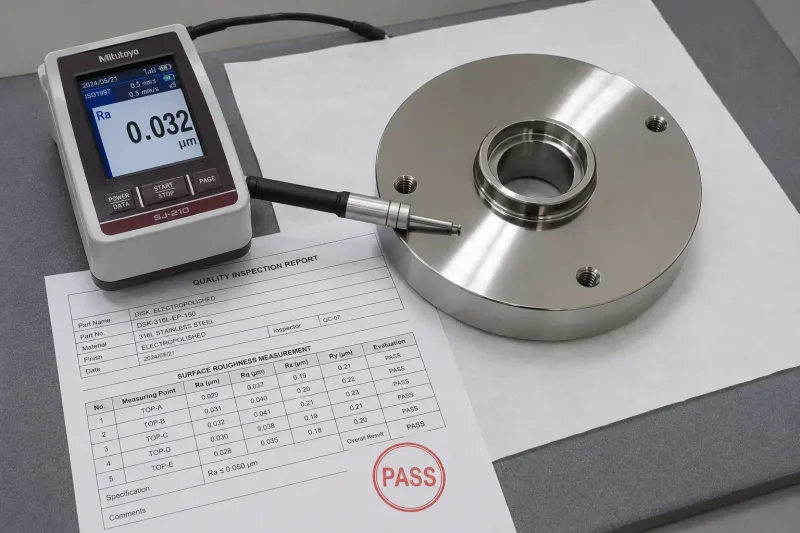
Quality verification goes beyond visual inspection. A credible supplier provides Ra measurement data, surface-finish reports, and conformance certificates with every sample batch.
A credible supplier should provide sample parts together with:
- A surface-finish report
- Ra measurements taken at multiple locations
- Salt-spray test results, where applicable
- A certificate of conformance referencing ASTM B912
If the supplier sends shiny parts without any supporting documentation, that tells you something.
Request Electrolyte Bath Maintenance Records
The chemistry of an electrolyte bath changes over time. Acid concentration, water content, and dissolved-metal levels all affect surface quality.
A disciplined supplier monitors and adjusts the bath on a documented schedule. Ask to review those records. If the supplier cannot provide them, the process may not be under control.
Review Rejection-Rate Data
Every factory produces rejected parts. A supplier claiming zero defects is either being dishonest or not inspecting thoroughly.
Ask about:
- The normal rejection rate
- The most common failure modes
- How rework is handled
For routine parts, a rejection rate below 2% is a reasonable benchmark.
Evaluate Fixture and Racking Design Capability
Electropolishing requires custom fixtures or racks to hold parts in the electrolyte bath. Poor fixture design causes uneven current distribution, resulting in uneven material removal.
Ask how the supplier designs fixtures for complex geometries. If the answer is, “We use standard racks for everything,” expect consistency problems with non-flat parts.
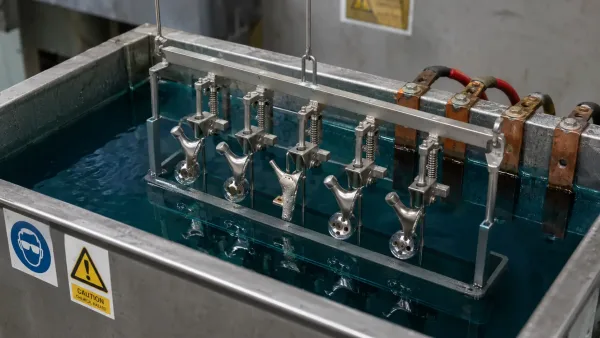
Custom fixture design is critical for consistent current distribution. Standard racks cannot accommodate complex geometries without causing uneven material removal.
Industry-Specific Requirements
Different industries impose different requirements on electropolished surfaces. A supplier that performs well on food-grade products may not meet aerospace requirements, and vice versa.
| Industry | Key Requirements | Common Standards |
|---|---|---|
| Medical Devices | Biocompatibility, very low Ra values of ≤0.25 μm, no embedded contaminants, complete traceability | ISO 13485, ASTM B912, FDA 21 CFR |
| Aerospace | Strict process validation, first-article inspection, NADCAP accreditation, material traceability | AS9100, NADCAP, AMS 2700 |
| Food and Beverage | Sanitary finishes, passivation verification, resistance to cleaning chemicals | 3-A Sanitary Standards, ASTM A967 |
| Semiconductor | Ultra-high purity, no particle generation, electropolished internal fluid-handling surfaces | SEMI F19, ASTM B912 |
| General Industrial | Corrosion resistance, improved surface finish, deburring | ASTM B912, ASTM A380 |
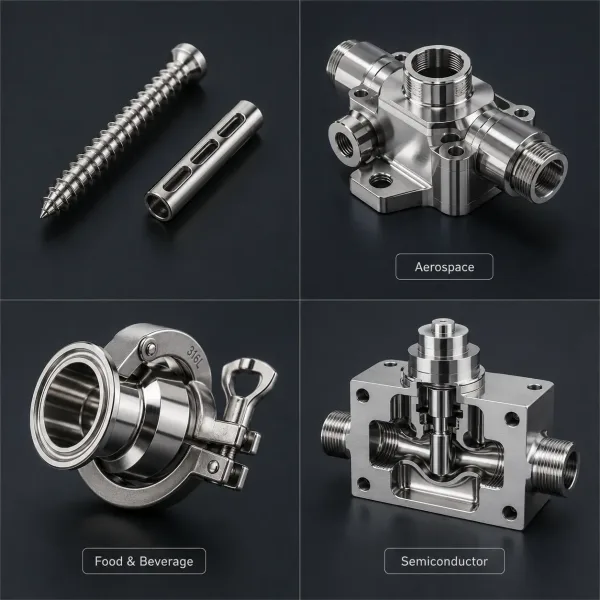
Electropolishing requirements vary significantly by industry — from biocompatibility and traceability in medical devices to ultra-high purity in semiconductor applications.
When evaluating a supplier, ask specifically about experience in your industry.
A provider that has electropolished 10,000 surgical instruments understands medical requirements in ways a general-purpose shop may not. Industry experience is not only about capability. It also means knowing what can go wrong and how to prevent it.
Understanding the True Cost of Electropolishing
The quoted price per part is rarely the total cost. Several additional charges can significantly affect the final amount.
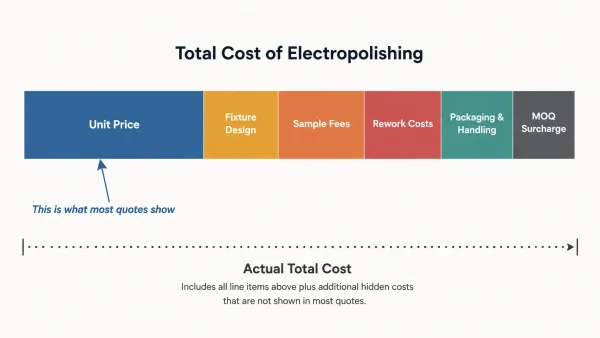
The quoted unit price is rarely the total cost. Fixture design, sample fees, rework policies, and minimum order surcharges can significantly increase the final amount.
Fixture and Racking Costs
Most non-flat parts require custom fixtures. Some suppliers charge a one-time fixture-design fee, while others spread the cost across the first order.
Confirm the cost in advance. Depending on complexity, fixture design for complex geometries may cost $200 to $2,000.
Sample and Qualification Fees
Before starting production, most suppliers process a small sample batch for approval.
Some charge separately, while others include the cost in the production order. Confirm whether sample fees will be credited toward the production order or billed separately.
Minimum Order Quantities
Electropolishing involves significant setup costs, including bath preparation, fixture installation, and process-parameter verification.
For small orders of fewer than 50 pieces, the unit cost may be three to five times higher than for a 1,000-piece run.
If you need only 20 parts, ask whether the supplier offers batch processing, allowing your parts to share a production run with other customers.
Rework and Rejection Costs
What happens when parts fail inspection?
Will the supplier rework them at no charge, or will you pay for a second processing cycle? Establish this before the first order, not after the first rejection.
Logistics and Handling
Electropolished parts require careful packaging to prevent surface damage during shipping.
Some suppliers include packaging in the quotation, while others charge separately. For international orders, also consider:
- Customs documentation
- Export packaging
- Shipping insurance
A supplier whose unit price is 15% lower but charges separately for fixtures, samples, packaging, and rework may cost more than one offering a higher all-inclusive price.
Sample vs. Production: Where Quality Slips
One of the most common frustrations in electropolishing sourcing is this:
The samples were perfect, but the production batch was inconsistent.
This happens because the conditions used to produce an excellent sample are not always maintained at production scale.
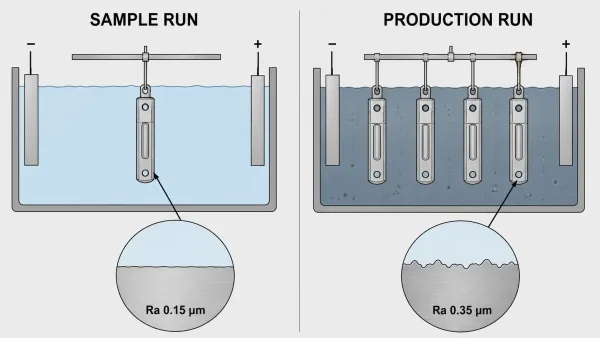
Why samples look perfect but production batches may not: bath chemistry changes, fixture degradation, and inspection rigor shifts all contribute to quality drift between sample and production runs.
Bath Chemistry Drift
During a small sample run, the electrolyte bath is often fresh or recently adjusted.
Over a production run of several hundred parts:
- Dissolved metals accumulate
- Acid concentration drops
- Temperature becomes harder to control
Ask how often the supplier tests and adjusts the bath during production.
Fixture Wear
Racks and fixtures degrade with use. Contact points corrode, and spring tension weakens.
If fixtures are reused without regular inspection, the final 100 parts in a 1,000-piece run may not receive the same current distribution as the first 100.
Operator Variation
Electropolishing includes manual steps such as loading, process monitoring, unloading, and inspection.
Different operators may make different judgments about timing and positioning. Suppliers with documented standard operating procedures and trained operators are more likely to deliver consistent results than suppliers relying on individual experience.
Inspection Rigor
During sample approval, every part may be inspected. During production, inspection may shift to statistical sampling.
Clarify the production inspection plan:
- What sampling method is used?
- What are the acceptance criteria?
- Is the Ra value measured on every part or only on a percentage of the batch?
Before placing a production order, ask:
“Can you show me quality data from your last three production runs of similar parts?”
A confident supplier will be willing to provide it. A supplier that cannot may not be tracking the data at all.
What to Check During a Facility Audit
If your order volume justifies an on-site audit, visiting the supplier’s factory is one of the most effective ways to evaluate capability.
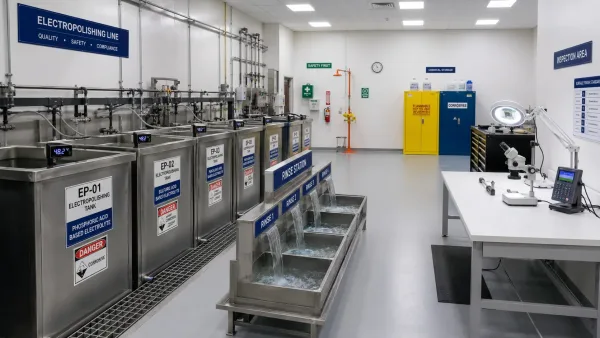
What to look for during a facility audit: well-maintained tanks with visible monitoring equipment, multiple rinse stations, controlled drying, and a dedicated inspection area indicate disciplined process control.
Bath Area Management
Clean, well-maintained tanks with clearly labeled chemistry and temperature gauges indicate disciplined process control.
Rust-stained tanks without visible monitoring equipment suggest the opposite.
Rinse Stations
Thorough rinsing between process stages is critical to surface quality.
Multiple flowing-water rinse tanks are a positive sign. A single rinse bucket is not.
Drying Process
How parts are dried after the final rinse affects surface quality.
Forced-air drying in a controlled environment is standard. Air-drying on open racks can leave water stains.
Inspection Area
A dedicated inspection station equipped with surface-roughness testers, lighting, and magnification shows that the supplier takes quality verification seriously.
If inspection is performed “in the same room as the process tanks,” that is a concern.
Chemical Storage and Waste Handling
How a supplier stores and disposes of electrolyte chemicals reflects both process discipline and regulatory compliance.
Proper chemical storage, MSDS documentation, and waste-treatment facilities are non-negotiable.
Watch a Live Production Run
Ask to observe an active production job.
Watch the operator’s technique, fixture loading, process timing, and post-treatment handling. Twenty minutes of observation can reveal more than two hours of conversation.
Major Electropolishing Service Providers
The following providers have established reputations in the electropolishing industry. This is not a ranking. The right choice depends on your requirements, industry, and order volume.
The list includes three established providers in the United States and three in China.
US providers are generally better suited to projects requiring extensive certification support and complete quality documentation. Chinese providers can also support certification and quality-documentation requirements, while offering stronger advantages in cost, lead time, custom processing, and local supply-chain coordination.
Able Electropolishing
Chicago, United States
Founded in 1954, Able has long specialized in metal electropolishing, passivation, and surface treatment. It serves the medical-device, aerospace, food-processing, and semiconductor industries.
The company handles both single-piece samples and high-volume production.
Best for: Medical-device components, food-processing equipment, and parts requiring strict ASTM B912 compliance.
Website: Able Electropolishing
New England Electropolishing
Fall River, Massachusetts, United States
Founded in 1985, New England Electropolishing specializes in precision stainless steel electropolishing and passivation.
Its services cover the medical, semiconductor, pharmaceutical, and food industries. It can process precision small parts, high-volume orders, large vessels, and assemblies.
Best for: Pharmaceutical equipment, semiconductor fluid-handling components, and complex geometries.
Website: New England Electropolishing
Harrison Electropolishing
Houston, United States
Founded in 1980, Harrison Electropolishing provides electropolishing, mechanical polishing, passivation, and precision cleaning.
The company can process pipes, tanks, pressure vessels, and other large stainless steel components either at its Houston facility or at the customer’s site.
Best for: Large parts, oil and gas components, and petrochemical equipment.
Website: Harrison Electropolishing
Marui Technology (Changzhou) Co., Ltd.
Changzhou, Jiangsu, China
Marui Technology is located in Xinbei District, Changzhou. It specializes in the electropolishing, passivation, and precision cleaning of stainless steel and other metal products.
Its services cover the semiconductor, display-panel, pharmaceutical, and chemical industries, and it can process parts and equipment of different sizes.
Best for: Semiconductor equipment components, pharmaceutical equipment, and stainless steel products with demanding cleanliness requirements.
Website: Marui Technology
Yabo Chemical Equipment (Shanghai) Co., Ltd.
Shanghai, China
Located in Fengxian District, Shanghai, Yabo Chemical Equipment provides stainless steel electropolishing, mechanical mirror polishing, pickling and passivation, and on-site polishing.
Its services mainly support the chemical, pharmaceutical, food, photovoltaic, and vacuum-equipment industries.
Best for: Stainless steel tanks, reactors, chemical equipment, and large equipment requiring on-site polishing.
Website: Yabo Chemical Equipment
Dongguan Yuelinsen Metal Technology Co., Ltd.
Dongguan, Guangdong, China
Dongguan Yuelinsen Metal Technology Co., Ltd. develops and manufactures custom precision metal components and non-standard hardware for medical devices.
Its equipment includes CNC lathes, Swiss-type lathes, and turn-mill machining centers. It also provides stainless steel electropolishing and passivation.
The company is certified to ISO 9001 and ISO 13485.
Best for: Precision medical hardware, stainless steel capillary tubes, thin-wall tubing, small machined components, and projects requiring integrated machining and electropolishing.
Website: Dongguan Yuelinsen Metal Technology Co., Ltd.
Choosing the Right Provider
The following table provides a simplified decision matrix:
| Your Priority | Consider First |
|---|---|
| Medical-device compliance under ISO 13485 | Able Electropolishing, New England Electropolishing |
| Aerospace or NADCAP requirements | Check the NADCAP-accredited supplier list directly |
| Large or heavy parts | Harrison Electropolishing |
| Semiconductor or high-purity applications | KEPCO Inc., New England Electropolishing |
| General industrial work and cost efficiency | Commercial Metal Polishing |
| Multiple processes, including electropolishing, passivation, and cleaning | Astro Pak |
Before shortlisting a supplier, confirm that its current certifications cover your specific alloy and part geometry.
A supplier’s reputation means little if its tanks cannot accommodate your parts or its bath chemistry is not optimized for your alloy.
Making the Final Decision
After evaluating certifications, verifying quality processes, understanding cost structures, and shortlisting suppliers, the final decision usually depends on three practical factors.
Communication and Responsiveness
How quickly does the supplier respond to RFQs?
Does the supplier ask questions about your parts, or simply send a price? A supplier that asks about alloy type, surface-finish requirements, and end-use application before quoting is more likely to deliver the required result.
Lead-Time Reliability
Ask for references from existing customers.
Confirm that the quoted lead time is realistic rather than overly optimistic. A supplier that consistently delivers on time may be worth paying more than one that promises faster delivery but repeatedly misses deadlines.
Willingness to Conduct a Trial Run
A good supplier will process a small trial batch before accepting a full production order.
This protects both parties. A supplier that insists on a large minimum order without offering a trial run presents a higher risk.
The right electropolishing provider is not the one with the most impressive website or the lowest quote. It is the one with verifiable process control, transparent documentation, and experience aligned with your industry requirements.
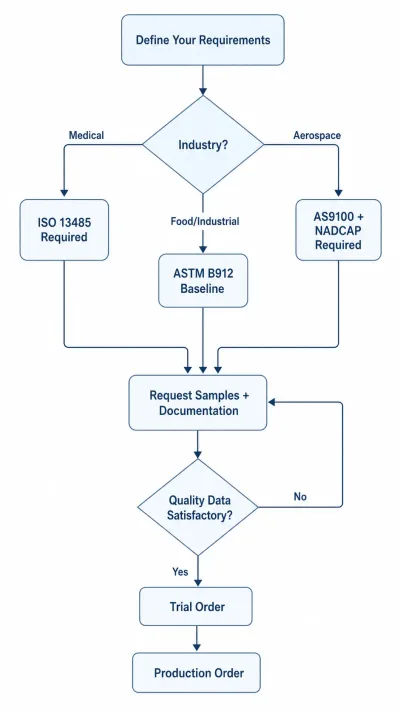
A practical decision path: define requirements by industry, verify certifications, evaluate documented samples, place a trial order, and only then commit to production volume.
Practical Next Steps
- Define your requirements first.
Before contacting suppliers, prepare a complete RFQ that documents the alloy, part geometry, target surface finish or Ra value, applicable industry standards, and order volume. Clear requirements lead to more accurate quotations and more meaningful comparisons. - Request documented samples from your top three candidates.
Compare not only the surface finish but also the completeness of the quality documentation. The supplier providing the most complete documentation often has the most disciplined process. - Start with a trial order before committing to production volume.
Use the trial to evaluate consistency, communication, and delivery reliability—not just surface quality. A small trial order can prevent a major production problem.
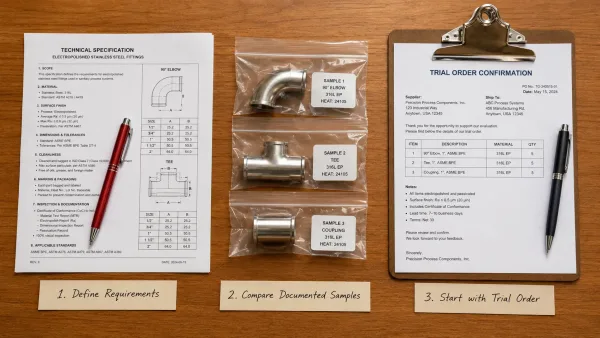
Three practical next steps: document your requirements clearly, compare documented samples from your top candidates, and start with a trial order before committing to production volume.
SR-MFG provides stainless steel fabrication services, including laser cutting, bending, welding, and surface-finishing coordination. If you need help evaluating electropolishing options for your sheet metal parts, contact our engineering team for a DFM review.